
Clocks · Vacuum clock
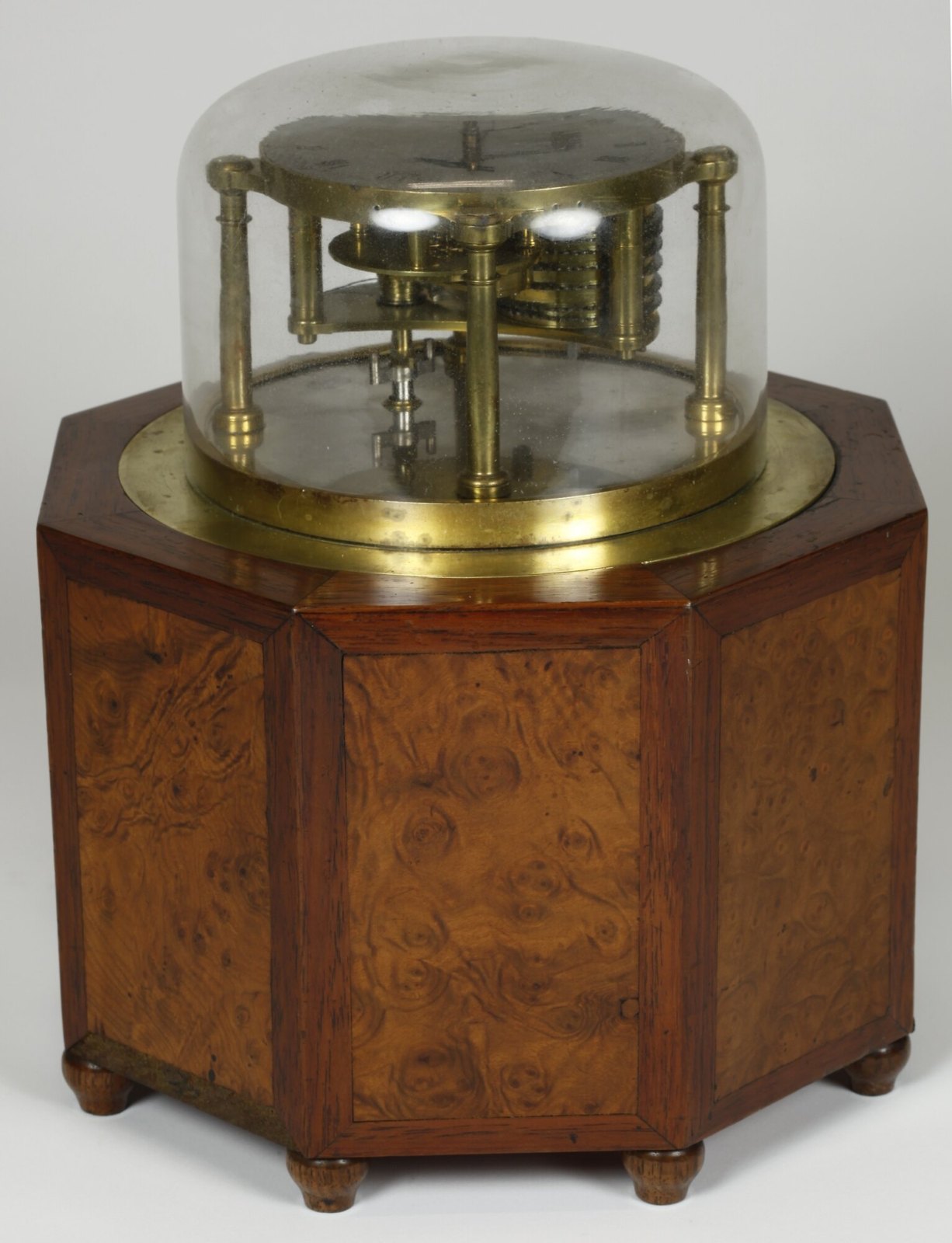
Vacuum Clock - Joseph Manton, London, c. 1810
- Maker / attribution
- Mr Joseph Manton (Maker)
- Date
- c. 1810
- Historical period
- Precision & Scientific Horology (1750 – 1850)
- Country of origin
- England
- Place
- London, England, Great Britain
- Object type
- Vacuum clock
- Dimensions
- 208 mm (Width), 205 mm (Depth), 250 mm (Height); 24.5 cm (Height), 22 cm (Outside Diameter)
- Holding institution
- Museums Victoria, Melbourne
- Accession / object no.
- ST 19435
- Catalogue title (original)
- Vacuum Clock - Joseph Manton, London, circa 1810 (English)
View the source record ↗ (opens another website in a new tab)Suggest a correction
Record summary
Held and catalogued by Museums Victoria, Melbourne (object number ST 19435), this is a vacuum clock by Mr Joseph Manton, made in London, England, Great Britain, dated c. 1810. The Atlas places it in the Precision & Scientific Horology period (1750 – 1850) of its Clocks collection. Recorded dimensions: 208 mm (Width), 205 mm (Depth), 250 mm (Height); 24.5 cm (Height), 22 cm (Outside Diameter). The record is illustrated with 5 photographs.
Assembled from the source record's structured fields. Dates and attributions are given as the source states them; where a field is missing the Atlas leaves it blank rather than estimating.
Catalogue description
Summary — Museums Victoria
Vacuum clock, consisting of a brass clock under an evacuated glass dome. Made by Joseph Manton, London, circa 1810. Joseph Manton (1760-1835) was a celebrated English gunsmith. In a letter to the Commissioners of Longitude in March 1807, Joseph Manton stated: "My invention is to put the whole of the Time-keeper into a Vacuum, so constructed that it may be wound up when required without admitting the external Air. The advantages of having the Time Keeper in a Vacuum, are, the Vibration of the Balance or Pendulum will be more uniform, and act with less friction - the Sea Air, Damps and Dust will be excluded, which are so injurious in rusting, and corroding the movements of Time-Keepers in long voyages; and the Oil will be in a more unifrom fluid State, by not being exposed to the alteration of the Atmosphere, which must have the effect of making a Time-keeper go much truer and nearer prefection that any hitherto constructed." [Neal and Black, 1966, p150-151] Joseph Manton had been unaware at that time that the idea of using vacuum had already been published in 1714 by Jeremiah Thacker and John Roberts. Ultimately, Manton's clock was not deemed to have been accurate enough for use as a chronometer, despite the use of a vacuum.
Physical description — Museums Victoria
Brass clock under evacuated glass dome, supported by octagonal box with door. Has taps inside box. Spring wound; detent escapement.
Inscriptions & marks
Dial is marked 'Joseph Manton Gun Maker etc etc London, Inventor & by His Majesty Patent, (Patented in 1807 no 3085)'.
Provenance
Loan & Subsequent Bequest from Mr John Askew, 12 Sep 1928
Historical context
Precision & Scientific Horology (1750 – 1850)
Harrison solves longitude; Mudge invents the lever; Breguet's Paris workshop defines the modern watch.
The age of the deadbeat escapement, compensated pendulums and observatory regulators. Domestic clocks spread through the middle classes: English longcase and bracket clocks, French gilt-bronze mantel clocks, Viennese Biedermeier wall clocks, Black Forest painted-shield clocks, and the first American shelf clocks.
Read the period in the timelineMore clocks from this periodEarlier: Early Modern Horology
Atlas type guide
Domestic clocks
A clock combines four systems: a source of power (falling weight, coiled spring, or later electricity), a gear train that divides time, an escapement and oscillator that regulate it (foliot, pendulum or balance), and an indicating system of dial and hands or a bell. Its history runs from the large iron weight-driven clocks of the late thirteenth century to Renaissance spring-driven table clocks, the pendulum revolution of 1656, the factory clocks of the nineteenth century and electric and quartz clocks of the twentieth.
Domestic clocks also reflect regional furniture and decorative traditions — English longcase and bracket clocks, French pendules, Viennese regulators, Black Forest and American shelf clocks — and therefore record changing tastes as much as technical progress.
What to look for
- How the clock is powered: weights, spring barrel, fusee, electric coil.
- The oscillator: foliot, short pendulum, long seconds pendulum or balance.
- Whether it strikes: hour only (count wheel) or hours and quarters (rack striking).
- The maker or retailer's name on dial and movement, and any factory trademarks.
- Signs of alteration — replaced dials, converted escapements, 'married' cases.
Dating clues
- Before 1656 clocks used foliots or balances; after, most domestic clocks have pendulums.
- Anchor escapements spread after c. 1670; minute hands became common at the same time.
- Factory production in America and Germany transformed prices after c. 1840.
General guidance written by the Atlas editors about this kind of object. It is not a statement about this particular piece; for that, rely on the source record above and on physical examination.
Related records
Clocks · 1740–1760
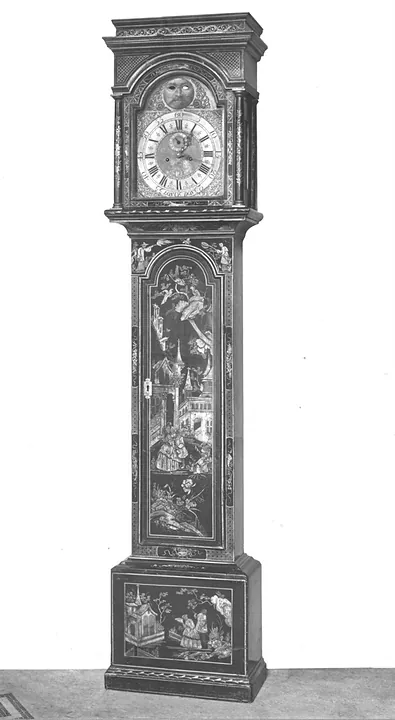
Longcase clock, English, 1740–1760, japanned wood, John Ellicott
Victoria and Albert Museum, London
Clocks · c.1750
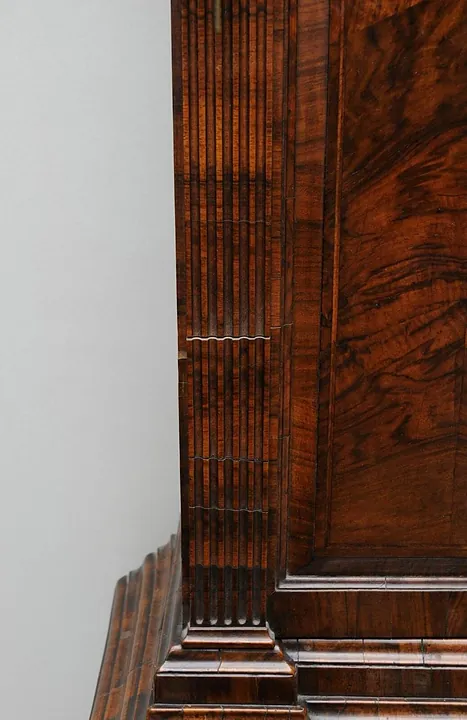
Long-case clock, English, ca. 1750, by Richard Peyton of Gloucester
Victoria and Albert Museum, London
Clocks · 1751
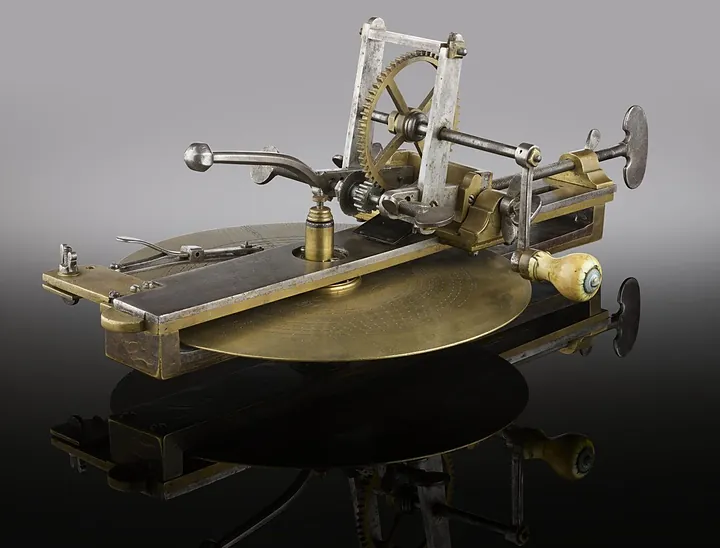
Large wheel engine, signed and dated "John Tipping, Whildon Green, 1751".
Science Museum Group, London
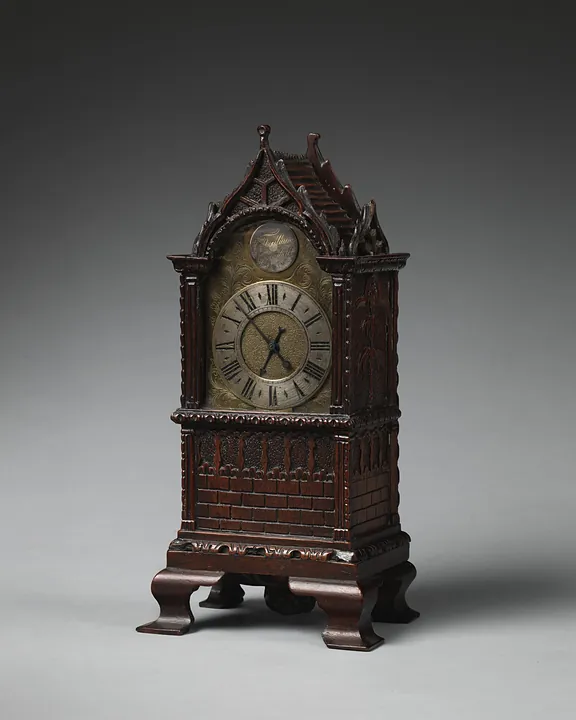
Clocks · 1755
Bracket clock by John Fordham, England, 1755
The Metropolitan Museum of Art, New York
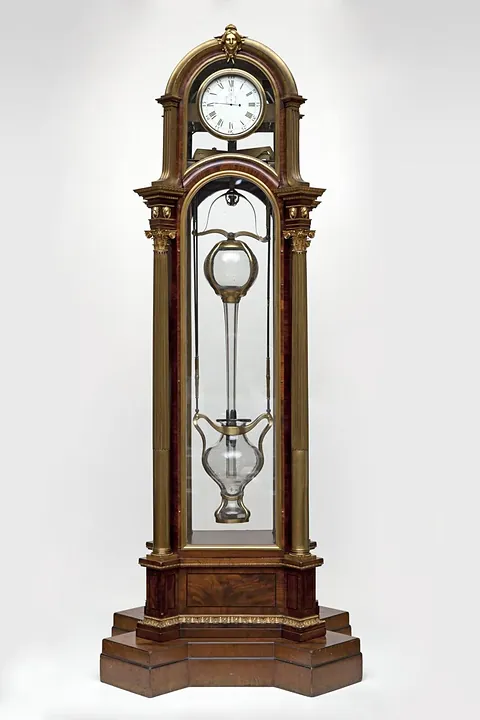
Clocks · c. 1760
Longcase clock by James Cox, England, c. 1760
Victoria and Albert Museum, London
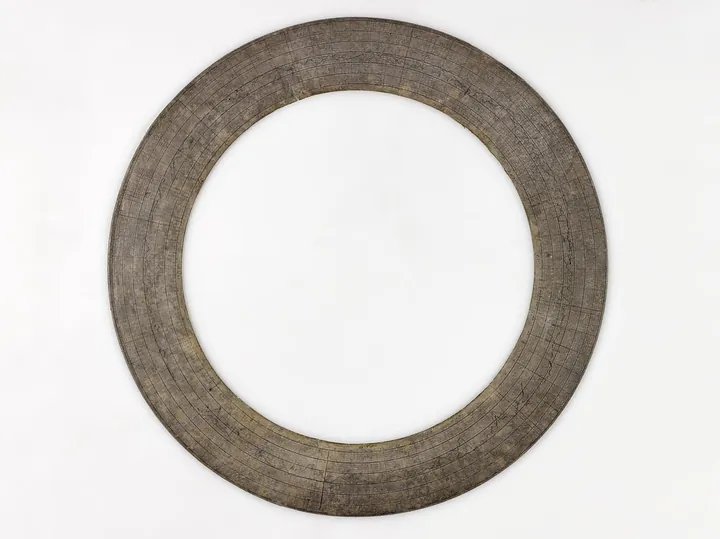
Clocks · 1766
Clock by Alexander Cumming, England, 1766
Science Museum Group, London
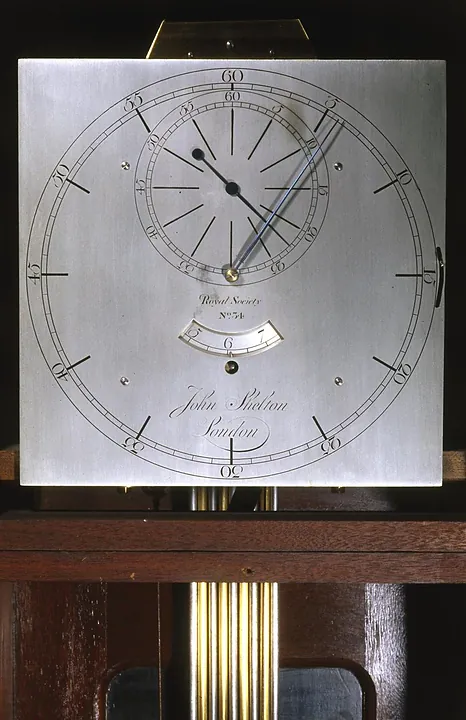
Clocks · 1768–1769
Regulator clock by John Shelton, England, 1768–1769
Science Museum Group, London
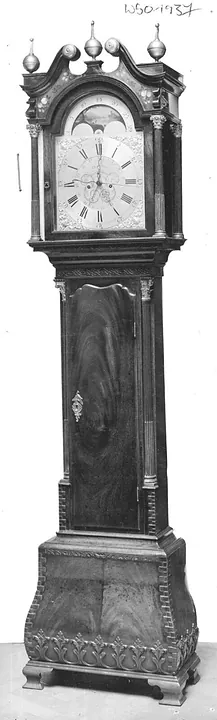
Clocks · c. 1775
Longcase clock, England, c. 1775
Victoria and Albert Museum, London