
Wristwatches · Wristwatch
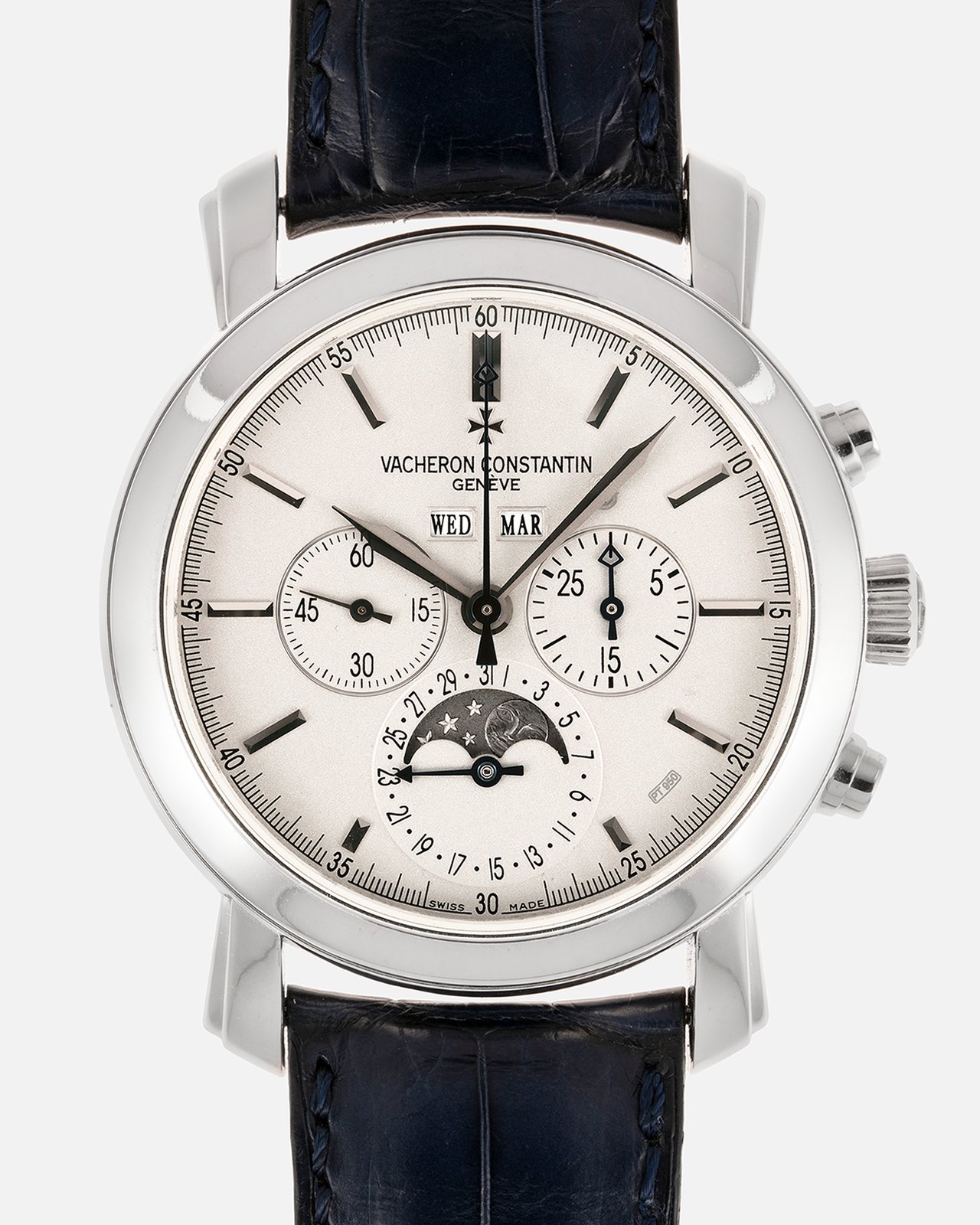
Vacheron Constantin Perpetual Calendar Chronograph Excellence Platine 47212, 2007
- Maker / attribution
- Vacheron Constantin (maker)
- Date
- 2007
- Historical period
- Mechanical Renaissance (1990 – 2010)
- Country of origin
- Switzerland
- Object type
- Wristwatch
- Dimensions
- Case 42 mm
- Stock no.
- Product 6799313993815
- Credit line
- Dealer listing, S.Song Watches (product 6799313993815)
- Catalogue title (original)
- Vacheron Constantin Perpetual Calendar Chronograph Excellence Platine 47212 (English)
View the source record (dealer listing) ↗ (opens another website in a new tab)Suggest a correction
Record summary
Catalogued by S.Song Watches (dealer), Seattle (stock number Product 6799313993815), this is a wristwatch by Vacheron Constantin, made in Switzerland, dated 2007. The Atlas places it in the Mechanical Renaissance period (1990 – 2010) of its Wristwatches collection. Recorded dimensions: Case 42 mm. The record is illustrated with 6 photographs.
Assembled from the source record's structured fields. Dates and attributions are given as the source states them; where a field is missing the Atlas leaves it blank rather than estimating.
Catalogue description
Dealer description — S.Song Watches
From as early as 1820, Vacheron Constantin was known as one of the first horological manufactures to have employed the use of platinum in the art of watchmaking. So why is platinum so desirable, you may ask? While 18-carat gold is only 75% precious metal, pure platinum is approximately 95%. It is also approximately 30 times rarer than gold and only found in a small number of deposits around the globe. Its density and heft contributed to its superiority in terms of resistance in comparison to many other precious metals that are available. This quality alone makes platinum an extremely exclusive and appropriate material for a watch that is meant to last for a lifetime. The watch we are very happy to be able to offer here today is a prime example of such technical pedigree - the Vacheron Constantin Malte Perpetual Calendar Chronograph Platinum Ref. 47212. The Ref. 47212 was first introduced in late 2007 as part of the Excellence Platine collection , where all platinum watches under this specific collection banner were presented as a limited edition, featured a platinum dial that discreetly bears the inscription “PT950”, and fitted with a platinum case along with matching clasps/buckles. Following the above, the Ref. 47212 we have on here today hails from an exclusive collection limited to only 50 pieces worldwide. Each of these examples comes equipped with a 21-jewel, manually-wound Cal. 1141 QPR with a frequency of 18,000 vph. The attention to detail and quality on its platinum dial is nothing short of exceptional. It features 18-carat white gold hands and numeral batons. You will also find a 30-minute counter at 3 o’clock, a constant-seconds indicator at 9 o ‘clock, a center blue-steeled chronograph seconds hand, a discreet “PT950” inscription at 5 o ‘clock, an off-centered leap year indicator tactfully placed between 1 and 2 o ‘clock, and a beautifully hand engraved, platinum disk moon phase display at 6 o ‘clock. This Cal. 1141 QPR also boasts a respectable 48-hour power reserve and some fantastic chronograph pusher action. When we talk about case sizes and overall aesthetics, not many watches do it quite like the Ref. 47212. The case band at the mid-section features a very interesting detail. From the side, you will find that the massive Maltese-styled lugs are welded onto the case itself and the joints are all hand finished in order to remove all evidence of soldering. This is actually an expensive and traditional way to produce a watch case, but looking at the end results on the Ref. 47212, I would say it is absolutely worth it. It produces a sharp but pronounced cleft and break between the case band itself and the flanks of the Maltese lugs, which in my opinion, is visually pleasing to the eyes of those who love details. The lugs are striking and voluminous, but it was designed to resemble Vacheron’s signature Maltese cross as it expands outwards and moves away from the case itself. This is a very intriguing lug design that gives the watch a lot more body. As far as wearability goes, the Ref. 47212 is presented in a fairly sizable 42mm platinum case, but it is still surprisingly quite a wearable watch. The watch has a nicely-stepped case which makes it easier to slide the watch under a cuff. The heft is something that I personally enjoy as well due to its platinum construction. The 47212 also comes on a nice leather strap with a matching Maltese buckle made from platinum as well. Overall, the Ref. 47212 is as good as it gets. It checks many boxes from rarity, technical specifications, and brand provenance to aesthetics.
Historical context
Mechanical Renaissance (1990 – 2010)
Mechanical watches return as cultural objects; independent watchmaking flourishes.
Mechanical watches returned as cultural and luxury objects. Complications, tourbillons and new materials proliferated; independent watchmakers such as George Daniels, F.P. Journe and Philippe Dufour revived artisanal watchmaking; collecting vintage watches became a major field.
Read the period in the timelineMore wristwatches from this periodEarlier: Quartz Revolution
Atlas type guide
Chronographs and split-seconds watches
A chronograph is a watch with an additional seconds hand that can be started, stopped and returned to zero independently of the timekeeping. Louis Moinet built an early example in 1816 and Nicolas Rieussec a recording 'chronographe' in 1821; Adolphe Nicole's heart-shaped reset cam (patented 1862) made the modern return-to-zero possible. Split-seconds (rattrapante) chronographs add a second hand that can be stopped for intermediate times; flyback chronographs restart instantly.
Chronographs were essential tools for doctors (pulsometer scales), artillery (telemeter), engineers and sport. In wristwatches, Valjoux, Venus, Lemania and later the automatic chronographs of 1969 (Zenith El Primero, the Chronomatic Calibre 11 group and Seiko 6139) are milestones.
What to look for
- Push-pieces on the case band or a single button in the crown (monopusher).
- Subsidiary registers for minutes and hours; tachymeter, telemeter or pulsometer scales.
- Column wheel versus cam control visible in the movement.
- Calibre markings of specialist makers (Valjoux, Lemania, Venus, Landeron).
Dating clues
- Pocket chronographs with heart cam reset: after 1862.
- Wrist chronographs: from c. 1910; two-button designs from the 1930s.
- Automatic chronographs: from 1969.
General guidance written by the Atlas editors about this kind of object. It is not a statement about this particular piece; for that, rely on the source record above and on physical examination.
Read next:Flyback chronographChronograph
Related records
Pocket Watches · c. 1896
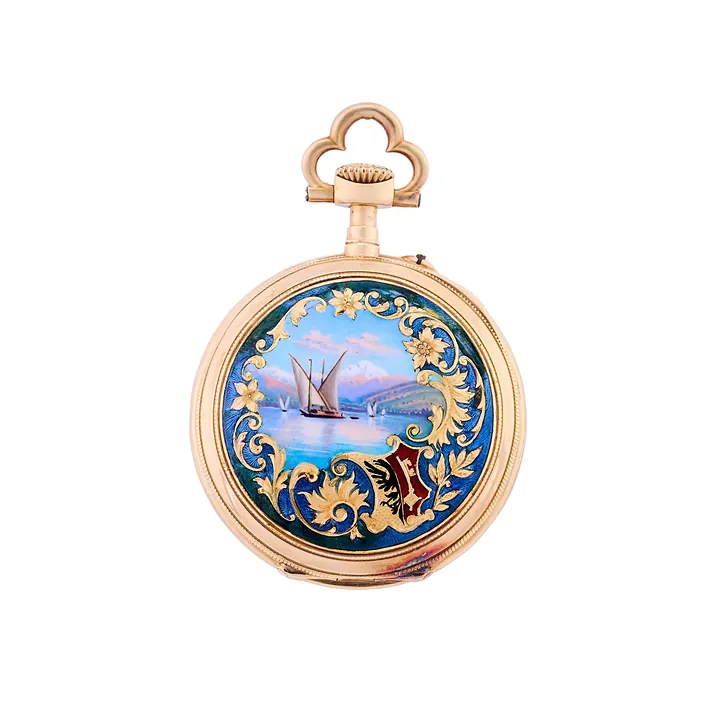
Vacheron Constantin “grand TIR de L’exposition Nationale, Genève 1896, c. 1896
Antiquorum auction archive, Geneva
Pocket Watches · c. 1940
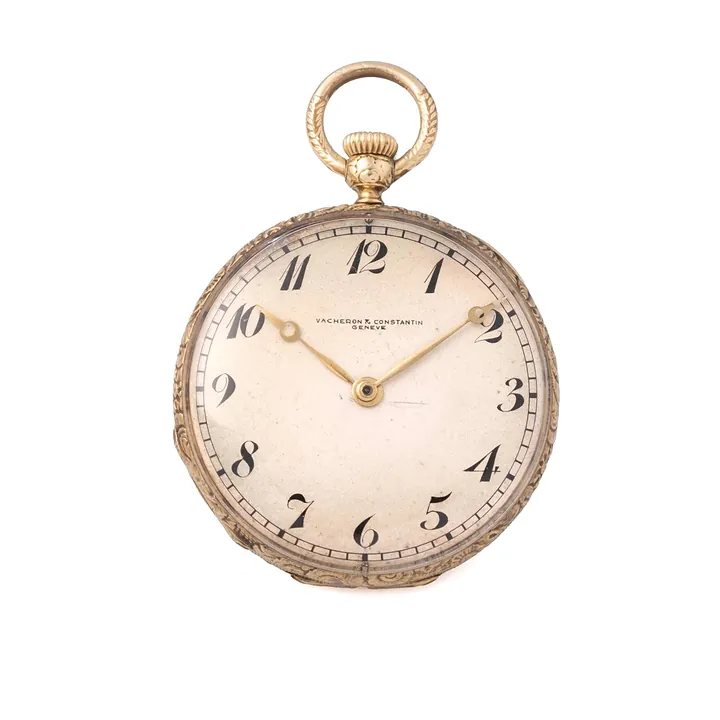
Vacheron Constantin pocket watch, ref. 345, c. 1940
Antiquorum auction archive, Geneva
Pocket Watches · c. 1945
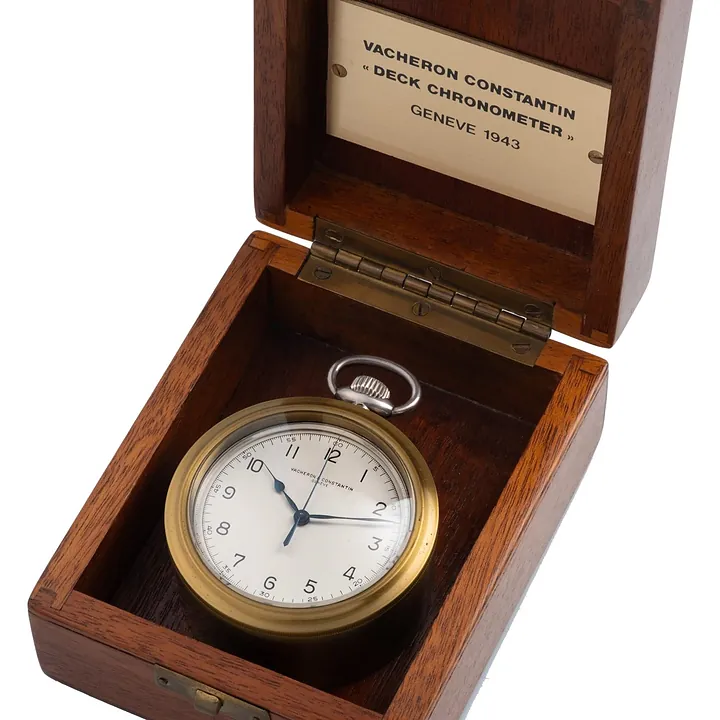
Vacheron Constantin pocket chronometer, c. 1945
Antiquorum auction archive, Geneva
Pocket Watches · c. 1945
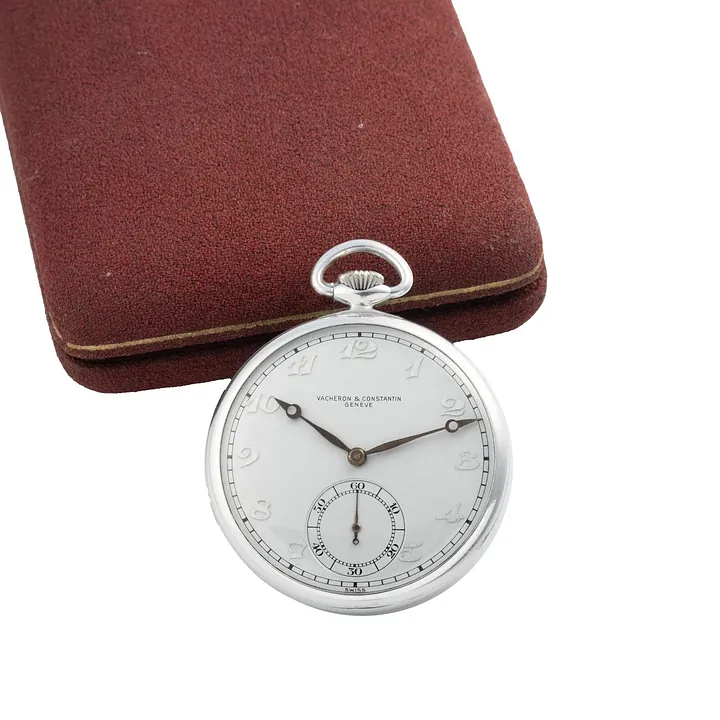
Vacheron Constantin watch, c. 1945
Antiquorum auction archive, Geneva

Wristwatches · 2008
Wristwatch by Breitling?, 2008
Museum Rotterdam

Wristwatches · c. 1990s
Audemars Piguet Bamboo, c. 1990s
Antiquorum auction archive, Geneva

Wristwatches · c. 1990
Audemars Piguet Huitieme Perpetual Calendar, ref. 25696PT, c. 1990
Antiquorum auction archive, Geneva

Wristwatches · c. 1990
Breitling Chronomat, ref. b13050.1, c. 1990
Antiquorum auction archive, Geneva