
Clocks · Table clock
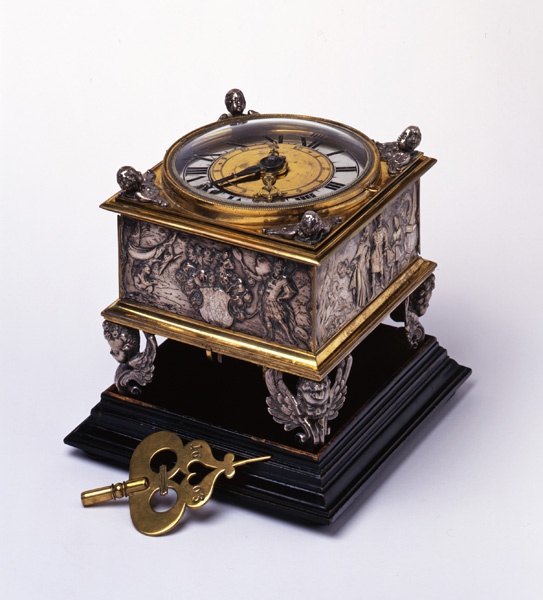
Table clock by Johannes Sayller, 1662–1663
- Maker / attribution
- Johannes Sayller (Created); Hans Georg Bauhoff (Created)
- Date
- 1662–1663
- Historical period
- Early Modern Horology (1600 – 1750)
- Country of origin
- Germany
- Place
- Ulm
- Object type
- Table clock
- Materials / technique
- Messing und Silber, vergoldet
- Dimensions
- H 14,5 cm; B 15,3 cm; T 15,2 cm
- Holding institution
- Museum Ulm
- Accession / object no.
- A.I. 1990.9326.31
- Credit line
- Museum Ulm
- Catalogue title (original)
- Tischuhr (Reiseuhr) (German)
View the source record ↗ (opens another website in a new tab)Suggest a correction
Record summary
Held and catalogued by Museum Ulm (object number A.I. 1990.9326.31), this is a table clock by Johannes Sayller, made in Ulm, Germany, dated 1662–1663. The Atlas places it in the Early Modern Horology period (1600 – 1750) of its Clocks collection. Materials and techniques recorded by the source: Messing und Silber, vergoldet. Recorded dimensions: H 14,5 cm; B 15,3 cm; T 15,2 cm. The record is illustrated with 1 photograph.
Assembled from the source record's structured fields. Dates and attributions are given as the source states them; where a field is missing the Atlas leaves it blank rather than estimating.
Catalogue description
Catalogue description from Museum Ulm (German)
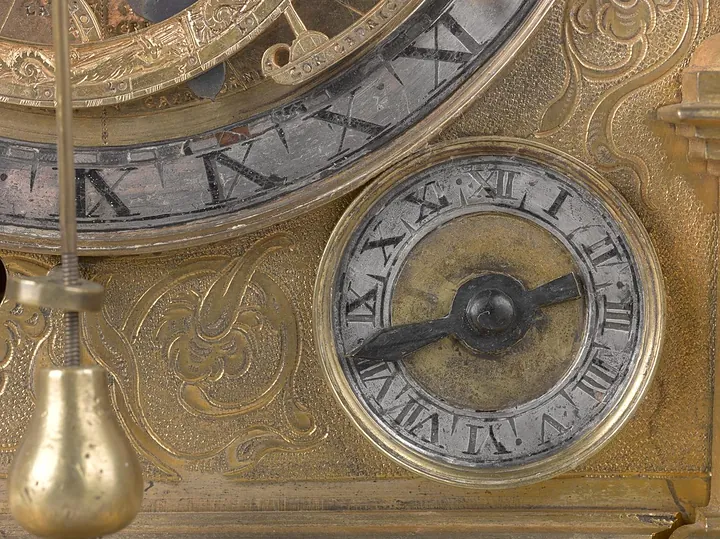
Bei der Tischuhr handelt es sich um ein besonders wertvolles und seltenes Exemplar. Das Uhrwerk fertigte der zu seiner Zeit hochgeschätzte Johann Sayller. Zur Herstellung des silbernen Gehäuses zog er den Ulmer Gold- und Silberschmied Hans Georg Bauhoff heran. Er wählte für seine Tischuhr die quadratische Kassettenform, die damals weit verbreitet war. Das Zifferblatt ist jeweils horizontal zur Tischplatte angebracht, die Zeit konnte so bequem abgelesen werden. Das Gehäuse lagert auf vier Füßen in Gestalt von geflügelten Engelsköpfen aus Silberguss. Dieses Motiv wird an den Ecken der Oberseite wiederholt. Die Seitenteile zeigen prunkvolle Reliefs, die in Treibtechnik ausgeführt sind. Auf ihnen sind die auf Uhren sonst unbekannten Erdteile dargestellt. Bevorzugte Themen waren die Jahreszeiten, die Elemente oder die Kardinaltugenden. Erst nach Mitte des 16. Jahrhunderts, als Amerika längst entdeckt war, etablierte sich die Vorstellung von den vier Kontinenten und fand in der Kunst große Verbreitung. Mit Ausnahme Amerikas, das durch eine Einzelfigur repräsentiert wird, werden die Kontinente Europa, Afrika und Asien durch Paare personifiziert, was von der gängigen ikonografischen Tradition abweicht, in der diese meist durch weibliche Personen repräsentiert werden. Die Darstellungen sind jedoch keine Neuschöpfungen: Als Vorlage dienten französische Kupferstiche aus der Zeit um 1650, die wiederum auf ein 1752 zerstörtes Deckenfresko in Versailles von Charles Lebrun (1619-1690) zurückgehen. Die Übereinstimmung geht bis ins Detail. Die Mechanik der Uhr besteht aus einem Spindelwerk, dem dazugehörigen Spindelkloben samt Schnecke und Kette sowie einem Wecker. Ein Schlagwerk signalisiert die vollen und Viertelstunden mittels zwei Hämmerchen und zwei Glocken. Ein weiteres Hämmerchen dient dem Weckruf. Auf der Oberseite des quadratischen Gehäuses liegt das runde Zifferblatt mit Stunden- und Minutenzeiger. Es wird von einem hochklappbaren Deckel aus Glas geschützt.
Shown in the original language of the source catalogue. An editor-reviewed English translation has not yet been published; we do not publish machine translations as authoritative text.
Provenance
Literature: Ulmer Museum [Hrsg.]: Goldschmiedekunst in Ulm, 15. Jahrhundert bis um 1850. Katalog IV des Ulmer Museums (1990)
Historical context
Early Modern Horology (1600 – 1750)
Huygens' pendulum and balance spring transform accuracy; English makers develop the anchor and deadbeat escapements.
Huygens's pendulum (1656–57) improved clock accuracy from about a quarter of an hour to under a minute a day. The anchor escapement (c. 1670) and the long seconds pendulum created the longcase clock; London makers such as Fromanteel, Knibb, Tompion and Quare led European clockmaking, and French makers created the Boulle pendule.
Read the period in the timelineMore clocks from this periodEarlier: Renaissance Horology
Atlas type guide
Bracket, table and spring-driven clocks
Spring-driven clocks freed timekeeping from the hanging weight. The coiled mainspring, documented from the fifteenth century, made portable table clocks possible; to even out its declining force, makers used the fusee, a conical pulley connected to the barrel by a gut line or chain. Renaissance table clocks from Augsburg and Nuremberg — drum-shaped, square or tower-shaped in gilt brass — were luxury scientific objects, often with astronomical dials and alarms.
After the pendulum, English makers developed the bracket clock: a wooden case with a carrying handle, a short pendulum with a verge escapement, and often repeating work to sound the hours on demand at night. Later examples use the anchor escapement. In the nineteenth century, 'table clock' became a broad term for spring clocks of every nationality.
What to look for
- A fusee in the movement (cone-shaped pulley) and the type of line — gut or chain.
- Verge escapement with a short bob pendulum, often with a decoratively engraved backplate.
- Repeat cords or buttons that make the clock strike again on demand.
- Gilt-brass engraved cases and horizontal dials on Renaissance pieces.
- Case shapes: inverted bell, bell top, break-arch, lancet or balloon.
Dating clues
- Drum and tower table clocks: c. 1520–1650.
- Ebony veneered English bracket clocks with verge escapements: c. 1670–1800.
- Engraved backplates were usual on English clocks until c. 1800, then generally plain.
General guidance written by the Atlas editors about this kind of object. It is not a statement about this particular piece; for that, rely on the source record above and on physical examination.
Related records
Clocks · 1626–1634
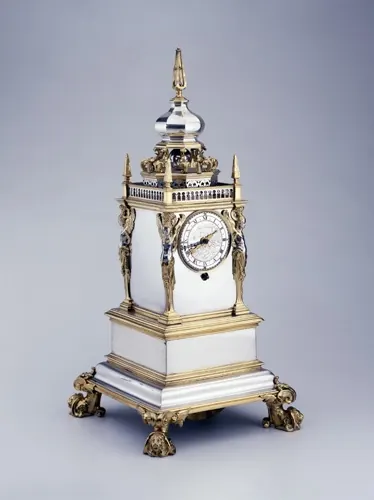
Table clock by Johannes Sayller, 1626–1634
Landesmuseum Württemberg
Clocks · 1600–1700
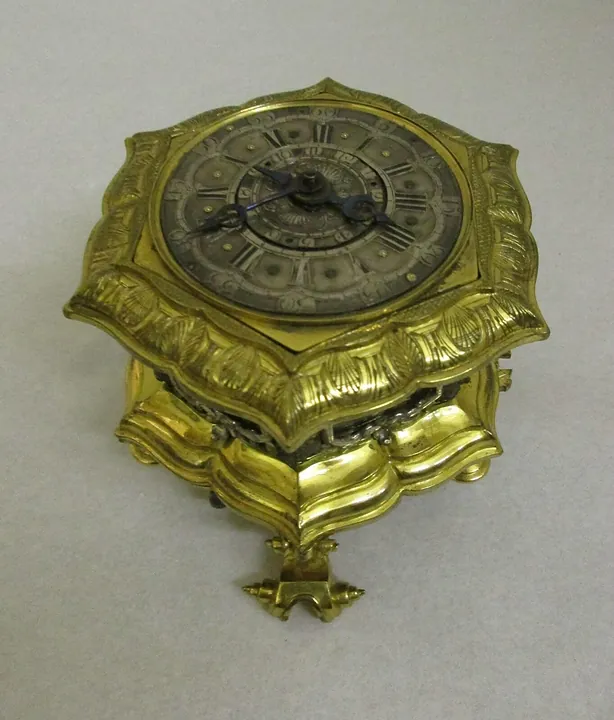
Clock, Germany, 1600–1700
Victoria and Albert Museum, London
Clocks · 1600–1699
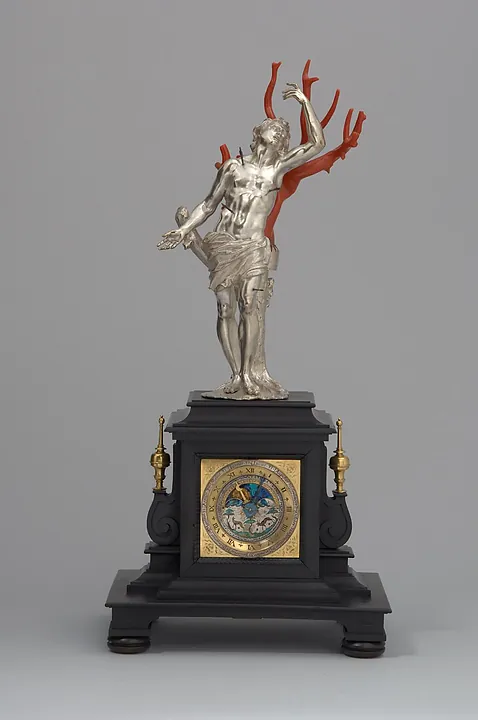
Table clock by Hans Christoph II. Fesenmair, Germany, 1600–1699
Fine Arts Museum Vienna
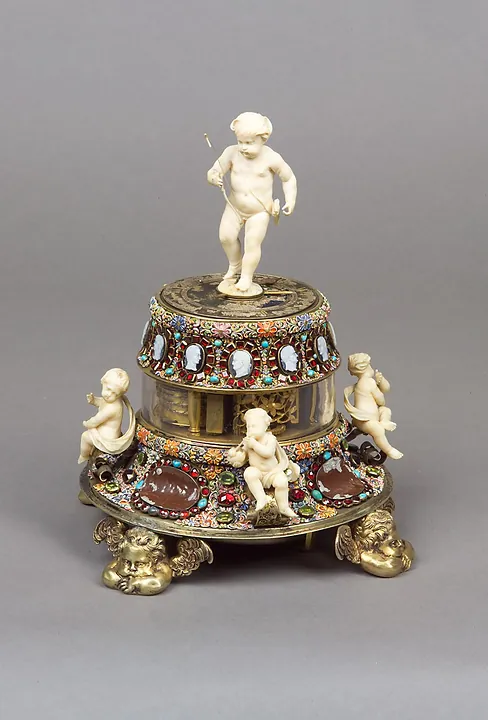
Clocks · 1600–1699
Table clock by Hans Jakob Mair, Germany, 1600–1699
Fine Arts Museum Vienna
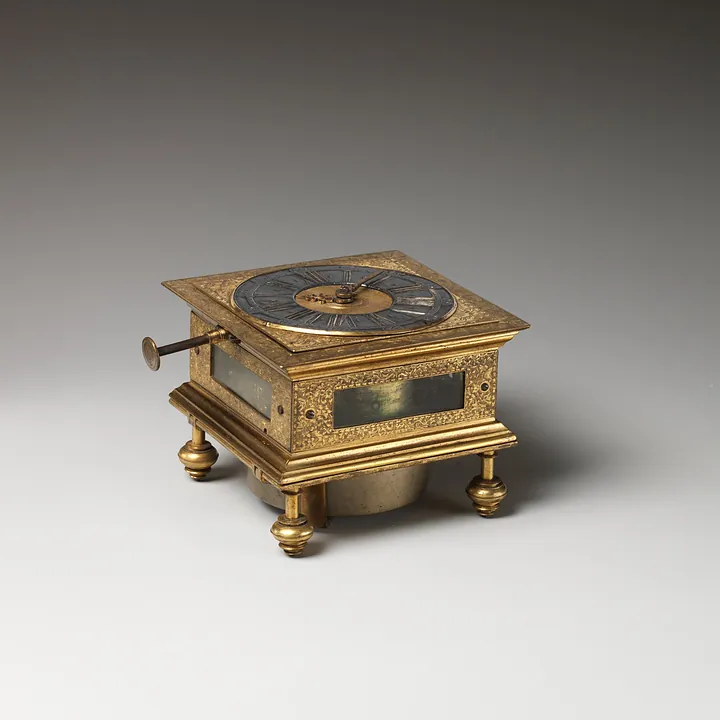
Clocks · 17th century
Table clock by Johann Heinrich Kleinschmidt, Germany, 17th century
The Metropolitan Museum of Art, New York
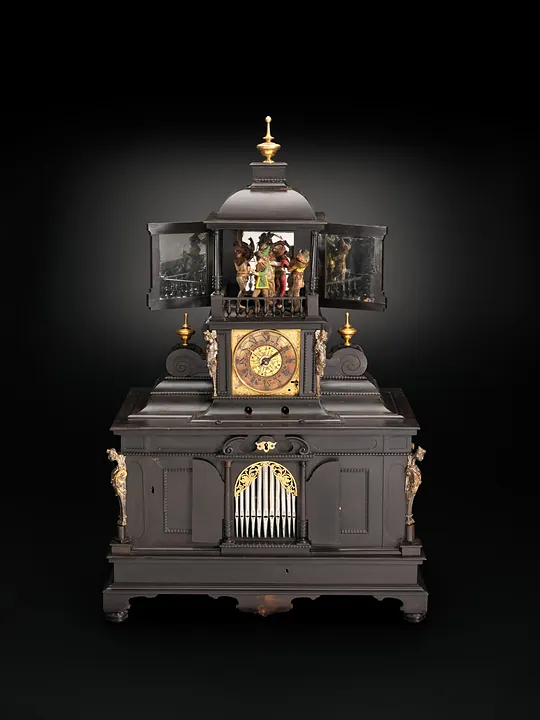
Clocks · c. 1625
Musical clock with spinet and organ by Veit Langenbucher, Germany, c. 1625
The Metropolitan Museum of Art, New York
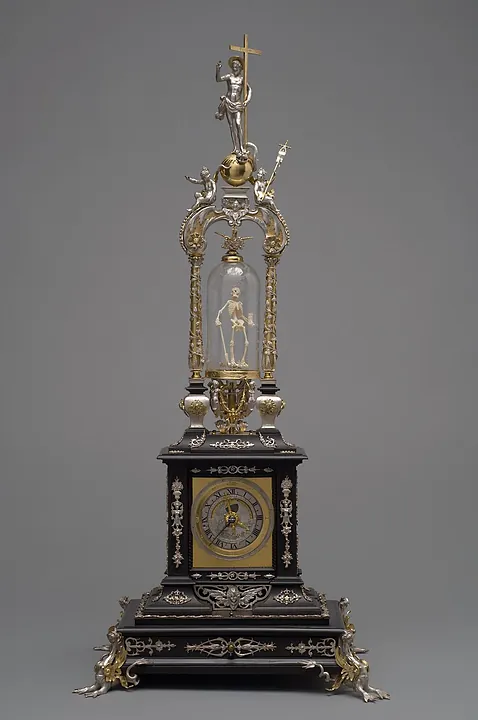
Clocks · 1624–1630
Table clock by Christoph Angermair, Germany, 1624–1630
Fine Arts Museum Vienna
Clocks · 1625–1635
Upright table clock with winding key, by unknown maker, made in Augsburg, Germany, 1625–1635
Science Museum Group, London