
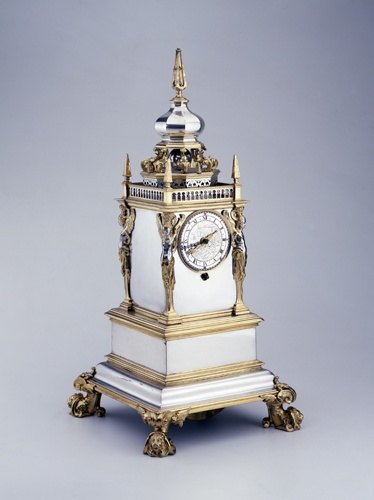
Clocks · Table clock
Table clock by Johannes Sayller, 1626–1634
- Maker / attribution
- Johannes Sayller (Created); Hans Jerg Merckle (der Ältere) (Created)
- Date
- 1626–1634
- Historical period
- Early Modern Horology (1600 – 1750)
- Country of origin
- Germany
- Place
- Ulm
- Object type
- Table clock
- Materials / technique
- Silber, teilweise vergoldet, Messing, Eisen
- Dimensions
- H. 57 cm, B. 23 cm, T. 23 cm
- Holding institution
- Landesmuseum Württemberg
- Accession / object no.
- 1970-90
- Credit line
- Landesmuseum Württemberg
- Catalogue title (original)
- Tischuhr (German)
View the source record ↗ (opens another website in a new tab)Suggest a correction
Record summary
Held and catalogued by Landesmuseum Württemberg (object number 1970-90), this is a table clock by Johannes Sayller, made in Ulm, Germany, dated 1626–1634. The Atlas places it in the Early Modern Horology period (1600 – 1750) of its Clocks collection. Materials and techniques recorded by the source: Silber, teilweise vergoldet, Messing, Eisen. Recorded dimensions: H. 57 cm, B. 23 cm, T. 23 cm. The record is illustrated with 2 photographs.
Assembled from the source record's structured fields. Dates and attributions are given as the source states them; where a field is missing the Atlas leaves it blank rather than estimating.
Catalogue description
Catalogue description from Landesmuseum Württemberg (German)
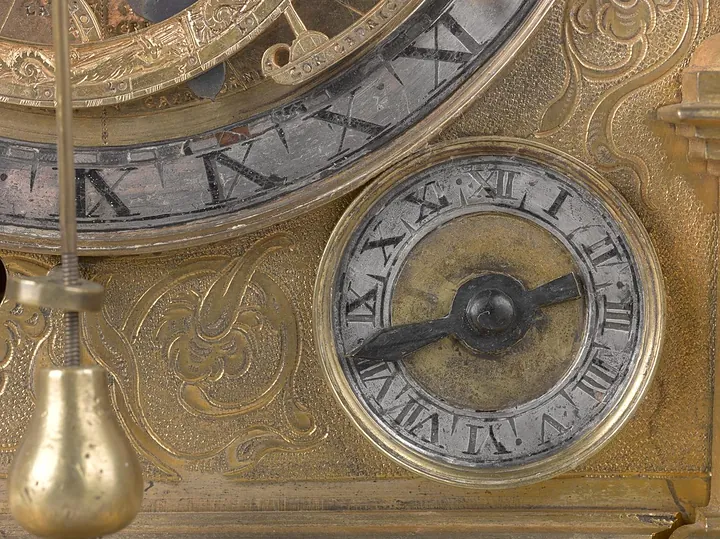
Zwei Meister ihres Faches, nämlich der Uhrmacher Johann Sayller und der Goldschmied H. J. Merckle der Ältere, gestalteten diese prächtige Uhr. Das Gehäuse besteht aus massivem, teilweise vergoldetem Silber. Gerade der Verzicht auf Flächen füllenden Dekor verleiht der Uhr ein sehr elegantes Aussehen. Effektvoll kontrastieren die silbernen Gehäusewände mit den goldenen Gesimsen, Füßen und weiteren architektonischen Elementen. An den drei Zifferblätter lassen sich kalendarische und astronomische Angaben wie das Datum sowie der Sonnenlauf im Tierkreis ablesen. Unter der Kuppel ist zudem eine Monduhr angebracht. Höchst innovativ ist die Konstruktion des Uhrwerks, bei dem die Feder des Gehwerks durch eine weitere, an das Schlagwerk gekoppelte Feder aufgezogen wird. Die Tischuhr ist in der Schausammlung "LegendäreMeisterWerke" im Alten Schloss ausgestellt. Erworben aus Lotto-Mitteln.
Shown in the original language of the source catalogue. An editor-reviewed English translation has not yet been published; we do not publish machine translations as authoritative text.
Provenance
Literature: Landesmuseum Württemberg: LegendäreMeisterWerke. Kulturgeschichte(n) aus Württemberg. Begleitband zur Dauerausstellung (2012); Württembergisches Landesmuseum, Schröder, Heike (Red.): Kunst im Alten Schloß (1998)
Historical context
Early Modern Horology (1600 – 1750)
Huygens' pendulum and balance spring transform accuracy; English makers develop the anchor and deadbeat escapements.
Huygens's pendulum (1656–57) improved clock accuracy from about a quarter of an hour to under a minute a day. The anchor escapement (c. 1670) and the long seconds pendulum created the longcase clock; London makers such as Fromanteel, Knibb, Tompion and Quare led European clockmaking, and French makers created the Boulle pendule.
Read the period in the timelineMore clocks from this periodEarlier: Renaissance Horology
Atlas type guide
Bracket, table and spring-driven clocks
Spring-driven clocks freed timekeeping from the hanging weight. The coiled mainspring, documented from the fifteenth century, made portable table clocks possible; to even out its declining force, makers used the fusee, a conical pulley connected to the barrel by a gut line or chain. Renaissance table clocks from Augsburg and Nuremberg — drum-shaped, square or tower-shaped in gilt brass — were luxury scientific objects, often with astronomical dials and alarms.
After the pendulum, English makers developed the bracket clock: a wooden case with a carrying handle, a short pendulum with a verge escapement, and often repeating work to sound the hours on demand at night. Later examples use the anchor escapement. In the nineteenth century, 'table clock' became a broad term for spring clocks of every nationality.
What to look for
- A fusee in the movement (cone-shaped pulley) and the type of line — gut or chain.
- Verge escapement with a short bob pendulum, often with a decoratively engraved backplate.
- Repeat cords or buttons that make the clock strike again on demand.
- Gilt-brass engraved cases and horizontal dials on Renaissance pieces.
- Case shapes: inverted bell, bell top, break-arch, lancet or balloon.
Dating clues
- Drum and tower table clocks: c. 1520–1650.
- Ebony veneered English bracket clocks with verge escapements: c. 1670–1800.
- Engraved backplates were usual on English clocks until c. 1800, then generally plain.
General guidance written by the Atlas editors about this kind of object. It is not a statement about this particular piece; for that, rely on the source record above and on physical examination.
Related records
Clocks · 1662–1663
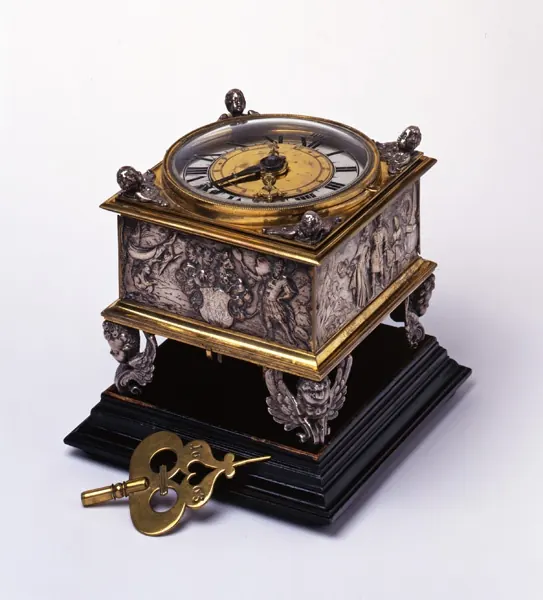
Table clock by Johannes Sayller, 1662–1663
Museum Ulm
Clocks · 1600–1700
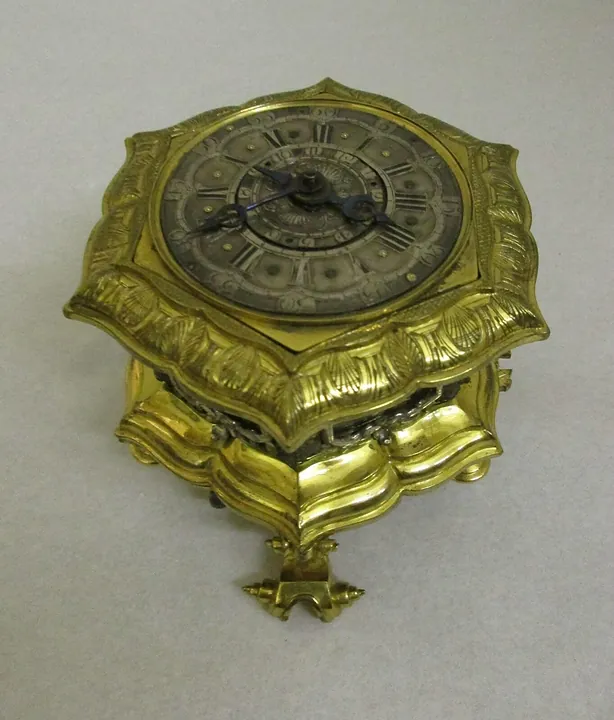
Clock, Germany, 1600–1700
Victoria and Albert Museum, London
Clocks · 1600–1699
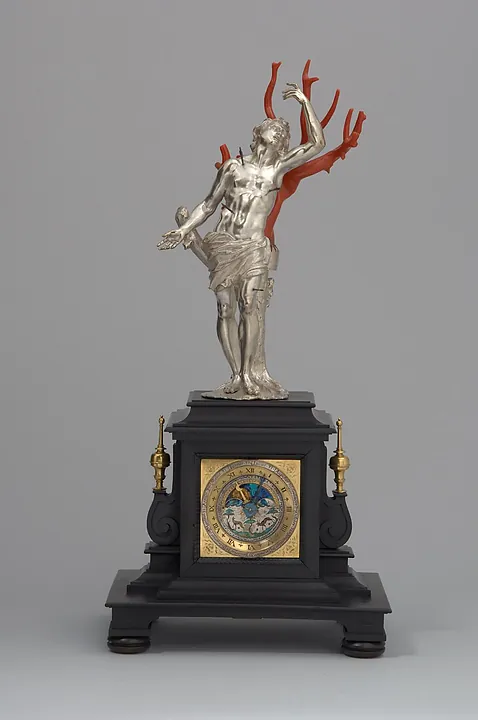
Table clock by Hans Christoph II. Fesenmair, Germany, 1600–1699
Fine Arts Museum Vienna
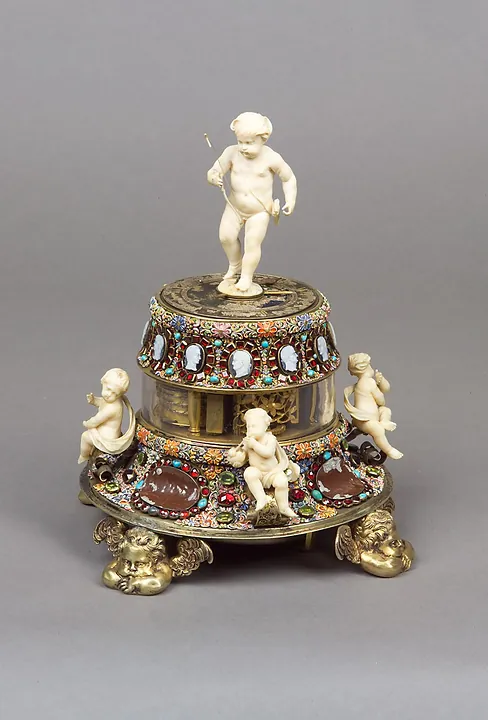
Clocks · 1600–1699
Table clock by Hans Jakob Mair, Germany, 1600–1699
Fine Arts Museum Vienna
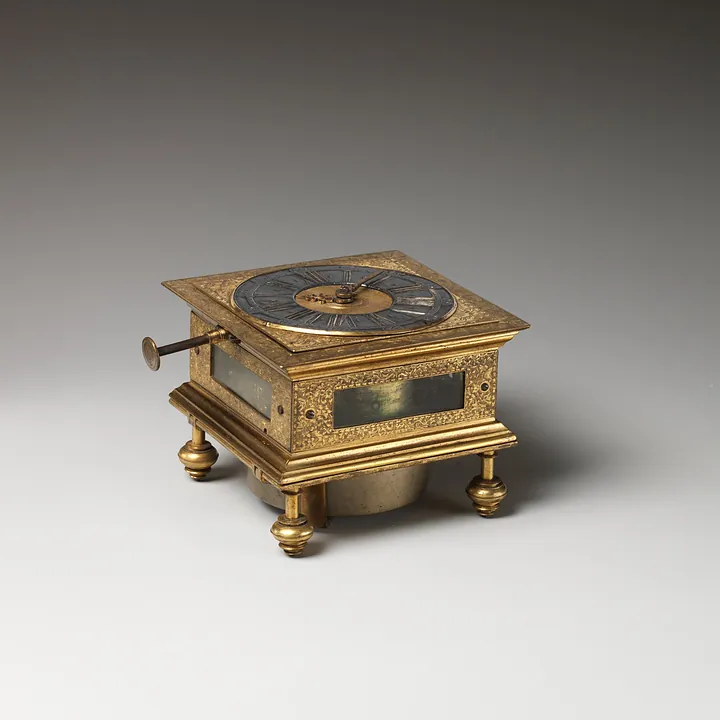
Clocks · 17th century
Table clock by Johann Heinrich Kleinschmidt, Germany, 17th century
The Metropolitan Museum of Art, New York
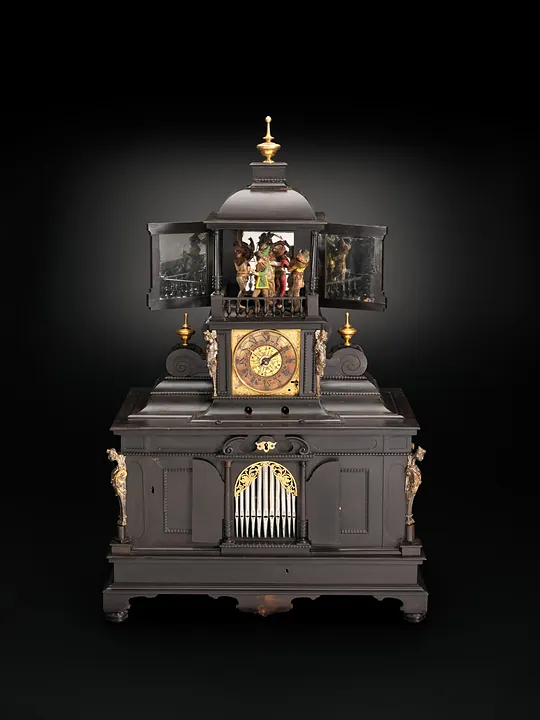
Clocks · c. 1625
Musical clock with spinet and organ by Veit Langenbucher, Germany, c. 1625
The Metropolitan Museum of Art, New York
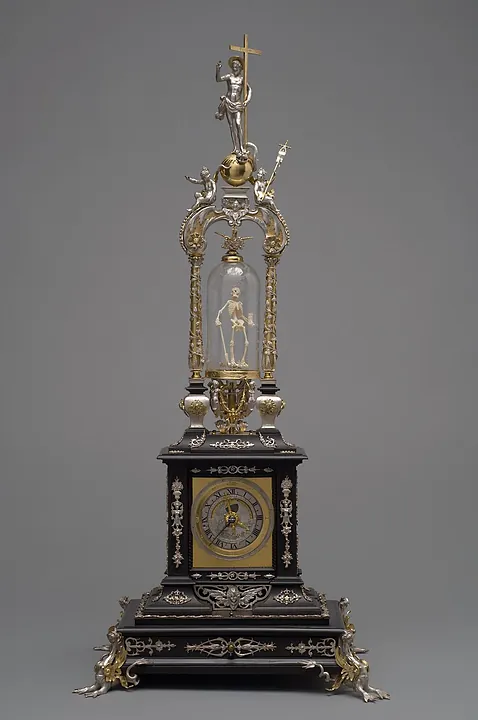
Clocks · 1624–1630
Table clock by Christoph Angermair, Germany, 1624–1630
Fine Arts Museum Vienna
Clocks · 1625–1635
Upright table clock with winding key, by unknown maker, made in Augsburg, Germany, 1625–1635
Science Museum Group, London