
Movements & Components · Spring-driven clock movement and dial
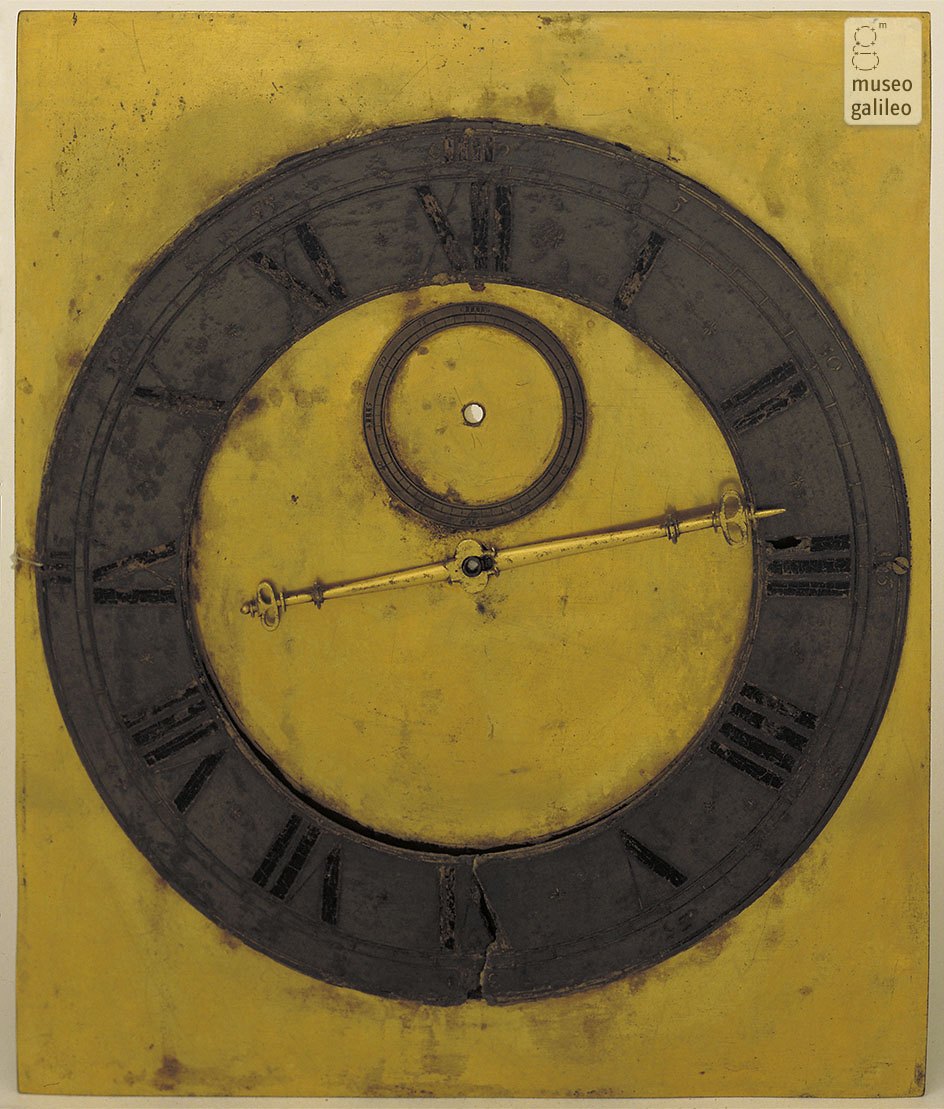
Spring-driven clock movement and dial by Johann Philipp Treffler, Italy, c. 1659
- Maker / attribution
- Johann Philipp Treffler (maker)
- Date
- c. 1659
- Historical period
- Early Modern Horology (1600 – 1750)
- Country of origin
- Italy
- Place
- Florence
- Object type
- Spring-driven clock movement and dial
- Materials / technique
- brass, pewter
- Dimensions
- movement: 90x36x190 mm; dial: 258x304 mm
- Holding institution
- Museo Galileo, Florence
- Accession / object no.
- Inv. 3557
- Credit line
- Museo Galileo, Florence
- Catalogue title (original)
- Spring-driven clock movement and dial (English)
View the source record ↗ (opens another website in a new tab)Suggest a correction
Record summary
Held and catalogued by Museo Galileo, Florence (object number Inv. 3557), this is a spring-driven clock movement and dial by Johann Philipp Treffler, made in Florence, Italy, dated c. 1659. The Atlas places it in the Early Modern Horology period (1600 – 1750) of its Movements & Components collection. Materials and techniques recorded by the source: brass, pewter. Recorded dimensions: movement: 90x36x190 mm; dial: 258x304 mm. The record is illustrated with 2 photographs.
Assembled from the source record's structured fields. Dates and attributions are given as the source states them; where a field is missing the Atlas leaves it blank rather than estimating.
Catalogue description
Catalogue description — Museo Galileo
The clock was originally housed in a wooden case, replaced by another destroyed in the 1966 flood. The brass dial displays the pewter hour circle and the seconds circle. The slim hour hand is elegantly designed and crafted. The minutes and seconds hands are missing. The brass going train has a large barrel for the mainspring and a gut fusee. The train comprises the fusee wheel, an intermediate wheel, a crown wheel, and a horizontal contrate wheel. The pendulum is missing. The back plate carries engraved ornamentation at the corners and on the rim; the center is engraved with the signature "Gio:Filipp Trefler Augosto" with flourishes. This instrument is traditionally believed to be one of the earliest applications of the pendulum to a clock in Italy. Appears to have belonged to Vincenzo Viviani.
Historical context
Early Modern Horology (1600 – 1750)
Huygens' pendulum and balance spring transform accuracy; English makers develop the anchor and deadbeat escapements.
The pendulum, anchor escapement and balance spring transformed movement design; English makers introduced jewelled bearings (1704).
Read the period in the timelineMore movements & components from this periodEarlier: Renaissance Horology
Atlas type guide
Dials and hands
Dials record both fashion and technology. Early watches had engraved metal dials; champlevé dials with raised numerals dominated around 1680–1730, followed by white vitreous enamel, guilloché gold and silver dials, and printed metal dials in the twentieth century. Luminous paints — radium from c. 1910, tritium from c. 1960 and non-radioactive pigments from the late 1990s — answered the need for legibility in the dark.
Because dials are visible and easily damaged, they were often restored or replaced. Distinguishing original dials from 'redials', and original hands from later replacements, is one of the main tasks of identification and authentication.
What to look for
- Enamel hairlines, chips and the quality of painted numerals.
- Signatures and Swiss-made markings ('Swiss', 'Swiss Made', 'T Swiss T') at the bottom edge.
- Lume colour and condition, which should match between hands and dial.
- Dial feet and their positions on the reverse, which must match the movement.
Dating clues
- Champlevé metal dials: c. 1680–1730.
- 'Swiss Made' dial markings became usual after the 1950s; 'T Swiss T' indicates tritium (c. 1960–1998).
General guidance written by the Atlas editors about this kind of object. It is not a statement about this particular piece; for that, rely on the source record above and on physical examination.
Related records
Movements & Components · 1745
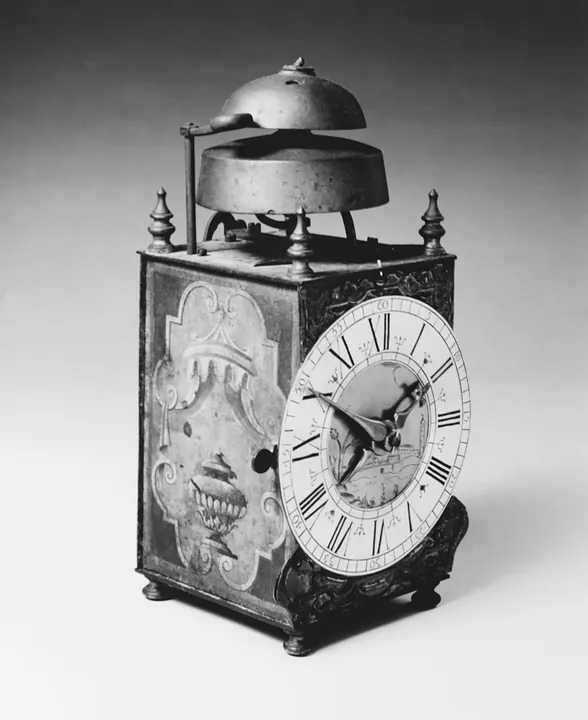
Clock movement by Filippo Polvini, Italy, 1745
The Metropolitan Museum of Art, New York
Movements & Components · 1600s
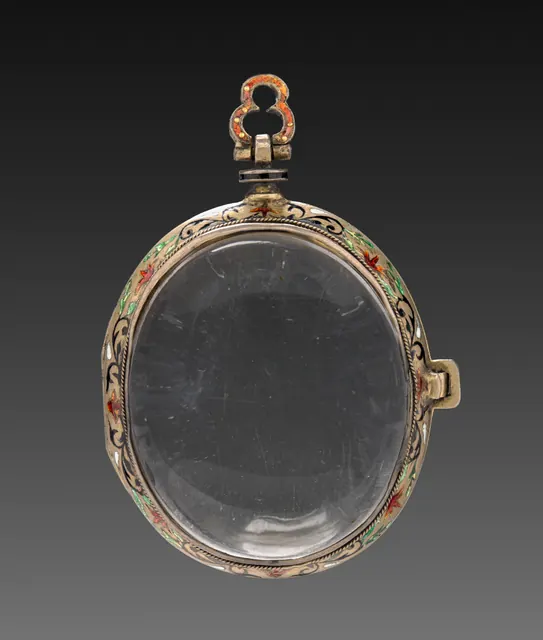
Watch case, Italy, 1600s
Cleveland Museum of Art
Movements & Components · 1600–1699
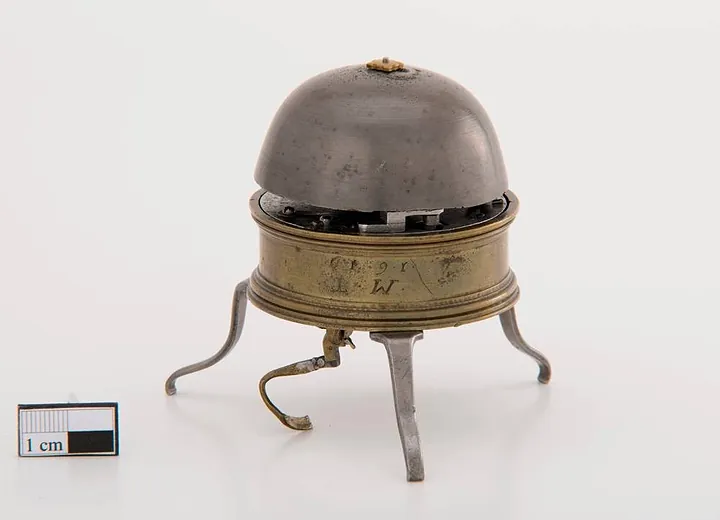
Clock movement, Germany, 1600–1699
Dresden State Art Collections. Royal Cabinet of Mathematical and Physical Instruments
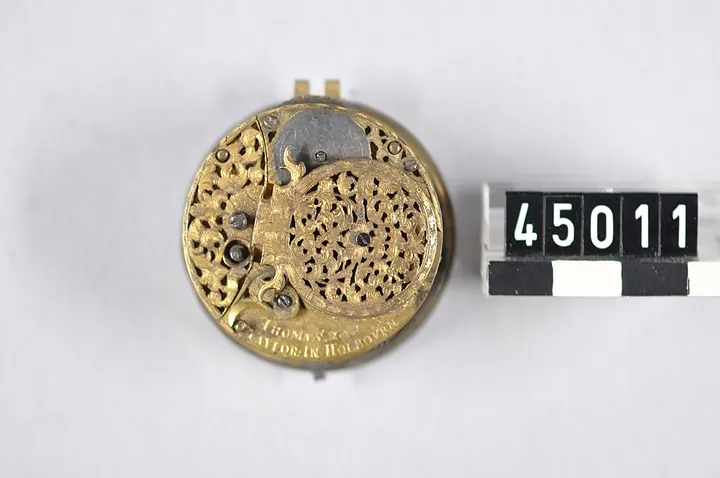
Movements & Components · 1600–1699
Watch movement by Thomas Tylor, 1600–1699
Swedish National Museum of Science and Technology
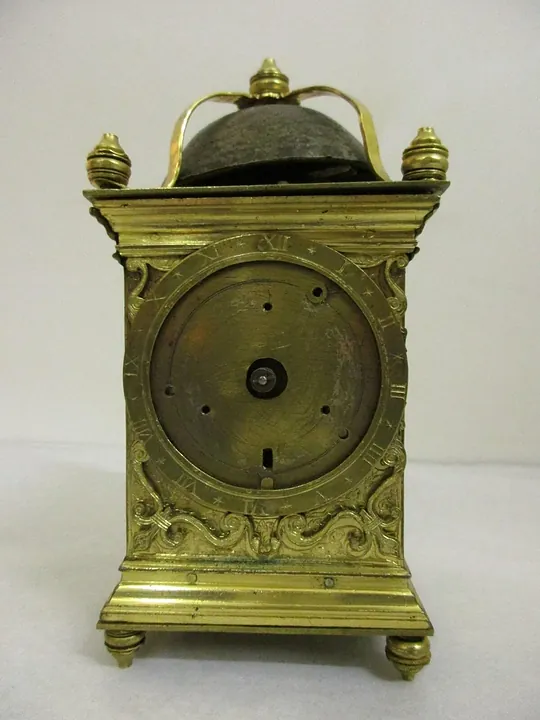
Movements & Components · 1620
Tabernacle clock, engraved with figures of Mercury, Minerva, and Venus with Cupid, German, about 1620.
Victoria and Albert Museum, London
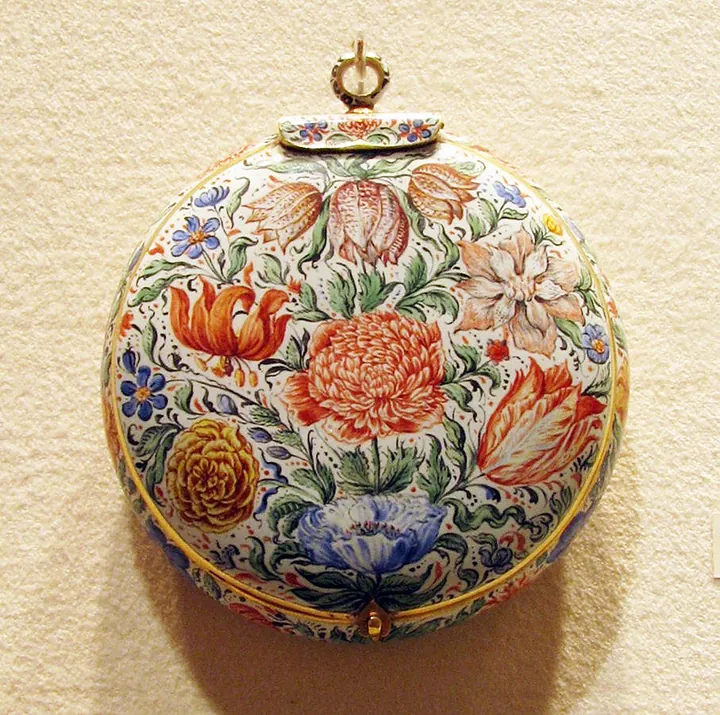
Movements & Components · c. 1645–50
Watch case by Christophe Morliêre, c. 1645–50
The Metropolitan Museum of Art, New York
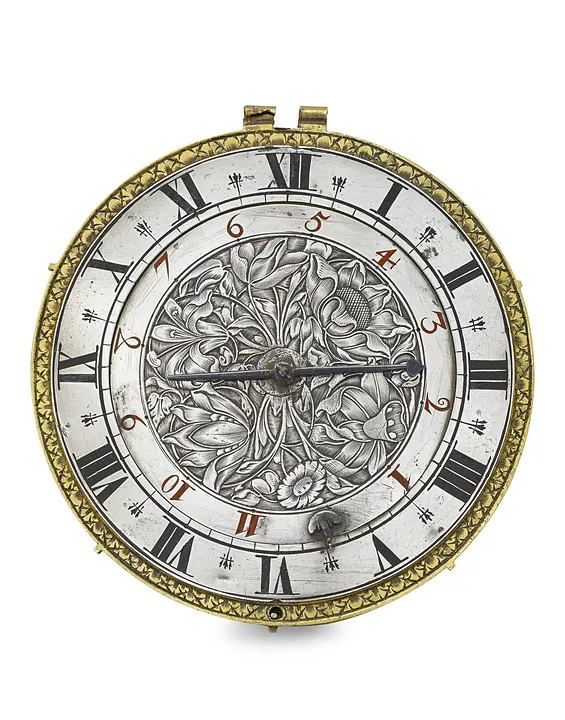
Movements & Components · 1640–1660
Watch movement by Edward East, England, 1640–1660
Science Museum Group, London
Movements & Components · 1650
Watch case, France, 1650
Victoria and Albert Museum, London