Movements & Components · Watch dial
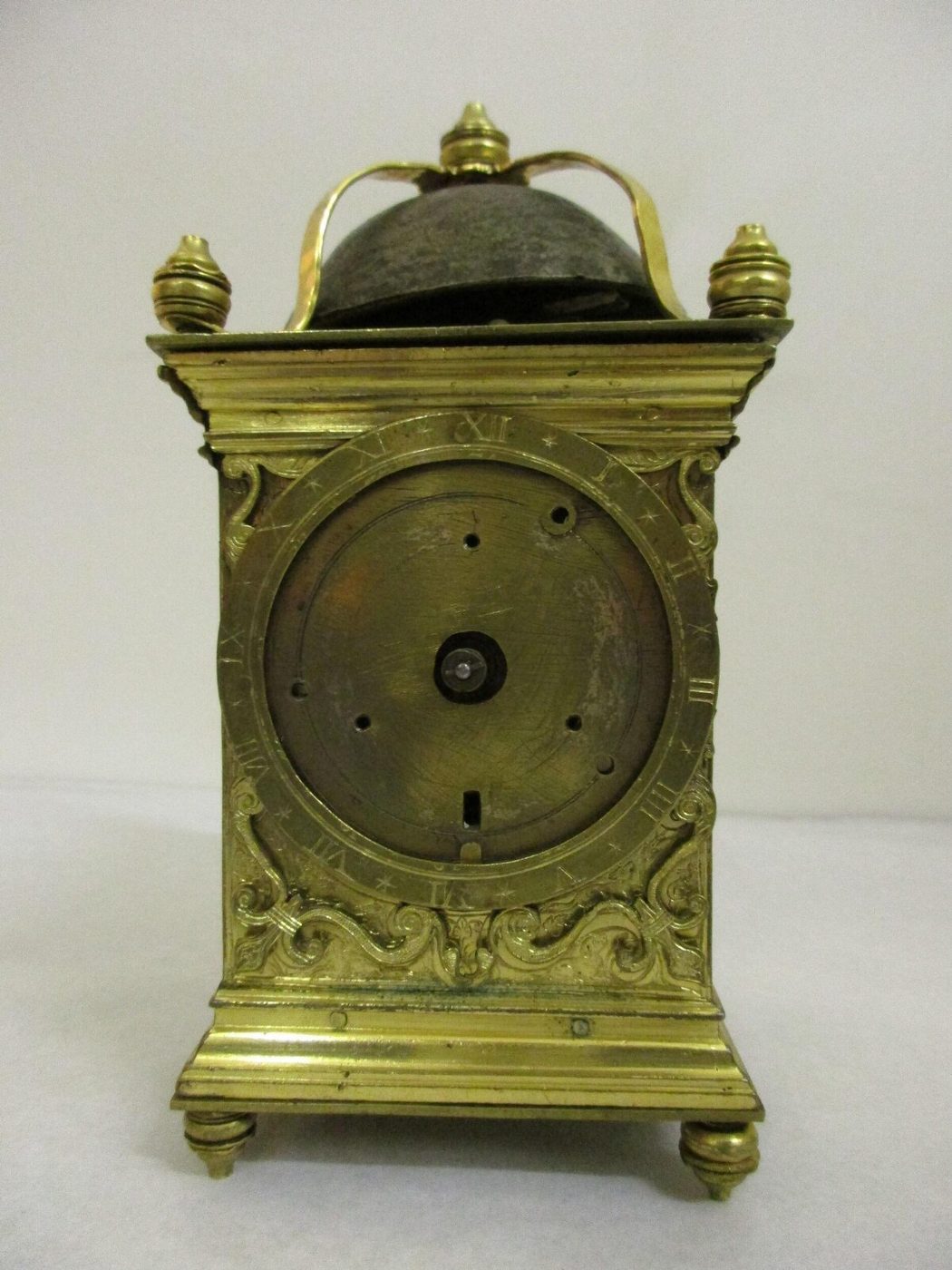
Tabernacle clock, engraved with figures of Mercury, Minerva, and Venus with Cupid, German, about 1620.
- Maker / attribution
- Unrecorded in source
- Date
- 1620
- Historical period
- Early Modern Horology (1600 – 1750)
- Country of origin
- Germany
- Place
- Germany
- Object type
- Watch dial
- Materials / technique
- Gilt-brass, iron
- Dimensions
- Height: 11.5 cm; Width: 8.3 cm; Depth: 8.3 cm
- Holding institution
- Victoria and Albert Museum, London
- Accession / object no.
- M.93-1913
- Credit line
- Purchased from Mr George Jorck, Putney, London, 1913
Record summary
Held and catalogued by Victoria and Albert Museum, London (object number M.93-1913), this is a watch dial, made in Germany, dated 1620. The Atlas places it in the Early Modern Horology period (1600 – 1750) of its Movements & Components collection. Materials and techniques recorded by the source: Gilt-brass, iron. Recorded dimensions: Height: 11.5 cm; Width: 8.3 cm; Depth: 8.3 cm. The record is illustrated with 4 photographs.
Assembled from the source record's structured fields. Dates and attributions are given as the source states them; where a field is missing the Atlas leaves it blank rather than estimating.
Catalogue description
V&A — Summary
A gilt brass upright square alarm clock the sides engraved with figures representing Mercury, Minerva and Venus with Cupid. Surmounted by a bell which is suspended from a double arch. The movement is of steel. On hand and a medallion are missing from the face. French, late 16th century. Purchased from Mr George Jorck, Putney, London, 1913
V&A — Physical description
Case: Gilt-brass case, the sides and back engraved with figures of Mercury, Minerva, and Venus with Cupid; turned feet, one missing. The bottom plate a renewal. Dial: Brass dial, 6.7 cm diameter, the applied brass chapter ring now engraved with Roman hours only, but formerly with an inner ring showing Italian hours 13 to 24 inclusive in arabic numerals. This part of the ring now cut away. The chapter-ring now riveted to the dial, but formerly held by posts, for which the holes remain. There was probably an inner one-quarter hour or minute dial, as the gearing provides for hour- and minute-hands, now missing. Applied engraved brass scrolls in the dial corners. Movement: Posted brass frame, brass fusees and barrels with gut lines, going train wheels of brass, but striking train wheels of iron. Going train in front compartment, with verge escapement and plain brass balance-wheel, now with a balance-spring of 2 one-half turns and a Tompion-type regulator, both later additions. The balance-cock a replacement. Striking train in rear compartment, with exterior count-wheel. The spider bell-support a later replacement.
V&A — Object history
French. Dented and damaged. Modern enamelled dial and steel hands removed, and dial-ring reversed. Bottom plate renewed.
Historical context
Early Modern Horology (1600 – 1750)
Huygens' pendulum and balance spring transform accuracy; English makers develop the anchor and deadbeat escapements.
The pendulum, anchor escapement and balance spring transformed movement design; English makers introduced jewelled bearings (1704).
Read the period in the timelineMore movements & components from this periodEarlier: Renaissance Horology
Atlas type guide
Dials and hands
Dials record both fashion and technology. Early watches had engraved metal dials; champlevé dials with raised numerals dominated around 1680–1730, followed by white vitreous enamel, guilloché gold and silver dials, and printed metal dials in the twentieth century. Luminous paints — radium from c. 1910, tritium from c. 1960 and non-radioactive pigments from the late 1990s — answered the need for legibility in the dark.
Because dials are visible and easily damaged, they were often restored or replaced. Distinguishing original dials from 'redials', and original hands from later replacements, is one of the main tasks of identification and authentication.
What to look for
- Enamel hairlines, chips and the quality of painted numerals.
- Signatures and Swiss-made markings ('Swiss', 'Swiss Made', 'T Swiss T') at the bottom edge.
- Lume colour and condition, which should match between hands and dial.
- Dial feet and their positions on the reverse, which must match the movement.
Dating clues
- Champlevé metal dials: c. 1680–1730.
- 'Swiss Made' dial markings became usual after the 1950s; 'T Swiss T' indicates tritium (c. 1960–1998).
General guidance written by the Atlas editors about this kind of object. It is not a statement about this particular piece; for that, rely on the source record above and on physical examination.
Related records
Movements & Components · 1669
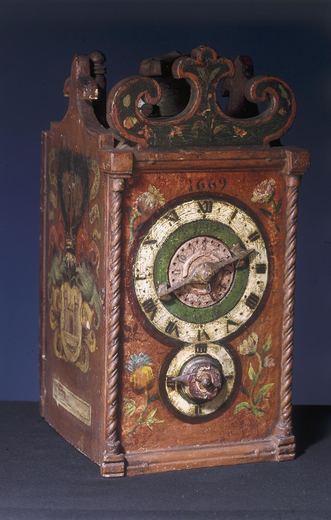
Wooden clock, with foliot type escapement, Germany, 1669 (driving weights missing).
Science Museum Group, London
Movements & Components · 1600–1699
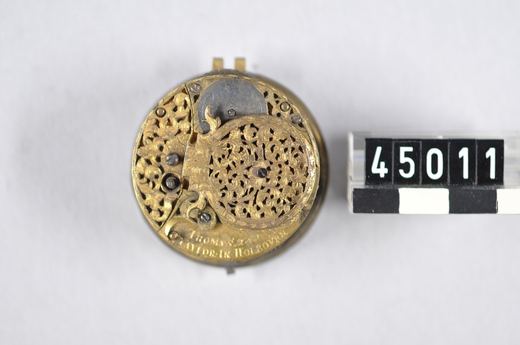
Watch movement by Thomas Tylor, 1600–1699
Swedish National Museum of Science and Technology
Movements & Components · ca. 1645–50
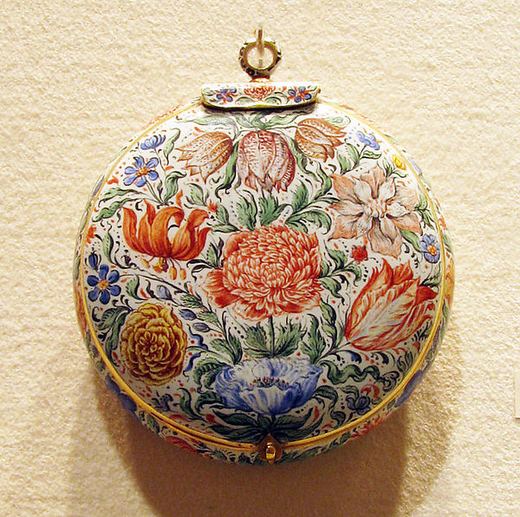
Watch case by Christophe Morliêre, France, ca. 1645–50
The Metropolitan Museum of Art, New York
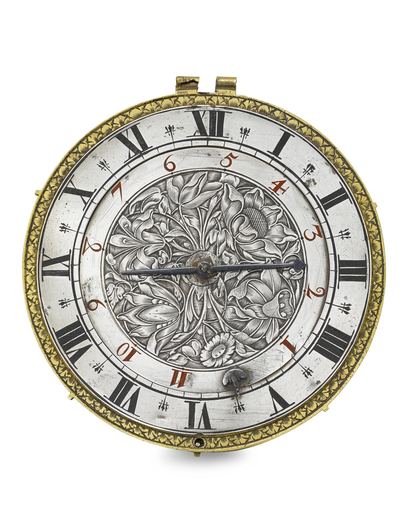
Movements & Components · 1640-1660
Watch movement by East, Edward, England, 1640-1660
Science Museum Group, London
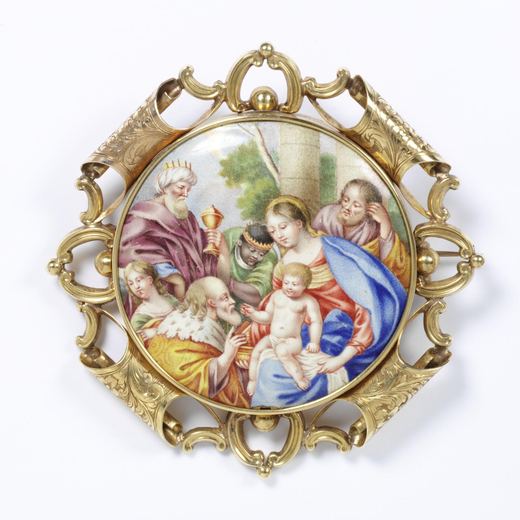
Movements & Components · 1650
Watch case, France, 1650
Victoria and Albert Museum, London
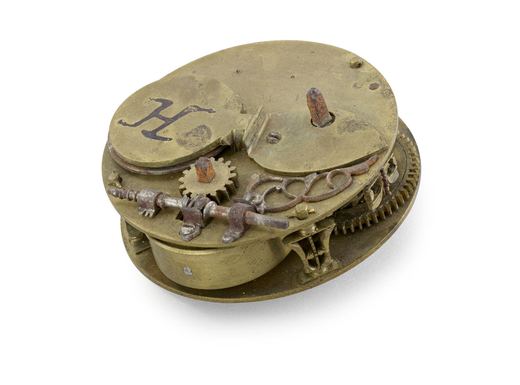
Movements & Components · 1670
Watch movement, England, 1670
Science Museum Group, London
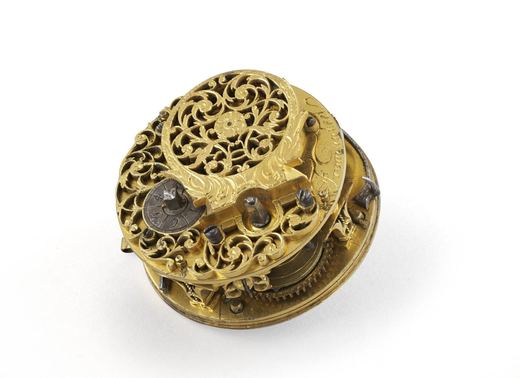
Movements & Components · 1685
Watch movement by Fromanteel, Ahasuerus, Netherlands, 1685
Science Museum Group, London
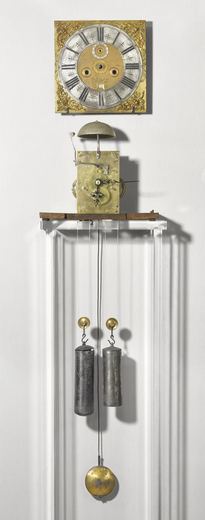
Movements & Components · 1690-1695
Clock movement by Bradford, Thomas, England, 1690-1695
Science Museum Group, London