
Clocks · Longcase clock
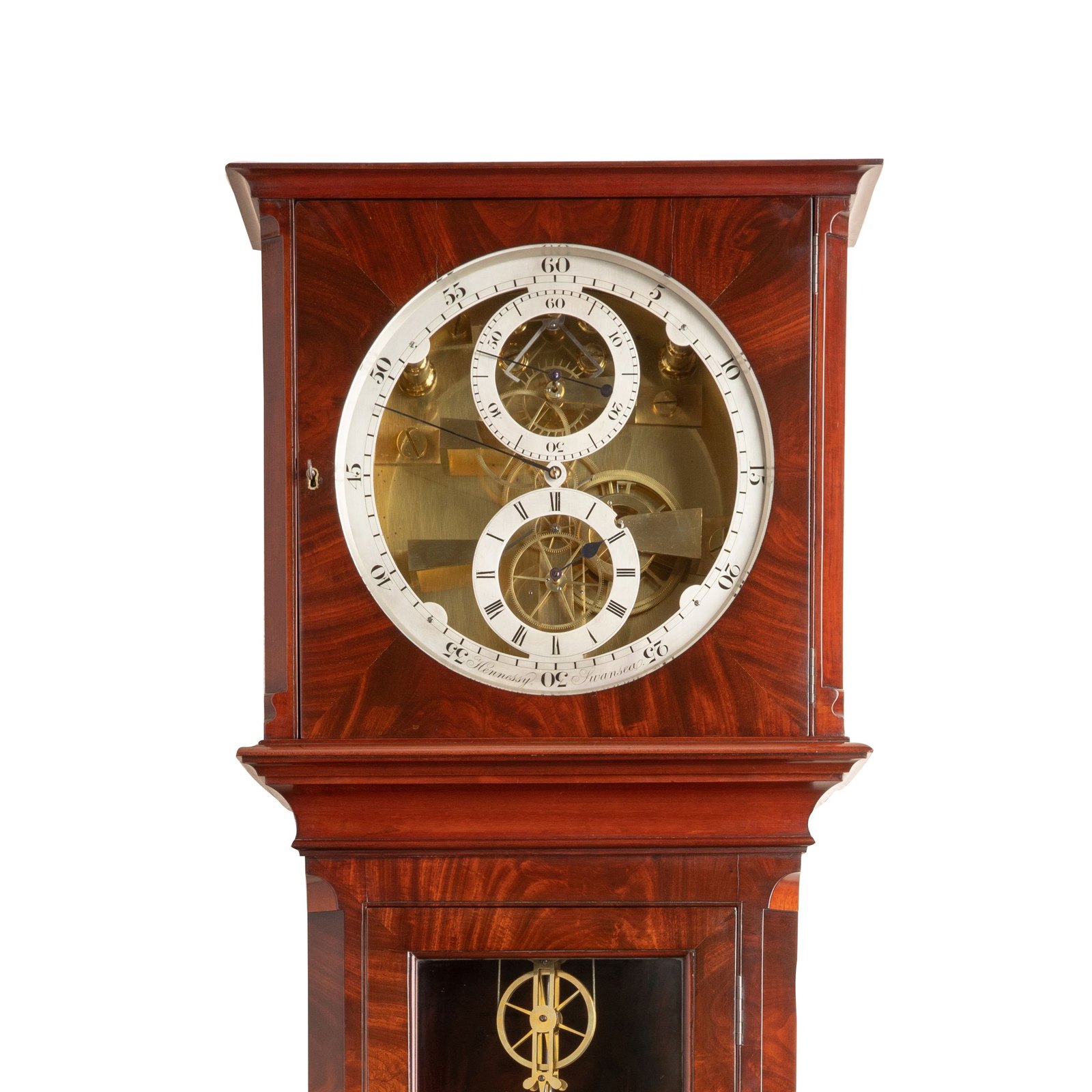
Skeletonised regulator longcase clock by Hennessy, Swansea
- Maker / attribution
- Hennessy (maker)
- Date
- c. 1865
- Historical period
- Industrial Revolution (1850 – 1900)
- Country of origin
- Wales
- Place
- Swansea
- Object type
- Longcase clock
- Dimensions
- Height 196 cm
- Stock no.
- Product 2568
- Credit line
- Dealer listing, The Antique Clock Company (product 2568)
- Catalogue title (original)
- A STUNNING SKELETONISED REGULATOR LONGCASE CLOCK – HENNESSY – SWANSEA (English)
View the source record (dealer listing) ↗ (opens another website in a new tab)Suggest a correction
Record summary
Catalogued by The Antique Clock Company (dealer), Dorset (stock number Product 2568), this is a longcase clock by Hennessy, made in Swansea, Wales, dated c. 1865. The Atlas places it in the Industrial Revolution period (1850 – 1900) of its Clocks collection. Recorded dimensions: Height 196 cm. The record is illustrated with 6 photographs.
Assembled from the source record's structured fields. Dates and attributions are given as the source states them; where a field is missing the Atlas leaves it blank rather than estimating.
Catalogue description
Dealer description — The Antique Clock Company
SOLD Bernard Rudkin Hennessy, Swansea, Wales. A fine and rare longcase regulator with a beautifully executed skeletonised dial and movement. This remarkable eight-day regulator has a fully skeletonised movement and dial with the front plate being completely omitted; the arbors all being carried by a series of massive cocks. The very thick backplate is circular, being some 12” in diameter, and a circular brass drum shaped case encloses the movement. The engraved and silvered brass dial consists, in effect, of three chapter rings. The narrow outer one for the minutes has Arabic numerals as also does the seconds ring below 12 o’clock. Roman numerals are employed for the hours. The dial is screwed to the four very heavy stepped dial pillars which in turn are fixed to the backplate by four heavy screws. All the wheelwork is finely finished each having delicately tapered crossings; indeed even the barrel cover is skeletonised with six tapering crossings. The train, which is given below, is of very high count, employing beautifully finished 24 leaf pinions throughout. WHEEL TEETH PINIONS Great Wheel 288 24 Centre Wheel 192 24 Intermediate Wheel 180 24 Escape Wheel 30 24 The Minute is 68 : 68 The Hour is 12 to 144. The dead-beat pallets are jewelled and are protected by ‘stop’ pins mounted on the backplate. An impressive feature is the long curving lever for the maintaining lever which snakes its way between a wheel and pinion. To complete the display, a very fine mercury compensated pendulum with beat plate is provided on which all the gilded brass work has been decorated with floral engraving and it is mounted on the backplate. The large ornamental pulley has six crossings. The well figured mahogany case is in the Regency style with a flat top, canted front corners to the hood (which slides off) and trunk, and a panelled base. The door is glazed and crossbanded. This clock is illustrated in ‘English Precision Pendulum Clocks’ by Derek Roberts on pages 236 and 237. Bernard Rudkin Hennessy, Swansea. Bernard Rudkin Hennessy was born in Dublin the son of an Irishman, Martin Hennessy, who opened a small academy in Swansea about 1840. Bernard Hennessy was the apprentice of John Jenkins, Clockmaker of Swansea, and, in this respect, he was fortunate indeed, since Jenkins was a very skilled scientist, being a Master of Arts and a Fellow of the Royal Astronomical Society. He abandoned his clock-making business in 1847 on being called to the Bar and, for the rest of his life, was a journalist and politician. His pupil, B. R. Hennessy, opened up business on his own account at 8 Wind Street, Swansea, in 1848, the time when Jenkins retired. I should imagine that he took over the business of John Jenkins. Later he moved to number 20 Wind Street. Mr Hennessy continued in business until 1875, when he retired with a very comfortable fortune. He was buried in Danygraig Cemetery, Swansea, on the 26 th January 1887, leaving two sons, Marten and Charles Hennessy. At the date of Hennessy’s marriage on the 11 th May 1845 to Elizabeth, the daughter of Richard Collier of Warminster, Wilts, he is described in the local Press as ‘watch-finisher and escapement maker’. At this time, of course, he was still an understudy of Jenkins. Hennessy was one of Swansea’s most celebrated Victorian horological and scientific entrepreneurs and everything he produced or sold was of the highest standard. He is recorded as being a Clockmaker, Watchmaker, Jeweller, Gunsmith, Optician, Supplier of Scientific Instruments and Contractor to the Admiralty. Further details can be found in: – ‘Clockmaking in Wales’ by Iorwerth C. Peate. ‘Wales Clocks & Clockmakers’ by William Linnard. ‘Swansea Clocks’ by Johanna Greenlaw. John Smith & Sons, Clerkenwell, London. John Smith & Sons were first established in 1780. By 1830 they were located next to St John’s Church in St John’s Square, Clerkenwell, London. This had formerly been occupied by Colonel Francis Magniac (1770-94) and was pulled down circa 1812. Colonel Magniac is recorded as making complicated clocks and was made famous for producing automaton clocks for the Emperor of China. John Smith & Sons employed a large number of workers in their factory and were able to produce every part of a clock in house. They had a brass foundry, clockmakers, case makers, engravers, dial makers and glass formers. All of the clocks they produced were of high quality, including small carriage clocks, skeleton clocks, regulators, right up to large turret clocks. A full and fascinating description of their works can be found in an article that appears in ‘The Illustrated London News’ of the the 20 th September 1851. In later years they continued just as suppliers of raw materials, especially non-ferrous metals. The business eventually closed in the last part of the 20 th century. Further details can be found in: – ‘Skeleton Clocks Britain 1800 – 1914’ by Derek Roberts pages 131 and 260. ‘Victorian Clocks’ by Richard Good pages 37-39. ‘J.Smith & Sons of Clerkenwell Facsimiles’ compiled by Chris McKay. ‘Visit to Clerkenwell Clock Factory’. The Illustrated London News 20 th September 1851, (this was re-printed in Antiquarian Horology No.3 Volume 12 Autumn 1980 and in ‘Skeleton Clocks’ by Derek Roberts). Height: 77 ¼ ″ (6′ 5″) or 196cm *This clock is delivered and set up for free within the UK. We regularly ship clocks all over the world with our approved and well-established Antiques and Fine Art Packers & Shippers. Please ask for a quote should you require this service.
Provenance
Private collection U.K.
Historical context
Industrial Revolution (1850 – 1900)
American interchangeable-parts manufacture; railroad time standards; Swiss and German factory systems.
Factory production transformed the clock into an everyday object. American makers (Seth Thomas, Ansonia, Waterbury) and German factories (Junghans, Gustav Becker, Lenzkirch) sold millions of shelf, wall and alarm clocks worldwide; France produced standardised Paris movements and carriage clocks; electric time distribution began.
Read the period in the timelineMore clocks from this periodEarlier: Precision & Scientific Horology
Atlas type guide
Longcase (tall-case or grandfather) clocks
The longcase clock was born from two seventeenth-century innovations: Christiaan Huygens's pendulum (1656–57) and the anchor escapement (c. 1670). A long seconds pendulum, nearly a metre long, swings with a small arc, and enclosing it together with the driving weights in a tall wooden case protected the mechanism and created a new piece of furniture. London makers such as Ahasuerus Fromanteel, Thomas Tompion and Joseph Knibb set the pattern.
By the eighteenth century longcase clocks were made throughout Britain, the Netherlands, Scandinavia (the Swedish Mora clock), France (the Comtoise from the Franche-Comté), Germany and colonial America. Eight-day movements with two weights became standard in better clocks; thirty-hour clocks with one weight and a rope or chain were cheaper alternatives.
What to look for
- Winding holes in the dial: two (eight-day, going and striking) or none (thirty-hour, pulled up by a chain).
- Brass dials with applied chapter rings (earlier) versus painted iron 'white' dials (after c. 1770 in Britain).
- Moon-phase arches, date apertures, seconds dials and maker's name on the dial.
- Case woods and style: ebonised, walnut marquetry, lacquer, oak or mahogany; regional styles from London, Lancashire, Scotland or America.
- Whether the movement and dial match the case — 'marriages' are common.
Dating clues
- Square brass dials suggest c. 1670–1720; arched brass dials c. 1715–1790.
- Painted (white) dials were made by Birmingham dial-makers from about 1772.
- Comtoise clocks with repoussé pendulums are mostly nineteenth century.
General guidance written by the Atlas editors about this kind of object. It is not a statement about this particular piece; for that, rely on the source record above and on physical examination.
Read next:Anchor (recoil) escapementDeadbeat escapementAnchor escapement
Related records
Clocks · 1830–1870
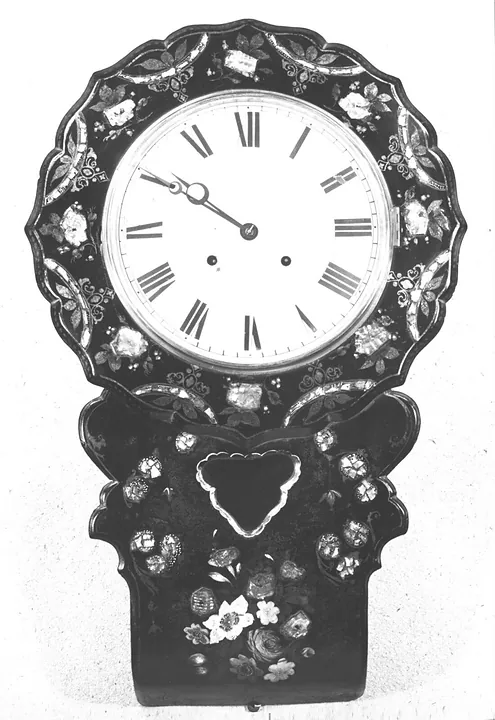
Wall clock in a papier mâché case with painted decoration. English, mid 19th century.
Victoria and Albert Museum, London
Clocks · 1840–1900
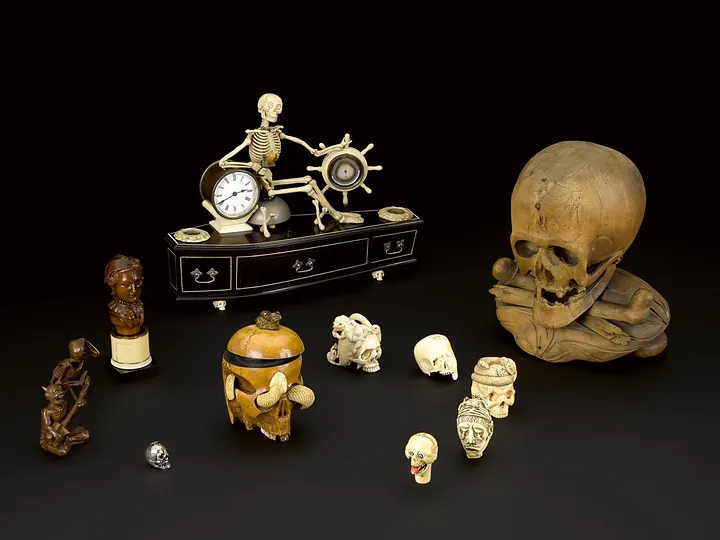
Alarm clock, mounted on model of coffin with skeleton, probably English, 1840–1900
Science Museum Group, London
Clocks · 1840–1880
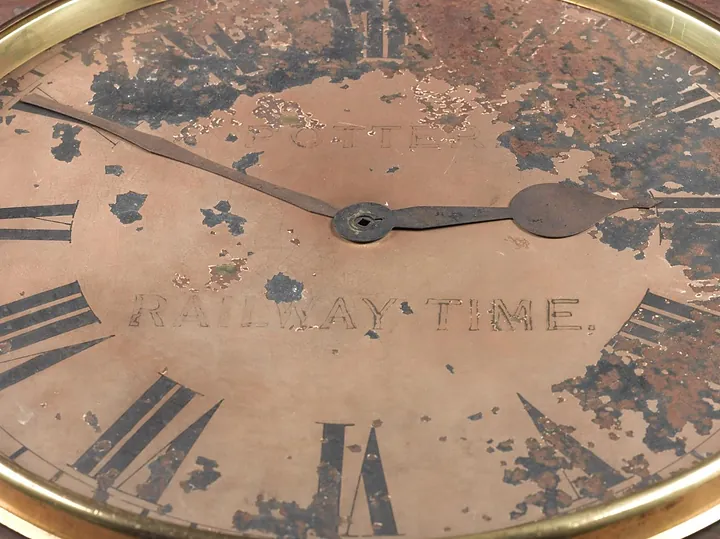
Clock dial marked "Potter, Railway Time" with two hands, unknown maker, British, 1840–1880
Science Museum Group, London
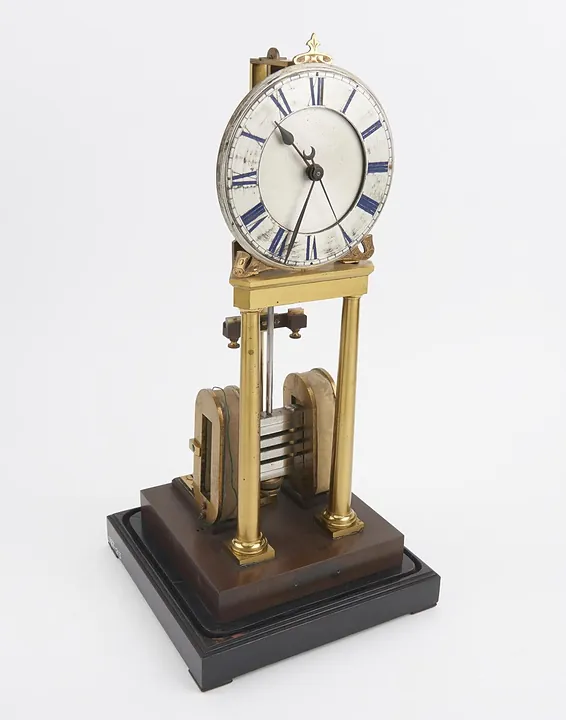
Clocks · 1840–1877
Electric clock of the Bain type
Science Museum Group, London
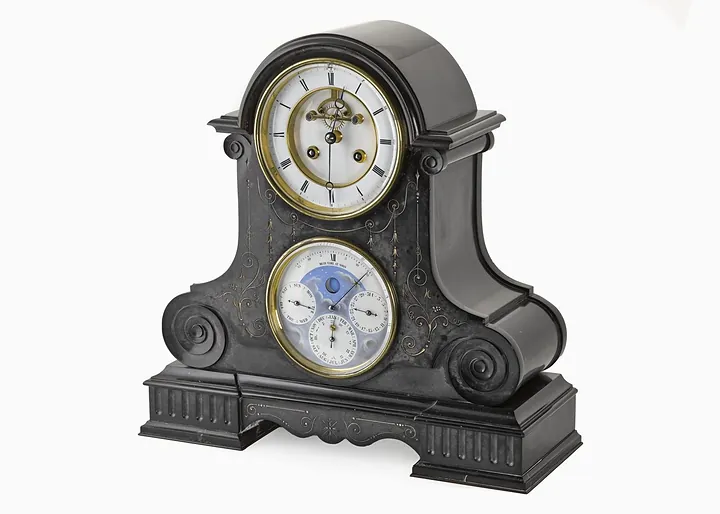
Clocks · 1840–1878
Mantel clock by A. Brocot, France, 1840–1878
Science Museum Group, London
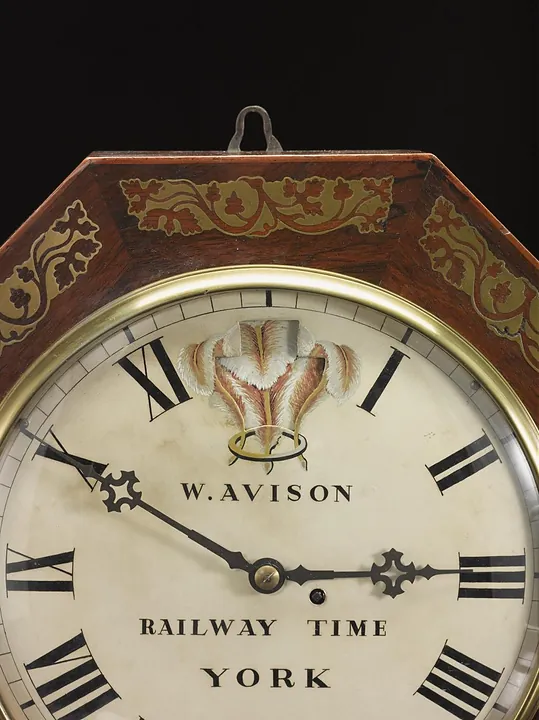
Clocks · 1840–1880
Wall Clock in octagonal case with Prince of Wales Feathers above makers name "W. Avison, Railway Time, York", made by William Avison, England, 1840–1880.
Science Museum Group, London
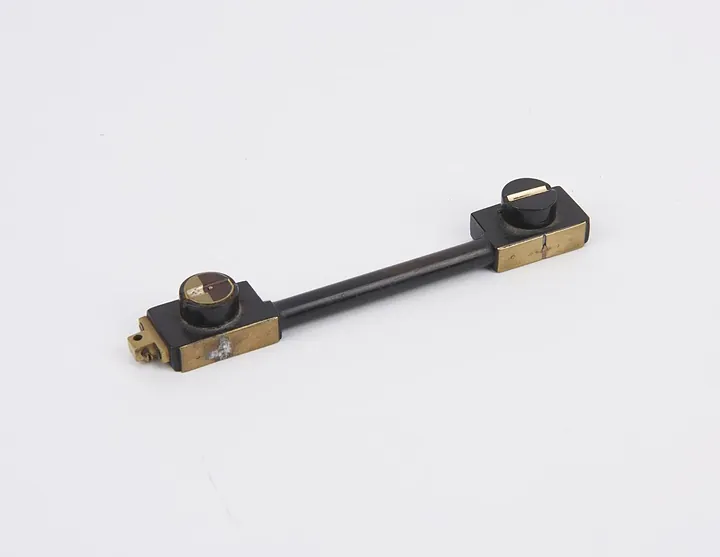
Clocks · 1841–1870
Contact bar from electric clock, unsigned, London, England, 1841–1870
Science Museum Group, London
Clocks · 1841–1870
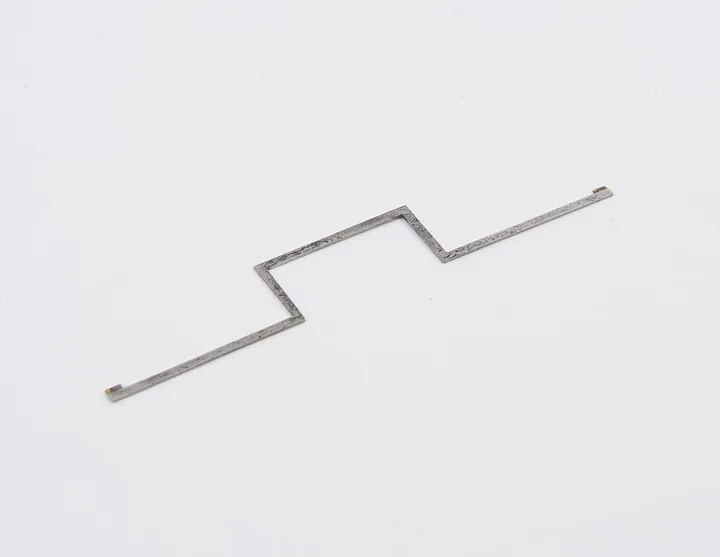
Contactor from electric clock, unsigned, London, England, 1841–1870
Science Museum Group, London