
Wristwatches · Wristwatch
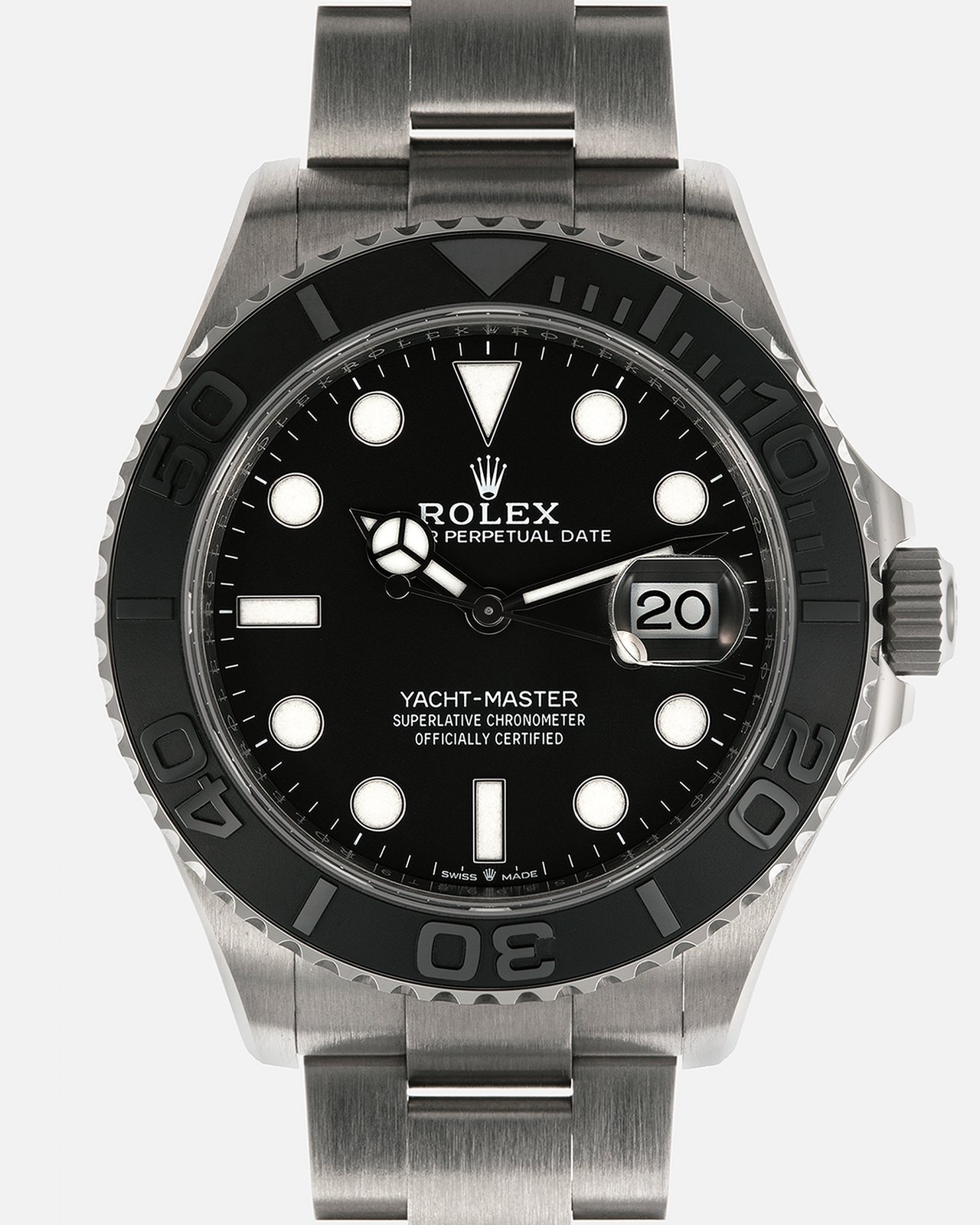
Rolex Yacht-Master 42 226627 RLX Titanium, 2025
- Maker / attribution
- Rolex (maker)
- Date
- 2025
- Historical period
- Contemporary Horology (2010 – Present)
- Country of origin
- Switzerland
- Object type
- Wristwatch
- Materials / technique
- titanium
- Dimensions
- Case 42 mm
- Stock no.
- Product 7551654985815
- Credit line
- Dealer listing, S.Song Watches (product 7551654985815)
- Catalogue title (original)
- Rolex Yacht-Master 42 226627 RLX Titanium (English)
View the source record (dealer listing) ↗ (opens another website in a new tab)Suggest a correction
Record summary
Catalogued by S.Song Watches (dealer), Seattle (stock number Product 7551654985815), this is a wristwatch by Rolex, made in Switzerland, dated 2025. The Atlas places it in the Contemporary Horology period (2010 – Present) of its Wristwatches collection. Materials and techniques recorded by the source: titanium. Recorded dimensions: Case 42 mm. The record is illustrated with 6 photographs.
Assembled from the source record's structured fields. Dates and attributions are given as the source states them; where a field is missing the Atlas leaves it blank rather than estimating.
Catalogue description
Dealer description — S.Song Watches
When you think of Rolex, the immediate suspects always come to mind. On the right, there are the classic dress pieces, such as the Datejust and Day-Date; on the left, the ever-popular sports models, including the Submariner, GMT-Master, and Daytona. For years, the Yacht-Master sat quietly in their shadow, never quite capturing the same level of attention, partly because they were seen as a kind of derivative Submariner- neither here nor there. The turning point came in 2015, when Rolex decided to rethink the Yacht-Master blueprint. The redesign, which debuted as the Yacht-Master Everose 116655/126655, caught everyone off guard. As you may know, Rolex is rarely one for curveballs; the brand is defined by steady, incremental evolution rather than dramatic reinvention. But when they do make a big change, it always makes huge news. With the release in 2015, the new Yachtmaster was less to do with the watch’s design but more to do with a new material: rubber. While the Oysterflex rubber bracelet we all know and love today seems quite a standard offering, in 2015, it was the first time Rolex had offered it on any model, and it was a huge success. The 226627, first released in 2023 and offered here today, continues the trajectory set by the critically acclaimed 112655/16655. Once again, the new Yachtmaster focused on materials and this time it was titanium. The headline move was the use of a new material known as RLX titanium. It is a grade 5 alloy prized for its strength, corrosion resistance, and lightness and is physically elevated through Rolex’s proprietary machining and finishing standards. This allows the metal to take on polished surfaces, sharp chamfers, and a subtle blend of satin and shine, creating a unique dark hue and luxury-level aesthetic that standard titanium rarely achieves. Specially selected and rigorously quality-controlled, RLX titanium transforms a technical material into something highly refined, as evident in this example. It is lighter on the wrist, highly technical, and more purposeful in form. Despite its seemingly bulky 42mm x 11.6mm case, the 226627 is remarkably wearable. Hovering at just 100 grams, I was genuinely surprised by how comfortable it felt on my wrist, especially as someone who usually prefers watches around 35–37 mm. It’s almost mind-blowing how our brains automatically anticipate the heft that would usually come with a 42 mm case, yet this wears and feels entirely different, further proving that on-paper numbers don’t always tell the full story. Moving to the dial, the 226627 maintains a familiar layout with a bold yet understated matte black background and three lines of contrasting white text at 6:00. Highly legible Maxi-style hour markers encircle the periphery and are filled with Rolex’s proprietary Chromalight material for excellent visibility in low light, while a practical date window at 3:00 is magnified by the signature Cyclops lens. The visual standout here, however, is the 120-click bidirectional 60-minute bezel. Its matte black Cerachrom insert features a sandblasted base that makes the polished, raised numerals and graduations pop, and it turns with a precise, solid, and satisfying tactile feel. The Oyster bracelet, also crafted in RLX titanium, is equally impressive. As I noted earlier regarding the watch’s overall lightness, when I first held it by the bracelet, I recall a moment where my brain struggled to reconcile how something so visually substantial could feel so light. It’s hard to put into words, but there is a curious sense of strength and robustness combined with an almost weightless feel that surprises as you adjust it. Beyond that, the bracelet is beautifully constructed with surgical-like precision. It also features an Oysterlock clasp and an Easylink extension allowing micro-adjustments of up to 5mm for a perfect fit. Powering the Yacht-Master from within is Rolex’s ever-reliable automatic Cal. 3235, featuring COSC ( Contrôle Officiel Suisse des Chronomètres ) certification, an anti-magnetic Parachrom Bleu hairspring, a Chronergy escapement, and Paraflex shock absorbers. The movement offers a robust 70-hour power reserve when fully wound. For a model that has seen its share of ups and downs, the 226627 stands out as a genuinely worthy successor, carrying the torch from the previous generation of Yacht-Masters with a clarity of purpose the line has long needed. In some ways, the highly technical character of the 226627 feels like a souped-up 718 Cayman GT4 RS compared to a standard 718 Cayman (I tend to view Yacht-Masters like the 718 Caymans). The core DNA is instantly recognisable, but every element has been thoroughly refined for better durability, enhanced wrist presence, and a more exhilarating wearing experience, all with a sharper focus on utility and performance. As far as Yacht-Masters go, this is one serious tool watch.
Historical context
Contemporary Horology (2010 – Present)
Silicon components, connected watches, optical-lattice research clocks and a thriving independent scene.
Smartwatches became the world's best-selling watches, while mechanical watchmaking focuses on craft, innovation (silicon components, new escapements) and independent makers.
Read the period in the timelineMore wristwatches from this periodEarlier: Mechanical Renaissance
Atlas type guide
Wristwatches
Bracelet watches were worn by women from the early nineteenth century — Breguet made one for Caroline Murat, Queen of Naples, in 1810–12 — but the wristwatch only became a man's instrument with military use and aviation in the early twentieth century. Between the World Wars it overtook the pocket watch; the 1920s and 1930s brought rectangular Art Deco cases, water-resistant cases and the first automatic winding systems.
After 1945 the wristwatch became a carrier of identity — dress watches, sports and dive watches, chronographs, calendars — produced by Swiss, American, Japanese, German, Soviet and Chinese industries. The quartz revolution after 1969 and the mechanical renaissance since the 1990s, including the rise of independent watchmakers, complete the story.
What to look for
- The reference number (between the lugs or inside the case back) and serial number, the starting point for dating.
- The calibre: its maker and number are often stamped under the dial or on the bridge.
- Originality of dial, hands and crown — refinished ('redial') dials are common.
- Case material marks: 18K/750, 14K/585, stainless steel, gold-filled, plated.
Dating clues
- Wire-lug cases: before c. 1925.
- Water-resistant screw-down cases: from 1926.
- Quartz movements: from 1969; sapphire crystals widespread after c. 1980.
General guidance written by the Atlas editors about this kind of object. It is not a statement about this particular piece; for that, rely on the source record above and on physical examination.
Related records

Movements & Components · c. 1970s
Rolex watch movement, c. 1970s
Antiquorum auction archive, Geneva

Pocket Watches · 1982
Fake Rolex watch, gold coloured metal, possibly made in Taiwan, 1982; part of a casual outfit, UK, 1982-84.
Victoria and Albert Museum, London

Wristwatches · c. 1920s
Rolex wristwatch, c. 1920s
Antiquorum auction archive, Geneva

Wristwatches · c. 1920s
Rolex wristwatch, ref. 6194, c. 1920s
Antiquorum auction archive, Geneva

Wristwatches · c. 2010s
Breguet Type XXI, ref. 3810, c. 2010s (Antiquorum Lot 381-24)
Antiquorum auction archive, Geneva

Wristwatches · c. 2010s
Breguet Type XXI, ref. 3810, c. 2010s (Antiquorum Lot 386-229)
Antiquorum auction archive, Geneva

Wristwatches · Sold in September 2010
Breitling Cosmonaute, ref. A 22322, Sold in September 2010
Antiquorum auction archive, Geneva

Wristwatches · c. 2010
Corum Bubble Chrono, ref. 396.150.20, c. 2010
Antiquorum auction archive, Geneva