
Wristwatches · Wristwatch
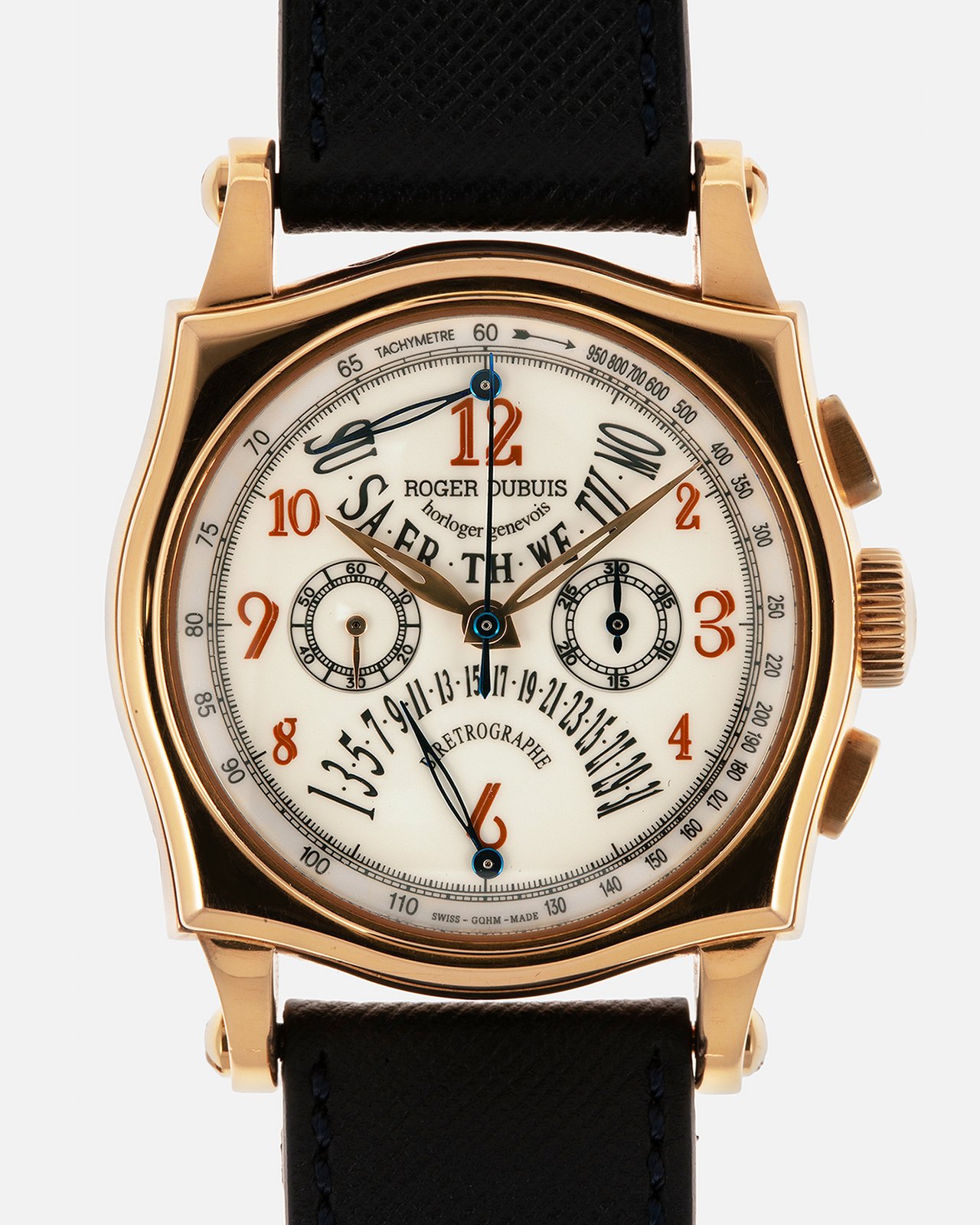
Roger Dubuis Sympathie 40 Biretrograde Chronograph, 2000s
- Maker / attribution
- Roger Dubuis (maker)
- Date
- 2000s
- Historical period
- Mechanical Renaissance (1990 – 2010)
- Country of origin
- Switzerland
- Object type
- Wristwatch
- Dimensions
- Case 40 mm
- Stock no.
- Product 7653847564375
- Credit line
- Dealer listing, S.Song Watches (product 7653847564375)
- Catalogue title (original)
- Roger Dubuis Sympathie 40 Biretrograde Chronograph (English)
View the source record (dealer listing) ↗ (opens another website in a new tab)Suggest a correction
Record summary
Catalogued by S.Song Watches (dealer), Seattle (stock number Product 7653847564375), this is a wristwatch by Roger Dubuis, made in Switzerland, dated 2000s. The Atlas places it in the Mechanical Renaissance period (1990 – 2010) of its Wristwatches collection. Recorded dimensions: Case 40 mm. The record is illustrated with 6 photographs.
Assembled from the source record's structured fields. Dates and attributions are given as the source states them; where a field is missing the Atlas leaves it blank rather than estimating.
Catalogue description
Dealer description — S.Song Watches
For a long time, the Roger Dubuis name was dismissed by collectors as overdesigned and irrelevant. Looking at the brand today, with its garish aesthetics and awkward proportions, it is easy to understand why. The truth, however, is that Roger Dubuis, the man, left the company in 2005, and while he was undoubtedly a brilliant watchmaker, he lacked the business instincts needed to protect his vision. It was this, rather than any deficiency in his watchmaking ability, that ultimately shaped the brand into what it is today: a company increasingly shaped by corporate executives rather than watchmakers. Yet beneath that modern image lies some of the most compelling watchmaking of the past three decades. Early Roger Dubuis watches were elegant, mechanically serious, and finished to standards that rivalled, and in some respects even surpassed, contemporaries such as Patek Philippe and Audemars Piguet. Collectors now recognise this, and values have risen sharply as a result. Roger Dubuis established his eponymous brand in 1995 after two decades at Patek Philippe. At the time, launching an independent watch atelier required immense conviction, particularly in a segment that had not yet entered the mainstream consciousness. Modern independent watchmaking owes much to pioneers such as Dubuis, who helped lay the groundwork for the scene collectors now celebrate. Early production centred around two collections: the Hommage series, with its traditional round cases, and the more expressive Sympathie line seen here. Defined by its asymmetrical curves and angular lugs, the Sympathie remains one of the most recognizable case designs of the era and perhaps the purest expression of Dubuis’ design ethos. This particular example offered here is a Sympathie 40, denoting its 40mm case size, and houses a biretrograde calendar chronograph. At its core is the legendary manually wound Lemania Cal. 2310, presented here as the Cal. RD 5630 with a retrograde calendar module and exceptional finishing throughout. The capped column wheel is especially noteworthy, a detail associated with Patek Philippe chronographs. Like all early examples, it also bears the Poinçon de Genève (Geneva Seal) and carries chronometer certification from the Besançon Observatory, two distinctions rarely found together. Beyond its distinctive case shape, the dial carries a visual identity entirely its own. The eggshell lacquer surface has a soft milky undertone, while the typography across the Arabic numerals and calendar display feels unmistakably of its period without appearing dated. What continues to distinguish early Roger Dubuis watches is not simply their level of finishing, but the confidence of their aesthetic language. They are original in a way that much of the modern industry no longer dares to be. Each Roger Dubuis reference from this period was produced in editions of just 28 pieces, making this Sympathie 40 an exceptionally rare example from one of independent watchmaking’s most overlooked early chapters.
Historical context
Mechanical Renaissance (1990 – 2010)
Mechanical watches return as cultural objects; independent watchmaking flourishes.
Mechanical watches returned as cultural and luxury objects. Complications, tourbillons and new materials proliferated; independent watchmakers such as George Daniels, F.P. Journe and Philippe Dufour revived artisanal watchmaking; collecting vintage watches became a major field.
Read the period in the timelineMore wristwatches from this periodEarlier: Quartz Revolution
Atlas type guide
Chronographs and split-seconds watches
A chronograph is a watch with an additional seconds hand that can be started, stopped and returned to zero independently of the timekeeping. Louis Moinet built an early example in 1816 and Nicolas Rieussec a recording 'chronographe' in 1821; Adolphe Nicole's heart-shaped reset cam (patented 1862) made the modern return-to-zero possible. Split-seconds (rattrapante) chronographs add a second hand that can be stopped for intermediate times; flyback chronographs restart instantly.
Chronographs were essential tools for doctors (pulsometer scales), artillery (telemeter), engineers and sport. In wristwatches, Valjoux, Venus, Lemania and later the automatic chronographs of 1969 (Zenith El Primero, the Chronomatic Calibre 11 group and Seiko 6139) are milestones.
What to look for
- Push-pieces on the case band or a single button in the crown (monopusher).
- Subsidiary registers for minutes and hours; tachymeter, telemeter or pulsometer scales.
- Column wheel versus cam control visible in the movement.
- Calibre markings of specialist makers (Valjoux, Lemania, Venus, Landeron).
Dating clues
- Pocket chronographs with heart cam reset: after 1862.
- Wrist chronographs: from c. 1910; two-button designs from the 1930s.
- Automatic chronographs: from 1969.
General guidance written by the Atlas editors about this kind of object. It is not a statement about this particular piece; for that, rely on the source record above and on physical examination.
Read next:Flyback chronographChronograph
Related records
Wristwatches · c. 2010
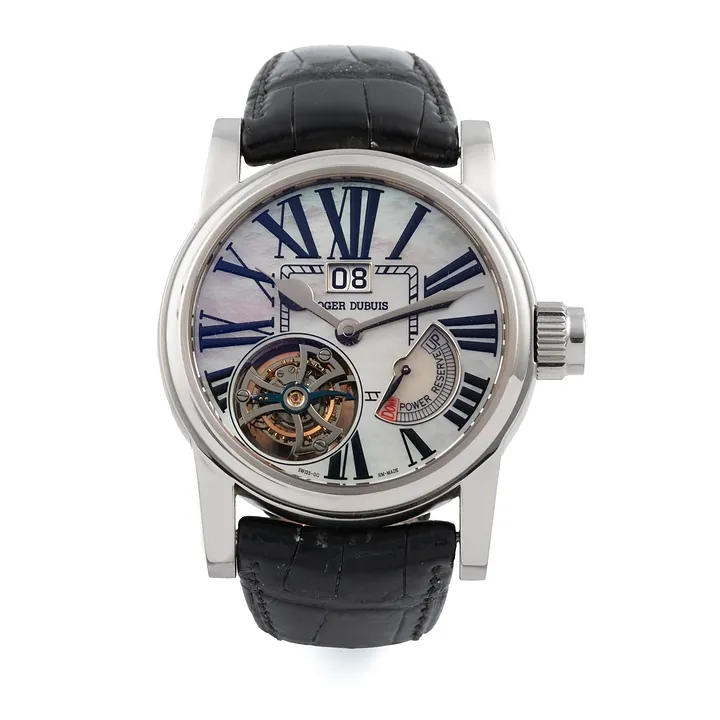
Roger Dubuis Hommage Tourbillon Marine, ref. H043 03 0 N1C.7A, c. 2010
Antiquorum auction archive, Geneva
Wristwatches · 2007
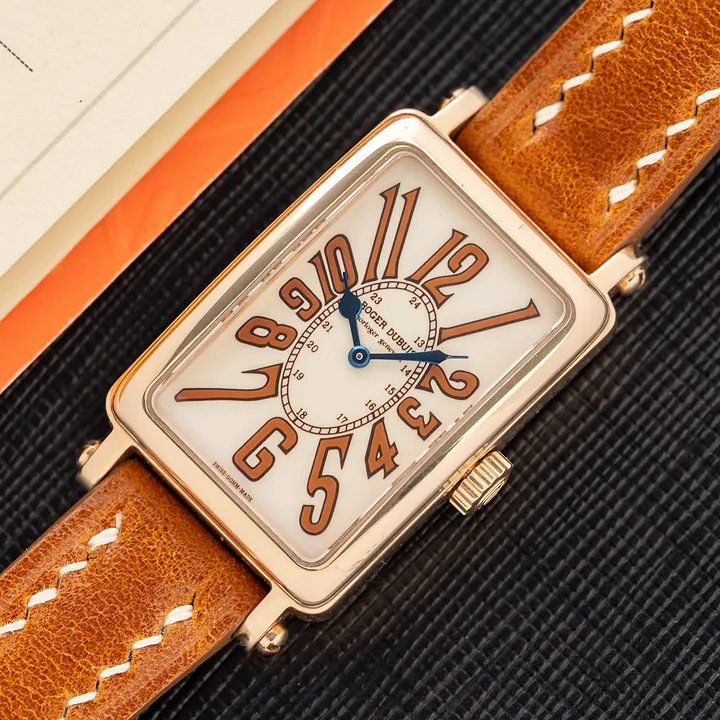
Roger Dubuis Much More M22 - 18K Rose Gold - Unpolished w/ Papers, 2007
Huntington Company (dealer)
Wristwatches · 2000s
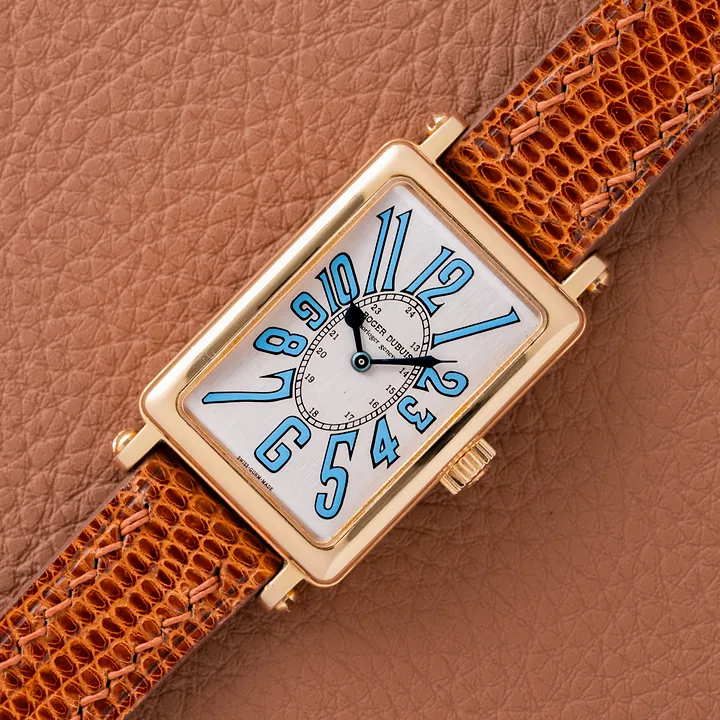
Roger Dubuis MuchMore Tiffany Dial (Ref. M22), 2000s
Huntington Company (dealer)
Wristwatches · 2001
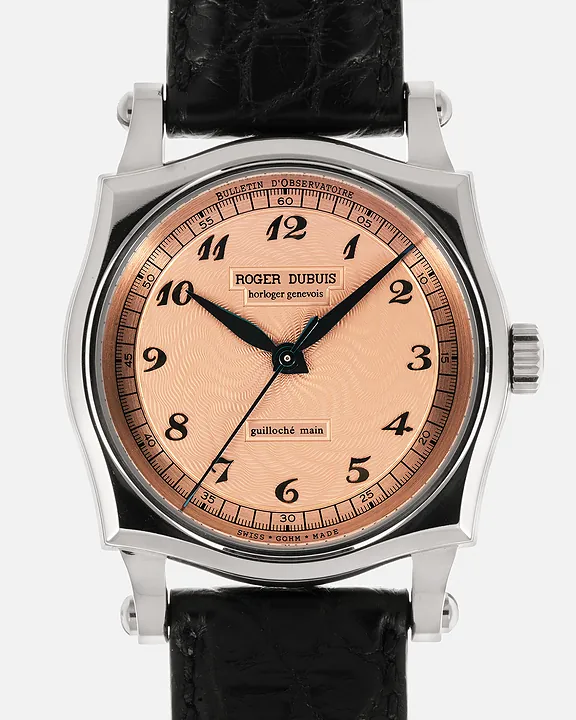
Roger Dubuis Sympathie 37 Salmon Guilloche No.01, 2001
S.Song Watches (dealer), Seattle

Wristwatches · 2008
Wristwatch by Breitling?, 2008
Museum Rotterdam

Wristwatches · c. 1990s
Audemars Piguet Bamboo, c. 1990s
Antiquorum auction archive, Geneva

Wristwatches · c. 1990
Audemars Piguet Huitieme Perpetual Calendar, ref. 25696PT, c. 1990
Antiquorum auction archive, Geneva

Wristwatches · c. 1990
Breitling Chronomat, ref. b13050.1, c. 1990
Antiquorum auction archive, Geneva