
Wristwatches · Wristwatch
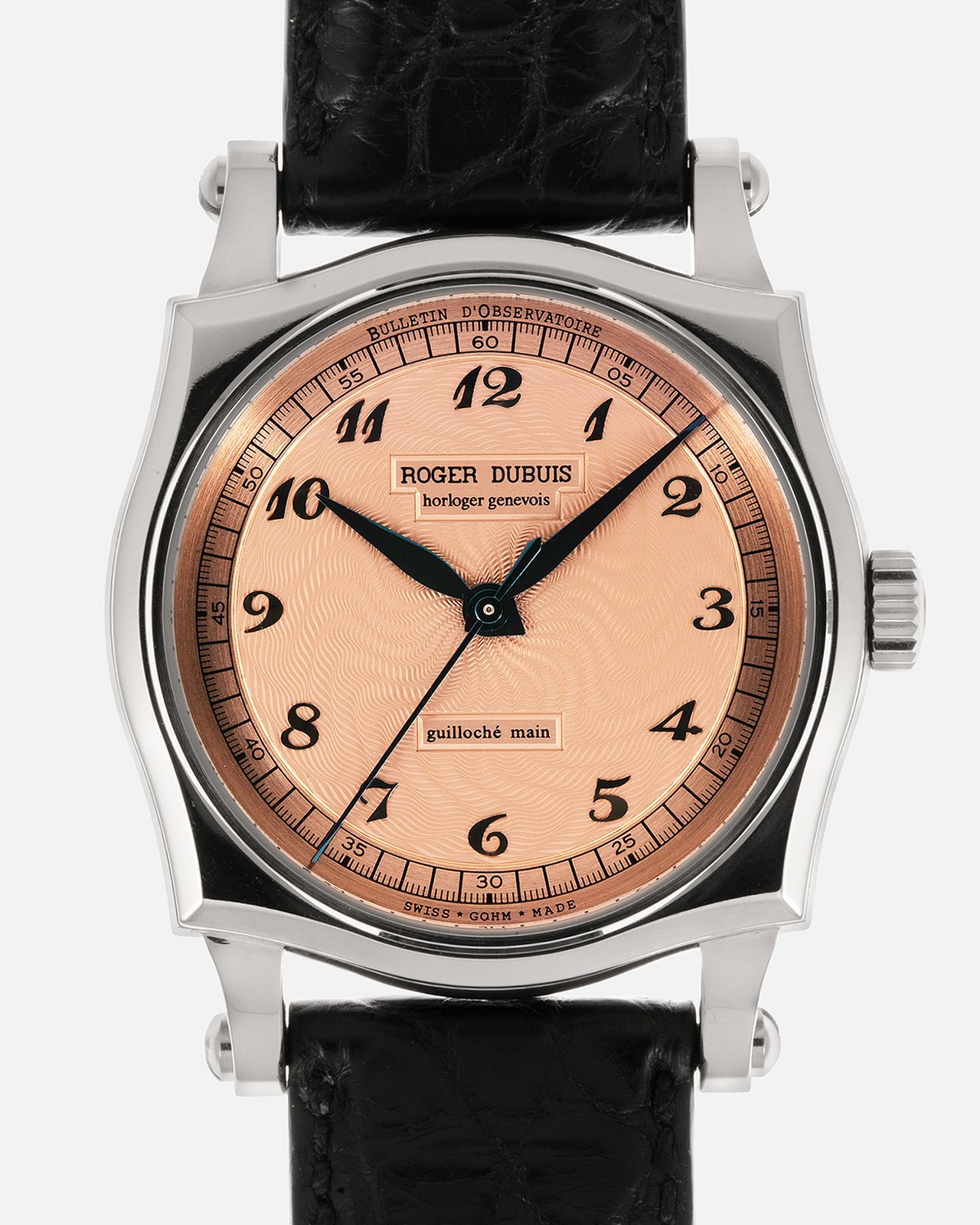
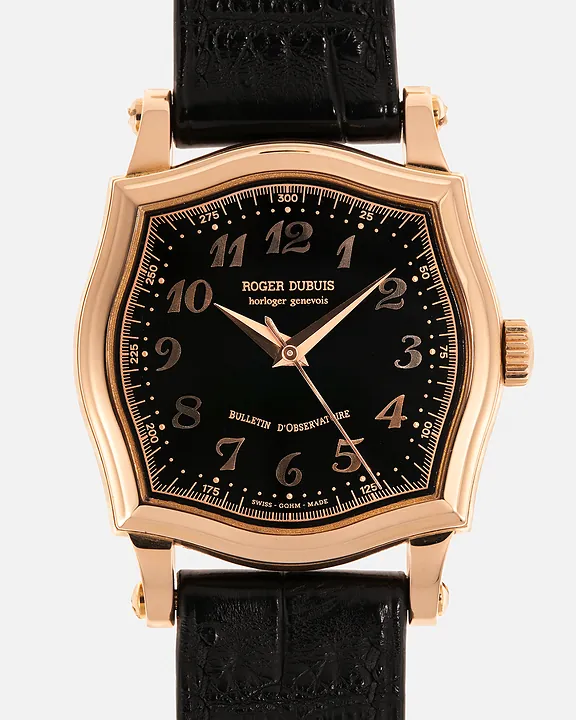
Roger Dubuis Sympathie 37 Salmon Guilloche No.01, 2001
- Maker / attribution
- Roger Dubuis (maker)
- Date
- 2001
- Historical period
- Mechanical Renaissance (1990 – 2010)
- Country of origin
- Switzerland
- Object type
- Wristwatch
- Dimensions
- Case 37 mm
- Stock no.
- Product 7508636598359
- Credit line
- Dealer listing, S.Song Watches (product 7508636598359)
- Catalogue title (original)
- Roger Dubuis Sympathie 37 Salmon Guilloche No.01 (English)
View the source record (dealer listing) ↗ (opens another website in a new tab)Suggest a correction
Record summary
Catalogued by S.Song Watches (dealer), Seattle (stock number Product 7508636598359), this is a wristwatch by Roger Dubuis, made in Switzerland, dated 2001. The Atlas places it in the Mechanical Renaissance period (1990 – 2010) of its Wristwatches collection. Recorded dimensions: Case 37 mm. The record is illustrated with 6 photographs.
Assembled from the source record's structured fields. Dates and attributions are given as the source states them; where a field is missing the Atlas leaves it blank rather than estimating.
Catalogue description
Dealer description — S.Song Watches
For a long time, the Roger Dubuis name was considered over and irrelevant to collectors. With today’s Dubuis watches defined by garish designs and awkward proportions, it’s easy to see why. The truth is, Roger Dubuis, the man himself, left the company in 2005. While he was undoubtedly a brilliant watchmaker, he lacked business acumen. It was this, not his craft, that led to the brand’s current state: emotionless and steered by executives with little to no passion for watchmaking. You see, beneath this surface of failure lies some of the most beautiful watches ever made. For those who follow independent watchmaking closely, there is something very distinct and intriguing about early Roger Dubuis pieces. Compared to what we see today, the brand’s earlier chapter told a completely different story. Elegant in design and finished to the highest standards, these watches rivaled, and in some cases, surpassed, horological contemporaries such as Patek Philippe and Audemars Piguet. Collectors are now beginning to recognize this, with more of these early examples appearing on the secondary market. As an independent brand with true aspiration, there’s no denying that Dubuis helped pave the way for many of today’s renowned independent watchmakers. After nine years at Longines and two decades at Patek Philippe, Roger Dubuis founded his eponymous brand in 1995—a bold move at a time when starting an independent watch company in haute horlogerie was far from mainstream. That said, Roger Dubuis produced two main lines: the Hommage series, which represented traditional round cases, and the Sympathie series, as seen here. The Sympathie was his most distinctive creation, defined by its unusual angular case and lug design that remains among the some of most recognizable case shapes of its era. Crafted from 18-carat white gold, the 37mm x 8.5mm Sympathie case is nothing short of mesmerizing. As I briefly touched on earlier, its flowing contours resist conventional classification—it is neither tonneau, cushion, nor rectangular, but something entirely its own. The result is a piece of design that feels both sculptural and deliberate, a testament to Dubuis’ savoir faire in case proportion, symmetry, and coherence. The vertical brushing along the caseband and lugs contrasts elegantly with the mirror-polished bezel, pronounced fixing screws, and sharply executed lug hoods. Every surface reveals an extraordinary level of care and finish that speaks to Dubuis’ unwavering pursuit of perfection. In the past, we’ve listed a handful of Sympathie’s, but none quite like the one we have here today. This particular example, the reference S37.57.0, features a stunning salmon guilloché dial unlike anything I’ve seen or handled from early Dubuis. Like most Sympathie designs, it rewards close inspection, revealing a wealth of intricate details. The guilloché motif radiates from the center toward the minute track along the outer edge, complemented by applied Breguet numerals and a pair of thermally blued feuille hands. It’s also worth highlighting that, unlike earlier versions, this example is fitted with a round sapphire crystal—an update introduced to soften the case’s angular geometry and improve overall serviceability. As a whole, I must say this is perhaps the most beautiful Sympathie we’ve come across so far. Every element on the dial feels impeccably balanced, coming together in perfect harmony to create a visually captivating presence. There’s a certain hypnotic quality to the way light dances across the guilloché surface and how it interacts with the Breguet numerals. It’s the kind of watch that holds your gaze and makes you lose track of time. Powering the S37.57.0 from within is the Cal. RD57, a self-winding movement with an architecture as refined as the watch’s exterior. Based on the ultra-thin Nouvelle Lémania 8811/8816 ébauche , it is visible through the sapphire caseback and showcases black-polished screws, a swan-neck regulator, Côtes de Genève decoration, mirror-polished bevels, and a gold skeletonized Roger Dubuis emblem tastefully integrated onto its oscillating rotor. On top of this, the movement was rigorously tested by the Beşancon Observatory and certified to be of superior quality. It comes with a certificate confirming its timekeeping and high precision. When it comes to independent watch collecting, there’s something to be said about Roger Dubuis’ place in this complex yet fascinating world. His early pieces are simply stunning, deeply individualistic and effortlessly distinctive. They don’t scream for attention, yet reveal a wealth of character and nuance when examined up close. That’s the allure of early Roger Dubuis: they reward curiosity and those who take the time to look closer. Few brands have managed to channel such genuine artistry, creativity, and emotion through design quite like Dubuis did in those formative years. Each watch from Dubuis’ original era was produced in limited editions of just 28 pieces, making this Sympathie S37.57.0 an exceptionally rare and meaningful example of what independent watchmaking once stood for: artistry, courage, and uncompromising execution.
Historical context
Mechanical Renaissance (1990 – 2010)
Mechanical watches return as cultural objects; independent watchmaking flourishes.
Mechanical watches returned as cultural and luxury objects. Complications, tourbillons and new materials proliferated; independent watchmakers such as George Daniels, F.P. Journe and Philippe Dufour revived artisanal watchmaking; collecting vintage watches became a major field.
Read the period in the timelineMore wristwatches from this periodEarlier: Quartz Revolution
Atlas type guide
Wristwatches
Bracelet watches were worn by women from the early nineteenth century — Breguet made one for Caroline Murat, Queen of Naples, in 1810–12 — but the wristwatch only became a man's instrument with military use and aviation in the early twentieth century. Between the World Wars it overtook the pocket watch; the 1920s and 1930s brought rectangular Art Deco cases, water-resistant cases and the first automatic winding systems.
After 1945 the wristwatch became a carrier of identity — dress watches, sports and dive watches, chronographs, calendars — produced by Swiss, American, Japanese, German, Soviet and Chinese industries. The quartz revolution after 1969 and the mechanical renaissance since the 1990s, including the rise of independent watchmakers, complete the story.
What to look for
- The reference number (between the lugs or inside the case back) and serial number, the starting point for dating.
- The calibre: its maker and number are often stamped under the dial or on the bridge.
- Originality of dial, hands and crown — refinished ('redial') dials are common.
- Case material marks: 18K/750, 14K/585, stainless steel, gold-filled, plated.
Dating clues
- Wire-lug cases: before c. 1925.
- Water-resistant screw-down cases: from 1926.
- Quartz movements: from 1969; sapphire crystals widespread after c. 1980.
General guidance written by the Atlas editors about this kind of object. It is not a statement about this particular piece; for that, rely on the source record above and on physical examination.
Related records
Wristwatches · c. 2010
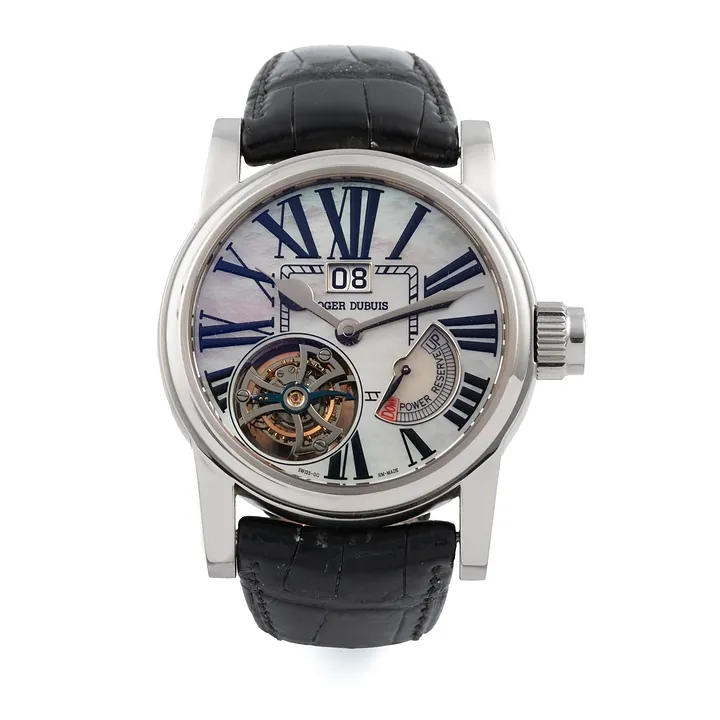
Roger Dubuis Hommage Tourbillon Marine, ref. H043 03 0 N1C.7A, c. 2010
Antiquorum auction archive, Geneva
Wristwatches · 2007
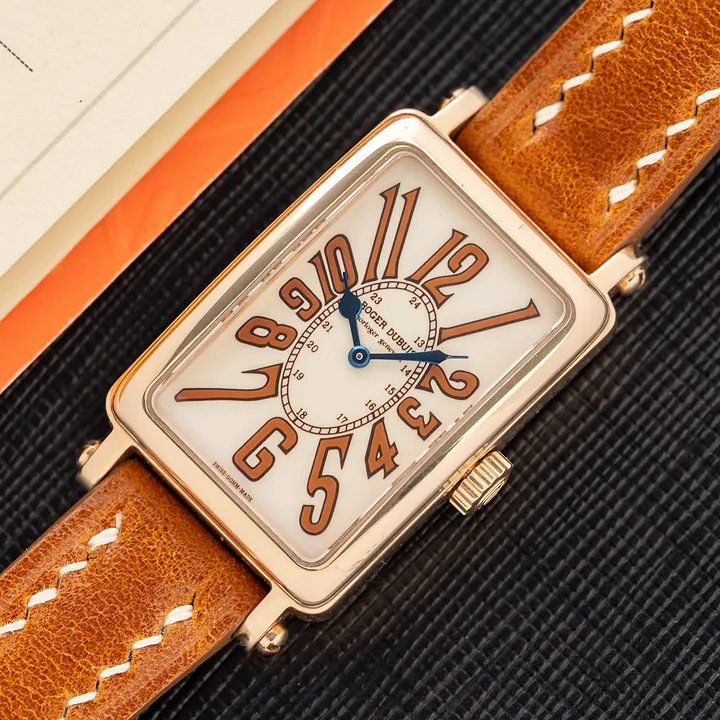
Roger Dubuis Much More M22 - 18K Rose Gold - Unpolished w/ Papers, 2007
Huntington Company (dealer)
Wristwatches · 2000s
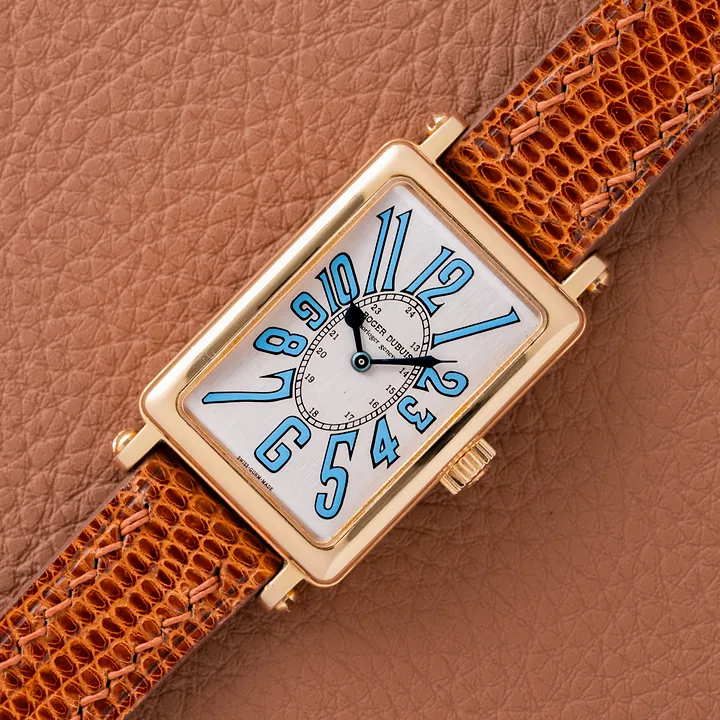
Roger Dubuis MuchMore Tiffany Dial (Ref. M22), 2000s
Huntington Company (dealer)
Wristwatches · 2000s
Roger Dubuis Sympathie 37 Breguet Numerals, 2000s
S.Song Watches (dealer), Seattle

Wristwatches · 2008
Wristwatch by Breitling?, 2008
Museum Rotterdam

Wristwatches · c. 1990s
Audemars Piguet Bamboo, c. 1990s
Antiquorum auction archive, Geneva

Wristwatches · c. 1990
Audemars Piguet Huitieme Perpetual Calendar, ref. 25696PT, c. 1990
Antiquorum auction archive, Geneva

Wristwatches · c. 1990
Breitling Chronomat, ref. b13050.1, c. 1990
Antiquorum auction archive, Geneva