
Wristwatches · Wristwatch
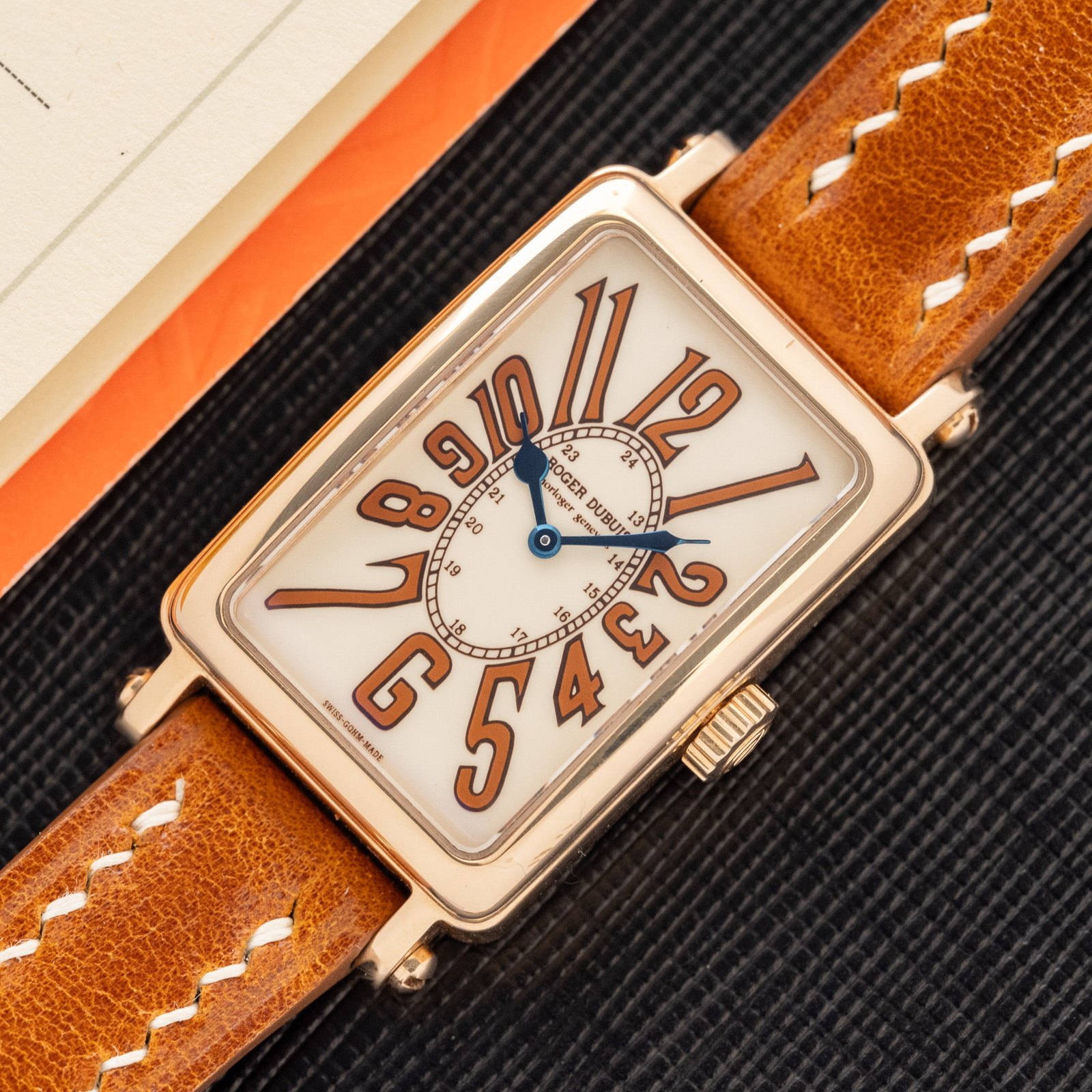
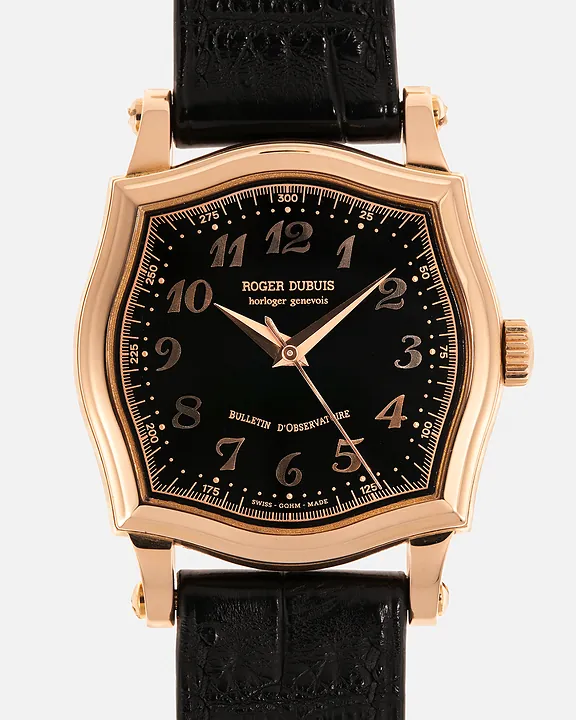
Roger Dubuis Much More M22 - 18K Rose Gold - Unpolished w/ Papers, 2007
- Maker / attribution
- Roger Dubuis (maker)
- Date
- 2007
- Historical period
- Mechanical Renaissance (1990 – 2010)
- Country of origin
- Switzerland
- Object type
- Wristwatch
- Materials / technique
- 18k rose gold
- Dimensions
- Case 33 mm
- Stock no.
- Product 7911365181623
- Credit line
- Dealer listing, Huntington Company (product 7911365181623)
- Catalogue title (original)
- 2007 Roger Dubuis Much More M22 - 18K Rose Gold - Unpolished w/ Papers (English)
View the source record (dealer listing) ↗ (opens another website in a new tab)Suggest a correction
Record summary
Catalogued by Huntington Company (dealer) (stock number Product 7911365181623), this is a wristwatch by Roger Dubuis, made in Switzerland, dated 2007. The Atlas places it in the Mechanical Renaissance period (1990 – 2010) of its Wristwatches collection. Materials and techniques recorded by the source: 18k rose gold. Recorded dimensions: Case 33 mm. The record is illustrated with 6 photographs.
Assembled from the source record's structured fields. Dates and attributions are given as the source states them; where a field is missing the Atlas leaves it blank rather than estimating.
Catalogue description
Dealer description — Huntington Company
Worth The Read Roger Dubuis started his eponymous watch brand in 1995, after working for esteemed watchmaker Patek Philippe for more than 20 years along with several other major brands. He quickly rose through the ranks of Swiss watchmaking, becoming one of the most celebrated watchmakers of the ‘neo-vintage’ era. Combining his adept technical creativity in producing masterful movements with his knowledge of historical watch design, Dubuis produced some of the most important watches of the era all with in-house calibers. Each in-house produced caliber by Dubuis in this era received the Geneva Seal, which is a certification of quality controlled by the Swiss government. This award is considered to be the highest hallmark of production quality that a movement can receive. As a result of this, Dubuis was established as one of the top quality movement producers in the Swiss watchmaking industry. A unique aspect of the Roger Dubuis brand is that every watch produced was done in a limited edition of no more than 28 pieces. However, many collectors believe that these limited editions were often not completely subscribed, and so fewer than 28 pieces may have been produced in an edition. This uncommon rarity coupled with supreme in-house movement quality, design, and finishing has made Roger Dubuis one of the most sought after brands amongst collectors. The Much More draws from Roger Dubuis’ knowledge of historical Patek Philippe design. Specifically, the Patek Ref. 10, a similar curved rectangular case shape often displayed with exploded numerals, which was one of the first wristwatches ever produced by Patek Philippe in the early 1900’s. We find that the curvature of the Much More case shape makes it one of the most appealing and comfortable designs of any watch we have handled. This particular example boasts a near perfect case size for those interested in elegant, dressy design watches. The case dimensions are similar to the classic Cartier Tank Louis Cartier, however, with the addition of lugs it wears slightly larger. But, where the Much More sets itself apart from the Cartier Tank is in the finishing. Without a doubt each and every component of this watch greatly surpasses the Cartier Tank. The 18K rose gold case, in unpolished condition, has significant heft to it despite its relatively small size. The dial treatment is much more sophisticated in design and we find the contrast of the brown numerals, blued hands, and rose gold case to be amongst the most appealing combinations we have ever come across. Within the watch is the in-house produced Geneva Sealed manual movement which is artfully displayed in the open display caseback. This particular example is in nearly flawless overall condition and comes complete with papers and its original Roger Dubuis signed 18K rose gold buckle. We love the Cartier Tank Louis Cartier and its important place in history, but from a quality perspective, it cannot compete with the Much More. It is for these reasons that we believe the Roger Dubuis Much More offers collectors one of the best values in the genre of dress and design watches. It boasts all of the heritage and tradition of an important watch combined with the masterful technical finishing and Geneva Seal quality that made Roger Dubuis one of the most significant watchmakers of the 20th Century. Specifications Reference: M22.54.5.5.6 Model: Much More Movement: In-House Roger Dubuis Geneva Sealed Manual Wind Year: 2007 Contents: Papers Dimensions: 33mm x 22mm Case: Unpolished 18K rose gold featuring open display caseback and engraved limited edition serial number out of 28 pieces. Dial: The dial is in perfect condition. A stunning cream gloss finish with tobacco brown hour markers. Strap & Buckle: It comes on a handmade strap with the original Roger Dubuis signed rose gold buckle.
Historical context
Mechanical Renaissance (1990 – 2010)
Mechanical watches return as cultural objects; independent watchmaking flourishes.
Mechanical watches returned as cultural and luxury objects. Complications, tourbillons and new materials proliferated; independent watchmakers such as George Daniels, F.P. Journe and Philippe Dufour revived artisanal watchmaking; collecting vintage watches became a major field.
Read the period in the timelineMore wristwatches from this periodEarlier: Quartz Revolution
Atlas type guide
Wristwatches
Bracelet watches were worn by women from the early nineteenth century — Breguet made one for Caroline Murat, Queen of Naples, in 1810–12 — but the wristwatch only became a man's instrument with military use and aviation in the early twentieth century. Between the World Wars it overtook the pocket watch; the 1920s and 1930s brought rectangular Art Deco cases, water-resistant cases and the first automatic winding systems.
After 1945 the wristwatch became a carrier of identity — dress watches, sports and dive watches, chronographs, calendars — produced by Swiss, American, Japanese, German, Soviet and Chinese industries. The quartz revolution after 1969 and the mechanical renaissance since the 1990s, including the rise of independent watchmakers, complete the story.
What to look for
- The reference number (between the lugs or inside the case back) and serial number, the starting point for dating.
- The calibre: its maker and number are often stamped under the dial or on the bridge.
- Originality of dial, hands and crown — refinished ('redial') dials are common.
- Case material marks: 18K/750, 14K/585, stainless steel, gold-filled, plated.
Dating clues
- Wire-lug cases: before c. 1925.
- Water-resistant screw-down cases: from 1926.
- Quartz movements: from 1969; sapphire crystals widespread after c. 1980.
General guidance written by the Atlas editors about this kind of object. It is not a statement about this particular piece; for that, rely on the source record above and on physical examination.
Related records
Wristwatches · c. 2010
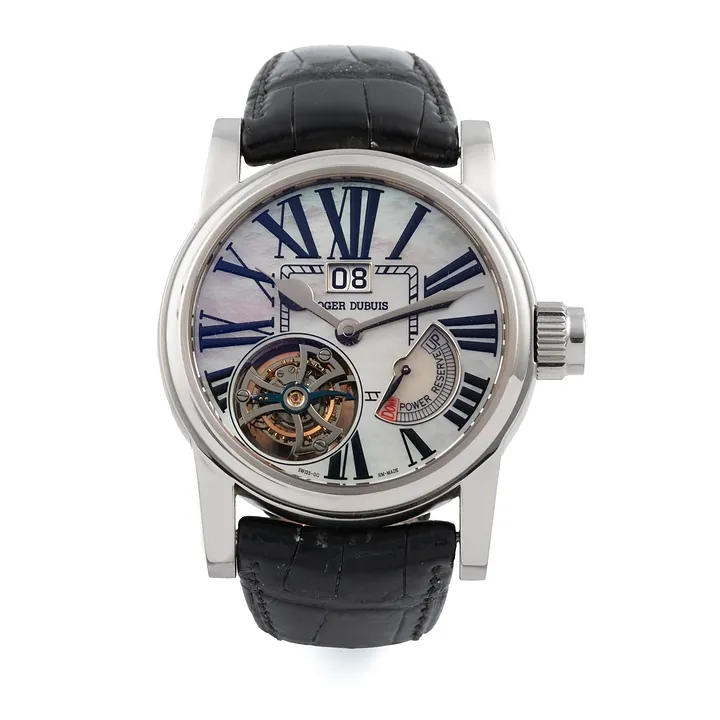
Roger Dubuis Hommage Tourbillon Marine, ref. H043 03 0 N1C.7A, c. 2010
Antiquorum auction archive, Geneva
Wristwatches · 2000s
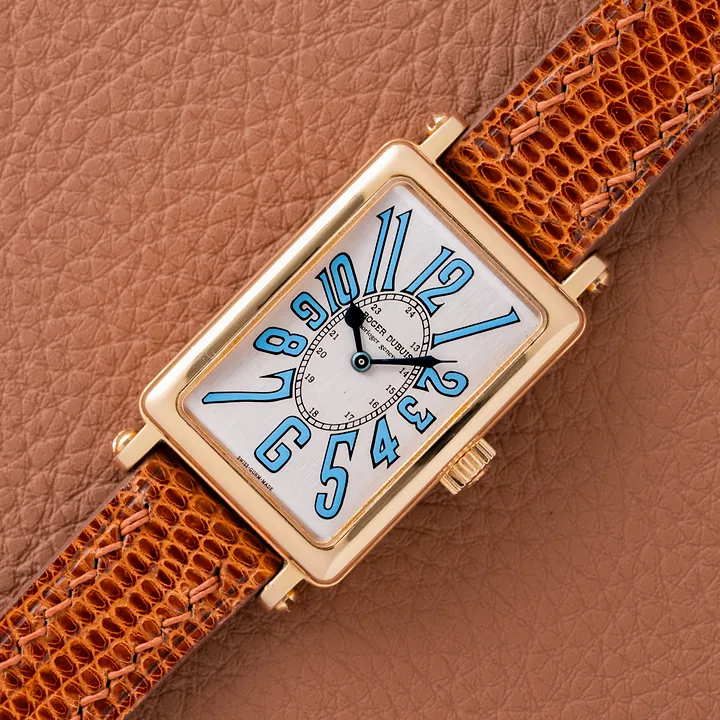
Roger Dubuis MuchMore Tiffany Dial (Ref. M22), 2000s
Huntington Company (dealer)
Wristwatches · 2001
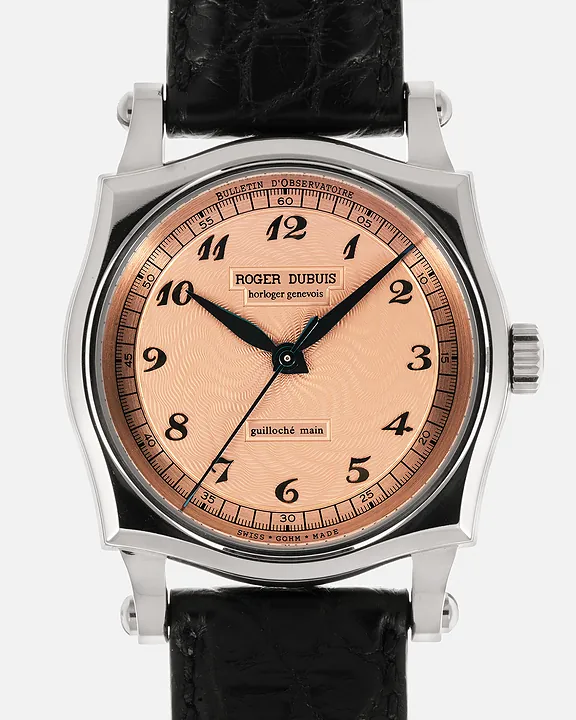
Roger Dubuis Sympathie 37 Salmon Guilloche No.01, 2001
S.Song Watches (dealer), Seattle
Wristwatches · 2000s
Roger Dubuis Sympathie 37 Breguet Numerals, 2000s
S.Song Watches (dealer), Seattle

Wristwatches · 2008
Wristwatch by Breitling?, 2008
Museum Rotterdam

Wristwatches · c. 1990s
Audemars Piguet Bamboo, c. 1990s
Antiquorum auction archive, Geneva

Wristwatches · c. 1990
Audemars Piguet Huitieme Perpetual Calendar, ref. 25696PT, c. 1990
Antiquorum auction archive, Geneva

Wristwatches · c. 1990
Breitling Chronomat, ref. b13050.1, c. 1990
Antiquorum auction archive, Geneva