
Wristwatches · Wristwatch
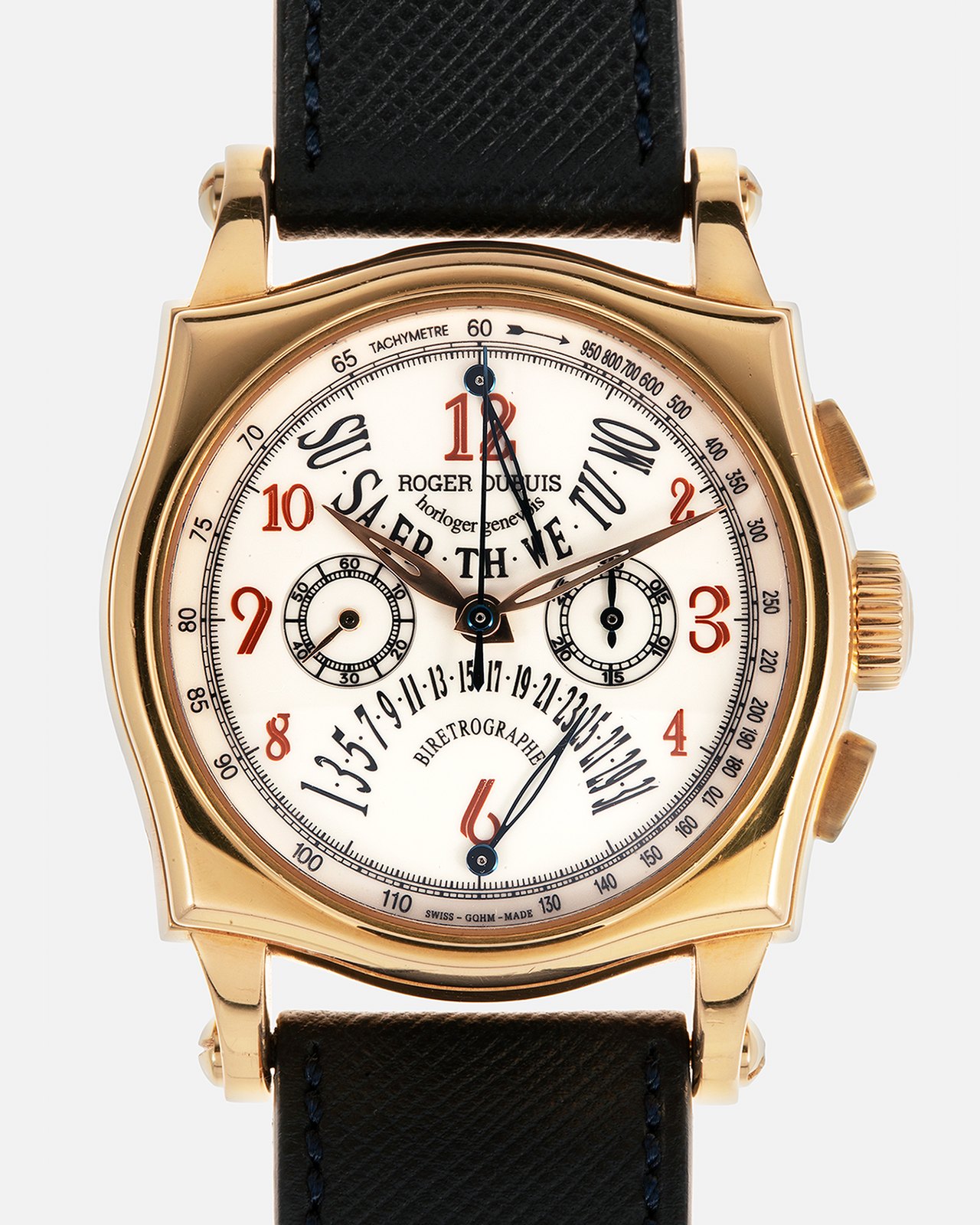
Roger Dubuis Sympathie 40 Biretrograde Chronograph, 2000s
- Maker / attribution
- Roger Dubuis (maker)
- Date
- 2000s
- Historical period
- Mechanical Renaissance (1990 – 2010)
- Country of origin
- Switzerland
- Object type
- Wristwatch
- Dimensions
- Case 40 mm
- Stock no.
- Product 7020207243351
- Credit line
- Dealer listing, S.Song Watches (product 7020207243351)
- Catalogue title (original)
- Roger Dubuis Sympathie 40 Biretrograde Chronograph (English)
View the source record (dealer listing) ↗ (opens another website in a new tab)Suggest a correction
Record summary
Catalogued by S.Song Watches (dealer), Seattle (stock number Product 7020207243351), this is a wristwatch by Roger Dubuis, made in Switzerland, dated 2000s. The Atlas places it in the Mechanical Renaissance period (1990 – 2010) of its Wristwatches collection. Recorded dimensions: Case 40 mm. The record is illustrated with 6 photographs.
Assembled from the source record's structured fields. Dates and attributions are given as the source states them; where a field is missing the Atlas leaves it blank rather than estimating.
Catalogue description
Dealer description — S.Song Watches
For a long time, the Roger Dubuis name was considered over and irrelevant to collectors. With Dubuis watches of today having garish designs and proportions that are just, all wrong, it is no wonder why. The truth is, Roger Dubuis, the man, left the company in 2005 and while he was undoubtedly a brilliant watchmaker, he lacked business expertise. An independent brand with aspiration, I do not doubt that today’s independent watch brands have Roger Dubuis and other pioneers of his time to thank for laying down the groundwork. Roger Dubuis formed his eponymous brand in 1995 after two decades at Patek Philippe and at the time, it not only took huge courage to start an independent brand but Dubuis had to also operate in an area that wasn’t as mainstream as it is today. There were two main lines that Dubuis produced- the Homage series, which were more traditional round-cased watches, and what you see here today the Sympathie series. Featuring a more experimental and unconventional case design, this is the most iconic Dubuis shape with an amorphous and angular shape. This particular example is a Sympathie 40, denoting a 40mm case size and houses a biretrograde calendar chronograph mechanism. With the legendary manually-wound Lemania Cal. 2310 movement as its base, the Cal. RD 5630 is fitted with a retrograde calendar module and finished to an incredibly high standard. Notice the capped column wheel — a trait seen on Patek Philippe chronographs to this day. Furthermore, every early Roger Dubuis bears the Poincon de Genève (Geneva Seal) and is chronometer-graded by the Besançon Observatory. Not only is the Sympathie case distinctively Roger Dubuis, but his dial design also has a strong identity. This Sympathie 40 has a beautiful eggshell lacquer dial that has a milky undertone and features stylized lettering on both the Arabic numerals and the calendar display. The thing that strikes me the most about early Roger Dubuis watches is that not only are they of the highest standard, but they somehow manage to have a truly original design language — something that is truly lacking in most of today’s industry. Each Roger Dubuis model from his time was made in limited editions of 28, making this example extremely special and rare.
Historical context
Mechanical Renaissance (1990 – 2010)
Mechanical watches return as cultural objects; independent watchmaking flourishes.
Mechanical watches returned as cultural and luxury objects. Complications, tourbillons and new materials proliferated; independent watchmakers such as George Daniels, F.P. Journe and Philippe Dufour revived artisanal watchmaking; collecting vintage watches became a major field.
Read the period in the timelineMore wristwatches from this periodEarlier: Quartz Revolution
Atlas type guide
Chronographs and split-seconds watches
A chronograph is a watch with an additional seconds hand that can be started, stopped and returned to zero independently of the timekeeping. Louis Moinet built an early example in 1816 and Nicolas Rieussec a recording 'chronographe' in 1821; Adolphe Nicole's heart-shaped reset cam (patented 1862) made the modern return-to-zero possible. Split-seconds (rattrapante) chronographs add a second hand that can be stopped for intermediate times; flyback chronographs restart instantly.
Chronographs were essential tools for doctors (pulsometer scales), artillery (telemeter), engineers and sport. In wristwatches, Valjoux, Venus, Lemania and later the automatic chronographs of 1969 (Zenith El Primero, the Chronomatic Calibre 11 group and Seiko 6139) are milestones.
What to look for
- Push-pieces on the case band or a single button in the crown (monopusher).
- Subsidiary registers for minutes and hours; tachymeter, telemeter or pulsometer scales.
- Column wheel versus cam control visible in the movement.
- Calibre markings of specialist makers (Valjoux, Lemania, Venus, Landeron).
Dating clues
- Pocket chronographs with heart cam reset: after 1862.
- Wrist chronographs: from c. 1910; two-button designs from the 1930s.
- Automatic chronographs: from 1969.
General guidance written by the Atlas editors about this kind of object. It is not a statement about this particular piece; for that, rely on the source record above and on physical examination.
Read next:Flyback chronographChronograph
Related records
Wristwatches · c. 2010
Roger Dubuis Hommage Tourbillon Marine, ref. H043 03 0 N1C.7A, c. 2010
Antiquorum auction archive, Geneva
Wristwatches · 2007
Roger Dubuis Much More M22 - 18K Rose Gold - Unpolished w/ Papers, 2007
Huntington Company (dealer)
Wristwatches · 2000s
Roger Dubuis MuchMore Tiffany Dial (Ref. M22), 2000s
Huntington Company (dealer)
Wristwatches · 2001
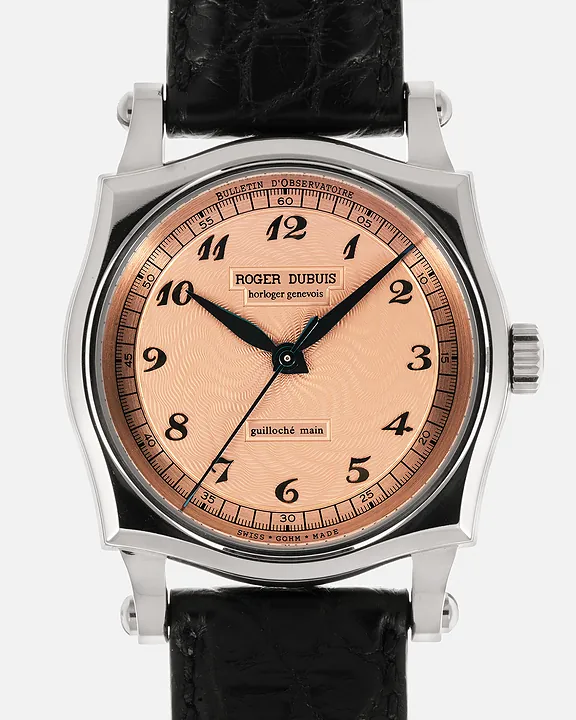
Roger Dubuis Sympathie 37 Salmon Guilloche No.01, 2001
S.Song Watches (dealer), Seattle

Wristwatches · 2008
Wristwatch by Breitling?, 2008
Museum Rotterdam

Wristwatches · c. 1990s
Audemars Piguet Bamboo, c. 1990s
Antiquorum auction archive, Geneva

Wristwatches · c. 1990
Audemars Piguet Huitieme Perpetual Calendar, ref. 25696PT, c. 1990
Antiquorum auction archive, Geneva

Wristwatches · c. 1990
Breitling Chronomat, ref. b13050.1, c. 1990
Antiquorum auction archive, Geneva