
Wristwatches · Wristwatch
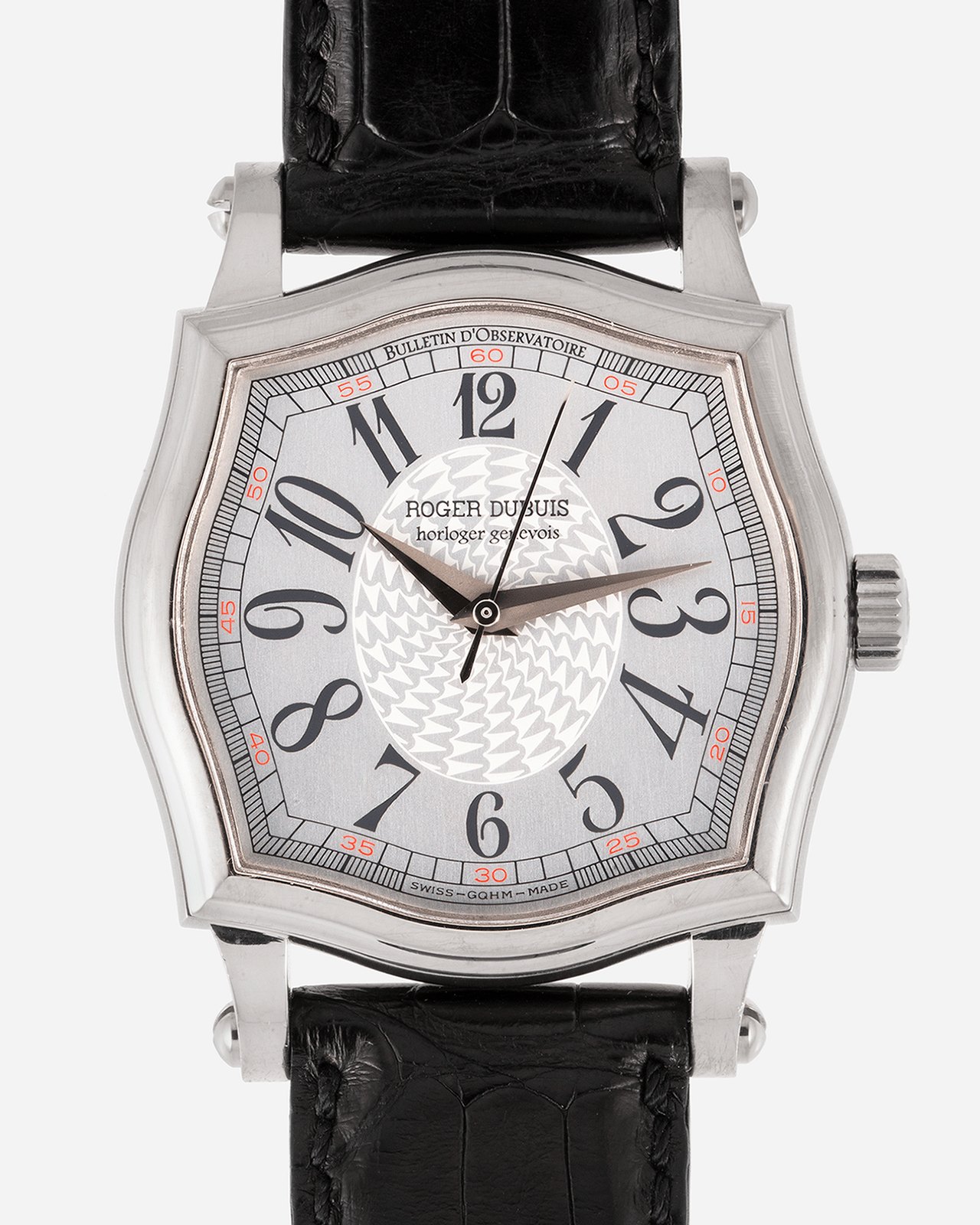
Roger Dubuis Sympathie 37, 1990s
- Maker / attribution
- Roger Dubuis (maker)
- Date
- 1990s
- Historical period
- Mechanical Renaissance (1990 – 2010)
- Country of origin
- Switzerland
- Object type
- Wristwatch
- Dimensions
- Case 37 mm
- Stock no.
- Product 6565108678743
- Credit line
- Dealer listing, S.Song Watches (product 6565108678743)
- Catalogue title (original)
- Roger Dubuis Sympathie 37 (English)
View the source record (dealer listing) ↗ (opens another website in a new tab)Suggest a correction
Record summary
Catalogued by S.Song Watches (dealer), Seattle (stock number Product 6565108678743), this is a wristwatch by Roger Dubuis, made in Switzerland, dated 1990s. The Atlas places it in the Mechanical Renaissance period (1990 – 2010) of its Wristwatches collection. Recorded dimensions: Case 37 mm. The record is illustrated with 6 photographs.
Assembled from the source record's structured fields. Dates and attributions are given as the source states them; where a field is missing the Atlas leaves it blank rather than estimating.
Catalogue description
Dealer description — S.Song Watches
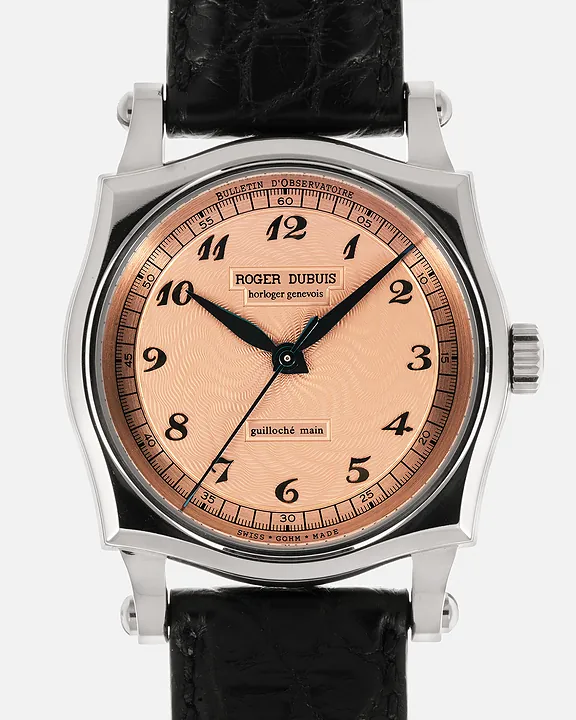
For a long time, the Roger Dubuis name was thought to be over and irrelevant to collectors. With Dubuis watches of today having garish designs and proportions that are all wrong, it is no wonder why. The truth is, Roger Dubuis, the man, left the company in 2005 and while he was undoubtedly a brilliant watchmaker, he lacked business expertise. An independent brand with aspiration, I have no doubt that today’s indies have Dubuis and other pioneers of his time to thank for laying out the groundwork. Roger Dubuis formed his eponymous brand in 1995 after two decades at Patek Philippe and at the time, it not only took huge courage to start an independent brand but Dubuis had to also operate in an area that wasn’t as mainstream as it is today. There were two main lines that Dubuis produced- the Homage series, which were more traditional round cased watches, and what you see here today- the Sympathie series. Featuring a more experimental case design, this is the most iconic Dubuis shape with an amorphous and angular shape. Constructed of 18kt white gold, the Sympathie’s 37mm case is a feast for the eyes. Featuring a vertical satin grain on the caseband and lug profiles with a contrasting high polish on the bezel, thick fixing screws, and lug hoods, the Sympathie is a finely executed timepiece with appreciable attention to detail. Aside from its case, the Sympathie’s dial also stands out as a unique piece of design. This variant is one of the rarest examples of Sympathie dials and it features exploding Arabic numerals atop a silver grainy dial. Powered by the automatic Roger Dubuis Cal. RD57, the Sympathie is as elegantly equipped within its case, as it is visually appealing from the outside. On display behind its sapphire crystal caseback, the RD57 is a finely finished piece of horology including black polished screws and swan's neck regulator, gorgeous côtes de Geneve motif, and mirrored chamfering throughout. As referenced by the dial signature "Bulletin D'Observatoire", a Besançon Observatory chronometer certificate from the French capital of watchmaking certifies the accuracy of this movement and goes to substantiate the level of quality on display by these early Roger Dubuis timepieces.
Historical context
Mechanical Renaissance (1990 – 2010)
Mechanical watches return as cultural objects; independent watchmaking flourishes.
Mechanical watches returned as cultural and luxury objects. Complications, tourbillons and new materials proliferated; independent watchmakers such as George Daniels, F.P. Journe and Philippe Dufour revived artisanal watchmaking; collecting vintage watches became a major field.
Read the period in the timelineMore wristwatches from this periodEarlier: Quartz Revolution
Atlas type guide
Wristwatches
Bracelet watches were worn by women from the early nineteenth century — Breguet made one for Caroline Murat, Queen of Naples, in 1810–12 — but the wristwatch only became a man's instrument with military use and aviation in the early twentieth century. Between the World Wars it overtook the pocket watch; the 1920s and 1930s brought rectangular Art Deco cases, water-resistant cases and the first automatic winding systems.
After 1945 the wristwatch became a carrier of identity — dress watches, sports and dive watches, chronographs, calendars — produced by Swiss, American, Japanese, German, Soviet and Chinese industries. The quartz revolution after 1969 and the mechanical renaissance since the 1990s, including the rise of independent watchmakers, complete the story.
What to look for
- The reference number (between the lugs or inside the case back) and serial number, the starting point for dating.
- The calibre: its maker and number are often stamped under the dial or on the bridge.
- Originality of dial, hands and crown — refinished ('redial') dials are common.
- Case material marks: 18K/750, 14K/585, stainless steel, gold-filled, plated.
Dating clues
- Wire-lug cases: before c. 1925.
- Water-resistant screw-down cases: from 1926.
- Quartz movements: from 1969; sapphire crystals widespread after c. 1980.
General guidance written by the Atlas editors about this kind of object. It is not a statement about this particular piece; for that, rely on the source record above and on physical examination.
Related records
Wristwatches · c. 2010
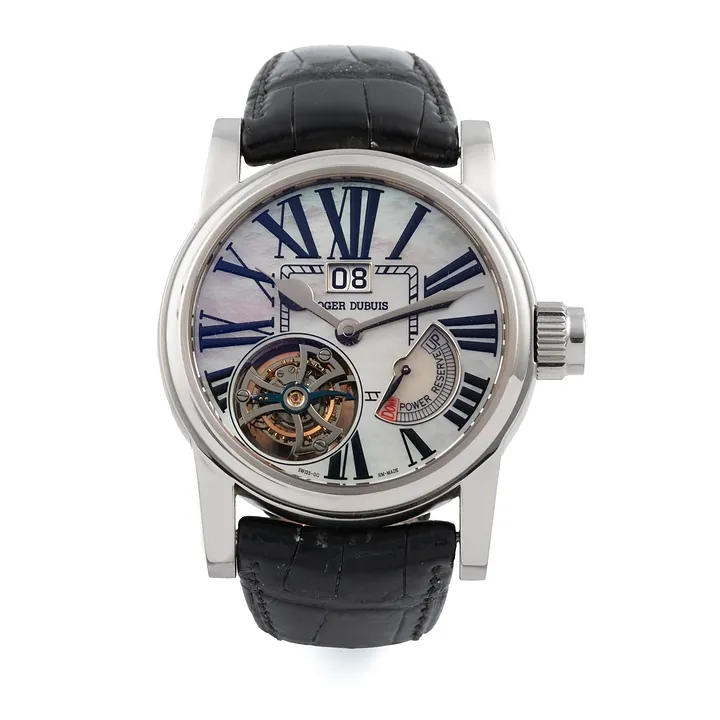
Roger Dubuis Hommage Tourbillon Marine, ref. H043 03 0 N1C.7A, c. 2010
Antiquorum auction archive, Geneva
Wristwatches · 2007
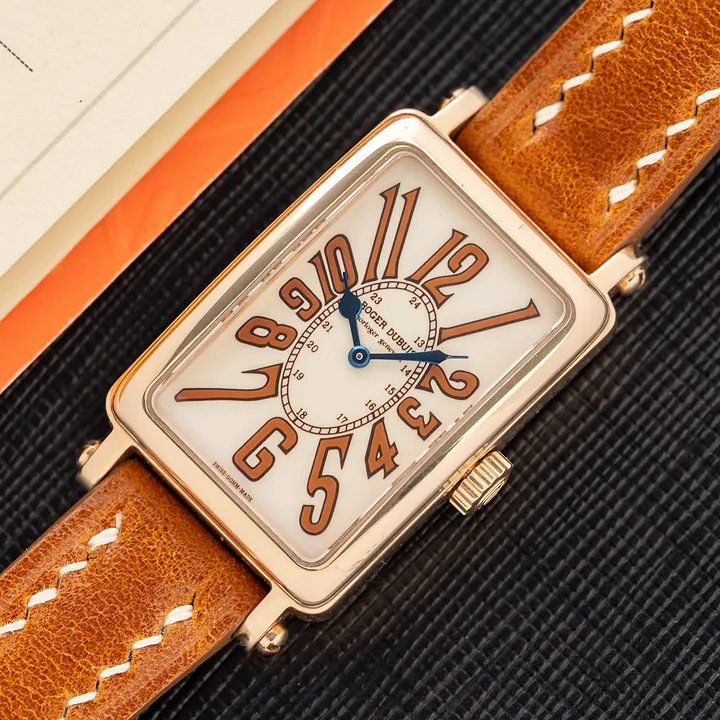
Roger Dubuis Much More M22 - 18K Rose Gold - Unpolished w/ Papers, 2007
Huntington Company (dealer)
Wristwatches · 2000s
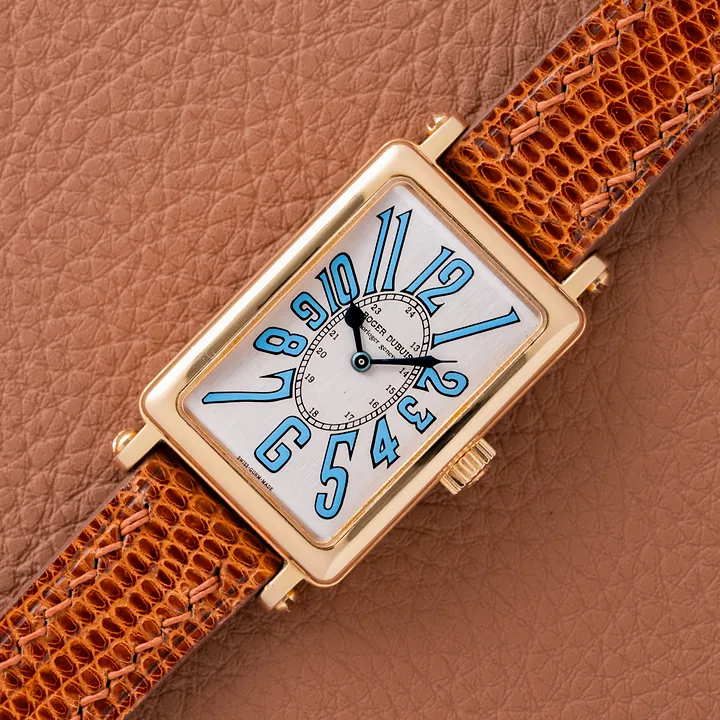
Roger Dubuis MuchMore Tiffany Dial (Ref. M22), 2000s
Huntington Company (dealer)
Wristwatches · 2001
Roger Dubuis Sympathie 37 Salmon Guilloche No.01, 2001
S.Song Watches (dealer), Seattle

Wristwatches · 2008
Wristwatch by Breitling?, 2008
Museum Rotterdam

Wristwatches · c. 1990s
Audemars Piguet Bamboo, c. 1990s
Antiquorum auction archive, Geneva

Wristwatches · c. 1990
Audemars Piguet Huitieme Perpetual Calendar, ref. 25696PT, c. 1990
Antiquorum auction archive, Geneva

Wristwatches · c. 1990
Breitling Chronomat, ref. b13050.1, c. 1990
Antiquorum auction archive, Geneva