
Wristwatches · Wristwatch
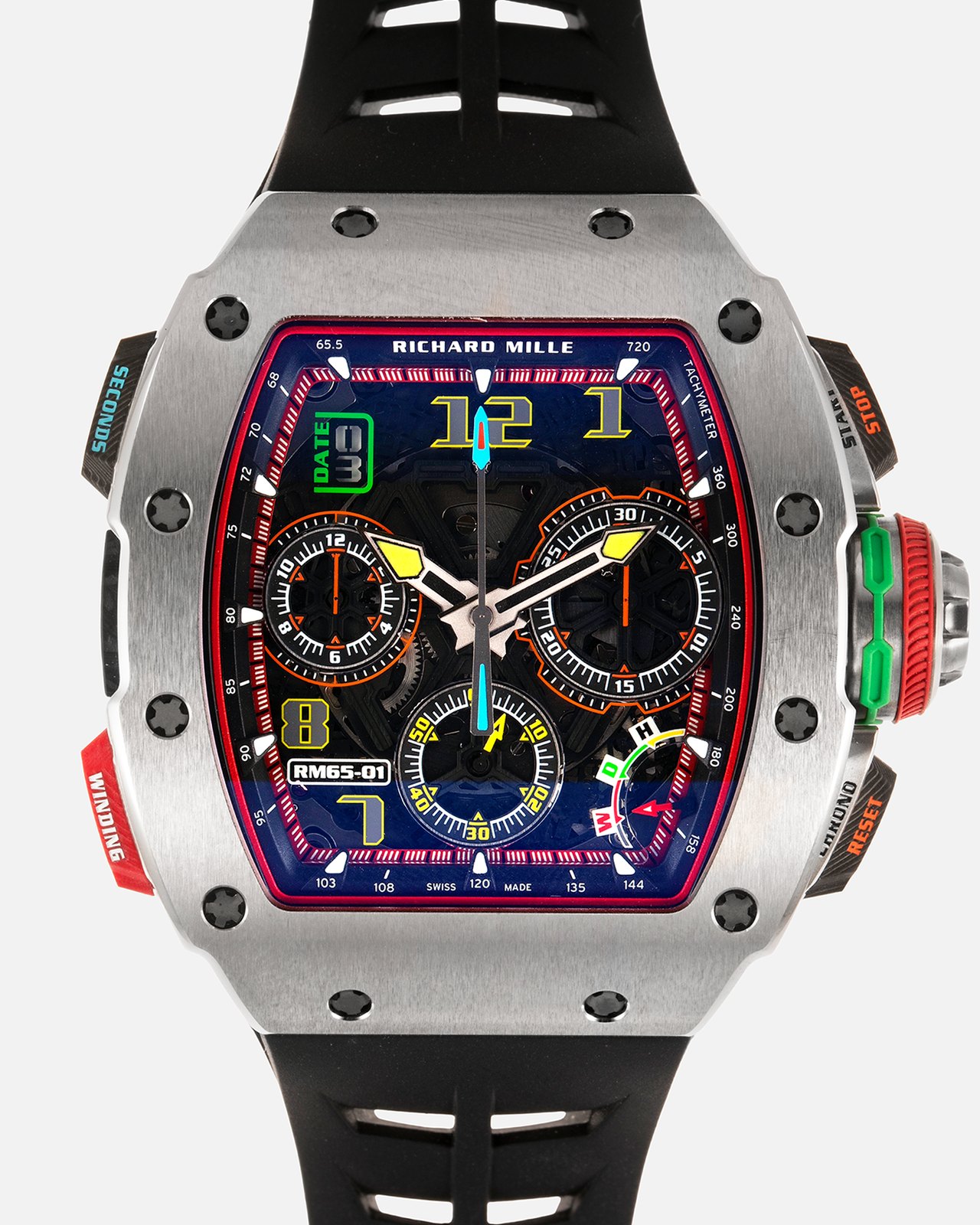
Richard Mille RM65-01 Split Seconds Titanium, 2022
- Maker / attribution
- Richard Mille (maker)
- Date
- 2022
- Historical period
- Contemporary Horology (2010 – Present)
- Country of origin
- Switzerland
- Object type
- Wristwatch
- Materials / technique
- titanium
- Stock no.
- Product 6819368435799
- Credit line
- Dealer listing, S.Song Watches (product 6819368435799)
- Catalogue title (original)
- Richard Mille RM65-01 Split Seconds Titanium (English)
View the source record (dealer listing) ↗ (opens another website in a new tab)Suggest a correction
Record summary
Catalogued by S.Song Watches (dealer), Seattle (stock number Product 6819368435799), this is a wristwatch by Richard Mille, made in Switzerland, dated 2022. The Atlas places it in the Contemporary Horology period (2010 – Present) of its Wristwatches collection. Materials and techniques recorded by the source: titanium. The record is illustrated with 6 photographs.
Assembled from the source record's structured fields. Dates and attributions are given as the source states them; where a field is missing the Atlas leaves it blank rather than estimating.
Catalogue description
Dealer description — S.Song Watches
Prized for its ability to create some of the most jaw-dropping pieces of horological excellence around, Richard Mille has surged from being a relatively under-the-radar indie watchmaker into a blue-chip powerhouse that has joined the big boys with over a billion CHF a year in sales. Paramount to their success has been their distinctive designs, incredible watchmaking, and next-level engineering; all attributes that many of its horological offerings like the RM65-01 Titanium Split-Seconds we have on offer here today, wields in abundance. The RM65-01 was considered the brand’s most complex motorsport-inspired wristwatch to have ever been released when it was first introduced in 2020. Despite it being an extremely technical and complicated-looking watch, the RM65-01 was, surprisingly, conceived for daily wear, which explains why it possesses some essential functions which I think would see some benefits for the daily wearer. The first RM65-01 was initially introduced in a Carbon TPT case configuration. However, the titanium version we have on offer here lends a different feel and variation to the original’s aesthetic. In today’s world of watchmaking, titanium is a trendy material for many watch cases due to its lightness and increased resistance. As far as physical appearances go, it tones down the RM65-01’s initial aggressive form by a significant notch, and in a good way - especially for those who intend to wear it daily. In my mind, the RM65-01 encapsulates everything that has come to signify Richard Mille and their avant-garde design language. Now, let’s talk a little bit about the movement. The RM65-01 features a skeletonized, high-beat (36,000 vph), 60-hour power reserve, and automatic winding Cal. RMAC4 which is machined with grade 5 titanium, a bio-compatible, corrosion-resistant alloy consisting of 90% grade 5 titanium, 6% aluminum, and 4% vanadium. This specific composition further enhances the material’s mechanical properties, which is also why you tend to see it frequently being used in fields of aerospace, aeronautical, and automobile industries. Another notable trait of this movement is the latest generation split-seconds mechanism developed and optimized for simultaneous movement and durability. An impressive feat for a watch of this caliber. While mechanical chronograph calibers are already complicated to make, a split-seconds chronograph as you can imagine is exponentially more difficult. With the top right pusher activating the initial chronograph, pressing the top left pusher simultaneously stops the first timer and begins the second chronograph, thus allowing the user to track the difference in two different timings. This is no easy feat and is considered one of the highest grand complications in mechanical watchmaking. On its vibrant-looking dial, you will find a seconds indication at 6 o ‘clock, a 12-hour counter at 9 o ‘clock, a date window at 11 o ‘clock, a 30-minute counter at 3 o ‘clock, a function selector at 5 o 'clock, and an in-house rapid winding mechanism which allows the barrel to be quickly rearmed in the event the watch stops - an ideal function for those who do not plan to wear the RM65-01 every day. The RM65-01 also features a variable geometry rotor, which means its winding rotor can be set to wind the movement at different speeds according to the level of activity that its wearer is undertaking, and so the RM65-01 can be personalized to the lifestyle of its owner. Another aspect that I really enjoyed about the RM65-01 is the time-setting mechanism. Gone are the days when one had to fiddle with the crown and attempt to pull it out to the right stop in order to set the time and date. This was achieved by introducing a highly specialized ‘gearbox’ design that is housed within the crown, which allows the user to seamlessly switch between 3 modes - ‘W’ for traditional winding, ‘D’ for date adjustment, and ‘H’ for time-setting. A state-of-the-art timepiece in just about every aspect possible, the RM65-01 Titanium Split-Seconds is an impressive showcase of the brand’s love for challenging the technical limits of what a high-end, yet wearable sports watch is meant to look like, as well as Richard Mille’s design ethos in a way that celebrates the spirit of modern mechanical watchmaking.
Historical context
Contemporary Horology (2010 – Present)
Silicon components, connected watches, optical-lattice research clocks and a thriving independent scene.
Smartwatches became the world's best-selling watches, while mechanical watchmaking focuses on craft, innovation (silicon components, new escapements) and independent makers.
Read the period in the timelineMore wristwatches from this periodEarlier: Mechanical Renaissance
Atlas type guide
Chronographs and split-seconds watches
A chronograph is a watch with an additional seconds hand that can be started, stopped and returned to zero independently of the timekeeping. Louis Moinet built an early example in 1816 and Nicolas Rieussec a recording 'chronographe' in 1821; Adolphe Nicole's heart-shaped reset cam (patented 1862) made the modern return-to-zero possible. Split-seconds (rattrapante) chronographs add a second hand that can be stopped for intermediate times; flyback chronographs restart instantly.
Chronographs were essential tools for doctors (pulsometer scales), artillery (telemeter), engineers and sport. In wristwatches, Valjoux, Venus, Lemania and later the automatic chronographs of 1969 (Zenith El Primero, the Chronomatic Calibre 11 group and Seiko 6139) are milestones.
What to look for
- Push-pieces on the case band or a single button in the crown (monopusher).
- Subsidiary registers for minutes and hours; tachymeter, telemeter or pulsometer scales.
- Column wheel versus cam control visible in the movement.
- Calibre markings of specialist makers (Valjoux, Lemania, Venus, Landeron).
Dating clues
- Pocket chronographs with heart cam reset: after 1862.
- Wrist chronographs: from c. 1910; two-button designs from the 1930s.
- Automatic chronographs: from 1969.
General guidance written by the Atlas editors about this kind of object. It is not a statement about this particular piece; for that, rely on the source record above and on physical examination.
Read next:Flyback chronographChronograph
Related records
Wristwatches · 2022
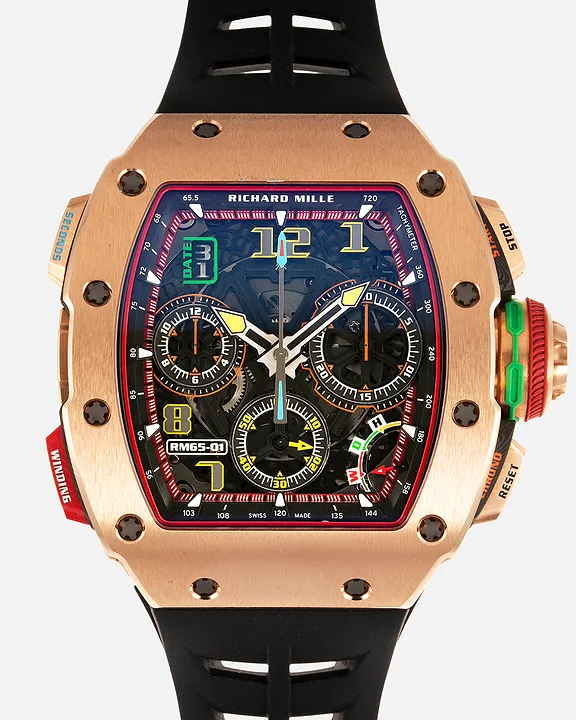
Richard Mille RM65-01 Split Seconds Full RG, 2022
S.Song Watches (dealer), Seattle
Wristwatches · 2019
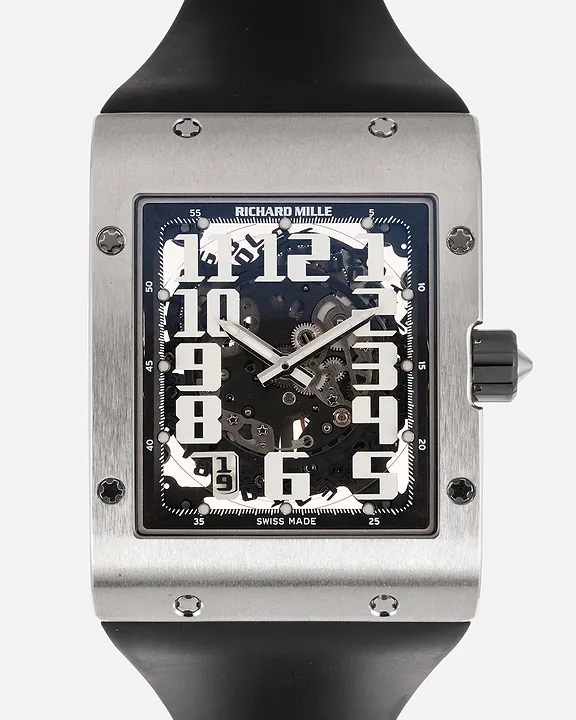
Richard Mille RM016 WG, 2019
S.Song Watches (dealer), Seattle
Wristwatches · 2015
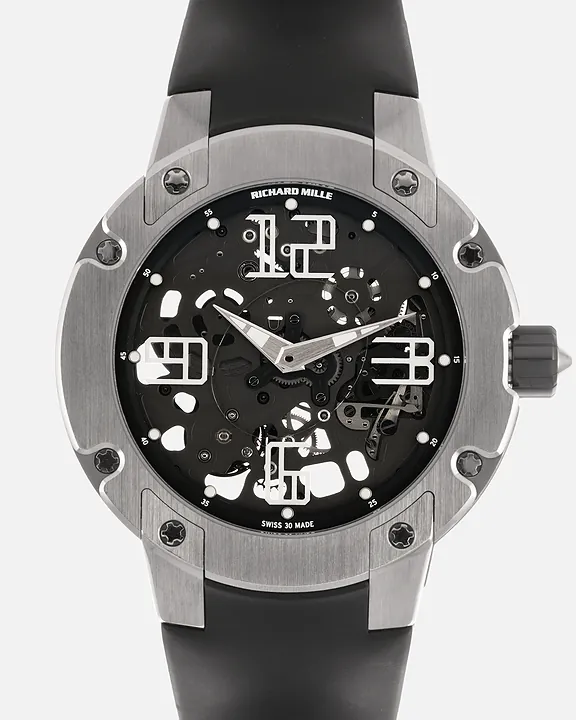
Richard Mille RM033 Extra Flat Titanium, 2015
S.Song Watches (dealer), Seattle
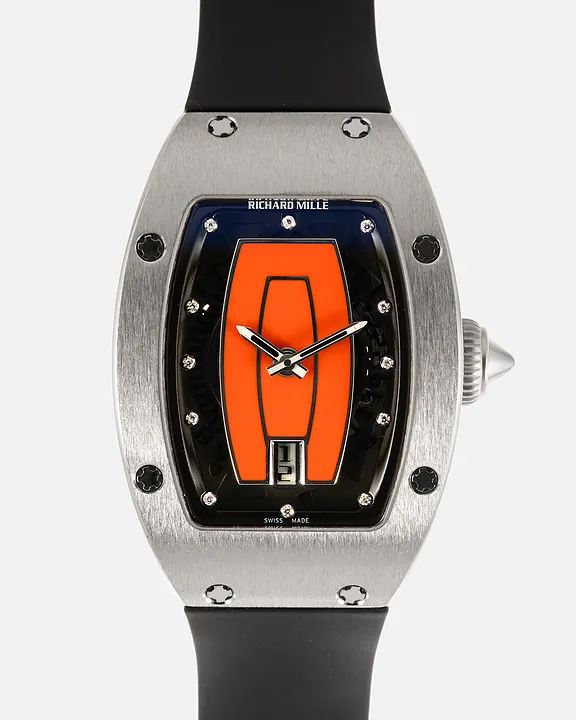
Wristwatches · 2000s
Richard Mille RM007 Orange Lip, 2000s
S.Song Watches (dealer), Seattle

Wristwatches · c. 2010s
Breguet Type XXI, ref. 3810, c. 2010s (Antiquorum Lot 381-24)
Antiquorum auction archive, Geneva

Wristwatches · c. 2010s
Breguet Type XXI, ref. 3810, c. 2010s (Antiquorum Lot 386-229)
Antiquorum auction archive, Geneva

Wristwatches · Sold in September 2010
Breitling Cosmonaute, ref. A 22322, Sold in September 2010
Antiquorum auction archive, Geneva

Wristwatches · c. 2010
Corum Bubble Chrono, ref. 396.150.20, c. 2010
Antiquorum auction archive, Geneva