
Wristwatches · Wristwatch
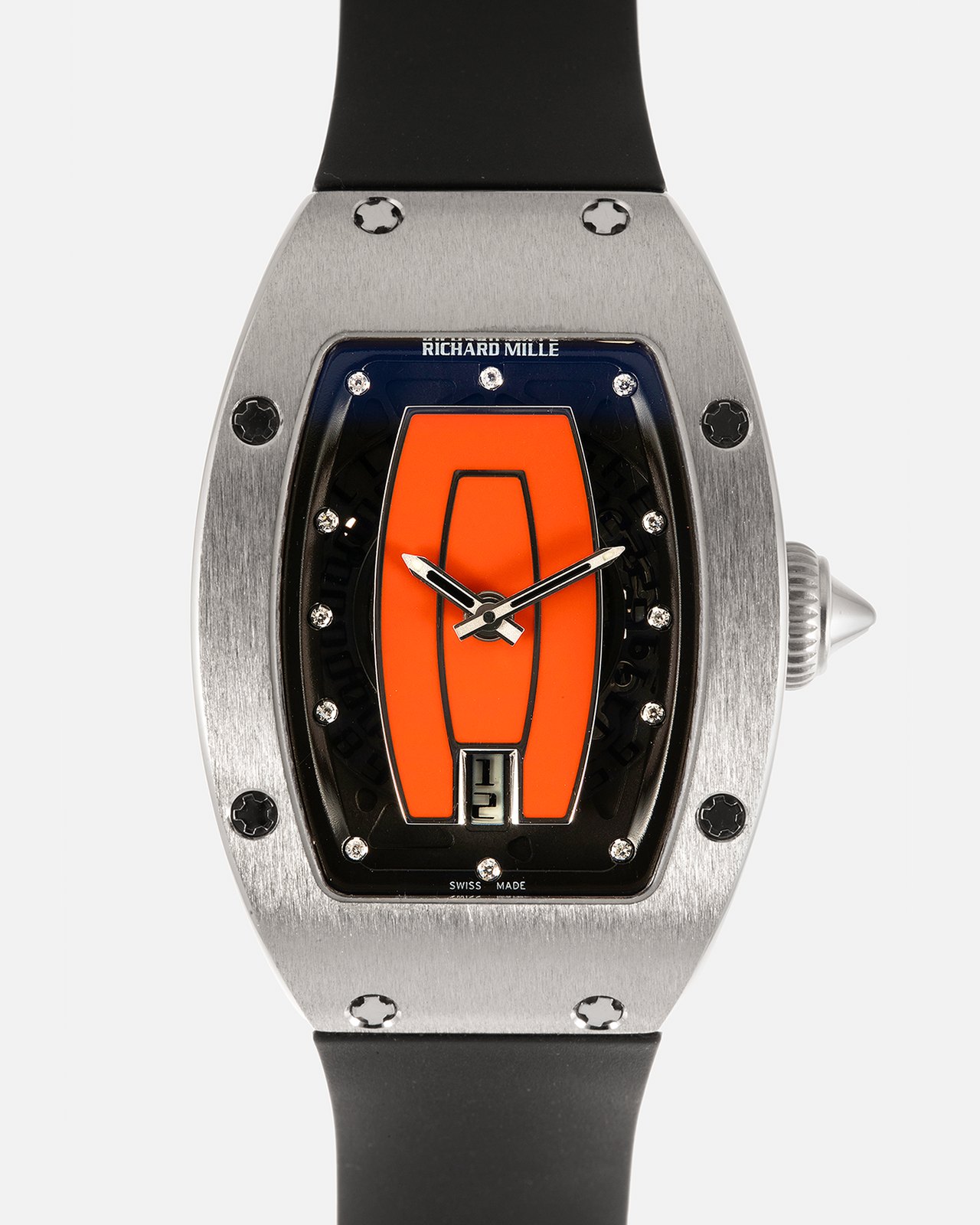
Richard Mille RM007 Orange Lip, 2000s
- Maker / attribution
- Richard Mille (maker)
- Date
- 2000s
- Historical period
- Mechanical Renaissance (1990 – 2010)
- Country of origin
- Switzerland
- Object type
- Wristwatch
- Dimensions
- Case 31 mm
- Stock no.
- Product 7184861397079
- Credit line
- Dealer listing, S.Song Watches (product 7184861397079)
- Catalogue title (original)
- Richard Mille RM007 Orange Lip (English)
View the source record (dealer listing) ↗ (opens another website in a new tab)Suggest a correction
Record summary
Catalogued by S.Song Watches (dealer), Seattle (stock number Product 7184861397079), this is a wristwatch by Richard Mille, made in Switzerland, dated 2000s. The Atlas places it in the Mechanical Renaissance period (1990 – 2010) of its Wristwatches collection. Recorded dimensions: Case 31 mm. The record is illustrated with 6 photographs.
Assembled from the source record's structured fields. Dates and attributions are given as the source states them; where a field is missing the Atlas leaves it blank rather than estimating.
Catalogue description
Dealer description — S.Song Watches
Prized for its ability to create some of the most jaw-dropping pieces of horological excellence around, Richard Mille has surged from being a relatively under-the-radar indie watchmaker into a blue-chip powerhouse that has joined the big boys with over a billion CHF a year in sales. Paramount to their success have been their distinctive designs, incredible watchmaking, and next-level engineering; all attributes the Richard Mille RM007 wields in abundance. The RM007 first made its grand entry onto the watch scene in 2005, serving as Richard Mille’s response to the dearth of high-end timepieces specifically tailored for the distinguished lady (at the time). What we have for you today is the RM007 ‘Orange Lip’, an exquisite high-end design from Richard Mille that seamlessly marries aesthetic beauty, ergonomic excellence, and cutting-edge watchmaking technology. With its 18-carat white gold tonneau-shaped case as the design foundation, the RM007 boasts a strikingly elongated case profile at just 31mm x 45mm. Its partially open-worked dial proudly reveals the multi-tonal Cal. RM007 movement beneath—a self-winding movement crafted from grade 5 titanium. When you turn the watch over onto its caseback, you’ll be greeted with a distinctive patented rotor system crafted from 18-carat sandblasted gold. Now, what's fascinating about this system is its unique construction with an integrated PVD-coated container housing 18-carat gold microbeads, which serves as a built-in shock reduction mechanism, as well as creating a mesmerizing visual display. In line with Richard Mille's signature avant-garde design ethos, it's evident that the RM007 embodies a touch of elegance not typically associated with the brand's ultra-technical and sporty/aggressive offerings. This example here has a captivating orange centerpiece which serves as a contrasting ornate backdrop to its luminous handset, date window aperture at 6:00, and tastefully set diamond hour markers. What can I say? The design of the RM007 is glamorous in spirit and makes no reservations about it. While a lot of classical collectors have reservations about Richard Mille due to its large size, I have to say that while this was made for women, it is the perfect mid-size Richard Mille for men as well. You can see the pictures on my 6.5 inch wrist and just how well it wears.
Historical context
Mechanical Renaissance (1990 – 2010)
Mechanical watches return as cultural objects; independent watchmaking flourishes.
Mechanical watches returned as cultural and luxury objects. Complications, tourbillons and new materials proliferated; independent watchmakers such as George Daniels, F.P. Journe and Philippe Dufour revived artisanal watchmaking; collecting vintage watches became a major field.
Read the period in the timelineMore wristwatches from this periodEarlier: Quartz Revolution
Atlas type guide
Wristwatches
Bracelet watches were worn by women from the early nineteenth century — Breguet made one for Caroline Murat, Queen of Naples, in 1810–12 — but the wristwatch only became a man's instrument with military use and aviation in the early twentieth century. Between the World Wars it overtook the pocket watch; the 1920s and 1930s brought rectangular Art Deco cases, water-resistant cases and the first automatic winding systems.
After 1945 the wristwatch became a carrier of identity — dress watches, sports and dive watches, chronographs, calendars — produced by Swiss, American, Japanese, German, Soviet and Chinese industries. The quartz revolution after 1969 and the mechanical renaissance since the 1990s, including the rise of independent watchmakers, complete the story.
What to look for
- The reference number (between the lugs or inside the case back) and serial number, the starting point for dating.
- The calibre: its maker and number are often stamped under the dial or on the bridge.
- Originality of dial, hands and crown — refinished ('redial') dials are common.
- Case material marks: 18K/750, 14K/585, stainless steel, gold-filled, plated.
Dating clues
- Wire-lug cases: before c. 1925.
- Water-resistant screw-down cases: from 1926.
- Quartz movements: from 1969; sapphire crystals widespread after c. 1980.
General guidance written by the Atlas editors about this kind of object. It is not a statement about this particular piece; for that, rely on the source record above and on physical examination.
Related records
Wristwatches · 2022
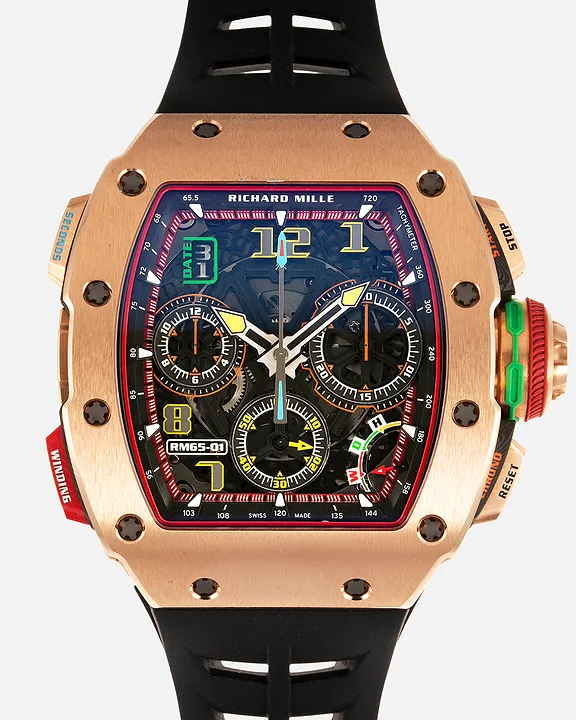
Richard Mille RM65-01 Split Seconds Full RG, 2022
S.Song Watches (dealer), Seattle
Wristwatches · 2022
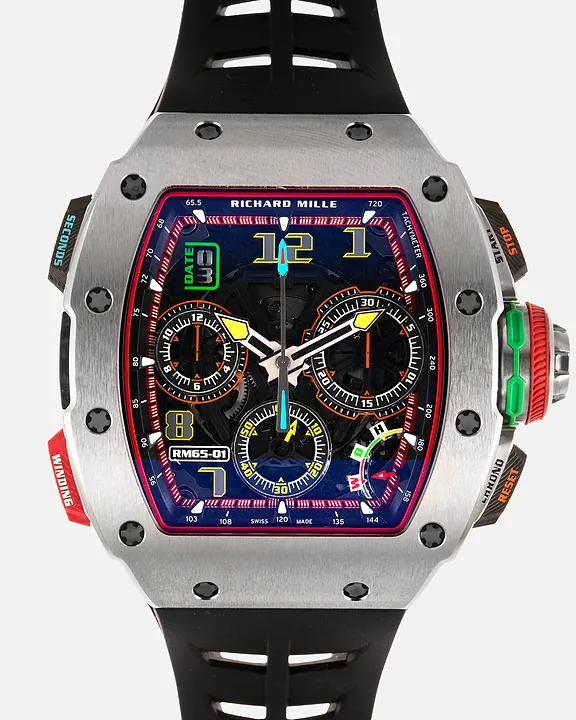
Richard Mille RM65-01 Split Seconds Titanium, 2022
S.Song Watches (dealer), Seattle
Wristwatches · 2019
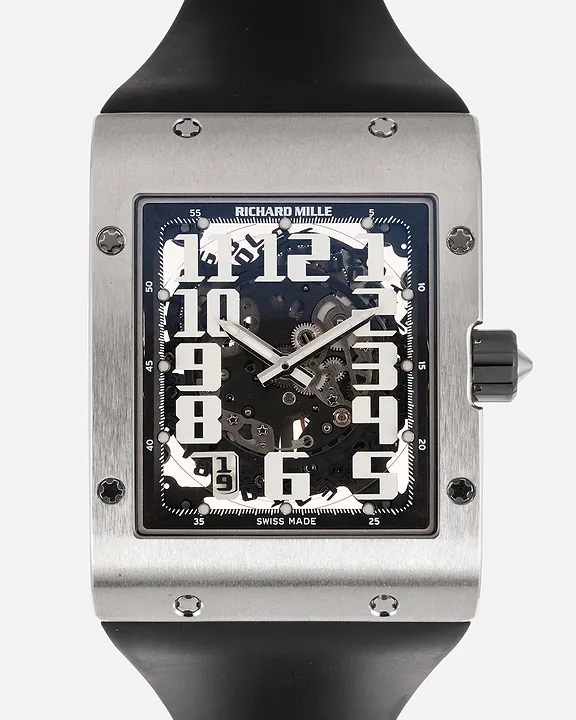
Richard Mille RM016 WG, 2019
S.Song Watches (dealer), Seattle
Wristwatches · 2015
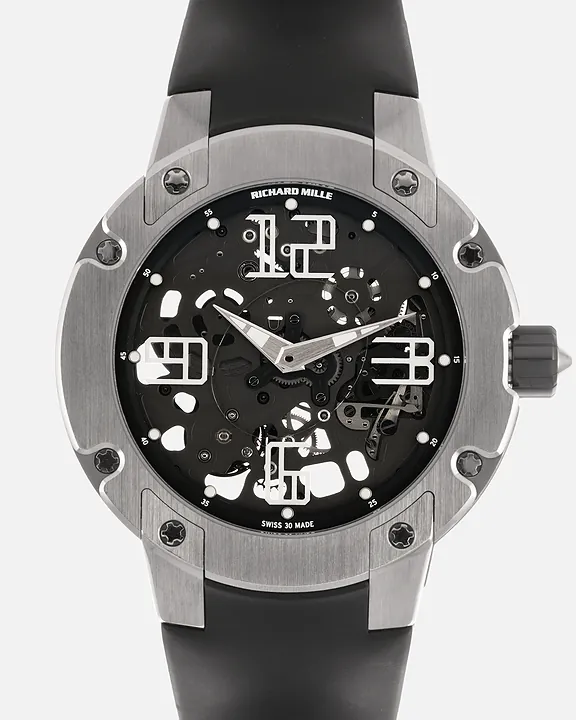
Richard Mille RM033 Extra Flat Titanium, 2015
S.Song Watches (dealer), Seattle

Wristwatches · 2008
Wristwatch by Breitling?, 2008
Museum Rotterdam

Wristwatches · c. 1990s
Audemars Piguet Bamboo, c. 1990s
Antiquorum auction archive, Geneva

Wristwatches · c. 1990
Audemars Piguet Huitieme Perpetual Calendar, ref. 25696PT, c. 1990
Antiquorum auction archive, Geneva

Wristwatches · c. 1990
Breitling Chronomat, ref. b13050.1, c. 1990
Antiquorum auction archive, Geneva