
Wristwatches · Wristwatch
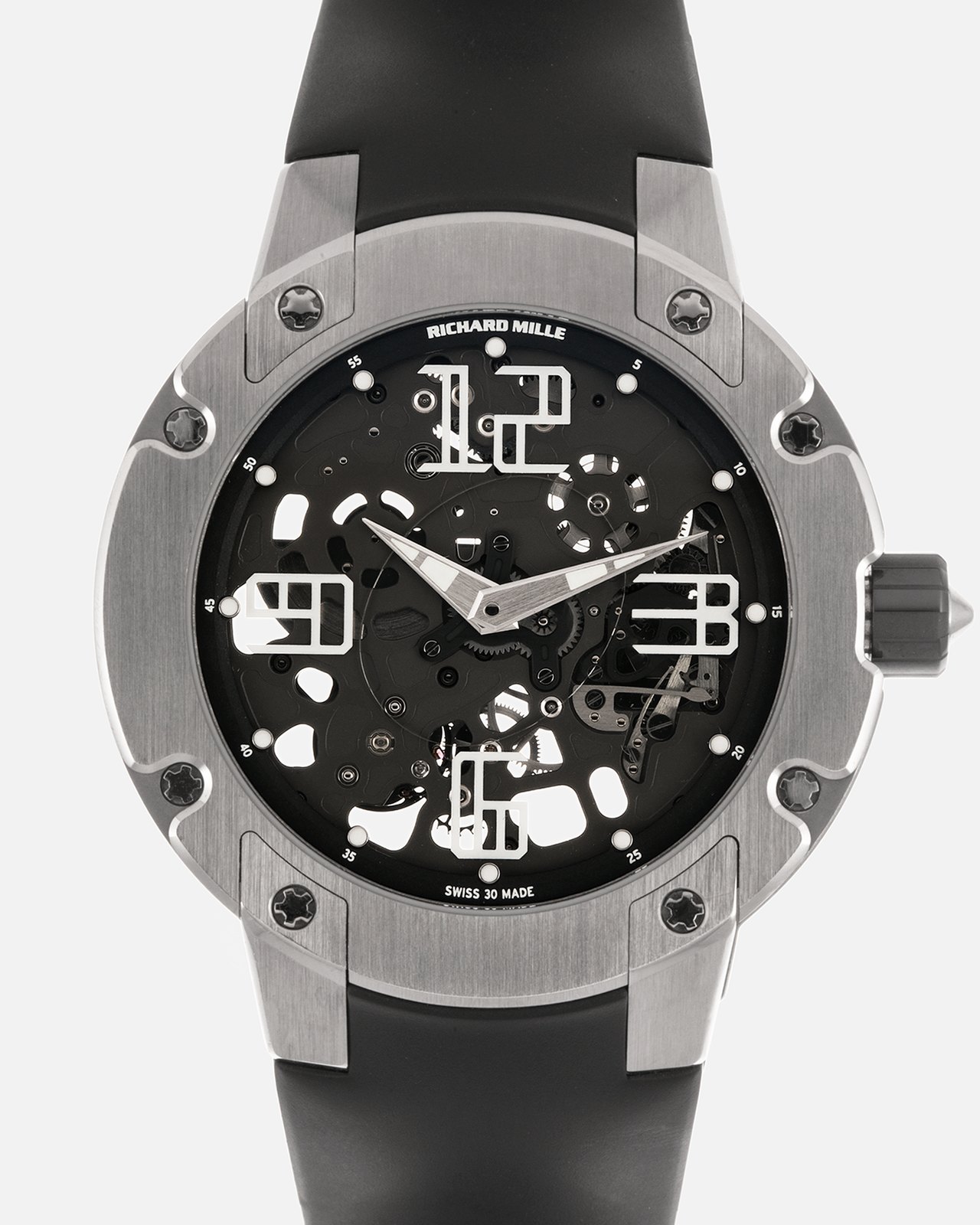
Richard Mille RM033 Extra Flat Titanium, 2015
- Maker / attribution
- Richard Mille (maker)
- Date
- 2015
- Historical period
- Contemporary Horology (2010 – Present)
- Country of origin
- Switzerland
- Object type
- Wristwatch
- Materials / technique
- titanium
- Dimensions
- Case 45.7 mm
- Stock no.
- Product 7853774307415
- Credit line
- Dealer listing, S.Song Watches (product 7853774307415)
- Catalogue title (original)
- Richard Mille RM033 Extra Flat Titanium (English)
View the source record (dealer listing) ↗ (opens another website in a new tab)Suggest a correction
Record summary
Catalogued by S.Song Watches (dealer), Seattle (stock number Product 7853774307415), this is a wristwatch by Richard Mille, made in Switzerland, dated 2015. The Atlas places it in the Contemporary Horology period (2010 – Present) of its Wristwatches collection. Materials and techniques recorded by the source: titanium. Recorded dimensions: Case 45.7 mm. The record is illustrated with 6 photographs.
Assembled from the source record's structured fields. Dates and attributions are given as the source states them; where a field is missing the Atlas leaves it blank rather than estimating.
Catalogue description
Dealer description — S.Song Watches
Since its establishment in 2001, Richard Mille has distinguished itself through an unconventional approach to watchmaking, combining advanced materials, highly technical movements and designs inspired by motorsport and aerospace engineering. While the brand is best known for its distinctive tonneau-shaped cases and elaborate complications, it has also produced a number of round-cased watches that retain the same technical philosophy. Introduced in 2011, the RM 033 Extra Flat represented a departure from Richard Mille's earlier collections. Featuring a completely round case and an exceptionally thin automatic movement, it was conceived as an alternative to the brand's more familiar tonneau-shaped watches. Unlike the more complicated references typically associated with Richard Mille, the RM 033 displays only the hours and minutes, placing greater emphasis on its skeletonised construction and unusually slim movement. Here, we have the RM 033 in titanium, featuring a skeletonised dial with oversized Arabic numerals at 12, 3, 6 and 9 o'clock. Measuring 45.7mm in diameter and just 6.3mm in thickness, the case is remarkably thin for a watch of its size. Its construction retains many of Richard Mille's characteristic design elements, including the exposed spline screws, integrated lugs and a combination of brushed and polished surfaces. Despite its relatively thin profile, the substantial diameter gives the watch considerable presence on the wrist, while the lightweight titanium construction helps offset its size. The dial is undoubtedly one of the most distinctive aspects of the RM 033. Rather than employing a conventional solid dial, the watch exposes the skeletonised movement beneath, with its darkened titanium bridges and mechanical components providing a technical backdrop. Particularly attractive are the four oversized Arabic numerals, which appear almost suspended above the movement, complemented by luminous hour markers and broad, skeletonised hands. The contrast between the silver numerals, dark movement and brushed titanium case creates a remarkably cohesive appearance. Powering the watch is the automatic calibre RMXP1, an exceptionally thin movement measuring just 2.6mm in thickness. Developed with a decentralised platinum micro-rotor, the movement achieves its slim proportions by positioning the winding mechanism alongside the movement rather than above it. The calibre features a free-sprung balance with variable inertia, operates at 21,600 vibrations per hour and provides approximately 42 hours of power reserve. Its baseplate and bridges are constructed from Grade 5 titanium, with extensive skeletonisation and specialised surface treatments providing the rigidity required for such a thin movement.
Historical context
Contemporary Horology (2010 – Present)
Silicon components, connected watches, optical-lattice research clocks and a thriving independent scene.
Smartwatches became the world's best-selling watches, while mechanical watchmaking focuses on craft, innovation (silicon components, new escapements) and independent makers.
Read the period in the timelineMore wristwatches from this periodEarlier: Mechanical Renaissance
Atlas type guide
Wristwatches
Bracelet watches were worn by women from the early nineteenth century — Breguet made one for Caroline Murat, Queen of Naples, in 1810–12 — but the wristwatch only became a man's instrument with military use and aviation in the early twentieth century. Between the World Wars it overtook the pocket watch; the 1920s and 1930s brought rectangular Art Deco cases, water-resistant cases and the first automatic winding systems.
After 1945 the wristwatch became a carrier of identity — dress watches, sports and dive watches, chronographs, calendars — produced by Swiss, American, Japanese, German, Soviet and Chinese industries. The quartz revolution after 1969 and the mechanical renaissance since the 1990s, including the rise of independent watchmakers, complete the story.
What to look for
- The reference number (between the lugs or inside the case back) and serial number, the starting point for dating.
- The calibre: its maker and number are often stamped under the dial or on the bridge.
- Originality of dial, hands and crown — refinished ('redial') dials are common.
- Case material marks: 18K/750, 14K/585, stainless steel, gold-filled, plated.
Dating clues
- Wire-lug cases: before c. 1925.
- Water-resistant screw-down cases: from 1926.
- Quartz movements: from 1969; sapphire crystals widespread after c. 1980.
General guidance written by the Atlas editors about this kind of object. It is not a statement about this particular piece; for that, rely on the source record above and on physical examination.
Related records
Wristwatches · 2022
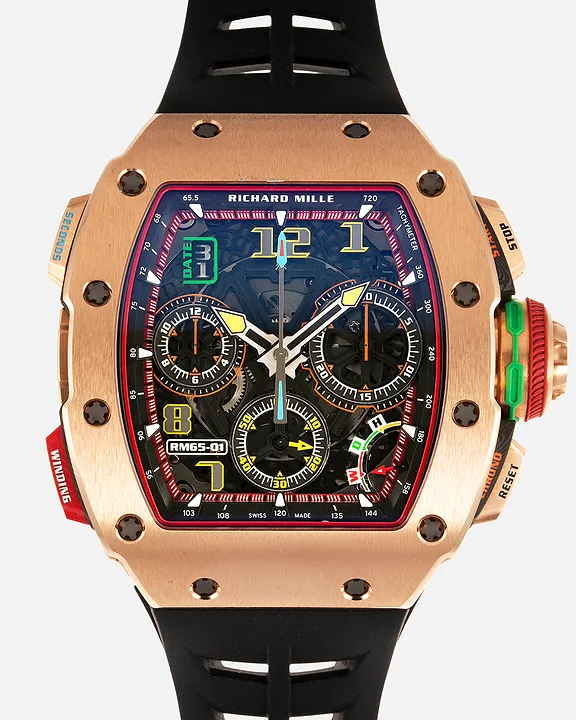
Richard Mille RM65-01 Split Seconds Full RG, 2022
S.Song Watches (dealer), Seattle
Wristwatches · 2022
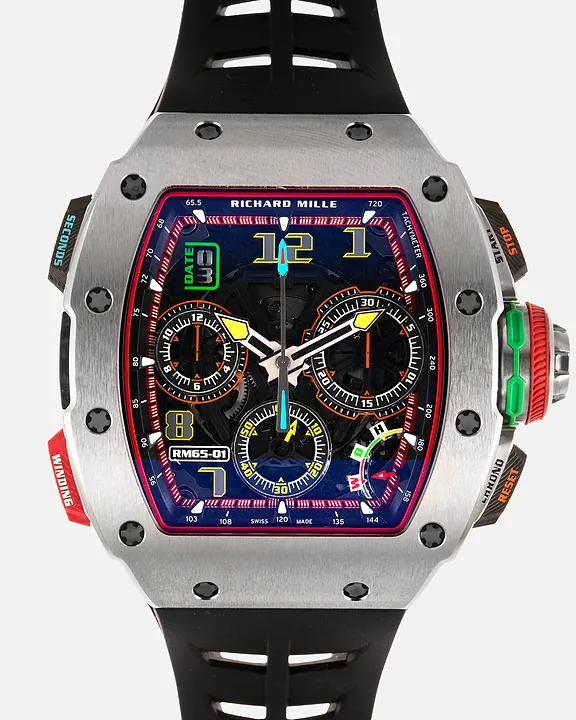
Richard Mille RM65-01 Split Seconds Titanium, 2022
S.Song Watches (dealer), Seattle
Wristwatches · 2019
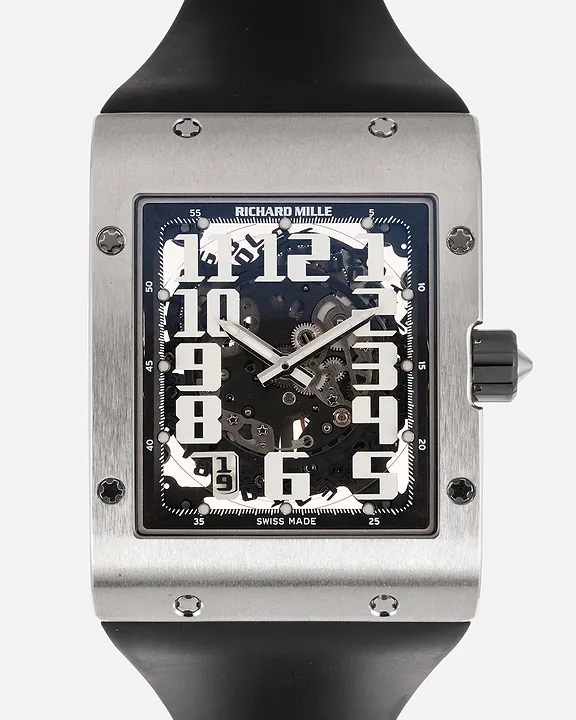
Richard Mille RM016 WG, 2019
S.Song Watches (dealer), Seattle
Wristwatches · 2000s
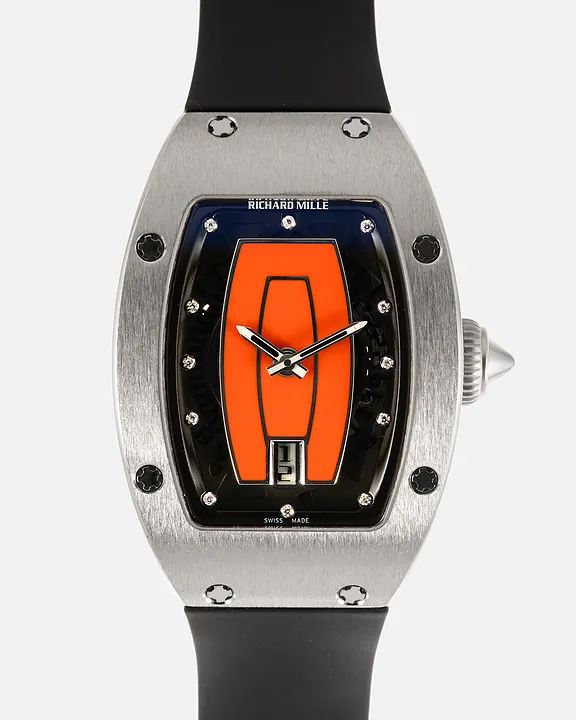
Richard Mille RM007 Orange Lip, 2000s
S.Song Watches (dealer), Seattle

Wristwatches · c. 2010s
Breguet Type XXI, ref. 3810, c. 2010s (Antiquorum Lot 381-24)
Antiquorum auction archive, Geneva

Wristwatches · c. 2010s
Breguet Type XXI, ref. 3810, c. 2010s (Antiquorum Lot 386-229)
Antiquorum auction archive, Geneva

Wristwatches · Sold in September 2010
Breitling Cosmonaute, ref. A 22322, Sold in September 2010
Antiquorum auction archive, Geneva

Wristwatches · c. 2010
Corum Bubble Chrono, ref. 396.150.20, c. 2010
Antiquorum auction archive, Geneva