
Clocks · Longcase clock
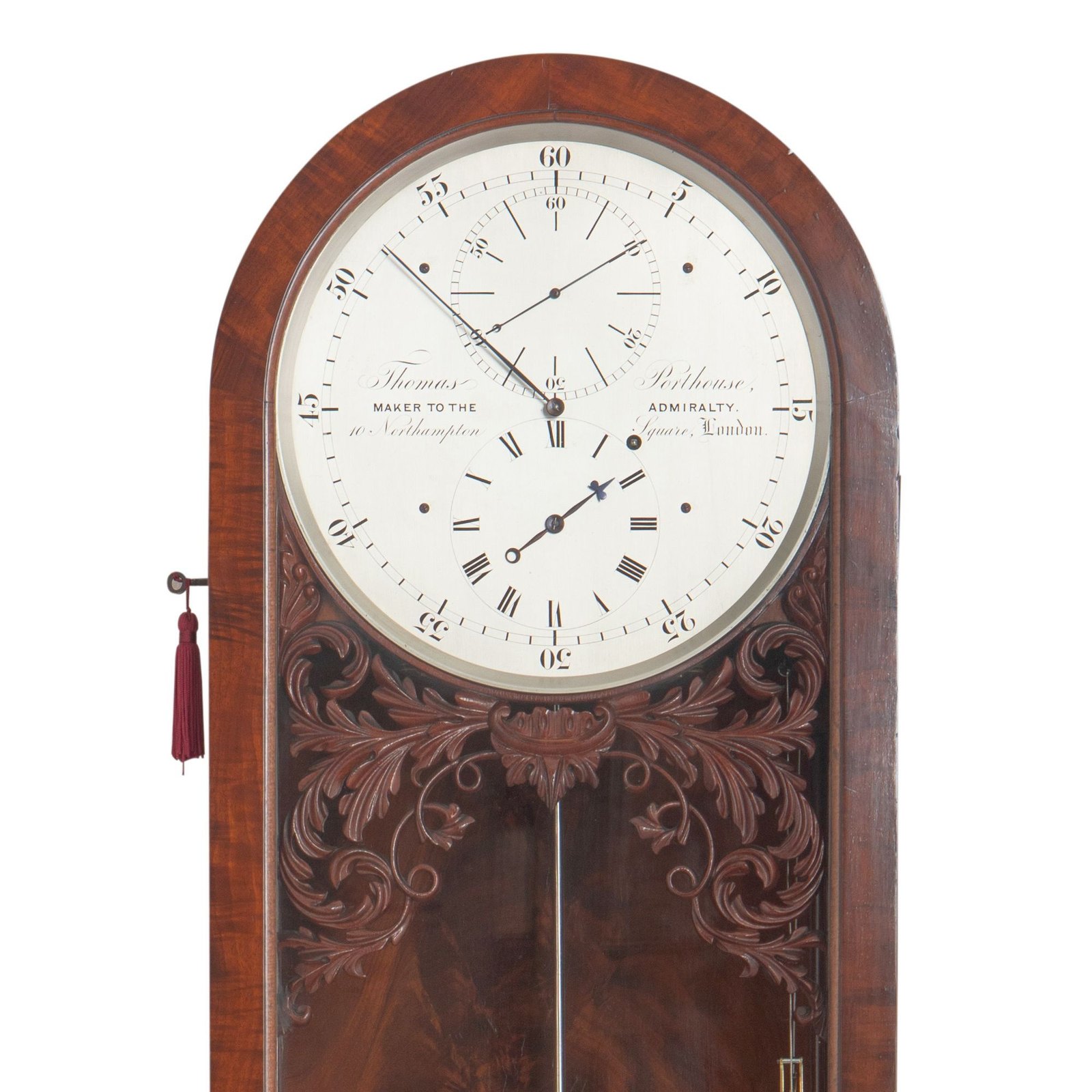
Regulator longcase clock by Thomas Porthouse, London
- Maker / attribution
- Thomas Porthouse (maker)
- Date
- c. 1850
- Historical period
- Industrial Revolution (1850 – 1900)
- Country of origin
- England
- Place
- London
- Object type
- Longcase clock
- Dimensions
- Height 182 cm
- Stock no.
- Product 2240
- Credit line
- Dealer listing, The Antique Clock Company (product 2240)
- Catalogue title (original)
- A VERY FINE REGULATOR LONGCASE CLOCK – THOMAS PORTHOUSE – MAKER TO THE ADMIRALTY – LONDON (English)
View the source record (dealer listing) ↗ (opens another website in a new tab)Suggest a correction
Record summary
Catalogued by The Antique Clock Company (dealer), Dorset (stock number Product 2240), this is a longcase clock by Thomas Porthouse, made in London, England, dated c. 1850. The Atlas places it in the Industrial Revolution period (1850 – 1900) of its Clocks collection. Recorded dimensions: Height 182 cm. The record is illustrated with 2 photographs.
Assembled from the source record's structured fields. Dates and attributions are given as the source states them; where a field is missing the Atlas leaves it blank rather than estimating.
Catalogue description
Dealer description — The Antique Clock Company
A very fine regulator longcase clock of great proportion, standing at just under 6ft, which has been made with superb quality and high attention to detail. The dial of standard regulator layout being silvered, engraved, 12” round with both Roman and Arabic numerals and signed “ Thomas Porthouse, Maker to the Admiralty. 10 Northampton Square, London “. The weight driven, 5 pillar movement features oversized plates, jewelled dead-beat escapement, a mercury pendulum and maintaining power. The mahogany case features fine veneers, a long glazed trunk door with mahogany base. Altogether a very high quality clock. Thomas Porthouse: C.1794-1860 He gained a considerable reputation as a watch and chronometer maker in London. His origins are unknown, but it is possible he was related to the 18th century family of clockmakers by that name from Penrith in Cumberland (now Cumbria) in the North of England. The known facts about Thomas Porthouse suggest that sometime around the year 1815 he started his own business on High Street, Poplar, in London’s East End, near the city’s main docklands. The first city directory to include information about Porthouse as a tradesman, published in 1822 by the Manchester firm Pigot and Co, lists his premises at 210 High Street. One year after the Royal Observatory announced its Premium Trials, Porthouse entered chronometer No.233 . No doubt recognizing the prestige to be gained by selling chronometers to the Royal Navy, Porthouse submitted a number of further chronometers for the Greenwich trials in the following years. Comparative Literature : Brian Loomes – The Early Clockmakers of Great Britain Height: 71 ½” (6ft) or 182cm *This clock is delivered and set up for free within the UK. We regularly ship clocks all over the world with our approved and well-established Antiques and Fine Art Packers & Shippers. Please ask for a quote should you require this service.
Historical context
Industrial Revolution (1850 – 1900)
American interchangeable-parts manufacture; railroad time standards; Swiss and German factory systems.
Factory production transformed the clock into an everyday object. American makers (Seth Thomas, Ansonia, Waterbury) and German factories (Junghans, Gustav Becker, Lenzkirch) sold millions of shelf, wall and alarm clocks worldwide; France produced standardised Paris movements and carriage clocks; electric time distribution began.
Read the period in the timelineMore clocks from this periodEarlier: Precision & Scientific Horology
Atlas type guide
Longcase (tall-case or grandfather) clocks
The longcase clock was born from two seventeenth-century innovations: Christiaan Huygens's pendulum (1656–57) and the anchor escapement (c. 1670). A long seconds pendulum, nearly a metre long, swings with a small arc, and enclosing it together with the driving weights in a tall wooden case protected the mechanism and created a new piece of furniture. London makers such as Ahasuerus Fromanteel, Thomas Tompion and Joseph Knibb set the pattern.
By the eighteenth century longcase clocks were made throughout Britain, the Netherlands, Scandinavia (the Swedish Mora clock), France (the Comtoise from the Franche-Comté), Germany and colonial America. Eight-day movements with two weights became standard in better clocks; thirty-hour clocks with one weight and a rope or chain were cheaper alternatives.
What to look for
- Winding holes in the dial: two (eight-day, going and striking) or none (thirty-hour, pulled up by a chain).
- Brass dials with applied chapter rings (earlier) versus painted iron 'white' dials (after c. 1770 in Britain).
- Moon-phase arches, date apertures, seconds dials and maker's name on the dial.
- Case woods and style: ebonised, walnut marquetry, lacquer, oak or mahogany; regional styles from London, Lancashire, Scotland or America.
- Whether the movement and dial match the case — 'marriages' are common.
Dating clues
- Square brass dials suggest c. 1670–1720; arched brass dials c. 1715–1790.
- Painted (white) dials were made by Birmingham dial-makers from about 1772.
- Comtoise clocks with repoussé pendulums are mostly nineteenth century.
General guidance written by the Atlas editors about this kind of object. It is not a statement about this particular piece; for that, rely on the source record above and on physical examination.
Related records
Clocks · 1830–1870
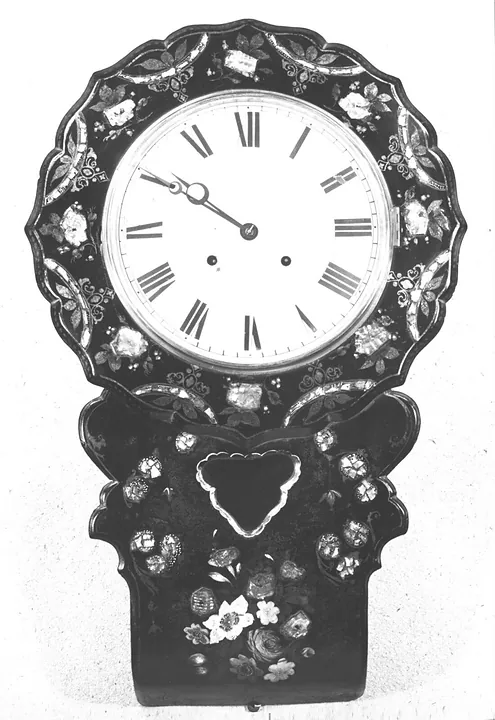
Wall clock in a papier mâché case with painted decoration. English, mid 19th century.
Victoria and Albert Museum, London
Clocks · 1840–1900
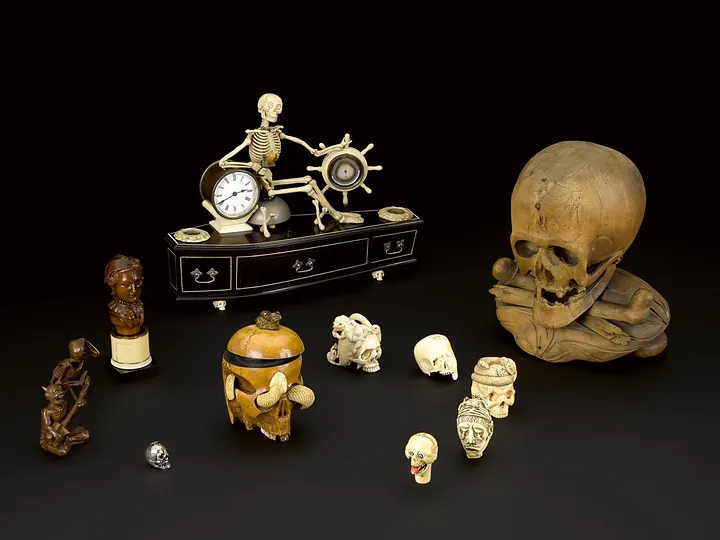
Alarm clock, mounted on model of coffin with skeleton, probably English, 1840–1900
Science Museum Group, London
Clocks · 1840–1880
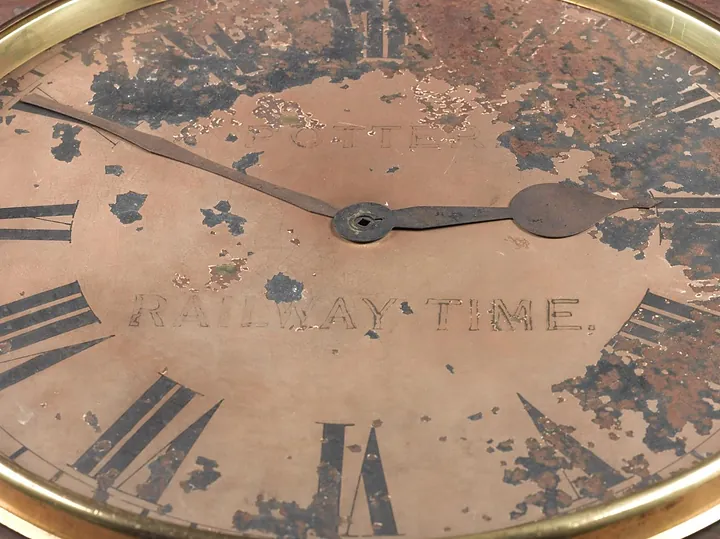
Clock dial marked "Potter, Railway Time" with two hands, unknown maker, British, 1840–1880
Science Museum Group, London
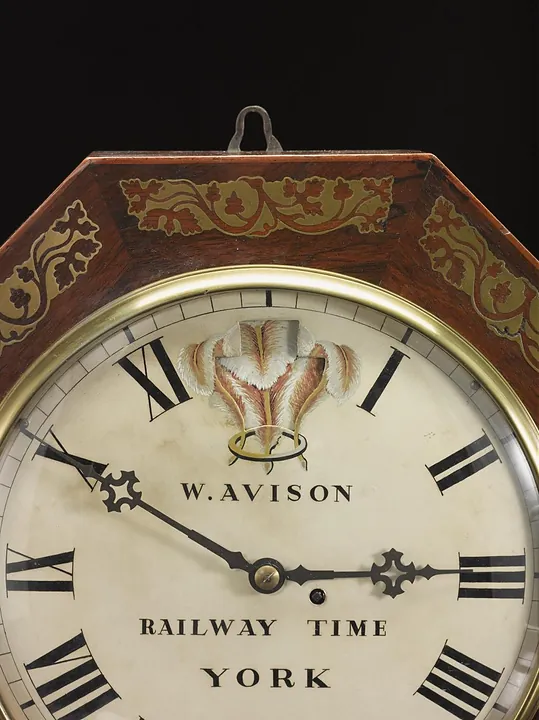
Clocks · 1840–1880
Wall Clock in octagonal case with Prince of Wales Feathers above makers name "W. Avison, Railway Time, York", made by William Avison, England, 1840–1880.
Science Museum Group, London
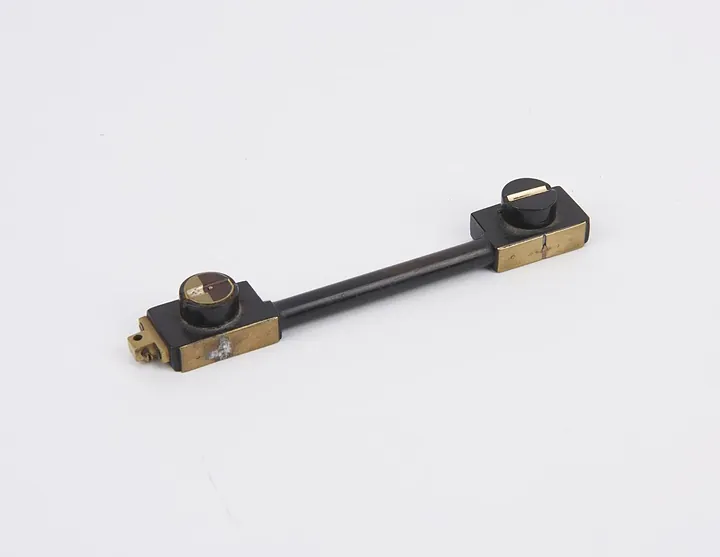
Clocks · 1841–1870
Contact bar from electric clock, unsigned, London, England, 1841–1870
Science Museum Group, London
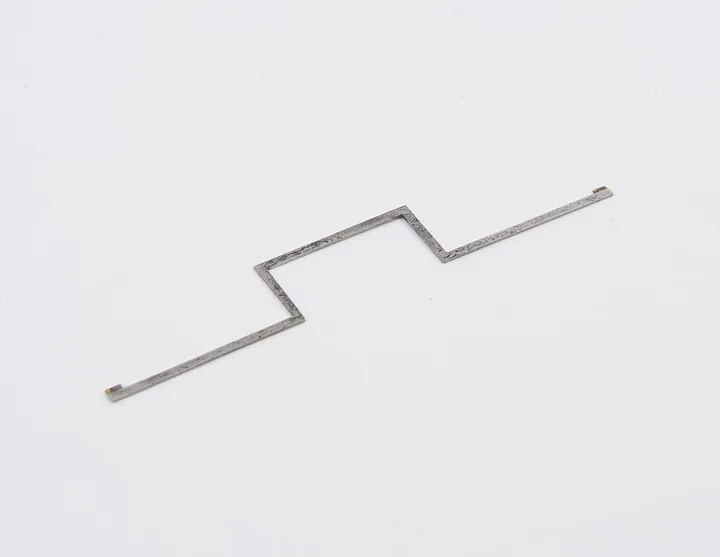
Clocks · 1841–1870
Contactor from electric clock, unsigned, London, England, 1841–1870
Science Museum Group, London
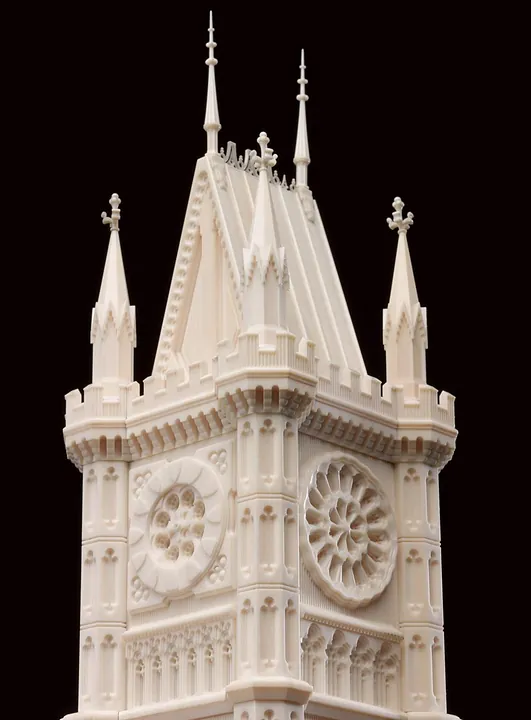
Clocks · 1843–1884
One ivory gothic clock tower & travelling case, by Holtzapffel and Company, London, England, 1843–1884
Science Museum Group, London
Clocks · 1845–1855
Clock by W. H. Darker, England, 1845–1855
Science Museum Group, London