
Wristwatches · Complicated wristwatch
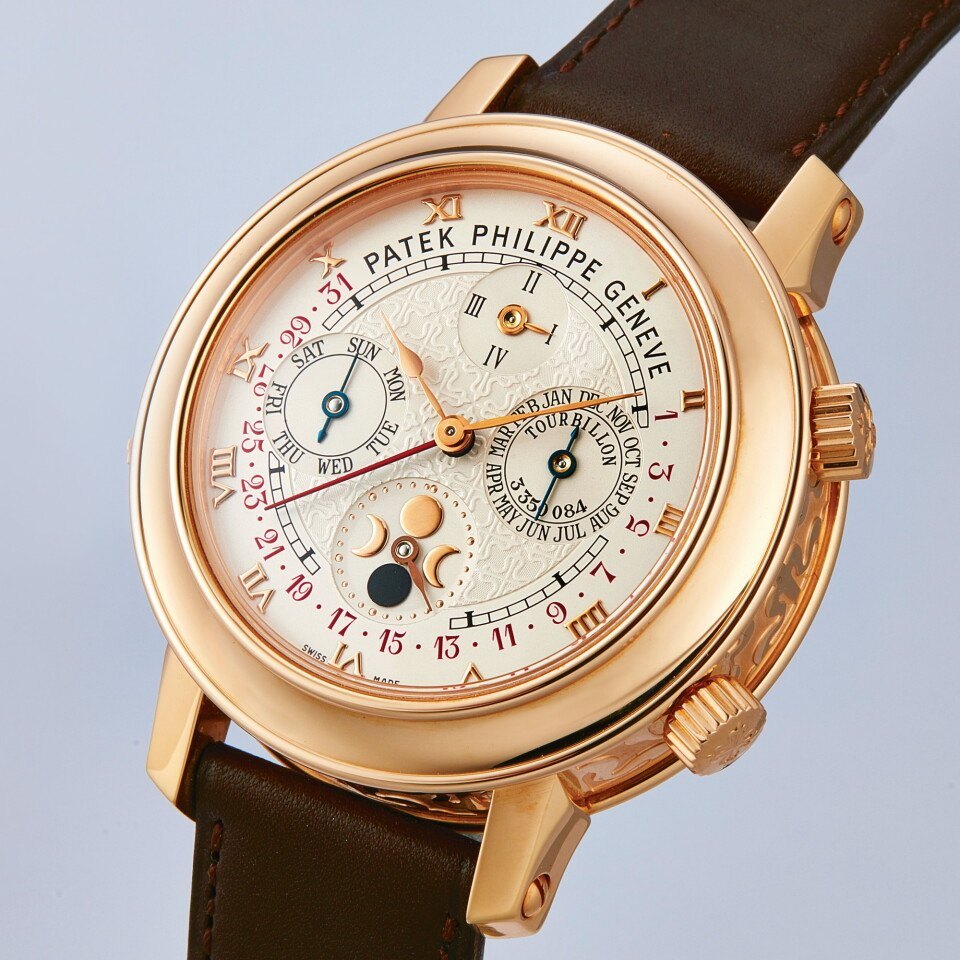
Patek Philippe Sky Moon Tourbillon, Ref. 5002R
- Maker / attribution
- Patek Philippe (source attribution)
- Date
- c. 2009
- Historical period
- Mechanical Renaissance (1990 – 2010)
- Country of origin
- Switzerland
- Object type
- Complicated wristwatch
- Materials / technique
- Pink gold
- Auction house
- Sotheby's
- Lot
- patek-philippe-sky-moon-tourbillon-ref-5002r-cb43a977ec
- Credit line
- Sotheby's
- Catalogue title (original)
- The Sky Moon Tourbillon: Patek Philippe’s Most Complicated Wristwatch | Sotheby’s (English)
View the source record (auction lot) ↗ (opens another website in a new tab)Suggest a correction
Record summary
Catalogued by Sotheby's (lot patek-philippe-sky-moon-tourbillon-ref-5002r-cb43a977ec), this is a complicated wristwatch attributed to Patek Philippe, made in Switzerland, dated c. 2009. The Atlas places it in the Mechanical Renaissance period (1990 – 2010) of its Wristwatches collection. Materials and techniques recorded by the source: Pink gold. The record is illustrated with 1 photograph.
Assembled from the source record's structured fields. Dates and attributions are given as the source states them; where a field is missing the Atlas leaves it blank rather than estimating.
Catalogue description
Original object description
Sotheby's attributes this double-faced pink gold Patek Philippe Sky Moon Tourbillon wristwatch, reference 5002R, to circa 2009. Reflecting the horological concepts of the firm's Star Calibre 2000 pocket watch, it integrates a dozen distinct complications: a tourbillon, perpetual calendar, leap year display, retrograde date, moon age indicator, sidereal time, celestial star chart, lunar phase tracking, orbital display, and a minute repeater sounding on cathedral gongs. Roman numerals border the textured central section of the primary face, which features subsidiary counters for the leap year, day, moon phase, and month. Movement number 3350084 is marked inside the 3 o'clock register, and the retrograde date scale is indicated by a long red-tipped hand. Displayed on the opposite face are the sidereal time, lunar phase, orbital progression, and the celestial sky map.
Inscriptions & marks
3350084
Historical context
Mechanical Renaissance (1990 – 2010)
Mechanical watches return as cultural objects; independent watchmaking flourishes.
Mechanical watches returned as cultural and luxury objects. Complications, tourbillons and new materials proliferated; independent watchmakers such as George Daniels, F.P. Journe and Philippe Dufour revived artisanal watchmaking; collecting vintage watches became a major field.
Read the period in the timelineMore wristwatches from this periodEarlier: Quartz Revolution
Atlas type guide
Wristwatches
Bracelet watches were worn by women from the early nineteenth century — Breguet made one for Caroline Murat, Queen of Naples, in 1810–12 — but the wristwatch only became a man's instrument with military use and aviation in the early twentieth century. Between the World Wars it overtook the pocket watch; the 1920s and 1930s brought rectangular Art Deco cases, water-resistant cases and the first automatic winding systems.
After 1945 the wristwatch became a carrier of identity — dress watches, sports and dive watches, chronographs, calendars — produced by Swiss, American, Japanese, German, Soviet and Chinese industries. The quartz revolution after 1969 and the mechanical renaissance since the 1990s, including the rise of independent watchmakers, complete the story.
What to look for
- The reference number (between the lugs or inside the case back) and serial number, the starting point for dating.
- The calibre: its maker and number are often stamped under the dial or on the bridge.
- Originality of dial, hands and crown — refinished ('redial') dials are common.
- Case material marks: 18K/750, 14K/585, stainless steel, gold-filled, plated.
Dating clues
- Wire-lug cases: before c. 1925.
- Water-resistant screw-down cases: from 1926.
- Quartz movements: from 1969; sapphire crystals widespread after c. 1980.
General guidance written by the Atlas editors about this kind of object. It is not a statement about this particular piece; for that, rely on the source record above and on physical examination.
Related records

Clocks · 1965–1975
Quartz master clock QM 1, with movement by Patek Phillippe, Switzerland, 1965–1975. Supplied by English Clock Systems.
Science Museum Group, London

Instruments · 1965–1984
Chronometer by Patek Philippe and Kelvin Hughes, England, 1965–1984
Science Museum Group, London

Pocket Watches · c. 1895
Patek Philippe pocket watch, c. 1895
Antiquorum auction archive, Geneva

Pocket Watches · c. 1900
Patek Philippe Chronometro Gondolo, c. 1900
Antiquorum auction archive, Geneva
Wristwatches · 1991
Limited edition watch designed by Eta relating to David Bowie's Serious Moonlight live tour, 1991
Victoria and Albert Museum, London

Wristwatches · 2008
Wristwatch by Breitling?, 2008
Museum Rotterdam

Wristwatches · c. 1990s
Audemars Piguet Bamboo, c. 1990s
Antiquorum auction archive, Geneva

Wristwatches · c. 1990
Audemars Piguet Huitieme Perpetual Calendar, ref. 25696PT, c. 1990
Antiquorum auction archive, Geneva