
Wristwatches · Wristwatch
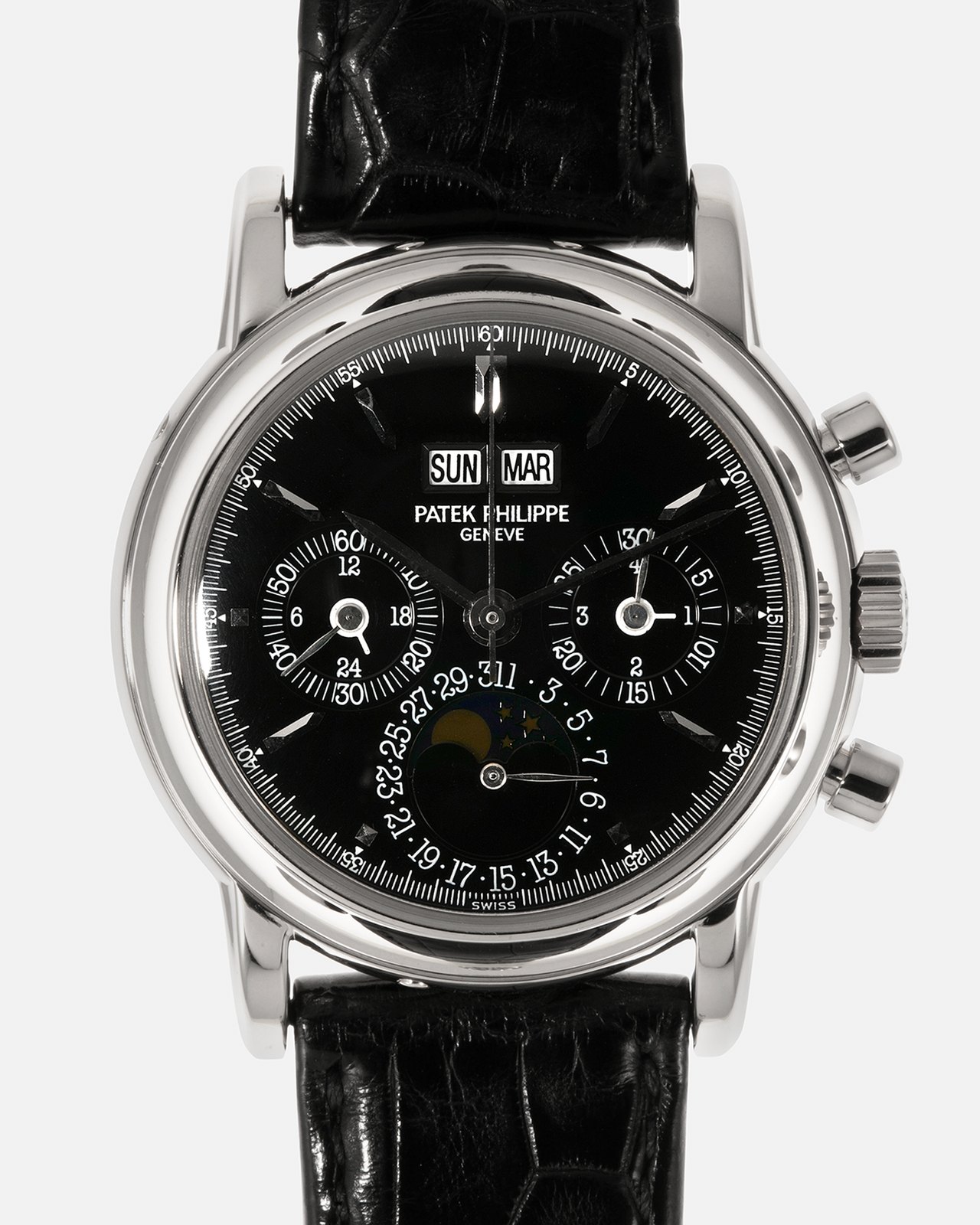
Patek Philippe Perpetual Calendar Chronograph 4th Series 3970EG, 1995
- Maker / attribution
- Patek Philippe (maker)
- Date
- 1995
- Historical period
- Mechanical Renaissance (1990 – 2010)
- Country of origin
- Switzerland
- Object type
- Wristwatch
- Dimensions
- Case 36 mm
- Stock no.
- Product 7468709511255
- Credit line
- Dealer listing, S.Song Watches (product 7468709511255)
- Catalogue title (original)
- Patek Philippe Perpetual Calendar Chronograph 4th Series 3970EG (English)
View the source record (dealer listing) ↗ (opens another website in a new tab)Suggest a correction
Record summary
Catalogued by S.Song Watches (dealer), Seattle (stock number Product 7468709511255), this is a wristwatch by Patek Philippe, made in Switzerland, dated 1995. The Atlas places it in the Mechanical Renaissance period (1990 – 2010) of its Wristwatches collection. Recorded dimensions: Case 36 mm. The record is illustrated with 6 photographs.
Assembled from the source record's structured fields. Dates and attributions are given as the source states them; where a field is missing the Atlas leaves it blank rather than estimating.
Catalogue description
Dealer description — S.Song Watches
In the pantheon of legendary Patek Philippe perpetual chronographs, the 3970 plays a key role in what it represents to the modern watchmaking history of the Maison, as it was the successor to the darling 2499, which ceased production in 1985. The 3970 was introduced in 1986, alongside its counterpart, the self-winding perpetual calendar 3940. Both models were significant for Patek Philippe and, to some extent, for the Swiss watchmaking industry as a whole. At that time, Switzerland was facing severe turmoil due to the Quartz crisis, which had deeply impacted the industry. Mechanical watches, once a cornerstone of the Swiss economy, appeared to be rendered obsolete. The severity of the crisis was evident in the dramatic reduction of the workforce in Swiss watchmaking, which fell from 90,000 to about 28,000 over a span of 18 years. Amidst a period marked by uncertainty, Patek Philippe, under the leadership of Philippe Stern, made a surprising move by introducing the 3940 and 3970 as a duo (the 3970 came one year after the 3940). At that time, major Swiss companies were generally reluctant to produce highly complicated and intricate timepieces for obvious reasons, leaving little to no room for bold investments in innovation and focusing primarily on preserving existing market shares. Patek's decision to unveil both a perpetual calendar and a perpetual calendar chronograph simultaneously represented a daring step, especially considering the prevailing economic climate. This move, however, proved timely as it coincided with a gradual shift in consumer sentiment towards a renewed appreciation for mechanical watches. Unlike their quartz counterparts, which operate on inscrutable electronic circuitry, mechanical watches offered a tangible emotional connection through their visible movements, fostering a deeper appreciation for artistry and craftsmanship. This appreciation, perhaps rooted in our universal admiration for skilled artistry, underscores the significance of these timepieces in Patek Philippe's enduring legacy despite the challenges it encountered. For those who are unaware, the 3970 was produced in four distinct series, and our particular example here—an absolutely stunning and elusive one, by the way—the 3970EG (where E stands for étanche , meaning waterproof in French, and G denotes white gold), belongs to the fourth series, which is also the final run of this reference spanning from 1995 up until 2004. It features a well-proportioned 36mm x 13mm case crafted from 18-carat white gold, distinguished by elegant stepped lugs. Notably, white gold is the rarest case material found within the fourth series. Turning to its mesmerising black dial, the 3970 showcases a design language akin to the 3940, exemplifying the classic elegance of a Patek Philippe Perpetual Calendar. The dial features a beautifully balanced layout with three distinct concentric sub-dials: a 30-minute totalizer combined with a leap year indicator at 3:00, a charming moonphase and date indication at 6:00, a 24-hour display and running seconds at 9:00, and twin apertures for the day of the week and month at 12:00. Additionally, beginning from the third series, the applied hour indexes have all been replaced by pointed and faceted baton-shaped markers; this also applies to the hands, which were initially feuille hands as seen on the first and second series 3970s. That said, it’s also important to underscore just how rare black dials are on the 3970. You see, unlike other dial variations, black dials were never part of the standard catalogue offering as they were only produced in very limited quantities as special orders, typically in platinum or white gold cases. In line with this exclusivity, many black-dial 3970s are typically set apart by the customary inclusion of diamond indices, which is a detail Patek Philippe traditionally reserved for their most prestigious, complicated models, particularly those in platinum cases. As a result, most surviving black-dial 3970s tend to follow this design approach and are already considered highly scarce by themselves. Rarer still are the few examples, like the one featured here, that opt for clean pointed markers instead of diamonds. These minimalistic configurations, typically commissioned through special orders, embody a quieter sense of refinement and were produced in extremely limited numbers for collectors and clients who favoured subtlety and restraint over ostentation. As for its movement, the 3970 features an exceptional manual-winding Cal. CH27-70Q, which was originally based on the Lemania Cal. 2310—a notable fact since this is Patek Philippe’s first chronograph movement not derived from Valjoux. For those unaware of its history, the Lemania Cal. 2310 is a renowned calibre that was developed by Albert Gustave Piguet in 1942, and it also served as the basis for the much-admired Cal. 321 used in early Omega Speedmasters. While this formed the foundation of the 3970’s movement, it would be a huge disservice to say that they are anywhere near comparable. Not only is there a perpetual calendar module added on top of it, but Patek Philippe reworked and refinished the movement impeccably to match their standards. The hand bevelling and polishing of each component is expertly executed, including the brand’s iconic capped column wheel. In contrast, some veteran collectors might argue that the 3970 is far less desirable compared to the legendary 1518 and 2499 due to its higher production numbers—approximately 2,000 pieces were made in the fourth series across all four precious metals. While rarity is often a key factor of consideration for collectors, I firmly believe that this does not detract from the fact that the 3970 is still one of Patek Philippe's most significant watches in recent history. On top of this, compared to production numbers for modern watches today, a 2,000-piece production run is actually relatively low. From our perspective, the 3970 (and its sibling, the 394
Historical context
Mechanical Renaissance (1990 – 2010)
Mechanical watches return as cultural objects; independent watchmaking flourishes.
Mechanical watches returned as cultural and luxury objects. Complications, tourbillons and new materials proliferated; independent watchmakers such as George Daniels, F.P. Journe and Philippe Dufour revived artisanal watchmaking; collecting vintage watches became a major field.
Read the period in the timelineMore wristwatches from this periodEarlier: Quartz Revolution
Atlas type guide
Chronographs and split-seconds watches
A chronograph is a watch with an additional seconds hand that can be started, stopped and returned to zero independently of the timekeeping. Louis Moinet built an early example in 1816 and Nicolas Rieussec a recording 'chronographe' in 1821; Adolphe Nicole's heart-shaped reset cam (patented 1862) made the modern return-to-zero possible. Split-seconds (rattrapante) chronographs add a second hand that can be stopped for intermediate times; flyback chronographs restart instantly.
Chronographs were essential tools for doctors (pulsometer scales), artillery (telemeter), engineers and sport. In wristwatches, Valjoux, Venus, Lemania and later the automatic chronographs of 1969 (Zenith El Primero, the Chronomatic Calibre 11 group and Seiko 6139) are milestones.
What to look for
- Push-pieces on the case band or a single button in the crown (monopusher).
- Subsidiary registers for minutes and hours; tachymeter, telemeter or pulsometer scales.
- Column wheel versus cam control visible in the movement.
- Calibre markings of specialist makers (Valjoux, Lemania, Venus, Landeron).
Dating clues
- Pocket chronographs with heart cam reset: after 1862.
- Wrist chronographs: from c. 1910; two-button designs from the 1930s.
- Automatic chronographs: from 1969.
General guidance written by the Atlas editors about this kind of object. It is not a statement about this particular piece; for that, rely on the source record above and on physical examination.
Read next:Flyback chronographChronograph
Related records
Clocks · 1965–1975
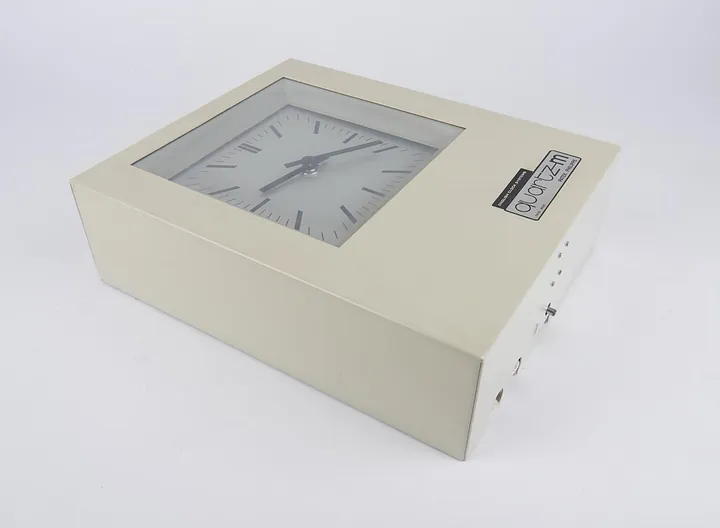
Quartz master clock QM 1, with movement by Patek Phillippe, Switzerland, 1965–1975. Supplied by English Clock Systems.
Science Museum Group, London
Instruments · 1965–1984
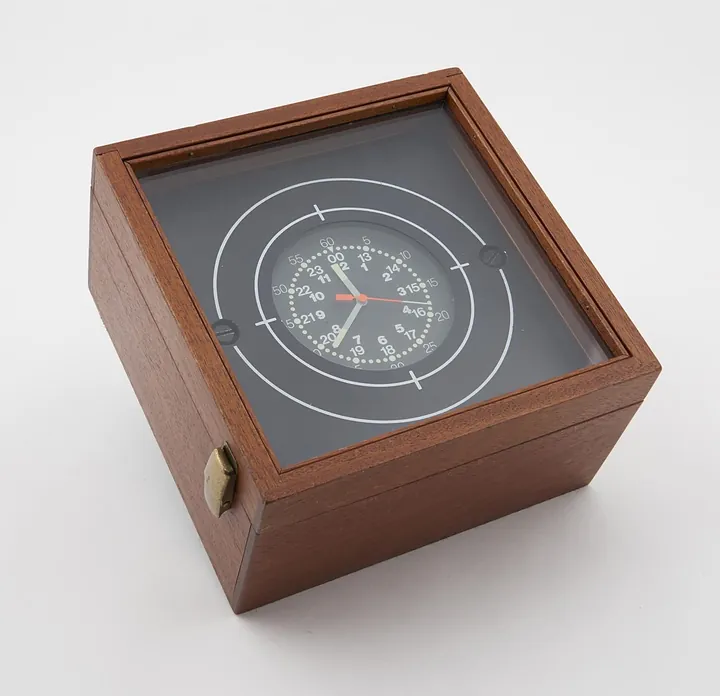
Chronometer by Patek Philippe and Kelvin Hughes, England, 1965–1984
Science Museum Group, London
Pocket Watches · c. 1895
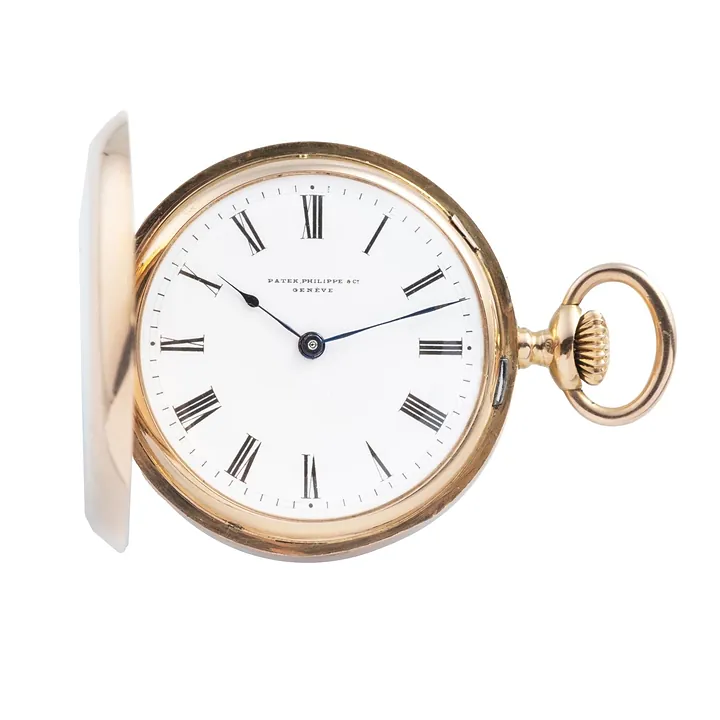
Patek Philippe pocket watch, c. 1895
Antiquorum auction archive, Geneva
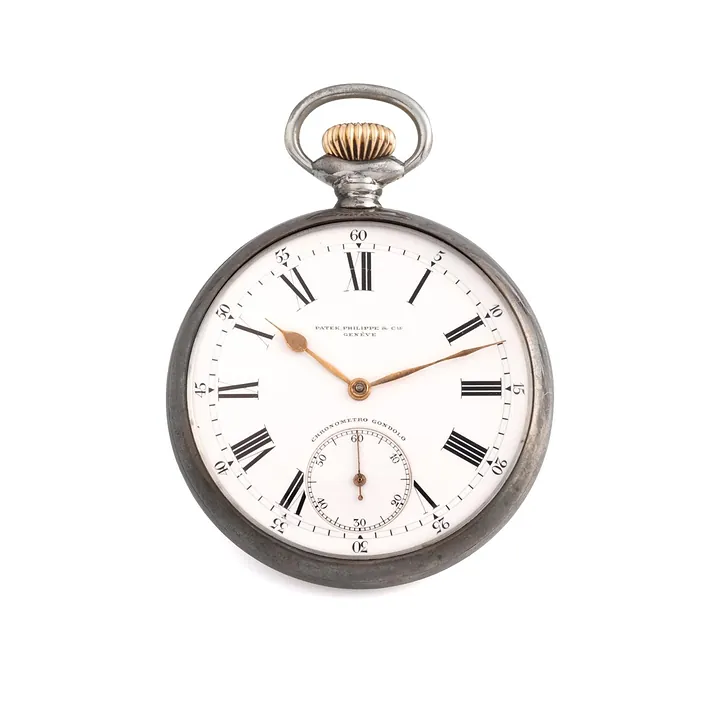
Pocket Watches · c. 1900
Patek Philippe Chronometro Gondolo, c. 1900
Antiquorum auction archive, Geneva

Wristwatches · 2008
Wristwatch by Breitling?, 2008
Museum Rotterdam

Wristwatches · c. 1990s
Audemars Piguet Bamboo, c. 1990s
Antiquorum auction archive, Geneva

Wristwatches · c. 1990
Audemars Piguet Huitieme Perpetual Calendar, ref. 25696PT, c. 1990
Antiquorum auction archive, Geneva

Wristwatches · c. 1990
Breitling Chronomat, ref. b13050.1, c. 1990
Antiquorum auction archive, Geneva