
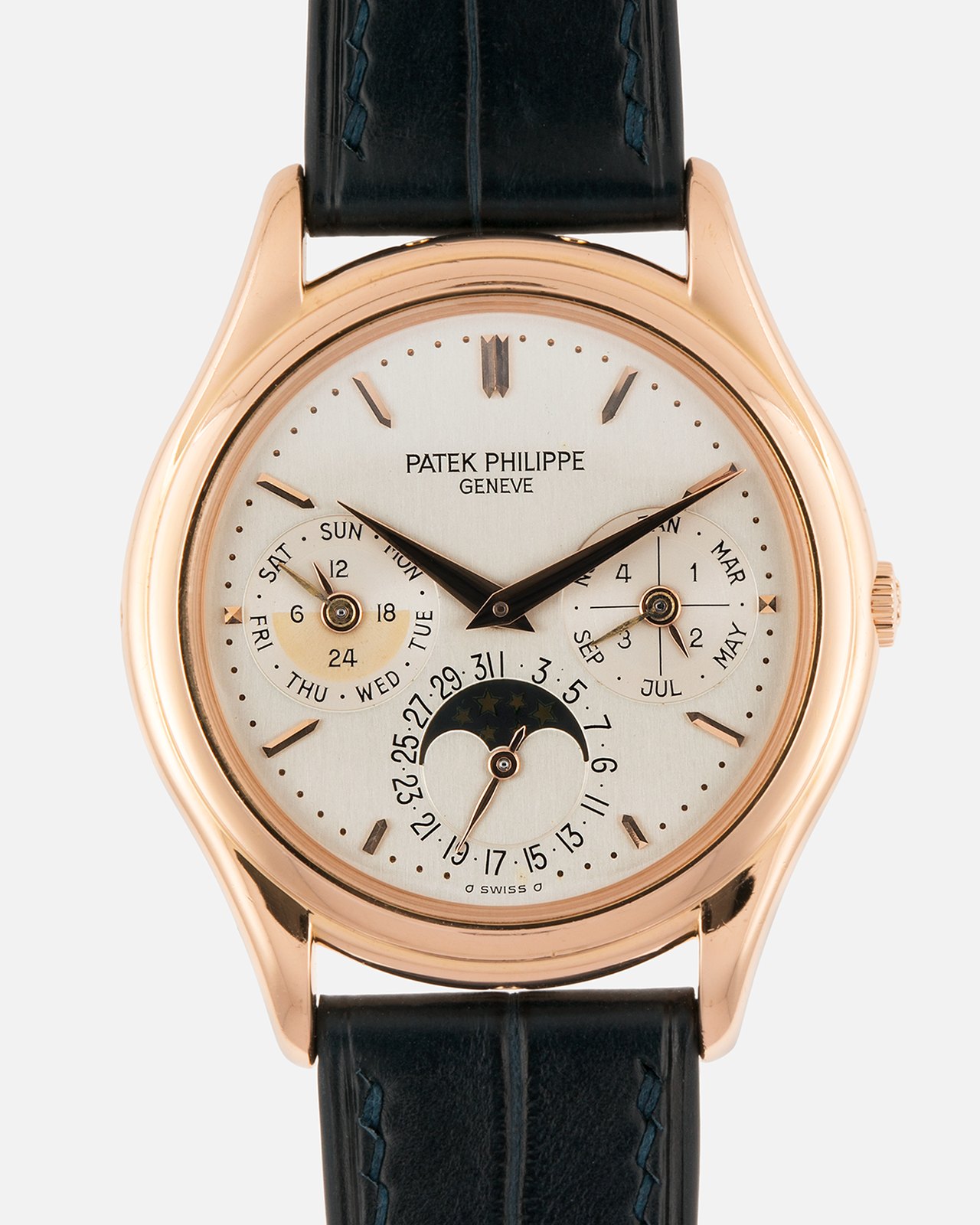
Wristwatches · Wristwatch
Patek Philippe Perpetual Calendar 3940R Second Series, 1995
- Maker / attribution
- Patek Philippe (maker)
- Date
- 1995
- Historical period
- Mechanical Renaissance (1990 – 2010)
- Country of origin
- Switzerland
- Object type
- Wristwatch
- Dimensions
- Case 36 mm
- Stock no.
- Product 7814610681943
- Credit line
- Dealer listing, S.Song Watches (product 7814610681943)
- Catalogue title (original)
- Patek Philippe Perpetual Calendar 3940R Second Series (English)
View the source record (dealer listing) ↗ (opens another website in a new tab)Suggest a correction
Record summary
Catalogued by S.Song Watches (dealer), Seattle (stock number Product 7814610681943), this is a wristwatch by Patek Philippe, made in Switzerland, dated 1995. The Atlas places it in the Mechanical Renaissance period (1990 – 2010) of its Wristwatches collection. Recorded dimensions: Case 36 mm. The record is illustrated with 6 photographs.
Assembled from the source record's structured fields. Dates and attributions are given as the source states them; where a field is missing the Atlas leaves it blank rather than estimating.
Catalogue description
Dealer description — S.Song Watches
The Patek Philippe 3940 is considered one of the most important watches in the manufacture's modern history. Introduced in 1985 alongside its sibling, the perpetual calendar chronograph 3970, it arrived at a particularly uncertain moment for the Swiss watch industry. The Quartz Crisis had decimated traditional Swiss watchmaking, and investment into complicated mechanical watches had largely disappeared. Yet under Philippe Stern, Patek Philippe did almost the opposite, introducing two highly complicated watches into regular production at precisely the moment when mechanical watchmaking appeared increasingly obsolete. The 3940 was particularly significant. While Patek Philippe had produced perpetual calendars for decades, these were historically made in extremely small quantities. The 3940 brought the complication into serial production and paired it with an entirely new automatic movement, the Calibre 240 Q. In many ways, it helped establish the template for Patek Philippe's modern perpetual calendar, both mechanically and aesthetically. Perhaps the greatest endorsement of the 3940 came from Philippe Stern himself. Despite having access to virtually anything produced by the manufacture, Stern famously chose a first-series 3940 with a Beyer-signed doré dial as his personal watch and wore it regularly. The configuration itself is exceptionally unusual, but more importantly, his decision to wear the 3940 says a great deal about the significance of the reference during one of the most formative periods in modern Patek Philippe history. Produced for more than two decades, the 3940 evolved gradually throughout its production, with collectors generally dividing the reference into three main series. Here, we have a later second-series example, distinguished by its bevelled subsidiary dials, cross divider within the leap-year indicator and the Swiss sigma signature positioned below the outer minute track. The typography is another subtle distinction. Second-series dials retain the more traditional serif typeface of the earlier watches, most easily identified by details such as the shape of the letter "J" and the numeral "5". With the introduction of the third series, these were replaced by a cleaner, more modern sans-serif font, making the typography of the second series another small but important link to the earlier 3940s. More importantly, this particular watch is a 3940R, crafted from 18-carat rose gold. While yellow gold, white gold and platinum examples can be found throughout the broader production of the reference, rose gold was only introduced towards the end of the second series. As a result, second-series examples in rose gold occupy a relatively narrow production window and are considerably less frequently encountered than the more familiar 3940J. The rose gold also changes the character of the watch considerably. While not so obvious at first glance, once put next to a yellow gold example, the difference becomes apparent. Its warm case is paired with an opaline dial, applied rose gold baton markers and matching dauphine hands. Despite displaying the day, date, month, leap year, 24-hour indication and moonphase, the dial remains remarkably coherent. Each subsidiary dial displays two sets of information, arranged within concentric circles to create a clear hierarchy across what is ultimately a very complicated display. The case itself measures just 36mm across and approximately 8.5mm thick. These proportions are an important part of what makes the 3940 so successful. It is an extremely complicated watch, yet with the shape and curvature of the lugs, on the wrist, it wears so naturally and elegantly. Powering it is the self-winding Calibre 240 Q. Its off-centred micro-rotor sits within the movement rather than above it, allowing Patek Philippe to accommodate the perpetual calendar mechanism while keeping the overall movement remarkably thin. This architecture was fundamental to the proportions of the 3940 and would go on to become one of Patek Philippe's most important modern movement families. The present example retains remarkably crisp hallmarks on the side of the case, a feature associated with earlier 3940 production before the hallmarks eventually migrated entirely to the backs of the lugs. On a highly polished rose gold case, their definition is a particularly nice indication of how well the watch has been preserved. For me, the 3940 is significant not simply because it is a perpetual calendar, but because of what it represented for Patek Philippe at the time. Introduced in the middle of one of the most difficult periods for Swiss mechanical watchmaking, it became the foundation for an entire generation of complicated Patek Philippe watches. The second-series 3940R takes that already important reference and adds another layer of rarity, with rose gold appearing only towards the end of the series. Combined with its beautifully preserved case and crisp side hallmarks, this is a particularly special example of one of Patek Philippe's most important modern watches. Oh, and also, I personally own one, given to me by my father, and I find it to be one of the nicest watches ever made. There's a difference between a watch that looks nice and a watch that is nice to wear. One is easier to do than the other, and the 3940 falls into the latter. It is a design masterpiece.
Historical context
Mechanical Renaissance (1990 – 2010)
Mechanical watches return as cultural objects; independent watchmaking flourishes.
Mechanical watches returned as cultural and luxury objects. Complications, tourbillons and new materials proliferated; independent watchmakers such as George Daniels, F.P. Journe and Philippe Dufour revived artisanal watchmaking; collecting vintage watches became a major field.
Read the period in the timelineMore wristwatches from this periodEarlier: Quartz Revolution
Atlas type guide
Calendar, moon-phase and perpetual calendar watches
Calendar complications range from a simple date to the perpetual calendar, which automatically allows for months of different lengths and leap years until 2100. Pocket watches with perpetual calendars were made in the eighteenth and nineteenth centuries; Patek Philippe made the first perpetual calendar wristwatch in 1925, and series production followed in 1941. The annual calendar (Patek Philippe, 1996) needs correction only once a year.
Moon-phase displays use a disc with two moons and 59 teeth advanced daily, approximating the 29.5-day lunation; more precise trains reduce the error to one day in over a century.
What to look for
- Apertures or subsidiary dials for day, date, month and leap year.
- Moon disc under a 'bosom' shaped aperture.
- Recessed correctors on the case band for setting the calendar.
Dating clues
- Triple-date wristwatches: popular c. 1940–1955.
- Perpetual calendar wristwatches: from 1925 (unique) and 1941 (series).
General guidance written by the Atlas editors about this kind of object. It is not a statement about this particular piece; for that, rely on the source record above and on physical examination.
Related records

Clocks · 1965–1975
Quartz master clock QM 1, with movement by Patek Phillippe, Switzerland, 1965–1975. Supplied by English Clock Systems.
Science Museum Group, London

Instruments · 1965–1984
Chronometer by Patek Philippe and Kelvin Hughes, England, 1965–1984
Science Museum Group, London

Pocket Watches · c. 1895
Patek Philippe pocket watch, c. 1895
Antiquorum auction archive, Geneva

Pocket Watches · c. 1900
Patek Philippe Chronometro Gondolo, c. 1900
Antiquorum auction archive, Geneva

Wristwatches · 2008
Wristwatch by Breitling?, 2008
Museum Rotterdam

Wristwatches · c. 1990s
Audemars Piguet Bamboo, c. 1990s
Antiquorum auction archive, Geneva

Wristwatches · c. 1990
Audemars Piguet Huitieme Perpetual Calendar, ref. 25696PT, c. 1990
Antiquorum auction archive, Geneva

Wristwatches · c. 1990
Breitling Chronomat, ref. b13050.1, c. 1990
Antiquorum auction archive, Geneva