
Wristwatches · Wristwatch
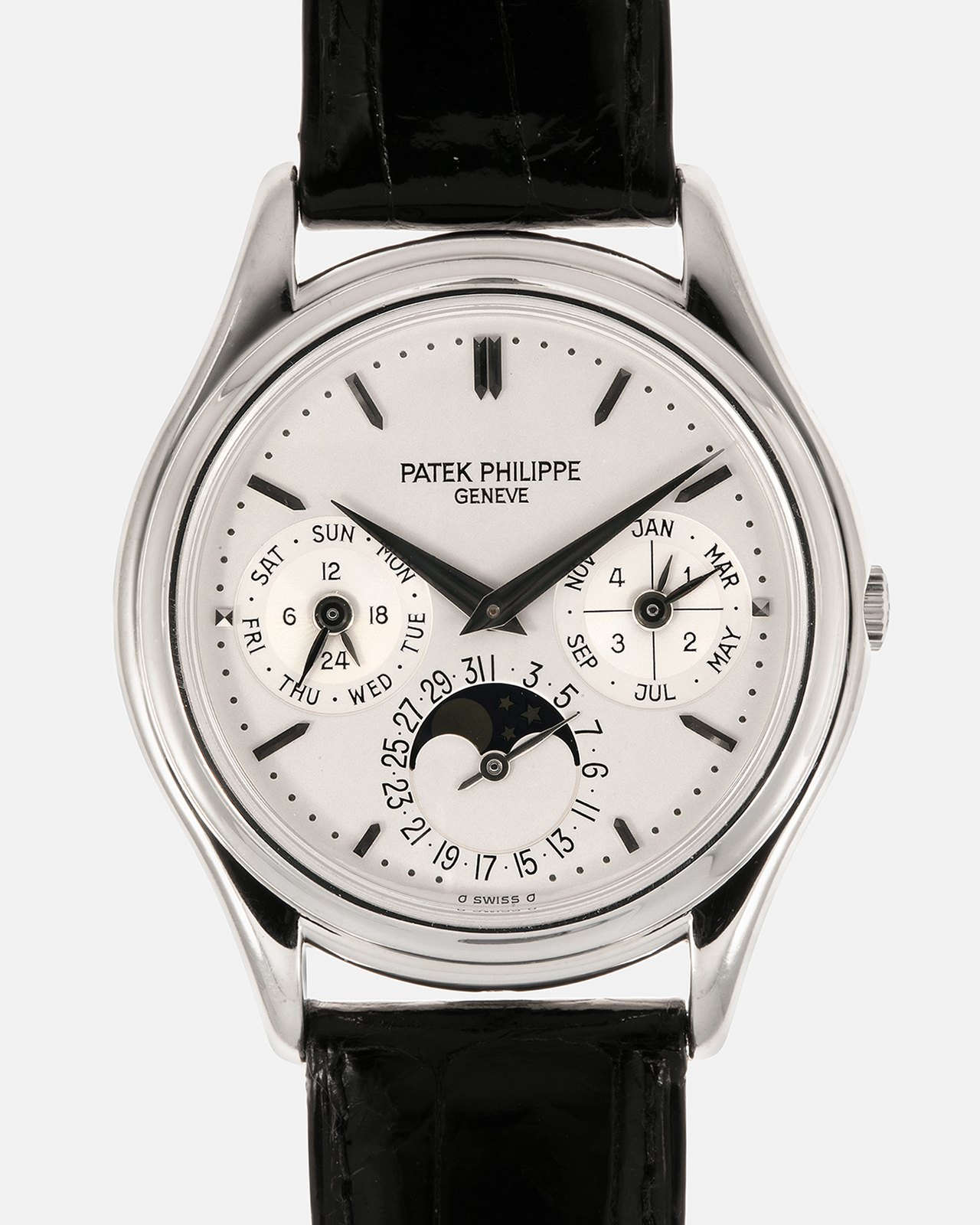
Patek Philippe 3940P Perpetual Calendar Second Series, 1994
- Maker / attribution
- Patek Philippe (maker)
- Date
- 1994
- Historical period
- Mechanical Renaissance (1990 – 2010)
- Country of origin
- Switzerland
- Object type
- Wristwatch
- Dimensions
- Case 36 mm
- Stock no.
- Product 7468709249111
- Credit line
- Dealer listing, S.Song Watches (product 7468709249111)
- Catalogue title (original)
- Patek Philippe 3940P Perpetual Calendar Second Series (English)
View the source record (dealer listing) ↗ (opens another website in a new tab)Suggest a correction
Record summary
Catalogued by S.Song Watches (dealer), Seattle (stock number Product 7468709249111), this is a wristwatch by Patek Philippe, made in Switzerland, dated 1994. The Atlas places it in the Mechanical Renaissance period (1990 – 2010) of its Wristwatches collection. Recorded dimensions: Case 36 mm. The record is illustrated with 6 photographs.
Assembled from the source record's structured fields. Dates and attributions are given as the source states them; where a field is missing the Atlas leaves it blank rather than estimating.
Catalogue description
Dealer description — S.Song Watches
The Patek Philippe 3940 is considered one of the most important pieces in Patek’s modern history, as it was the first highly complicated, serially produced timepiece with a perpetual calendar, alongside its sibling, the perpetual calendar chronograph 3970. When viewed in context, the 3940 is significant in that when it was released in 1985, Switzerland was in turmoil. An economic crisis in the Swiss watchmaking industry set upon by the Quartz crisis (or revolution, depending on how you look at it), mechanical watches, a significant driver of the Swiss economy, had, on paper, become redundant. As an indicator of the drastic times and the effects felt, the number of people working in the Swiss watch industry dwindled from 90,000 to around 28,000 in the space of 18 years. During this time of uncertainty, Patek Philippe, then headed by Philippe Stern, surprisingly released the 3940 and 3970 as a pair. Big Swiss companies were not making complicated pieces at this time, as the decline in the industry meant that there was no spare money for innovative investment, but instead only enough to consolidate whatever market share they had left. To release a perpetual calendar and perpetual calendar chronograph at the same time was certainly a bold move by Patek, and the timing could not have been greater, as the tide was slowly turning with people realising the value of mechanical watches. This is partly because looking at a mechanical watch and its movement is a very relatable experience, where you can see how it works, how it is all connected, unlike a quartz watch that is powered by an incomprehensible chipboard. Perhaps it has something to do with a universal appreciation we have for artisanal craftsmanship as a whole, but whatever it was, this watch is a significant bedrock as to how far Patek has come today, despite the adversities it faced. It is no coincidence that Philippe Stern himself, who, despite being in the position to wear any and as many Patek Philippe watches he wished, chose to wear a 3940 every day. Stepping back from the broader contextual significance of the 3940 reference, the watch itself stands as a marvel of both design and mechanical ingenuity. The example offered here hails from the second series of the 3940, produced between 1987 and the end of 1994. More specifically, according to its accompanying paperwork, this piece specifically dates to December 1994, placing it towards the later end of the second-series production run, which began sometime in 1989. Starting with the 3940P’s 36mm × 8.5mm platinum case, the watch sits proportionately on the wrist, and its ultra-slim profile completes what is perhaps one of the most understated and elegant timepieces. It houses the beautifully finished in-house Cal. 240 Q, a perpetual calendar movement that is as technically impressive as it is aesthetically refined. One of its defining features is the integrated off-centered micro-rotor, which enables the watch to maintain an incredibly slim profile of just 9mm, despite its mechanical complexity. To ensure that such a compact rotor could generate sufficient winding power, it was crafted in 22-carat gold, with the added mass providing the necessary inertia to efficiently wind the mainspring. As we all know, making a perpetual calendar is no easy task, with 275 different parts, and as testament to this, at the time it was released, there were only two people within the manufacture allowed to make watches this complicated. Sure, a perpetual calendar does not enjoy the same status as a chronograph, despite being more difficult to manufacture, as it lacks the tactile experience. But for a watch to have an integrated memory of 4 years, accounting for the days in every month, including February and the leap year, involves a large measure of skill. Add a moon phase and a 24-hour clock on top, and you’ll start to understand the grandeur and overall complexity of this. The aesthetics of the 3940 is a masterful exercise in restraint, a timeless design combining the need for legibility with a beautiful symmetry of sub-dials. It has a silver dial with gold applied index markers and dauphine hands. Each sub-dial provides two sets of information, with the 3:00 sub-dial showing the leap year indicator and the day of the week, the 6:00 sub-dial showing the enamel moon phase and the day of the month, and finally the 9:00 sub-dial showing the 24-hour clock and the month. As a whole, the sub-dials are systemised within concentric circles and in an obvious hierarchy, with the day, month and date on the outer track of the sub-dial, with the less important leap year indicator, moon phase and 24-hour clock inside it. A noteworthy detail in later second-series models, such as this one, is the presence of a cross-divider on the leap year indicator, distinguishing it visually from its earlier counterparts. Also, a cool little quirk of these 3940s is in the 24-hour sub-dial. In what looks to be discolouration, the orange tint of the bottom half is actually a subtle indicator to show that it is nighttime. Completing the ensemble is a Patek Philippe signed deployant clasp. The 3940 was made in yellow, rose, white gold, and platinum, with this particular example obviously being the latter and most expensive variant available at the time, as denoted by the “P” in its reference number. The added heft of platinum is immediately noticeable on the wrist, offering a tactile sense of gravitas. While the white gold and platinum models may appear nearly identical at first glance, there are subtle yet distinctive aesthetic differences. A distinguishing feature lies in the caseback. Whereas clients purchasing gold models were given the option between an exhibition or solid caseback, with both options later becoming available across the board during the later stages of the second series production run, platinum models were only produced exclusively with a solid caseback. This further reinforces the visual and physical weight o
Historical context
Mechanical Renaissance (1990 – 2010)
Mechanical watches return as cultural objects; independent watchmaking flourishes.
Mechanical watches returned as cultural and luxury objects. Complications, tourbillons and new materials proliferated; independent watchmakers such as George Daniels, F.P. Journe and Philippe Dufour revived artisanal watchmaking; collecting vintage watches became a major field.
Read the period in the timelineMore wristwatches from this periodEarlier: Quartz Revolution
Atlas type guide
Calendar, moon-phase and perpetual calendar watches
Calendar complications range from a simple date to the perpetual calendar, which automatically allows for months of different lengths and leap years until 2100. Pocket watches with perpetual calendars were made in the eighteenth and nineteenth centuries; Patek Philippe made the first perpetual calendar wristwatch in 1925, and series production followed in 1941. The annual calendar (Patek Philippe, 1996) needs correction only once a year.
Moon-phase displays use a disc with two moons and 59 teeth advanced daily, approximating the 29.5-day lunation; more precise trains reduce the error to one day in over a century.
What to look for
- Apertures or subsidiary dials for day, date, month and leap year.
- Moon disc under a 'bosom' shaped aperture.
- Recessed correctors on the case band for setting the calendar.
Dating clues
- Triple-date wristwatches: popular c. 1940–1955.
- Perpetual calendar wristwatches: from 1925 (unique) and 1941 (series).
General guidance written by the Atlas editors about this kind of object. It is not a statement about this particular piece; for that, rely on the source record above and on physical examination.
Related records
Clocks · 1965–1975
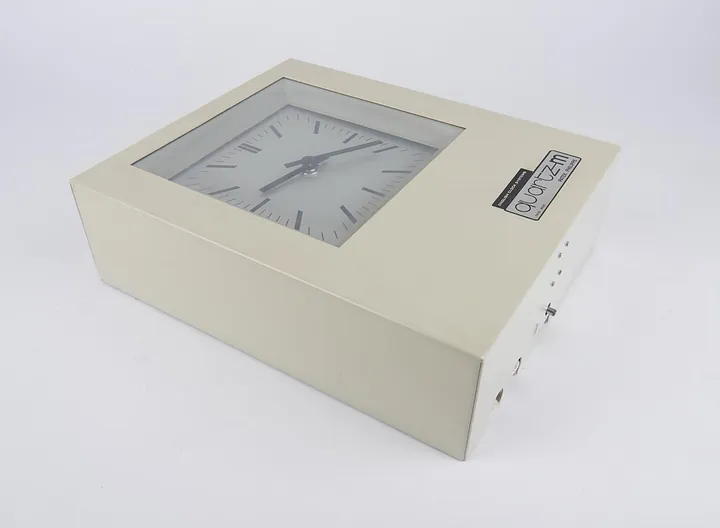
Quartz master clock QM 1, with movement by Patek Phillippe, Switzerland, 1965–1975. Supplied by English Clock Systems.
Science Museum Group, London
Instruments · 1965–1984
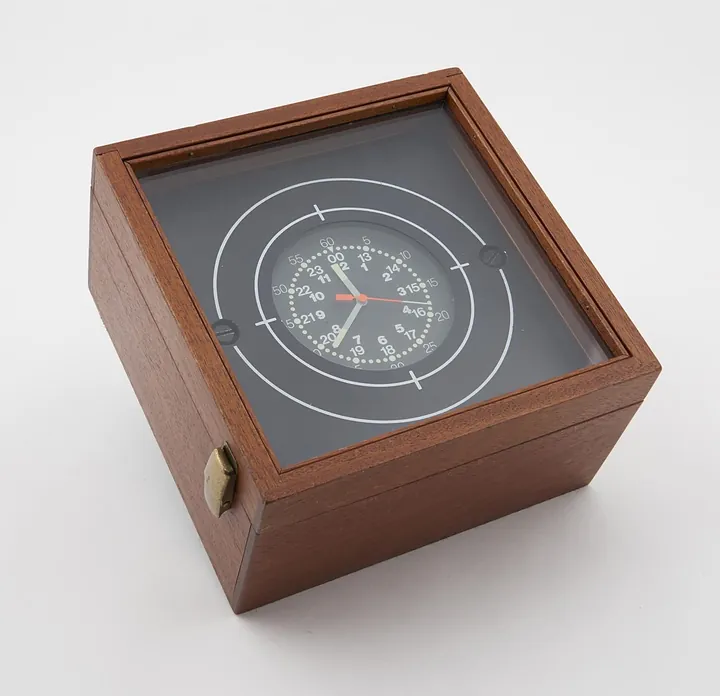
Chronometer by Patek Philippe and Kelvin Hughes, England, 1965–1984
Science Museum Group, London
Pocket Watches · c. 1895
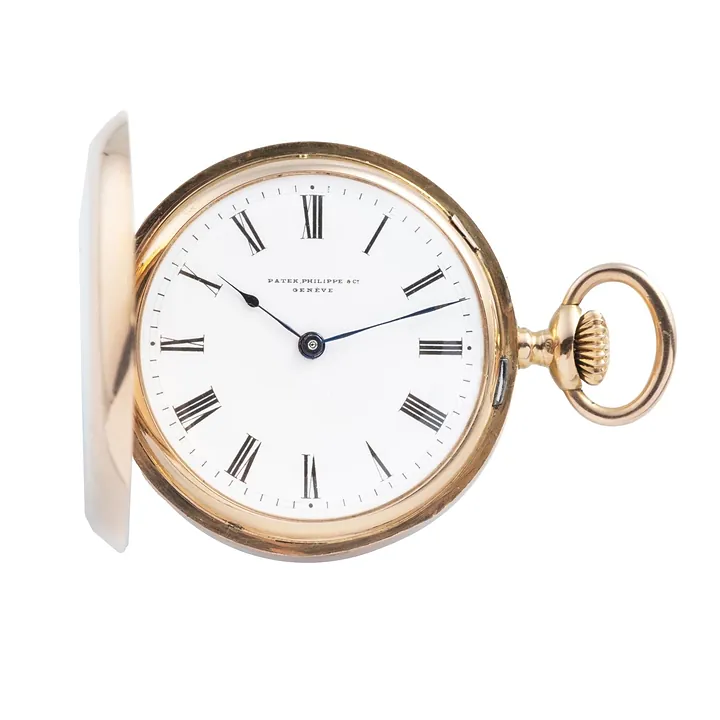
Patek Philippe pocket watch, c. 1895
Antiquorum auction archive, Geneva

Pocket Watches · c. 1900
Patek Philippe Chronometro Gondolo, c. 1900
Antiquorum auction archive, Geneva

Wristwatches · 2008
Wristwatch by Breitling?, 2008
Museum Rotterdam

Wristwatches · c. 1990s
Audemars Piguet Bamboo, c. 1990s
Antiquorum auction archive, Geneva

Wristwatches · c. 1990
Audemars Piguet Huitieme Perpetual Calendar, ref. 25696PT, c. 1990
Antiquorum auction archive, Geneva

Wristwatches · c. 1990
Breitling Chronomat, ref. b13050.1, c. 1990
Antiquorum auction archive, Geneva