
Wristwatches · Wristwatch
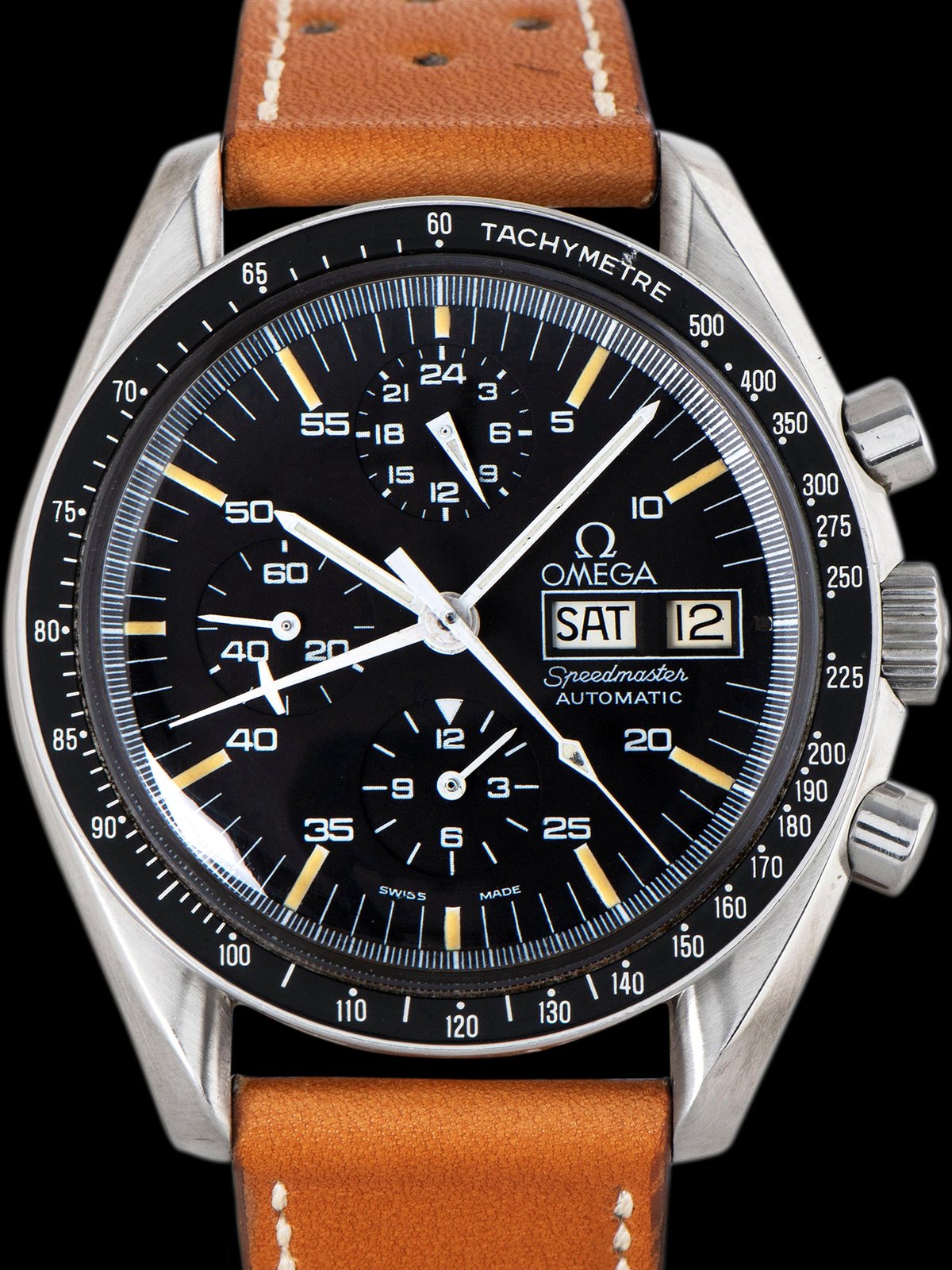
Omega Speedmaster Automatic (Ref. 376.0822) "Holy Grail", 1987
- Maker / attribution
- Omega (maker)
- Date
- 1987
- Historical period
- Quartz Revolution (1969 – 1990)
- Country of origin
- Switzerland
- Object type
- Wristwatch
- Stock no.
- OMSPHG3760822
- Credit line
- Dealer listing, Craft & Tailored (OMSPHG3760822)
- Catalogue title (original)
- 1987 Omega Speedmaster Automatic (Ref. 376.0822) "Holy Grail" (English)
View the source record (dealer listing) ↗ (opens another website in a new tab)Suggest a correction
Record summary
Catalogued by Craft & Tailored (dealer), Los Angeles (stock number OMSPHG3760822), this is a wristwatch by Omega, made in Switzerland, dated 1987. The Atlas places it in the Quartz Revolution period (1969 – 1990) of its Wristwatches collection. The record is illustrated with 6 photographs.
Assembled from the source record's structured fields. Dates and attributions are given as the source states them; where a field is missing the Atlas leaves it blank rather than estimating.
Catalogue description
Dealer description — Craft & Tailored
The Omega Speedmaster Professional remains one of the most iconic chronographs ever produced. Its story spans from the world of motorsport to aviation, and ultimately to NASA and the U.S. Space Program. Within the expansive Speedmaster lineage, countless subtle reference variations have become highly sought after by collectors. By the mid-1980s, Omega faced mounting pressure from inexpensive and technologically advanced Japanese quartz watches. In response, the brand introduced a trio of innovative limited-production Speedmasters that expanded upon the traditional Moonwatch formula: • 20-Year Flight-Qualified for Space (Ref. ST 345.0808, 1985–1988) — A numbered series of 1,000 pieces and the first Moonwatch-cased Speedmaster to feature a display caseback, revealing the copper-colored Calibre 863. • "Speedy-Moon" (Ref. ST 345.0809, 1985–1988) — Produced in approximately 1,300 examples and the first Moonwatch-cased Speedmaster equipped with a moonphase complication, powered by the Calibre 866. • "Holy Grail" (Ref. ST 376.0822, 1987–1988) — Produced in approximately 1,800 examples and the first Moonwatch-cased Speedmaster fitted with a self-winding chronograph movement, featuring both day and date displays and powered by the Calibre 1045. The "Holy Grail" Speedmaster, its nickname coined by the late Omega authority Chuck Maddox, is among the most uncommon and desirable Speedmaster variants ever produced. Combining the classic design language of the Speedmaster Professional with the highly regarded Lemania-based Calibre 1045 from the Speedmaster Mark 4.5, it represents a unique fusion of form and function. In addition to the traditional chronograph layout, the Calibre 1045 incorporates day and date displays as well as a 24-hour indicator, creating one of the most technically sophisticated and compelling Speedmasters of its era. SPECS Stock # OMSPHG3760822 Brand Omega Style Speedmaster Automatic "Holy Grail" Model 376.0822 Serial 482XXXXX Size Men's Material Stainless Steel Dial Matte Black Millimeters 42 Strap 2pc Handmade Leather Rally Strap CASE & BRACELET The slightly modified take on the classic asymmetrical case design makes for a slightly thicker timepiece, to accomodate for the extra complications as well as the automatic winding function. The case itself is in wonderful condition, exhibiting minimal signs of wear and only light evidence of prior polishing. The black aluminum tachymetre bezel remains in well-preserved, clean condition, with only signs of gentle wear present. The case retains its original pump pushers and Omega-signed crown. The case back is in very crisp condition, with the medallion fully intact, and only light wear marks. The watch comes supplied on a 2pc handmade leather rally strap. DIAL & HANDS The original matte black dial is the perfect combination of complicated, but uncluttered, and remains in excellent vintage condition, with no damage or wear present on the dial itself. The tritium lume plots have achieved a golden yellow patina and remain almost entirely intact, though the 3 o'clock plot is missing, which is common for this model. All of the hands, including the subsidiary hands, remain original to the watch. Under UV light inspection, the lume in the minute hand exhibits some minor cracking and remains stable, and the lume in the center chronograph hand features a small repair and also remains stable, while the lume in the hour hand and 24-hour hand exhibit no degradation. The lume in the hands has taken on a subtle green coloration throughout, which is common for Speedmaster lume in this era. ACCESSORIES None. The watch is keeping time perfectly, though the service history is unknown. A movement service can be purchased upon request.
Historical context
Quartz Revolution (1969 – 1990)
Seiko's Astron begins mass quartz timekeeping; traditional industries contract sharply.
Quartz and digital watches transformed the market after 1969. Swiss employment collapsed, Japanese and Hong Kong production soared, and the Swatch (1983) helped the Swiss industry recover; mechanical watches survived as luxury goods.
Read the period in the timelineMore wristwatches from this periodEarlier: Modern Mechanical Horology
Atlas type guide
Automatic (self-winding) watches
Self-winding watches use the wearer's motion to wind the mainspring. Abraham-Louis Perrelet and Breguet made 'perpétuelle' pocket watches with oscillating weights in the late eighteenth century, but the principle only became practical in the wristwatch. John Harwood patented a bumper automatic in 1923; Rolex's Perpetual rotor (1931) winding in one direction, and later bidirectional rotors (Eterna, Felsa Bidynator), established the modern form. Micro-rotors (Universal Genève, Buren) and peripheral rotors made automatic watches thinner.
What to look for
- A semicircular rotor turning 360° over the movement, or a 'bumper' weight that rebounds between springs.
- 'Automatic', 'Perpetual' or 'Self-winding' on the dial.
- A sealed screw-back case, since automatic watches are wound less often by the crown.
Dating clues
- Bumper automatics: 1923–c. 1955.
- Full rotors: from 1931 (Rolex); widespread after c. 1950.
- Micro-rotors: from 1954–1958.
General guidance written by the Atlas editors about this kind of object. It is not a statement about this particular piece; for that, rely on the source record above and on physical examination.
Related records

Instruments · 1950–1976
Omega Megaquartz 2400 marine chronometer, 1950–1976
Science Museum Group, London

Instruments · 1960–1979
Stopwatch / timer by Omega, 1960–1979
Science Museum Group, London

Instruments · 1960–1979
Stopwatch / timer by Omega, Switzerland, 1960–1979
Science Museum Group, London

Instruments · 1960–1979
Stopwatch by Omega, Swiss made, single-button type reading 0 - 60 seconds in fifths and 0 - 5 minutes in minutes on subsidiary dial, 1960-79.
Science Museum Group, London

Wristwatches · 1970
Wristwatch by Heno, Switzerland, 1970
Museum Rotterdam

Wristwatches · 1960–1986
'Tri-Compax' calendar chronograph wristwatch in gold case, by Universal, Geneva, Switzerland, 1960–1986.
Science Museum Group, London

Wristwatches · 1969–1970
Beta 21 Quartz wristwatch movement, made in Switzerland, 1970.
Science Museum Group, London

Wristwatches · c. 1969
Omega Speedmaster Moonwatch, ref. 145022-69st, c. 1969
Antiquorum auction archive, Geneva