
Wristwatches · Wristwatch
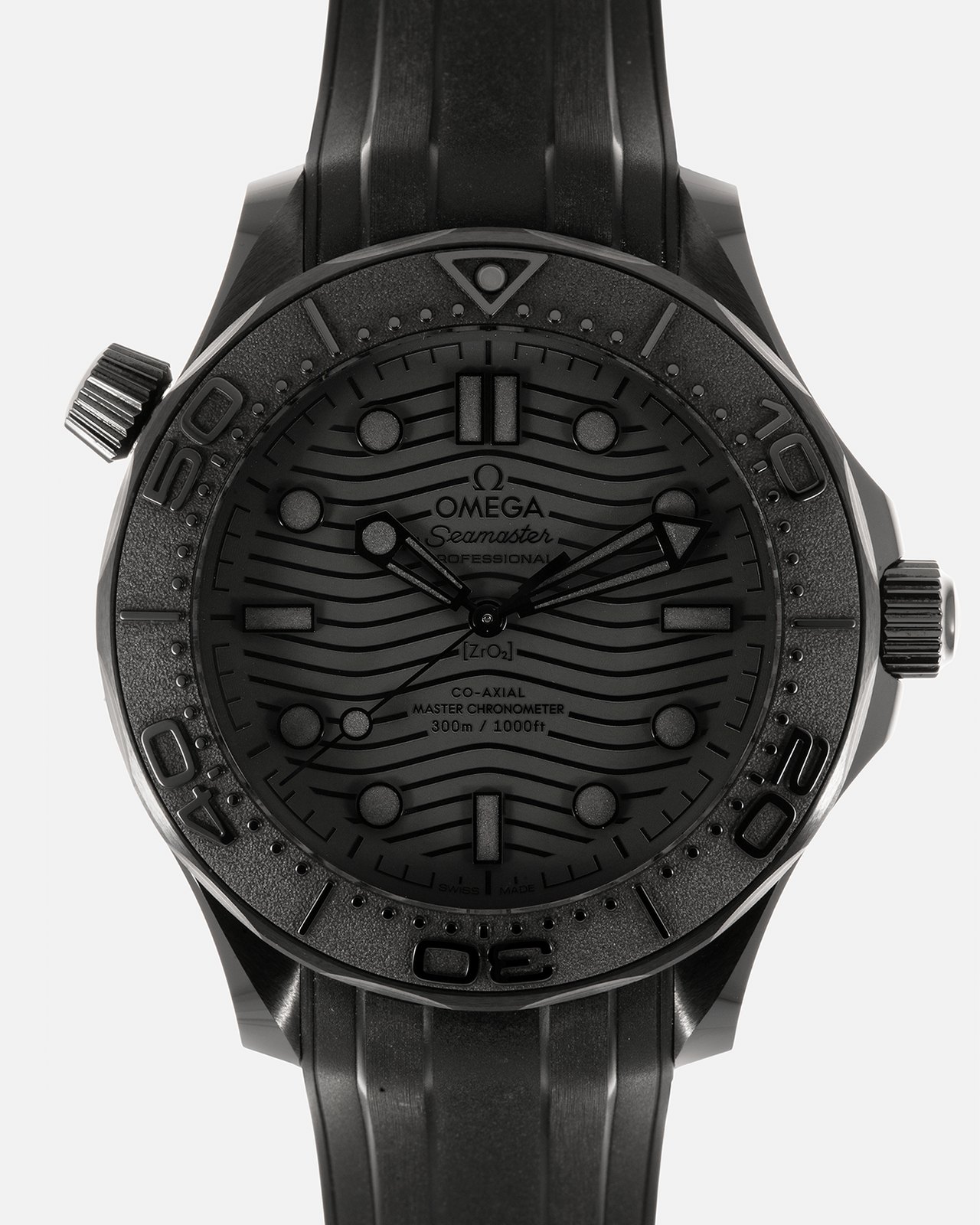
Omega Seamaster Diver 300m Black Black, 2022
- Maker / attribution
- Omega (maker)
- Date
- 2022
- Historical period
- Contemporary Horology (2010 – Present)
- Country of origin
- Switzerland
- Object type
- Wristwatch
- Dimensions
- Case 43.5 mm
- Stock no.
- Product 7309403521111
- Credit line
- Dealer listing, S.Song Watches (product 7309403521111)
- Catalogue title (original)
- Omega Seamaster Diver 300m Black Black (English)
View the source record (dealer listing) ↗ (opens another website in a new tab)Suggest a correction
Record summary
Catalogued by S.Song Watches (dealer), Seattle (stock number Product 7309403521111), this is a wristwatch by Omega, made in Switzerland, dated 2022. The Atlas places it in the Contemporary Horology period (2010 – Present) of its Wristwatches collection. Recorded dimensions: Case 43.5 mm. The record is illustrated with 6 photographs.
Assembled from the source record's structured fields. Dates and attributions are given as the source states them; where a field is missing the Atlas leaves it blank rather than estimating.
Catalogue description
Dealer description — S.Song Watches
This is the Omega Seamaster 300m ‘Black Black’—and no, that’s not a typo, because everything about this watch is black, except for the Co-Axial movement nestled within, of course. As one of Omega's more divisive modern offerings to date, the Seamaster ‘Black Black’ presents a technically sophisticated and contemporary interpretation of the classic Seamaster design template, by enveloping it in a sleek, all-black ceramic construction that extends from the case to the bezel, and even the crowns. I’d start by saying that the Seamaster ‘Black Black’ represents a conceptual juxtaposition in its own right. What was supposedly a tool watch—the Seamaster with its iconic and pragmatic design—has been presented in a material that seemingly detracts from its overall practicality and, to a larger extent, its legibility. However, Omega’s intention with the ‘Black Black’ wasn’t to stir controversy; rather, it aimed to showcase its technical expertise through the innovative use of materials and finishing techniques rarely seen in traditional watchmaking. After handling and experiencing the watch in the metal, it becomes evident to me that Omega has also thoughtfully designed the Seamaster ‘Black Black’ in a way that deliberately highlights the contrasting finishes on the dial, bezel, and, to some degree, the case itself, as an effort to compensate for legibility. This approach results in a watch with a beautifully sculpted, dynamic yet stealthy in appearance that remains surprisingly straightforward to read under regular lighting conditions. Starting with its robust 43.5mm x 14.47mm ZrO2 ceramic case, the Seamaster ‘Black Black’ showcases a stealthy yet aggressive styling not typically seen on the other Seamasters. Given that it is a proper professional dive watch, it utilizes a screw-down crown at 3:00 and a helium escape valve at the 10:00 position which are both crafted from ceramic. The watch also features a ceramic bezel insert with polished and raised numeral indications, complemented by a contrasting textured/grained finish that is achieved via laser ablation—a method that removes material by irradiating it with a concentrated laser beam. According to Omega, this addresses the common issue of fingerprints accumulating on the surface of ceramic by incorporating raised indications on the bezel in positive relief. Turning our attention to its seemingly all-black dial, the Seamaster ‘Black Black’ is, as I previously mentioned, surprisingly easy to read. This is achieved by having the Seamaster’s signature wave pattern engraved in positive relief, complemented by the text and Omega logo, which are all laser-ablated from a single piece of ceramic. Additionally, it also hosts a set of skeletonized hands at the center and applied hour markers in black PVD and filled with anthracite lume. The best part? There’s no date window aperture here to disrupt the uniformity of the dial—it is as clean as it gets. Powering the ‘Black Black’ is Omega’s in-house, self-winding, METAS-certified Cal. 8806. The movement is regulated by a Co-Axial escapement and a free-sprung balance wheel featuring a silicon balance spring. True to Omega's standards, this anti-magnetic (15,000-gauss) caliber is beautifully finished, showcasing a rhodium-plated rotor and bridges adorned with Geneva waves in Arabesque. It operates methodically at 25,200 bph and offers a 55-hour power reserve on a full wind. The movement can be admired through the sapphire exhibition caseback, which uses Omega’s patented NAIAD lock system, ensuring the caseback remains perfectly aligned when locked. In conclusion, I find it quite exciting to see brands like Omega pushing the technical boundaries of modern watchmaking, especially with their bold use of innovative technology and unconventional materials. In a time where innovation can sometimes feel stagnant, uninspiring and heavy with languor, this experimental spirit deserves to be celebrated.
Historical context
Contemporary Horology (2010 – Present)
Silicon components, connected watches, optical-lattice research clocks and a thriving independent scene.
Smartwatches became the world's best-selling watches, while mechanical watchmaking focuses on craft, innovation (silicon components, new escapements) and independent makers.
Read the period in the timelineMore wristwatches from this periodEarlier: Mechanical Renaissance
Atlas type guide
Dive and water-resistant watches
Keeping water and dust out of a wristwatch was a long-standing challenge. Rolex's screw-down Oyster case (1926) and Omega's Marine (1932) were landmarks; in the early 1950s Blancpain's Fifty Fathoms and Rolex's Submariner defined the professional dive watch with rotating bezels for timing dives, luminous dials and high water resistance. The ISO 6425 standard (1982) later codified what a 'diver's watch' must do.
Dive watches became icons of post-war design and exploration, and their evolution — helium escape valves, ceramic bezels, saturation-diving depth ratings — records the history of underwater work.
What to look for
- Unidirectional or bidirectional rotating bezel with minute markings.
- Screw-down crown and case back; depth rating printed on the dial.
- Luminous hands and markers (radium before c. 1960, tritium c. 1960–1998, then Super-LumiNova).
- Reference numbers on the case between the lugs or inside the back.
Dating clues
- Screw-down Oyster cases: from 1926.
- Professional dive watches: from 1953.
- Tritium 'T' marks on dials: c. 1960–1998.
General guidance written by the Atlas editors about this kind of object. It is not a statement about this particular piece; for that, rely on the source record above and on physical examination.
Related records

Instruments · 1950–1976
Omega Megaquartz 2400 marine chronometer, 1950–1976
Science Museum Group, London

Instruments · 1960–1979
Stopwatch / timer by Omega, 1960–1979
Science Museum Group, London

Instruments · 1960–1979
Stopwatch / timer by Omega, Switzerland, 1960–1979
Science Museum Group, London

Instruments · 1960–1979
Stopwatch by Omega, Swiss made, single-button type reading 0 - 60 seconds in fifths and 0 - 5 minutes in minutes on subsidiary dial, 1960-79.
Science Museum Group, London

Wristwatches · c. 2010s
Breguet Type XXI, ref. 3810, c. 2010s (Antiquorum Lot 381-24)
Antiquorum auction archive, Geneva

Wristwatches · c. 2010s
Breguet Type XXI, ref. 3810, c. 2010s (Antiquorum Lot 386-229)
Antiquorum auction archive, Geneva

Wristwatches · Sold in September 2010
Breitling Cosmonaute, ref. A 22322, Sold in September 2010
Antiquorum auction archive, Geneva

Wristwatches · c. 2010
Corum Bubble Chrono, ref. 396.150.20, c. 2010
Antiquorum auction archive, Geneva