
Wristwatches · Wristwatch
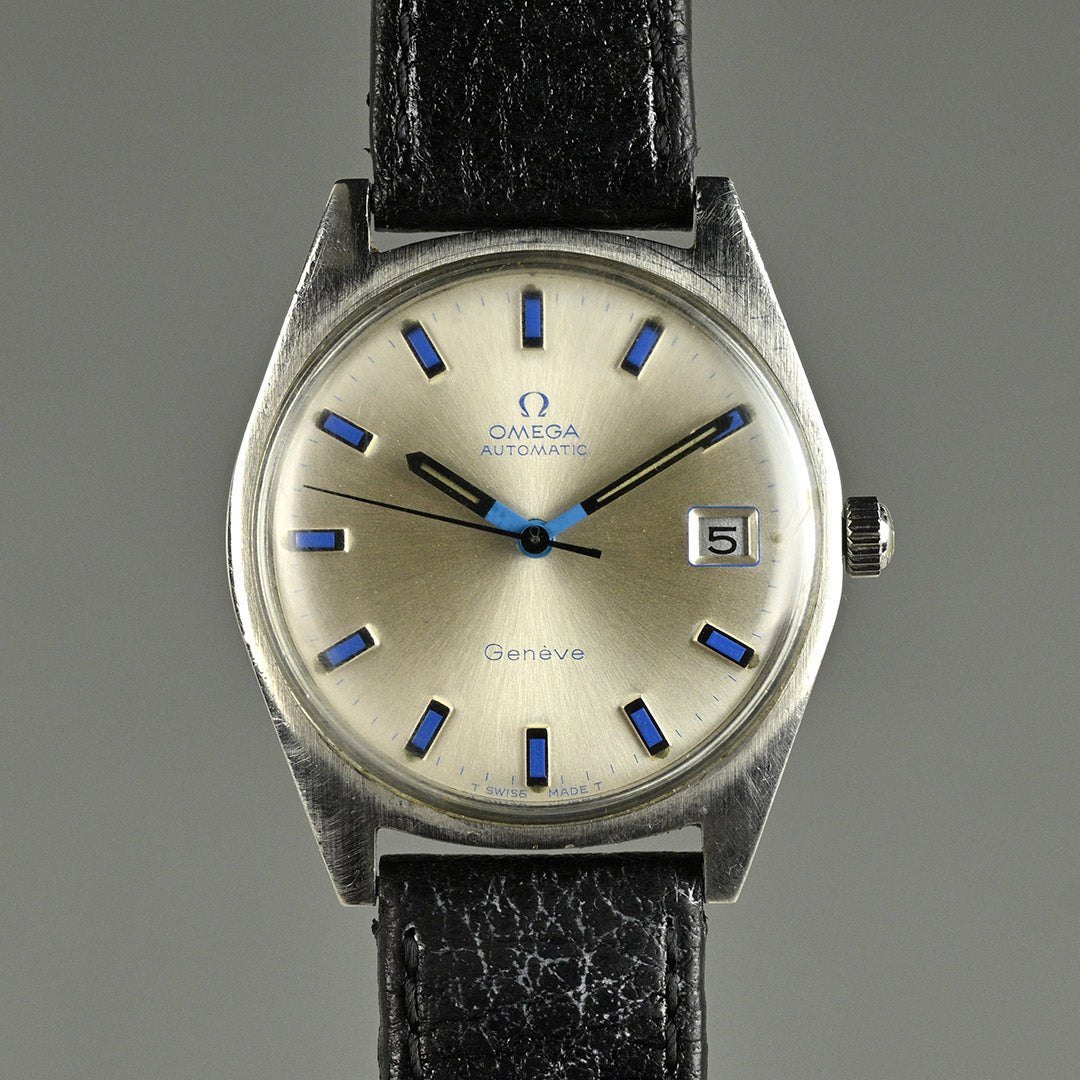
Omega Genève Automatic Date, ref. 166.041, Calibre 565, circa 1969
- Maker / attribution
- Omega (maker)
- Date
- c. 1969
- Historical period
- Quartz Revolution (1969 – 1990)
- Country of origin
- Switzerland
- Object type
- Wristwatch
- Dimensions
- Case 34 mm
- Stock no.
- vws4390cs
- Credit line
- Dealer listing, Vintage Watch Specialist (vws4390cs)
- Catalogue title (original)
- Omega Genève Automatic Date - Reference 166.041 - Calibre 565 - c.1969 (English)
View the source record (dealer listing) ↗ (opens another website in a new tab)Suggest a correction
Record summary
Catalogued by Vintage Watch Specialist (dealer), United Kingdom (stock number vws4390cs), this is a wristwatch by Omega, made in Switzerland, dated c. 1969. The Atlas places it in the Quartz Revolution period (1969 – 1990) of its Wristwatches collection. Recorded dimensions: Case 34 mm. The record is illustrated with 6 photographs.
Assembled from the source record's structured fields. Dates and attributions are given as the source states them; where a field is missing the Atlas leaves it blank rather than estimating.
Catalogue description
Dealer description — Vintage Watch Specialist
By the late 1960s, Omega's Genève collection had become an important part of the company's range, offering well-made Swiss watches with a slightly less formal character than some of Omega's more prestigious lines. The Genève name itself had appeared on Omega watches considerably earlier, but during the 1960s and early 1970s it became increasingly familiar as a collection in its own right. This period also produced some of Omega's most respected automatic movements. The Calibre 565 belongs to the company's 55x/56x movement family and combines automatic winding with a date complication. It is a 24-jewel movement with a power reserve of approximately 50 hours and is particularly associated with Omega watches of the 1960s and early 1970s. Reference 166.041 is a good example of Omega's late-1960s approach to everyday watch design. Rather than the round dress-watch cases that had dominated the previous decade, it has a more angular profile, while remaining relatively restrained by modern standards. It is a style that has aged particularly well. At 34mm, it retains the proportions of a genuine vintage watch, while its automatic movement and date display make it an eminently usable piece of late-1960s Omega. What’s on Offer Here we have an Omega Genève Automatic Date, reference 166.041, dating from approximately 1969 and powered by the 24-jewel Omega Calibre 565. The stainless-steel case measures approximately 34mm across and 40.5mm from top to bottom, with angular shoulders and short, substantial lugs giving it a pleasingly purposeful late-1960s shape. The silver sunburst dial is one of the most distinctive elements of this particular watch. Applied baton hour markers provide a splash of blue around the dial, complemented by the blue Omega symbol and signatures, this being very rare and unusual. The black and blue-accented hands add further contrast, while a framed date aperture at 3 o'clock completes the layout. The watch also retains its original Omega-etched Plexiglass, an important detail on a vintage Omega of this age. Inside is the Omega Calibre 565, a 24-jewel automatic movement with an approximate 50-hour power reserve. The watch has been placed on a timegrapher and the readings indicate that it is currently running well. It is fitted to a black leather strap, and with an 18mm lug width there is plenty of scope to change the look of the watch with an alternative strap if desired. Condition is rated at 7.5/10. There are visible marks and signs of wear to the case consistent with its age and previous use, which we have taken into account when assessing and pricing the watch. There is no original box or paperwork. Although this watch has been tested on a timegrapher and we believe it to be running well, its previous service history is unknown. A service can be arranged through our watchmaker at additional cost if required. Simply leave a note when placing your order and we will contact you to discuss this.
Historical context
Quartz Revolution (1969 – 1990)
Seiko's Astron begins mass quartz timekeeping; traditional industries contract sharply.
Quartz and digital watches transformed the market after 1969. Swiss employment collapsed, Japanese and Hong Kong production soared, and the Swatch (1983) helped the Swiss industry recover; mechanical watches survived as luxury goods.
Read the period in the timelineMore wristwatches from this periodEarlier: Modern Mechanical Horology
Atlas type guide
Automatic (self-winding) watches
Self-winding watches use the wearer's motion to wind the mainspring. Abraham-Louis Perrelet and Breguet made 'perpétuelle' pocket watches with oscillating weights in the late eighteenth century, but the principle only became practical in the wristwatch. John Harwood patented a bumper automatic in 1923; Rolex's Perpetual rotor (1931) winding in one direction, and later bidirectional rotors (Eterna, Felsa Bidynator), established the modern form. Micro-rotors (Universal Genève, Buren) and peripheral rotors made automatic watches thinner.
What to look for
- A semicircular rotor turning 360° over the movement, or a 'bumper' weight that rebounds between springs.
- 'Automatic', 'Perpetual' or 'Self-winding' on the dial.
- A sealed screw-back case, since automatic watches are wound less often by the crown.
Dating clues
- Bumper automatics: 1923–c. 1955.
- Full rotors: from 1931 (Rolex); widespread after c. 1950.
- Micro-rotors: from 1954–1958.
General guidance written by the Atlas editors about this kind of object. It is not a statement about this particular piece; for that, rely on the source record above and on physical examination.
Related records

Instruments · 1950–1976
Omega Megaquartz 2400 marine chronometer, 1950–1976
Science Museum Group, London

Instruments · 1960–1979
Stopwatch / timer by Omega, 1960–1979
Science Museum Group, London

Instruments · 1960–1979
Stopwatch / timer by Omega, Switzerland, 1960–1979
Science Museum Group, London

Instruments · 1960–1979
Stopwatch by Omega, Swiss made, single-button type reading 0 - 60 seconds in fifths and 0 - 5 minutes in minutes on subsidiary dial, 1960-79.
Science Museum Group, London

Wristwatches · 1970
Wristwatch by Heno, Switzerland, 1970
Museum Rotterdam

Wristwatches · 1960–1986
'Tri-Compax' calendar chronograph wristwatch in gold case, by Universal, Geneva, Switzerland, 1960–1986.
Science Museum Group, London

Wristwatches · 1969–1970
Beta 21 Quartz wristwatch movement, made in Switzerland, 1970.
Science Museum Group, London

Wristwatches · c. 1969
Omega Speedmaster Moonwatch, ref. 145022-69st, c. 1969
Antiquorum auction archive, Geneva