
Wristwatches · Wristwatch
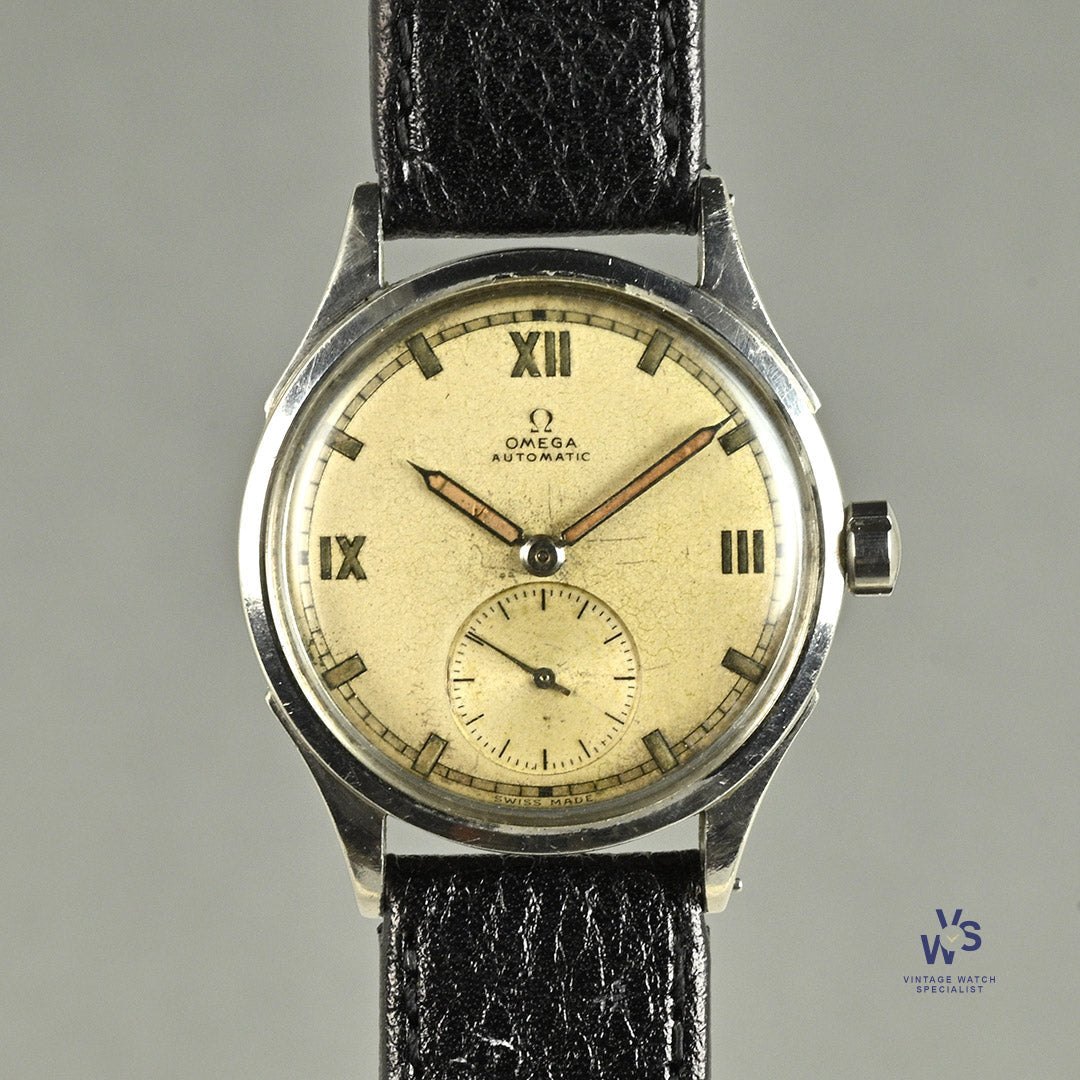
Omega Automatic Bumper, ref. 2375/1, circa 1944
- Maker / attribution
- Omega (maker)
- Date
- c. 1944
- Historical period
- Golden Age of Mechanical Watchmaking (1900 – 1945)
- Country of origin
- Switzerland
- Object type
- Wristwatch
- Dimensions
- Case 10 mm
- Stock no.
- vws4357cs
- Credit line
- Dealer listing, Vintage Watch Specialist (vws4357cs)
- Catalogue title (original)
- Omega Automatic Bumper - Reference 2375/1 - c.1944 (English)
View the source record (dealer listing) ↗ (opens another website in a new tab)Suggest a correction
Record summary
Catalogued by Vintage Watch Specialist (dealer), United Kingdom (stock number vws4357cs), this is a wristwatch by Omega, made in Switzerland, dated c. 1944. The Atlas places it in the Golden Age of Mechanical Watchmaking period (1900 – 1945) of its Wristwatches collection. Recorded dimensions: Case 10 mm. The record is illustrated with 6 photographs.
Assembled from the source record's structured fields. Dates and attributions are given as the source states them; where a field is missing the Atlas leaves it blank rather than estimating.
Catalogue description
Dealer description — Vintage Watch Specialist
Omega S/S Auto Bumper Movement Movement No: 10517455 Cal: 28.10 RA PC 17j Caseback/Model Ref: 2375/1 Patent + C. 1944 This Omega takes us back to the formative years of the automatic wristwatch, when self-winding technology was still developing and the familiar full-rotor system had yet to become the industry norm. Omega introduced its first automatic wristwatches in the early 1940s, using what collectors now commonly call a bumper movement. Rather than making a complete rotation, the oscillating weight travels through a limited arc before meeting sprung buffers at either end. The gentle movement of the weight can often be felt on the wrist, giving these early automatics a mechanical character quite unlike their modern descendants. The 28.10 RA PC belongs to this early generation of Omega automatic calibres. The movement was based around Omega's 28.10mm architecture and used the bumper winding system to replenish the mainspring as the watch was worn. In an era when manual winding remained entirely normal, an automatic watch was still a relatively novel proposition. Dating from around 1944, this example comes from a particularly interesting moment in Omega's history. Its restrained case proportions and subsidiary seconds retain the look of a traditional 1940s wristwatch, while the automatic movement inside points towards the direction watchmaking would increasingly take during the following decade. What’s on Offer Here we have an early Omega Automatic, reference 2375/1, dating from approximately 1944 and housing the 17-jewel Omega Calibre 28.10 RA PC bumper automatic movement. The stainless-steel case measures approximately 32mm across and 40mm from top to bottom, with an attractive stepped profile and gently curved lugs. These are authentic 1940s proportions, but the relatively long lug-to-lug measurement helps give the watch a little more presence on the wrist. Its dial is where much of this watch's vintage character lies. What would originally have been a much lighter surface has developed a warm cream tone with extensive age-related patina and fine crazing across the finish. It is visibly an old dial and, rather wonderfully, looks like one. The layout itself is particularly attractive. Bold Roman numerals at 12, 3 and 9 are combined with rectangular hour markers around the remainder of the dial. A railway-style minute track runs around its outer edge, while the Omega symbol and OMEGA AUTOMATIC signature sit neatly beneath 12 o'clock. At 6 o'clock is a recessed subsidiary seconds dial, helping to give the watch the balanced appearance associated with watches of this era. The hour and minute hands have also aged considerably, their warm tones sitting naturally alongside the patinated dial. Inside is the Omega Calibre 28.10 RA PC, a 17-jewel automatic bumper movement with an approximate power reserve of 42 hours. The watch is fitted to a black leather strap with an adjustable fit and has a 17mm lug width. There is no original box or paperwork. Condition is rated at 8.5/10. As the photographs show, this is not a pristine or restored-looking vintage Omega. There are marks to the stainless-steel case and extensive ageing to the dial and hands, but these elements give the watch the unmistakable appearance of a piece that has survived for more than 80 years. This watch forms part of a larger collection that we have been asked to sell on behalf of a watch collector's family. If you would like the watch serviced before receiving it, this can be arranged through our watchmaker at additional cost. Simply leave a note when placing your order and we will contact you to discuss the options.
Historical context
Golden Age of Mechanical Watchmaking (1900 – 1945)
The wristwatch displaces the pocket watch; waterproof cases, self-winding and grand complications.
The wristwatch overtook the pocket watch. Military use in the First World War, aviation, water-resistant cases (1926), automatic winding (1923–31), rectangular Art Deco designs and early chronographs and calendars defined the period.
Read the period in the timelineMore wristwatches from this periodEarlier: Industrial Revolution
Atlas type guide
Automatic (self-winding) watches
Self-winding watches use the wearer's motion to wind the mainspring. Abraham-Louis Perrelet and Breguet made 'perpétuelle' pocket watches with oscillating weights in the late eighteenth century, but the principle only became practical in the wristwatch. John Harwood patented a bumper automatic in 1923; Rolex's Perpetual rotor (1931) winding in one direction, and later bidirectional rotors (Eterna, Felsa Bidynator), established the modern form. Micro-rotors (Universal Genève, Buren) and peripheral rotors made automatic watches thinner.
What to look for
- A semicircular rotor turning 360° over the movement, or a 'bumper' weight that rebounds between springs.
- 'Automatic', 'Perpetual' or 'Self-winding' on the dial.
- A sealed screw-back case, since automatic watches are wound less often by the crown.
Dating clues
- Bumper automatics: 1923–c. 1955.
- Full rotors: from 1931 (Rolex); widespread after c. 1950.
- Micro-rotors: from 1954–1958.
General guidance written by the Atlas editors about this kind of object. It is not a statement about this particular piece; for that, rely on the source record above and on physical examination.
Related records

Instruments · 1950–1976
Omega Megaquartz 2400 marine chronometer, 1950–1976
Science Museum Group, London

Instruments · 1960–1979
Stopwatch / timer by Omega, 1960–1979
Science Museum Group, London

Instruments · 1960–1979
Stopwatch / timer by Omega, Switzerland, 1960–1979
Science Museum Group, London

Instruments · 1960–1979
Stopwatch by Omega, Swiss made, single-button type reading 0 - 60 seconds in fifths and 0 - 5 minutes in minutes on subsidiary dial, 1960-79.
Science Museum Group, London

Wristwatches · 1931
Rolex 'Oyster Perpetual' rotor self-winding wrist-watch, lever escapement, in steel case with glass in back, Montres Rolex SA, Geneva, Switzerland, 1931
Science Museum Group, London

Wristwatches · 1900–1999
Wristwatch by Certina, Switzerland, 1900–1999
Nordic Museum Foundation
Wristwatches · 1900–1999
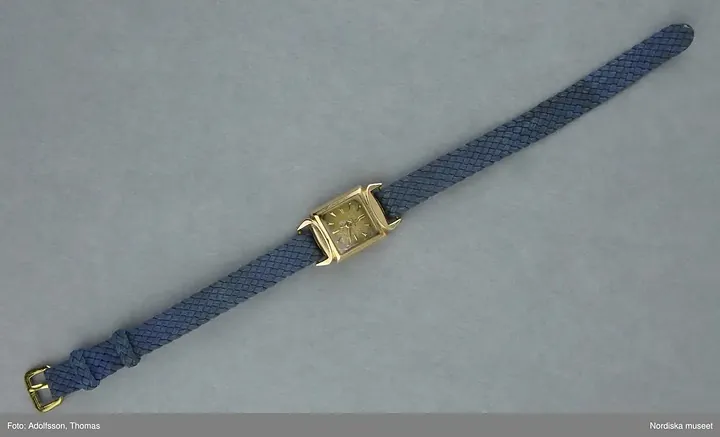
Wristwatch by Omega, Västerås, 1900–1999
Nordic Museum Foundation
Wristwatches · 1900–1999
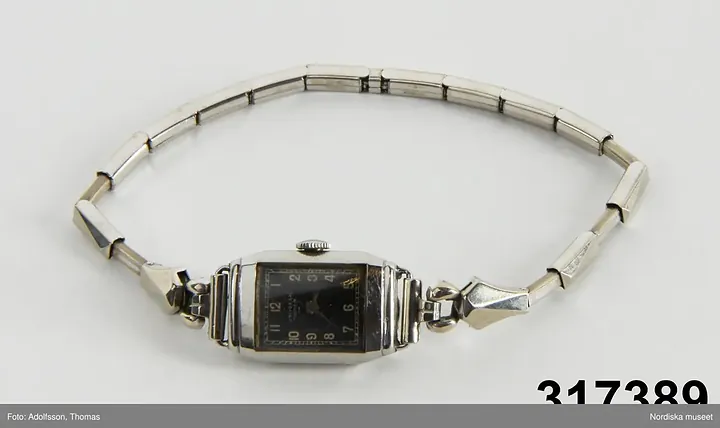
Wristwatch by Universal, Switzerland, 1900–1999
Nordic Museum Foundation