
Wristwatches · Wrist-watch
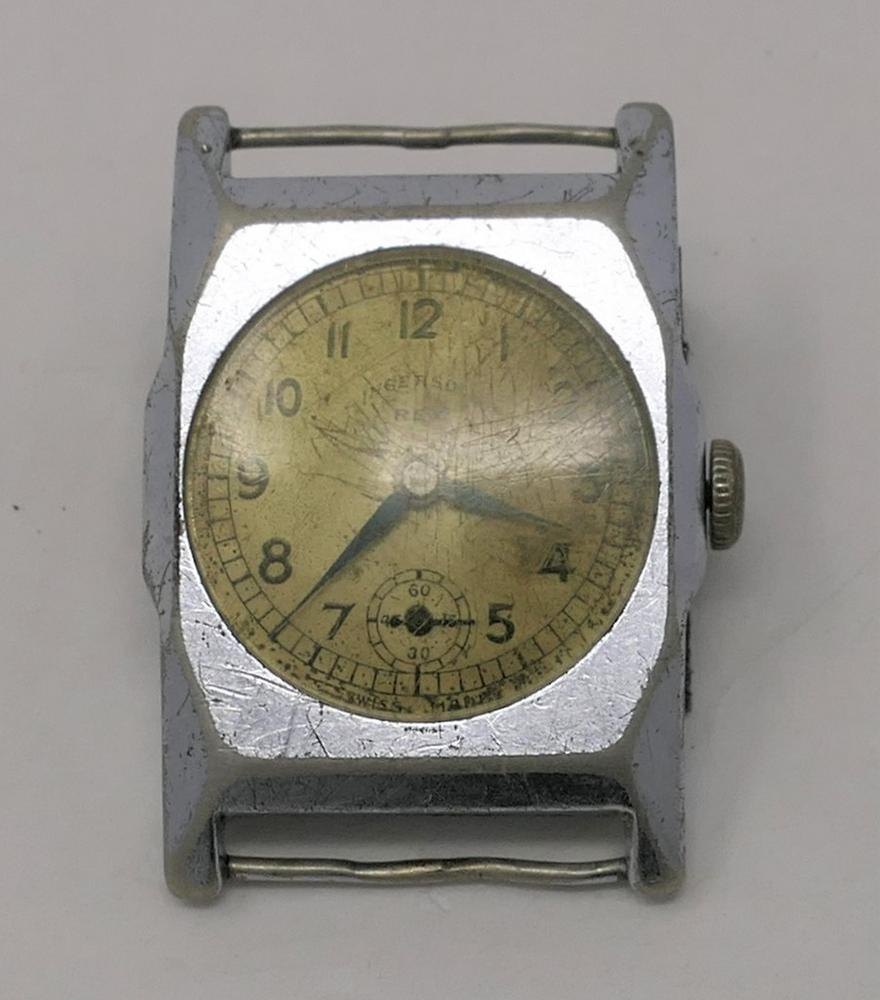
Nickel-plated cased club-tooth lever wrist watch
- Maker / attribution
- Robert H Ingersoll & Bro (Made by)
- Date
- c1935
- Historical period
- Golden Age of Mechanical Watchmaking (1900 – 1945)
- Country of origin
- Switzerland
- Place
- Switzerland
- Object type
- Wrist-watch
- Materials / technique
- metal, nickel, plastic
- Dimensions
- Diameter: 20.10 millimetres (dial) Length: 36 millimetres Thickness: 7.70 millimetres Width: 25.40 millimetres
- Holding institution
- British Museum
- Accession / object no.
- 1983,1012.174
- Credit line
- British Museum, London
- Catalogue title (original)
- Nickel-plated cased club-tooth lever wrist watch (English)
View the source record ↗ (opens another website in a new tab)Suggest a correction
Record summary
Held and catalogued by British Museum (object number 1983,1012.174), this is a wrist-watch by Robert H Ingersoll & Bro, made in Switzerland, dated c1935. The Atlas places it in the Golden Age of Mechanical Watchmaking period (1900 – 1945) of its Wristwatches collection. Materials and techniques recorded by the source: metal, nickel, plastic. Recorded dimensions: Diameter: 20.10 millimetres (dial) Length: 36 millimetres Thickness: 7.70 millimetres Width: 25.40 millimetres. The record is illustrated with 2 photographs.
Assembled from the source record's structured fields. Dates and attributions are given as the source states them; where a field is missing the Atlas leaves it blank rather than estimating.
Catalogue description
Description — British Museum
Ingersoll Rex wrist-watch. 7 jewel Swiss movement with club-tooth lever escapement; keyless winding and hand-setting. Silvered dial with Arabic hour numerals and subsidiary seconds. Blued-steel hands. Nickel-plated metal case.
Curator's comments — British Museum
Comment from Richard Good, Catalogue of Watches in the British Museum. Vol. V (Unpublished manuscript) Made by Ingersoll Switzerland, c. 1960 Wrist watch with a club tooth lever escapement. Signature: 'INGERSOLL REX SWISS MADE' on the dial. Case: A basically rectangular, chrome plated two piece case much the worse for wear. Inside the back is stamped 'INGERSOLL NICKEL-CHROMIUM SWISS MADE'. Fixed wire lugs. The 'glass' is crazed and discoloured. Dial & Hands: A silvered metal dial now stained with, in black, Arabic numerals and minute circle. A subsidiary seconds dial. The dial secured by screws from the side of the front plate. The hands in blued -steel. Movement: A round movement of nickel silver. Ebauche Marks: On the inside of the front plate is 3. Frame: a bridge for the keyless work and barrel one for the train and cocks for the pallets and balance. The barrel bridge marked 'SWISS MADE' and the train bridge 'CAL 101 7 RUBIES' and 'INGERSOLL'. Barrel and Mainspring: A going barrel with a recessed cover. Barrel: I diameter 9.5 mm., height 1.5 mm. Mainspring: height 1.4 mm., thickness 0.125 mm. Barrel Arbor: diameter 3.0 mm., snailed. Hooking: Punched from the barrel wall. Train: All the wheels gilded, the centre wheel, third and fourth wheels with five crossings. The steel escape wheel with four. Jewelling: Jewelled bearings for the balance, the jewels pressed in. Ruby endstones to the balance jewels. Escapement: A straight line layout, club tooth lever escapement with short lever, double roller and D-shaped impulse pin. The exposed pallet stones have flat acting faces, one of the stones is chipped. A steel escape wheel with four crossings. An equidistant locking escapement. No. of teeth embraced 3½. Balance & Spring: a monometallic balance with brass screws. Balance diameter 9.0 mm., thickness 0.7 mm. A blued-steel flat spiral spring with 10 turns. Means of Regulation: An index on the balance cock registers against a divided scale with 'F S' and 'A R' engraved on the balance cock table.The curb pin is broken off leaving the boot alone. Train Counts and Beat Rate: Great wheel 70 (barrel) Centre wheel 64 pinion 10 Third wheel 60 pinion 8 Fourth wheel 60 pinion 8 Escape wheel 15 pinion 6 Beat rate 18,000 Motion work: cannon pinion 10 minute wheel 30, minute pinion 8 hour wheel 32 Winding System: Stem set positive keyless work, the bolt broken. Dimensions: Case: Length 36.2 mm., width 25.2 mm., height over the glass 7.7 mm. Movement: diameter 23.6 mm., height 6.1 mm. Provenance: Donated by Heron Corporation Ltd in 1983.
Inscriptions & marks
inscription; INGERSOLL REX [dial]; inscription; SWISS MADE [dial]; inscription; INGERSOLL 7 RUBIS CAL 101 SWISS MADE [back-plate]
Provenance
Donated by:, Heron Corporation
Historical context
Golden Age of Mechanical Watchmaking (1900 – 1945)
The wristwatch displaces the pocket watch; waterproof cases, self-winding and grand complications.
The wristwatch overtook the pocket watch. Military use in the First World War, aviation, water-resistant cases (1926), automatic winding (1923–31), rectangular Art Deco designs and early chronographs and calendars defined the period.
Read the period in the timelineMore wristwatches from this periodEarlier: Industrial Revolution
Atlas type guide
Wristwatches
Bracelet watches were worn by women from the early nineteenth century — Breguet made one for Caroline Murat, Queen of Naples, in 1810–12 — but the wristwatch only became a man's instrument with military use and aviation in the early twentieth century. Between the World Wars it overtook the pocket watch; the 1920s and 1930s brought rectangular Art Deco cases, water-resistant cases and the first automatic winding systems.
After 1945 the wristwatch became a carrier of identity — dress watches, sports and dive watches, chronographs, calendars — produced by Swiss, American, Japanese, German, Soviet and Chinese industries. The quartz revolution after 1969 and the mechanical renaissance since the 1990s, including the rise of independent watchmakers, complete the story.
What to look for
- The reference number (between the lugs or inside the case back) and serial number, the starting point for dating.
- The calibre: its maker and number are often stamped under the dial or on the bridge.
- Originality of dial, hands and crown — refinished ('redial') dials are common.
- Case material marks: 18K/750, 14K/585, stainless steel, gold-filled, plated.
Dating clues
- Wire-lug cases: before c. 1925.
- Water-resistant screw-down cases: from 1926.
- Quartz movements: from 1969; sapphire crystals widespread after c. 1980.
General guidance written by the Atlas editors about this kind of object. It is not a statement about this particular piece; for that, rely on the source record above and on physical examination.
Read next:Identification Centre
Related records
Wristwatches · 1909–1919
Nickel-plated cased pin-pallet lever wrist-watch
British Museum
Wristwatches · 1937–1938
Nickel-plated cased pin-pallet lever wrist-watch with leather wrist-strap
British Museum
Wristwatches · c. 1955
Chrome-plated cased pin-pallet lever wrist-watch with leather wrist-strap
British Museum
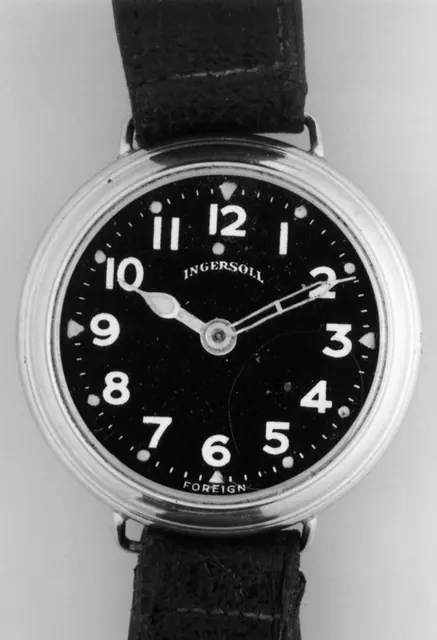
Wristwatches · 1937
Chrome-plated cased pin-pallet lever wrist-watch with leather wrist-strap
British Museum

Wristwatches · 1931
Rolex 'Oyster Perpetual' rotor self-winding wrist-watch, lever escapement, in steel case with glass in back, Montres Rolex SA, Geneva, Switzerland, 1931
Science Museum Group, London

Wristwatches · 1900–1999
Wristwatch by Certina, Switzerland, 1900–1999
Nordic Museum Foundation
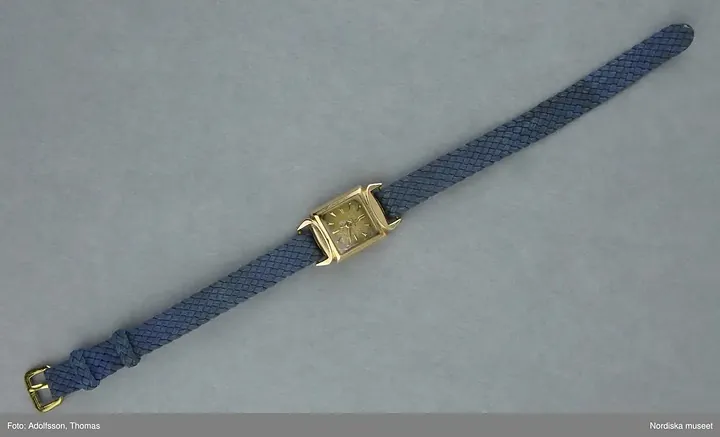
Wristwatches · 1900–1999
Wristwatch by Omega, Västerås, 1900–1999
Nordic Museum Foundation
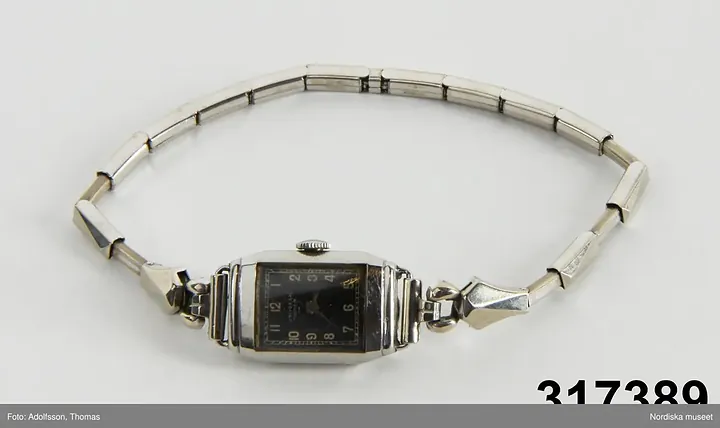
Wristwatches · 1900–1999
Wristwatch by Universal, Switzerland, 1900–1999
Nordic Museum Foundation