
Wristwatches · Wristwatch
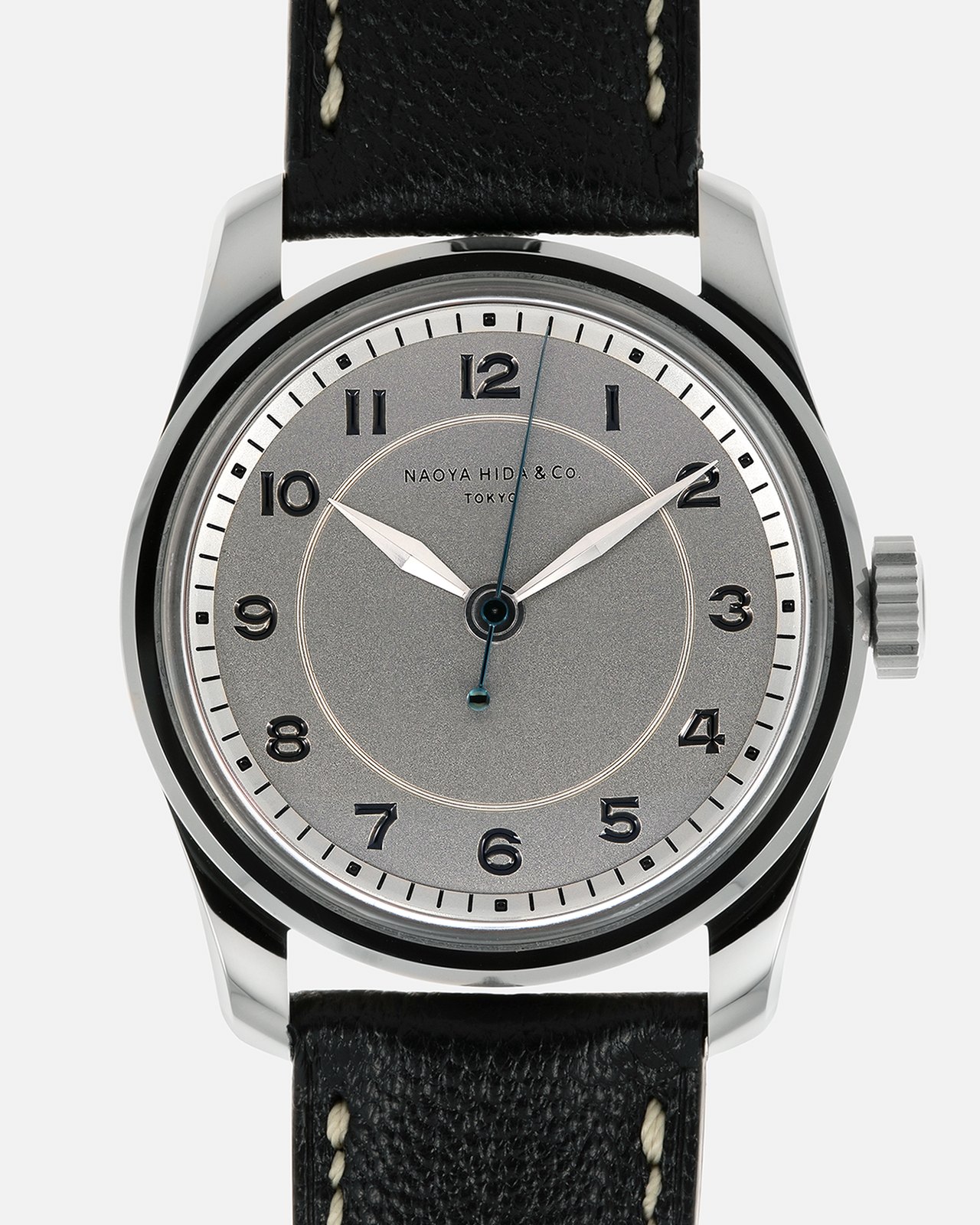
Naoya Hida Type 4A Silver Dial, 2024
- Maker / attribution
- Naoya Hida (maker)
- Date
- 2024
- Historical period
- Contemporary Horology (2010 – Present)
- Country of origin
- Unrecorded in source
- Object type
- Wristwatch
- Materials / technique
- silver
- Dimensions
- Case 36 mm
- Stock no.
- Product 7508629028951
- Credit line
- Dealer listing, S.Song Watches (product 7508629028951)
- Catalogue title (original)
- Naoya Hida Type 4A Silver Dial (English)
View the source record (dealer listing) ↗ (opens another website in a new tab)Suggest a correction
Record summary
Catalogued by S.Song Watches (dealer), Seattle (stock number Product 7508629028951), this is a wristwatch by Naoya Hida, dated 2024. The Atlas places it in the Contemporary Horology period (2010 – Present) of its Wristwatches collection. Materials and techniques recorded by the source: silver. Recorded dimensions: Case 36 mm. The record is illustrated with 6 photographs.
Assembled from the source record's structured fields. Dates and attributions are given as the source states them; where a field is missing the Atlas leaves it blank rather than estimating.
Catalogue description
Dealer description — S.Song Watches
Many of us tend to overlook the fact that the realm of high-end watchmaking extends far beyond the Swiss Jura mountains. In addition to Switzerland, Germany and Japan also hold their place of prominence in this arena. Among the Japanese independent brands, Naoya Hida stands firmly at the forefront. Founded in 2018, Naoya Hida & Co. is a Tokyo-based atelier that reflects the vision of its founder, Hida-san. Having previously served as a representative for esteemed brands like F.P. Journe and Ralph Lauren in Japan, Hida-san brought a wealth of experience to his newly founded venture, as he sought to create highly limited timepieces that fuse classical design inspiration with modern technical proficiency. The result? A line of restrained yet exquisitely finished watches, like the NH Type 4A we have on offer here today. Starting with the case, the Type 4A features refined Calatrava styling and proportions, measuring a modest 36mm x 11mm and is expertly crafted from 904L stainless steel, chosen for its superior corrosion resistance. The screw-down caseback here is adorned with a circular brushed finish, echoing classic watch designs from the 1950s and 1960s. Though understated at first glance, the case’s flawless finishing reveals Hida-san’s uncompromising approach to craft and detail. Moving on to the stunning dial, the Type 4A beautifully marries vintage aesthetics with Japanese craftsmanship. Crafted from German silver, it recalls early Calatrava references with its engraved, sector-like inner circle—reminiscent of vintage Patek, Vacheron, Omega, and Longines designs. That said, when you compare this Type 4A to Hida-san’s other earlier releases, it becomes clear this model is, without a doubt, a contemporary watch at its core, thanks to the inclusion of a set of newly designed diamond-shaped hands. Adding to this visual, the silver-grey dial is also adorned with hand-engraved, black-filled, modern sans-serif Arabic numerals with a lustrous glossy sheen. This is achieved by carefully filling them with a synthetic lacquer called ‘Cashew’, as noted by Hida-san. Completing the composition is a thermally blued, hand-bent seconds hand, providing just the right amount of visual tension to offset the sterility of the dial. Needless to say, the execution of all design elements on this Type 4A dial is simply impeccable, achieving a level of ‘cleanliness’ that is almost second to none. Powering the Type 4A is the manually wound NH Cal. 3020SS, a heavily modified Valjoux 7750 chosen for its proven reliability and ease of service. The automatic winding and chronograph mechanisms have been removed, along with the sub-seconds display, to accommodate an indirect central seconds hand. Hida’s team also designed new main and balance bridges, together with a custom winding click spring that recreates the tactile feel of vintage calibres. In terms of power reserve, the 22-jewel movement offers a charge of up to 45 hours on a full wind. To me, Naoya Hida’s horological creations exemplify the Japanese approach to independent watchmaking—refined, deliberate, and focused on elevating simplicity through execution. It is a testament to their unwavering commitment to excellence and their deep understanding of the intricacies of their craft. Amid an industry largely driven by mass production, the quiet persistence of a small atelier like this feels both rare and meaningful. While not officially a limited edition, only around 15 examples of the NH Type 4A were produced during the 2023–2024 cycle, making this an exceptionally uncommon reference to boot
Historical context
Contemporary Horology (2010 – Present)
Silicon components, connected watches, optical-lattice research clocks and a thriving independent scene.
Smartwatches became the world's best-selling watches, while mechanical watchmaking focuses on craft, innovation (silicon components, new escapements) and independent makers.
Read the period in the timelineMore wristwatches from this periodEarlier: Mechanical Renaissance
Atlas type guide
Wristwatches
Bracelet watches were worn by women from the early nineteenth century — Breguet made one for Caroline Murat, Queen of Naples, in 1810–12 — but the wristwatch only became a man's instrument with military use and aviation in the early twentieth century. Between the World Wars it overtook the pocket watch; the 1920s and 1930s brought rectangular Art Deco cases, water-resistant cases and the first automatic winding systems.
After 1945 the wristwatch became a carrier of identity — dress watches, sports and dive watches, chronographs, calendars — produced by Swiss, American, Japanese, German, Soviet and Chinese industries. The quartz revolution after 1969 and the mechanical renaissance since the 1990s, including the rise of independent watchmakers, complete the story.
What to look for
- The reference number (between the lugs or inside the case back) and serial number, the starting point for dating.
- The calibre: its maker and number are often stamped under the dial or on the bridge.
- Originality of dial, hands and crown — refinished ('redial') dials are common.
- Case material marks: 18K/750, 14K/585, stainless steel, gold-filled, plated.
Dating clues
- Wire-lug cases: before c. 1925.
- Water-resistant screw-down cases: from 1926.
- Quartz movements: from 1969; sapphire crystals widespread after c. 1980.
General guidance written by the Atlas editors about this kind of object. It is not a statement about this particular piece; for that, rely on the source record above and on physical examination.
Related records
Wristwatches · 2023
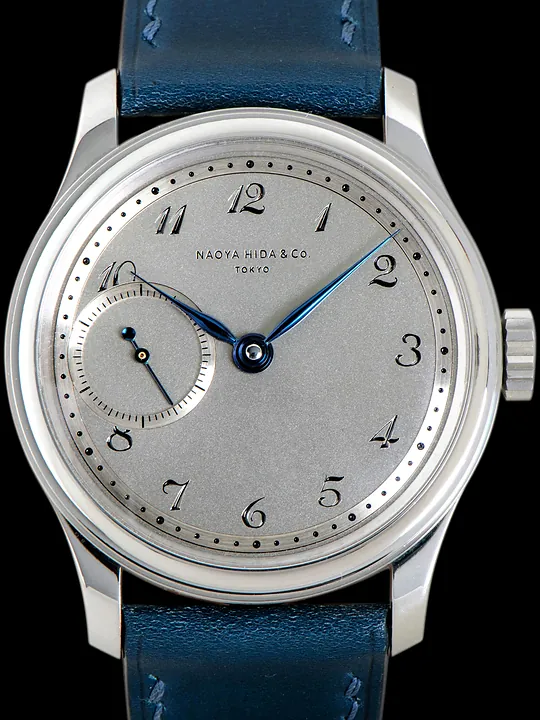
Naoya Hida & Co. (Type 1D) "No. 002", 2023
Craft & Tailored (dealer), Los Angeles
Wristwatches · 2025
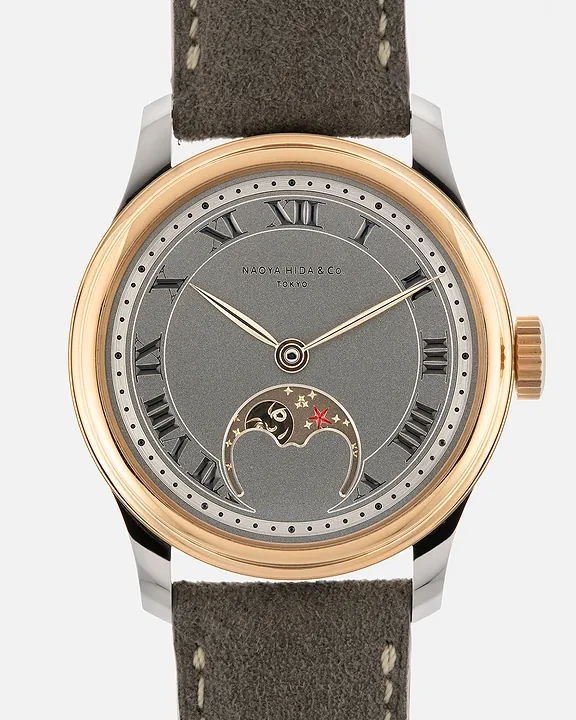
Naoya Hida NH Type 3B-2 ‘Rising Star’ Revolution, 2025
S.Song Watches (dealer), Seattle
Wristwatches · 2024
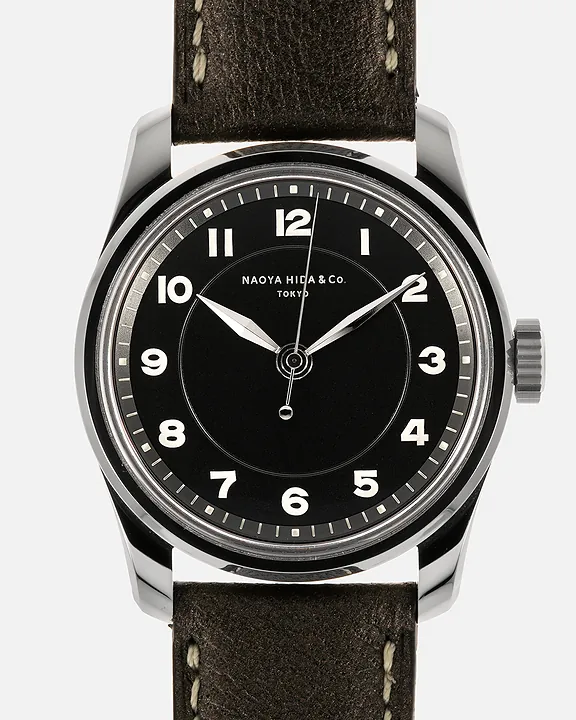
Naoya Hida Type 4A-1 Black Dial, 2024
S.Song Watches (dealer), Seattle
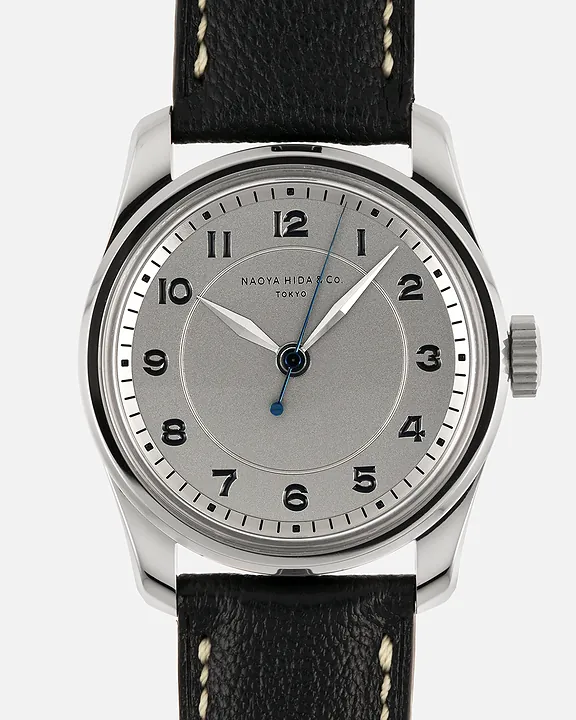
Wristwatches · 2024
Naoya Hida Type 4A, 2024
S.Song Watches (dealer), Seattle
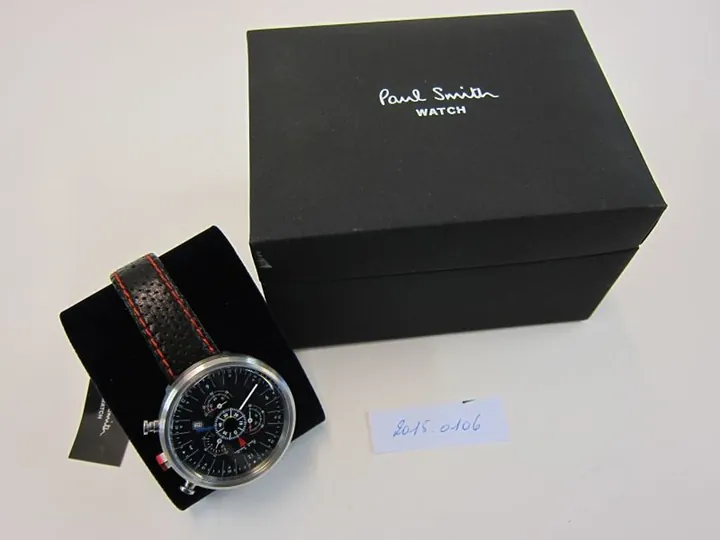
Wristwatches · 2010
Wristwatch, 2010
Modemuseum Hasselt
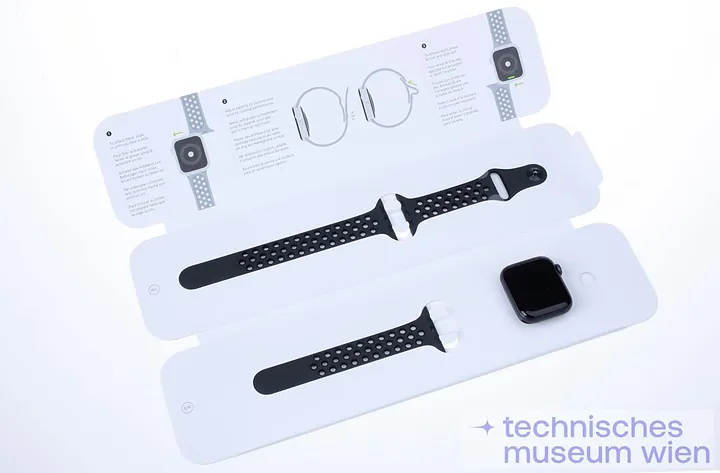
Wristwatches · 2018 (Series 4 released in September 2018; '1977' in the source is the model number A1977)
Apple Watch Series 4 (GPS, 40 mm, model A1977), 2018
Vienna Museum of Science and Technology
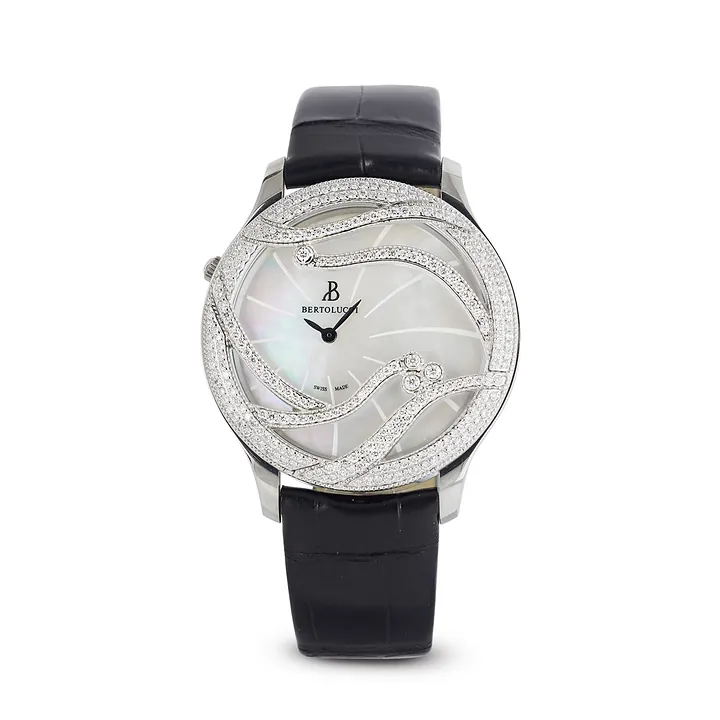
Wristwatches · c. 2010s
Bertolucci Stria III, ref. 11513.50.45.B88.6C1.501, c. 2010s
Antiquorum auction archive, Geneva
Wristwatches · c. 2010s
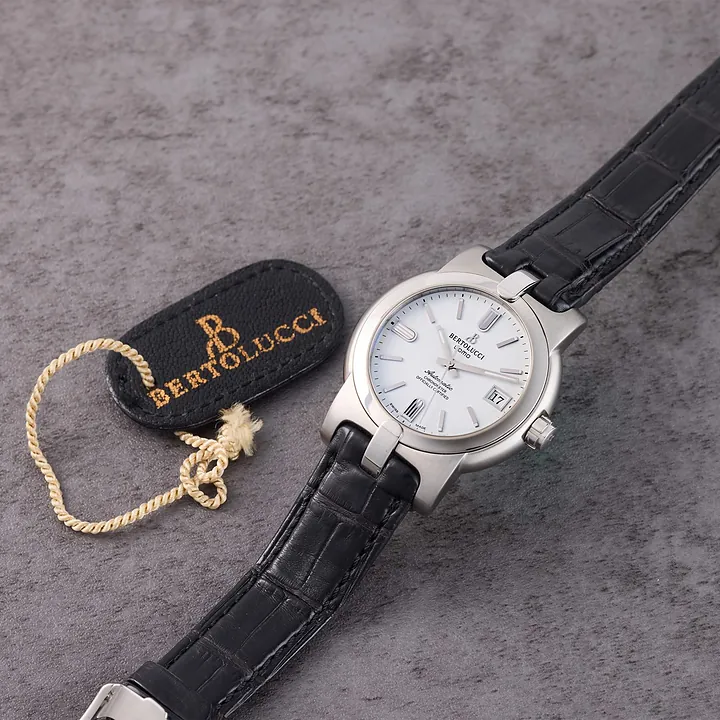
Bertolucci Uoma, ref. 824.51.41.10B, c. 2010s
Antiquorum auction archive, Geneva