
Wristwatches · Wristwatch
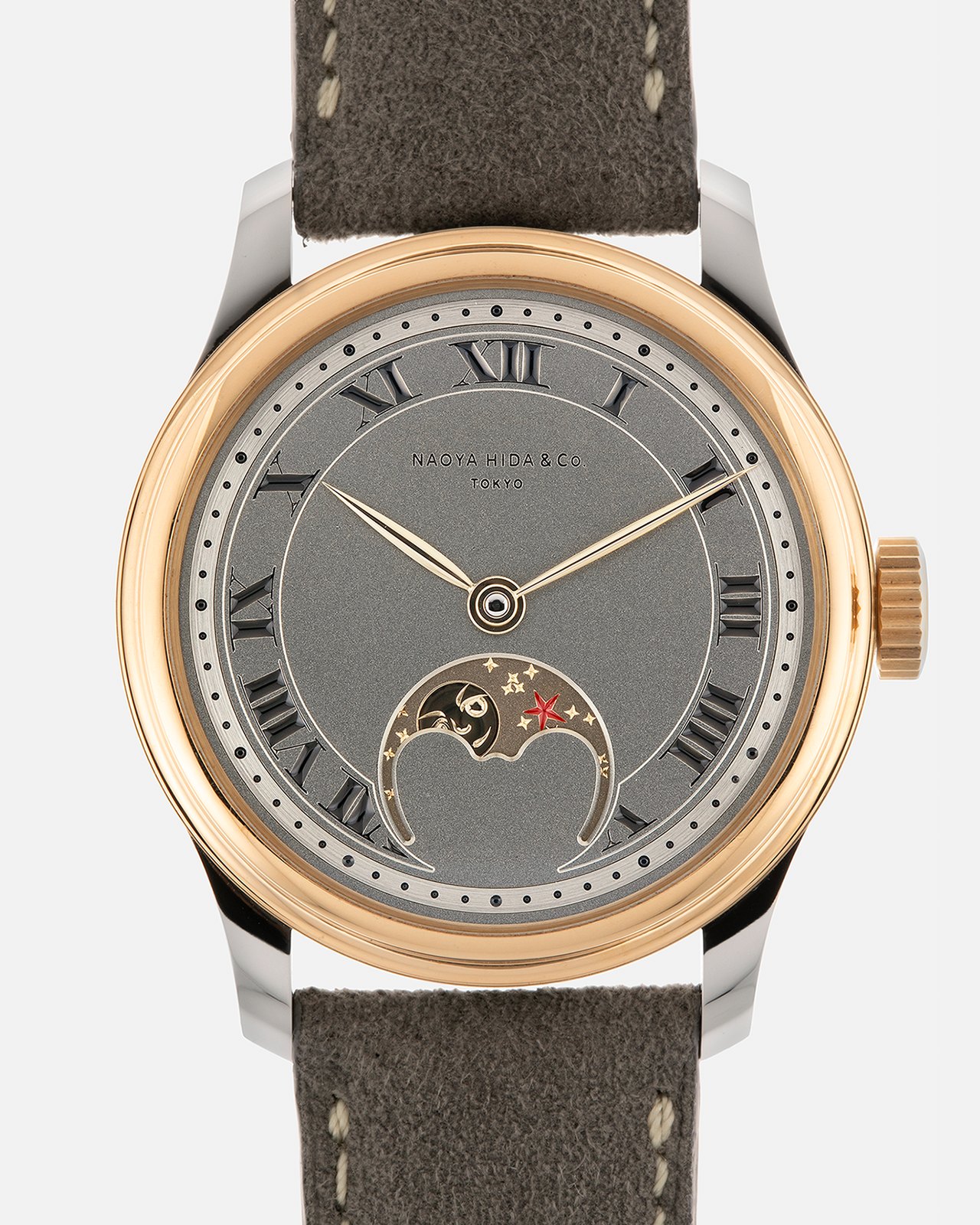
Naoya Hida NH Type 3B-2 ‘Rising Star’ Revolution, 2025
- Maker / attribution
- Naoya Hida (maker)
- Date
- 2025
- Historical period
- Contemporary Horology (2010 – Present)
- Country of origin
- Unrecorded in source
- Object type
- Wristwatch
- Dimensions
- Case 37 mm
- Stock no.
- Product 7626616012887
- Credit line
- Dealer listing, S.Song Watches (product 7626616012887)
- Catalogue title (original)
- Naoya Hida NH Type 3B-2 ‘Rising Star’ Revolution (English)
View the source record (dealer listing) ↗ (opens another website in a new tab)Suggest a correction
Record summary
Catalogued by S.Song Watches (dealer), Seattle (stock number Product 7626616012887), this is a wristwatch by Naoya Hida, dated 2025. The Atlas places it in the Contemporary Horology period (2010 – Present) of its Wristwatches collection. Recorded dimensions: Case 37 mm. The record is illustrated with 6 photographs.
Assembled from the source record's structured fields. Dates and attributions are given as the source states them; where a field is missing the Atlas leaves it blank rather than estimating.
Catalogue description
Dealer description — S.Song Watches
Many of us tend to overlook the fact that the realm of high-end watchmaking extends far beyond the Swiss Jura mountains. In addition to Switzerland, Germany and Japan also hold their place of prominence in this arena. Among the Japanese independent brands, Naoya Hida occupies a prominent position at the forefront. Established in 2018, Naoya Hida & Co. was founded by Hida-san, a Tokyo-based watchmaker whose career included serving as a representative for esteemed brands such as F.P. Journe and Ralph Lauren in Japan. Drawing on this experience, he set out to create highly limited timepieces that fuse classical design inspiration with modern technical proficiency. The result? Simple timepieces that are finished to a very, very high level. Introduced in 2025 to commemorate the 20th anniversary of Revolution Magazine, the NH Type 3B-2 ‘Rising Star’ was produced in a highly limited run of just 10 pieces. As with many limited edition pieces in general, there is a fine and delicate balance between expressing the significance behind the partnership and preserving the traits that make the base design appealing. In some cases, some brands tend to overdo it, but this is one of the rare limited editions that gets it right, introducing subtle, meaningful details while retaining the minimalistic appeal of the Type 3 template. Let me explain. Starting with its two-tone case, the Type 3B-2 builds on the existing template of the Type 3B-1 with a few thoughtful refinements. Two-tone watches can be notoriously difficult to execute well, often appearing either too loud or visually disjointed, but the balance here feels just right. The 37mm x 10.7mm case is crafted from 904L stainless steel and paired with a stepped 3N yellow gold bezel, which adds a gentle touch of warmth without overwhelming the design. Matching elements such as the gold feuille handset and crown help tie the composition together, giving the watch a sense of visual harmony that feels entirely natural within the minimalistic design language of Naoya Hida & Co. Like most of the brand’s offerings, the 3B-2 features a solid screw-down caseback with a circular brushed finish and a screw-in pattern reminiscent of “étanche” casebacks from the 1940s, which is a subtle nod to classic mid-century watchmaking. Moving on to the dial, the Type 3B-2 is where much of the watch’s character comes through. Crafted from DLC-treated German silver, the dial has a dark tone that highlights the meticulously engraved details across its multi-layered construction. The Roman numerals and minute track dots are filled with black synthetic urushi lacquer called ‘Cashew’, creating a crisp contrast against the surface. Arguably, the star of the show here is the gold moonphase disc at 6:00, hand-engraved by master engraver Keisuke Kano-san and finished with a micro-bead blasted texture. A small red ‘Revolution’ star here marks the limited edition, similarly filled with red ‘Cashew’ lacquer, providing a nice contrasting coloured accent. Viewed alongside the yellow gold elements of the case, the dial feels cohesive and is immensely satisfying to look at; it's the sort of precise alignment and symmetry that will quietly delight anyone with a slightly obsessive eye for detail. As for the movement encased within, the Type 3B-2 is powered by a highly modified Valjoux Cal. 7750 movement, specifically adapted here as the manual-winding NH Cal. 3021LU. This choice was influenced by the renowned reliability and serviceability of the workhorse Valjoux Cal. 7750. Several notable modifications have been made to this Valjoux calibre, including the removal of the self-winding mechanism, the chronograph components, and the sub-seconds to accommodate an indirect centre seconds mechanism. Additionally, a newly designed main and balance bridge is included, as well as a new winding click spring to resemble the tactile winding feel reminiscent of movements found in vintage watches. The 18-jeweled NH Cal. 3021LU also offers a power reserve of 45 hours on a full wind. As I have briefly mentioned earlier, in a landscape saturated with limited editions, very few truly get the balance right. The NH Type 3B-2 ‘Rising Star’ is one of them. It does not try too hard to differentiate itself, and the details are subtle enough to enhance rather than overshadow the original spirit of the design. Combined with a genuinely low production run of just 10 pieces, the result is a limited edition that feels thoughtful, restrained, and ultimately very desirable. More broadly, I find that timepieces made by Naoya Hida embody the very essence of what makes the Japanese approach to artisanal craftsmanship and independent horology so captivating. Their ability to take something seemingly simple and elevate it to the highest level of artistry is truly remarkable. It is a testament to their unwavering commitment to excellence and their deep understanding of the intricacies of their craft. Also, in a world where mass production often dominates, witnessing the work of a small independent watch atelier like Naoya Hida is truly refreshing.
Historical context
Contemporary Horology (2010 – Present)
Silicon components, connected watches, optical-lattice research clocks and a thriving independent scene.
Smartwatches became the world's best-selling watches, while mechanical watchmaking focuses on craft, innovation (silicon components, new escapements) and independent makers.
Read the period in the timelineMore wristwatches from this periodEarlier: Mechanical Renaissance
Atlas type guide
Wristwatches
Bracelet watches were worn by women from the early nineteenth century — Breguet made one for Caroline Murat, Queen of Naples, in 1810–12 — but the wristwatch only became a man's instrument with military use and aviation in the early twentieth century. Between the World Wars it overtook the pocket watch; the 1920s and 1930s brought rectangular Art Deco cases, water-resistant cases and the first automatic winding systems.
After 1945 the wristwatch became a carrier of identity — dress watches, sports and dive watches, chronographs, calendars — produced by Swiss, American, Japanese, German, Soviet and Chinese industries. The quartz revolution after 1969 and the mechanical renaissance since the 1990s, including the rise of independent watchmakers, complete the story.
What to look for
- The reference number (between the lugs or inside the case back) and serial number, the starting point for dating.
- The calibre: its maker and number are often stamped under the dial or on the bridge.
- Originality of dial, hands and crown — refinished ('redial') dials are common.
- Case material marks: 18K/750, 14K/585, stainless steel, gold-filled, plated.
Dating clues
- Wire-lug cases: before c. 1925.
- Water-resistant screw-down cases: from 1926.
- Quartz movements: from 1969; sapphire crystals widespread after c. 1980.
General guidance written by the Atlas editors about this kind of object. It is not a statement about this particular piece; for that, rely on the source record above and on physical examination.
Related records
Wristwatches · 2023
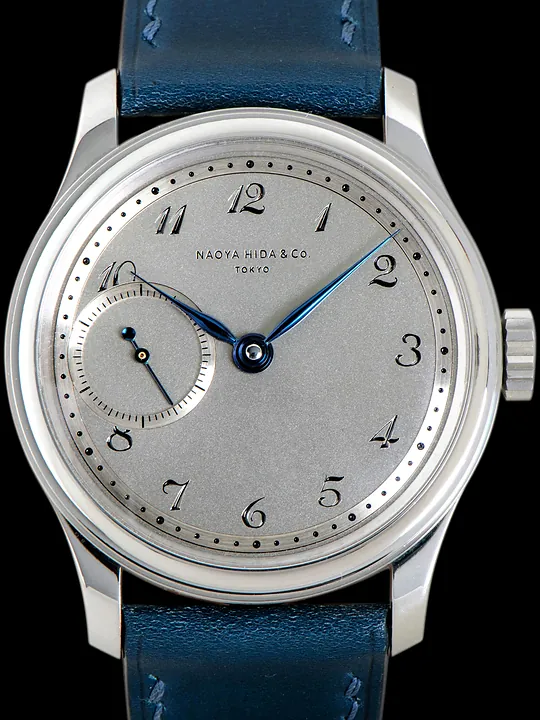
Naoya Hida & Co. (Type 1D) "No. 002", 2023
Craft & Tailored (dealer), Los Angeles
Wristwatches · 2024
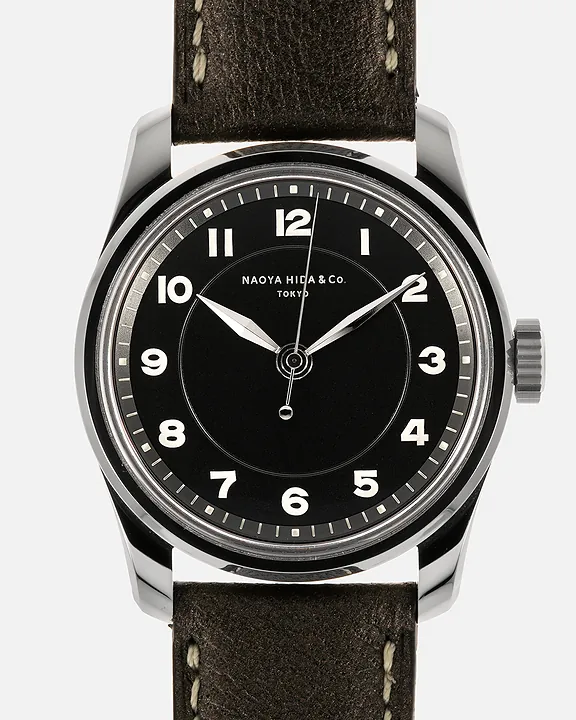
Naoya Hida Type 4A-1 Black Dial, 2024
S.Song Watches (dealer), Seattle
Wristwatches · 2024
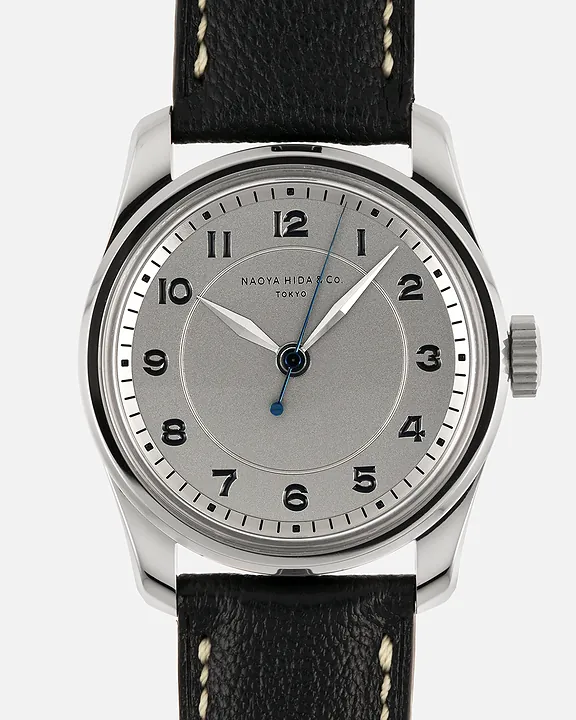
Naoya Hida Type 4A, 2024
S.Song Watches (dealer), Seattle
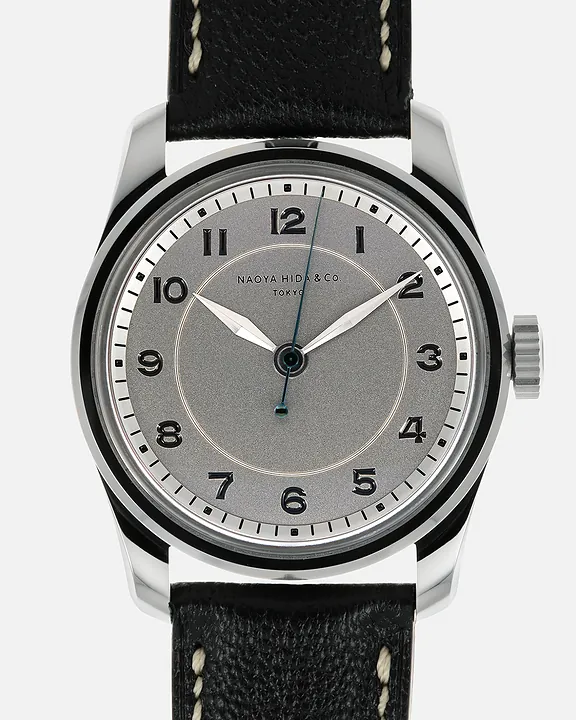
Wristwatches · 2024
Naoya Hida Type 4A Silver Dial, 2024
S.Song Watches (dealer), Seattle
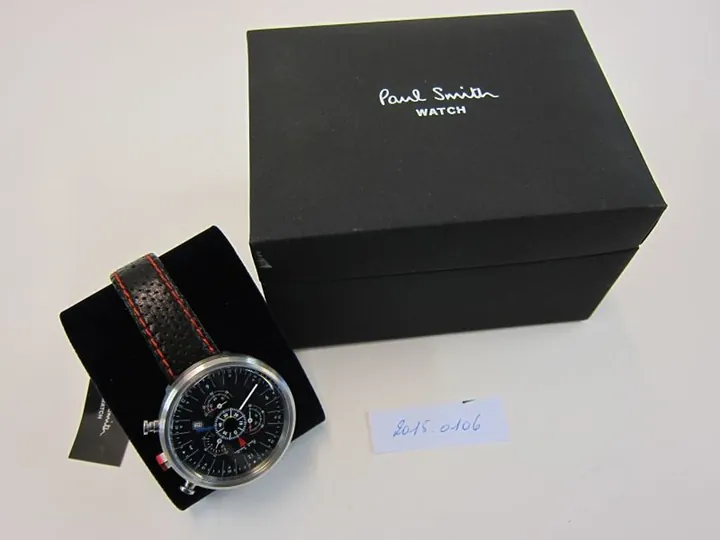
Wristwatches · 2010
Wristwatch, 2010
Modemuseum Hasselt
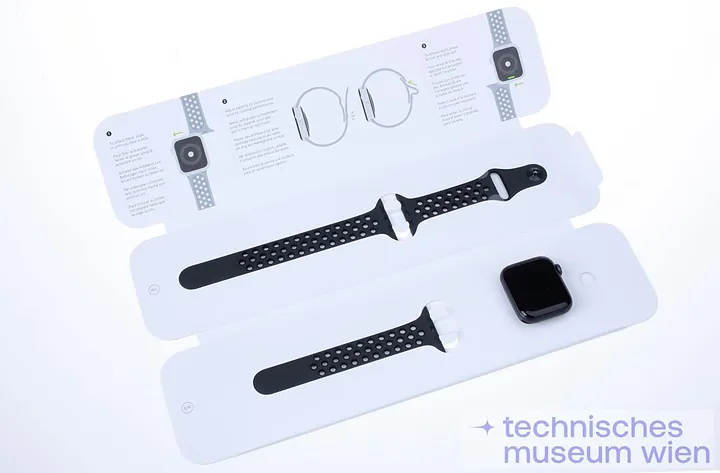
Wristwatches · 2018 (Series 4 released in September 2018; '1977' in the source is the model number A1977)
Apple Watch Series 4 (GPS, 40 mm, model A1977), 2018
Vienna Museum of Science and Technology
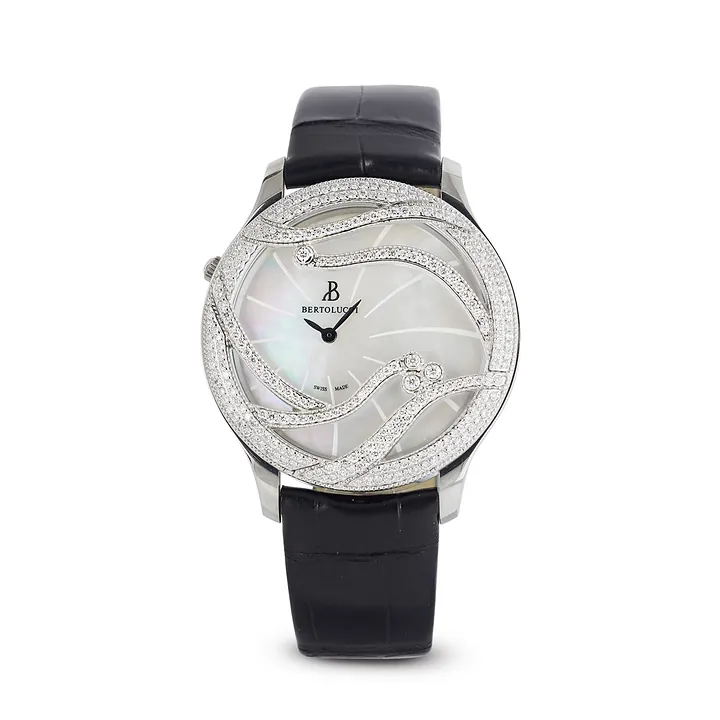
Wristwatches · c. 2010s
Bertolucci Stria III, ref. 11513.50.45.B88.6C1.501, c. 2010s
Antiquorum auction archive, Geneva
Wristwatches · c. 2010s
Bertolucci Uoma, ref. 824.51.41.10B, c. 2010s
Antiquorum auction archive, Geneva