
Instruments · Marine chronometer
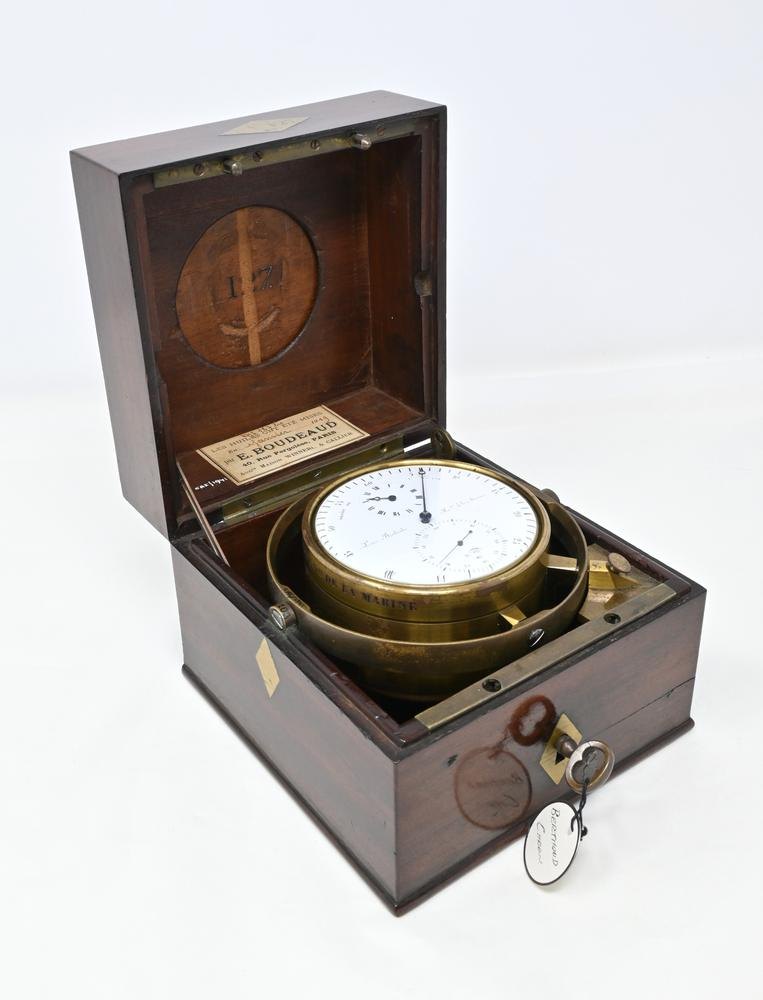
Marine chronometer by Louis Berthoud
- Maker / attribution
- Louis Berthoud (Made by)
- Date
- 1811
- Historical period
- Precision & Scientific Horology (1750 – 1850)
- Country of origin
- France
- Place
- France
- Object type
- Marine chronometer
- Materials / technique
- brass, mahogany
- Holding institution
- British Museum
- Accession / object no.
- 1958,1006.1941
- Credit line
- British Museum, London
- Catalogue title (original)
- Marine chronometer; pivoted detent escapement; movement in brass drum gimballed in mahogany box; tipsy key; enamel regulator type dial; blued steel moon hands (English)
View the source record ↗ (opens another website in a new tab)Suggest a correction
Record summary
Held and catalogued by British Museum (object number 1958,1006.1941), this is a marine chronometer by Louis Berthoud, made in France, dated 1811. The Atlas places it in the Precision & Scientific Horology period (1750 – 1850) of its Instruments collection. Materials and techniques recorded by the source: brass, mahogany. The record is illustrated with 6 photographs.
Assembled from the source record's structured fields. Dates and attributions are given as the source states them; where a field is missing the Atlas leaves it blank rather than estimating.
Catalogue description
Description — British Museum
Marine chronometer; pivoted detent escapement; movement in brass drum gimballed in mahogany box; tipsy key; enamel regulator type dial; blued steel moon hands.
Curator's comments — British Museum
Comment from Anthony G. Randall and Richard Good, Catalogue of Watches in the British Museum. Vol. VI (1990) Made by Louis Berthoud, 1811 Marine Chronometer Signature: On the back plate 'Construite par Louis Berthoud No 127.' On the dial 'Louis Berthoud Horger de la Marine No 127 bis'(l) and DEPÔT DE LA MARINE written on top of the glaze.… Around the edge of the dial ring: 'No 127 Construite par Louis Berthoud'. Box: The movement contained in a brass drum in which it is held by a bayonet fastening and secret catch operated by pushing with a pin through a very small hole in the side. This arrangement also used by Motel. The threaded bezel, engraved DÉPÔT GAL DE LA MARINE, holds another similar unthreaded bezel with a raised glass, and similarly signed but without the GAL. The bottom is a push fit, secured by two screws in the edge and engraved 'No 127 Département de la Marine 9bre 1811'. In order to insert the key for winding, two overlapping escutcheon plates must be rotated until their holes coincide with a third in the bottom. The brass drum fits into a weighted brass cradle with a gimbal ring pivoted in a mahogany box similar to, but larger than, registration no. 1958,1201.1928. Inscribed on a diamond-shaped brass insert on the front of the top 'No 127 BIS'. There is a tipsy key in one corner of the box.(2) Dimensions: Brass drum, 82.9 mm diam, 43.5 mm h.; Mahogany box: base 140 mm square; sides 136 mm square; overall h. 114 mm. Dial and hands: Enamel regulator type of dial attached in a recess in the dial ring on the front plate by two feet passing through the front plate and pins. Blued steel moon hands. Movement: Dial ring diam. 80.1 mm; front plate diam. 75.1 mm; back plate diam. 74.6 mm; frame h. 17.0 mm. Frame: Similar to L. Berthoud, registration no. 1958,1201.1928, but larger. The brass parts smooth but not polished or gilded. The dial plate held by a small screw and four larger screws. If the small screw is removed and the others slackened, the dial ring can be rotated and removed. Fusee: Similar to L. Berthoud, registration no. 1958,1201.1928. The bride is still in place in the barrel. Going train: Similar to L. Berthoud, 1958,1201.1928. Jewelling: The pivots of the centre arbor and the third in the back plate, in detachable bushes held with screws. The third arbor in the front plate, both fourth arbor pivots and those of the escape pinion and balance staff in pierced jewels. Steel end-thrust plates, highly polished and held with a single screw, are fitted over all bearings except the centre and fourth at the front. Only the balance staff pivots run between endstones. Escapement: Similar to L. Berthoud, 1958,1201.1928. The brass escape wheel is sunk out on both sides and is exceptionally light. There is a brass stop-piece which can be swung into the path of the escape wheel teeth. The detent is banked by its tail resting against a brass peg set in the back plate, and there is a small hole in the locking surface at the height of locking. Balance: Bimetallic four-armed balance with brass seg¬ment weights, the free ends of the rim sections finely graduated to help in positioning the weights. Each weight is held by a small brass screw from the outside. There are two other screws in the outside of the weight, a fixed brass screw towards the fixed end of the rim section and a larger steel screw towards the free end. T here is a small brass clamping screw for each steel screw set in the end of the weight. The steel screws are for poising and bringing to time. The balance is held by two screws on a brass collet. Diam. of rim 27.0 mm; h. 2.1 mm. Balance spring: Blued steel helical spring of ¾ turns without terminal curves, clamped concentrically at full turns to both collet and stud. The stud has 3 levelling screws and a central fixing screw. Going-train counts: Great wheel (fusee) 108 teeth, 8 turns of groove Centre pinion 26 leaves, wheel 112 teeth, 4 arms 3rd pinion 14 leaves, wheel 105 teeth, 4 arms 4th pinion 14 leaves, wheel 120 teeth, 4 arms Escape pinion 10 leaves, wheel 15 teeth, 4 arms Beats per hour: 21,600 Motion work: Centre pinion 18 leaves, clamped to the arbor by a screw in a spring collar, minute pinion 16 leaves Hour wheel 64 teeth, minute wheel 54 teeth Provenance: Ilbert Collection; Ilbert in his inventory notebook records the acquisition of this chronometer from the Royal Observatory, Greenwich, on 22 November 1930. He also mentions that no. 108 is dated 1811. Presented by Mr Gilbert Edgar C.B.E. in 1958. Notes (1) The 'bis' on the dial and on the brass insert indicate that this was the second of two chronometers with the same number. (2) Inside the box lid there is a label: 'Les Huiles ont été mises en Janvier 1919 par E. Boudeaud 40, Rue Pergolèsi Paris Ancne Maison Winnerl and Callier. 127 bis'. Bibliography: Bertele 1981, p. 176.
Inscriptions & marks
signature; back-plate; Construite par Louis Berthoud No 127; signature; dial; Louis Berthoud Horger de la Marine No 127 bis; inscription; dial; DEPôT DE LA MARINE; signature; dial ring; No 127 Construite par Louis Berthoud; inscription; bezel of box; DÉPôT GAL DE LA MARINE; inscription; bezel of box; DÉPôT DE LA MARINE; inscription; box; No 127 Département de la Marine 9bre 1811; inscription; box; No 127 BIS; inscription; label on box; Les Huiles ont été mises en Janvier 1919 par E.Boudeaud 40, Rue Pergolèsi Paris Ancne Maison Winnerl and Callier. 127 bis.
Provenance
Previous owner/ex-collection:, Courtenay Adrian Ilbert; Donated by:, Gilbert Edgar; Acquired 1958
Historical context
Precision & Scientific Horology (1750 – 1850)
Harrison solves longitude; Mudge invents the lever; Breguet's Paris workshop defines the modern watch.
The longitude problem was solved by the marine chronometer and lunar distance methods; dividing engines made precision scales possible, and observatories set time by transit instruments.
Read the period in the timelineMore instruments from this periodEarlier: Early Modern Horology
Atlas type guide
Marine chronometers
A marine chronometer is a precision timekeeper carried at sea to find longitude: the navigator compares local noon, observed with a sextant, with the time at a reference meridian kept by the chronometer. Each hour of difference corresponds to fifteen degrees of longitude. John Harrison proved the method in the 1760s; Pierre Le Roy, Ferdinand Berthoud, John Arnold and Thomas Earnshaw then developed the detent escapement and the compensation balance that made chronometers practical to manufacture.
By the nineteenth century London, Liverpool, Le Locle and Glashütte supplied navies and merchant fleets. A typical box chronometer has a spring-detent escapement, a fusee to equalise mainspring torque, a bimetallic compensation balance with a helical balance spring, and is mounted in gimbals inside a wooden box so that it stays level.
What to look for
- Gimbals and a three-tier wooden box with a glazed inner lid.
- A power-reserve ('up and down') indicator on the dial, usually showing 56 hours on two-day instruments.
- Spring-detent escapement and a cylindrical (helical) balance spring visible through the movement.
- Admiralty or navy marks (broad arrow), and rating certificates from observatories.
- The maker's number on the dial and movement; many makers' registers survive, allowing dating.
Dating clues
- Earnshaw-type spring-detent chronometers became standard after about 1800.
- Auxiliary compensation devices on the balance appear from the mid-nineteenth century.
- Quartz and radio time signals ended routine use of mechanical chronometers in the 1970s and 1980s.
General guidance written by the Atlas editors about this kind of object. It is not a statement about this particular piece; for that, rely on the source record above and on physical examination.
Read next:Detent escapement
Related records
Instruments · 1751–1850
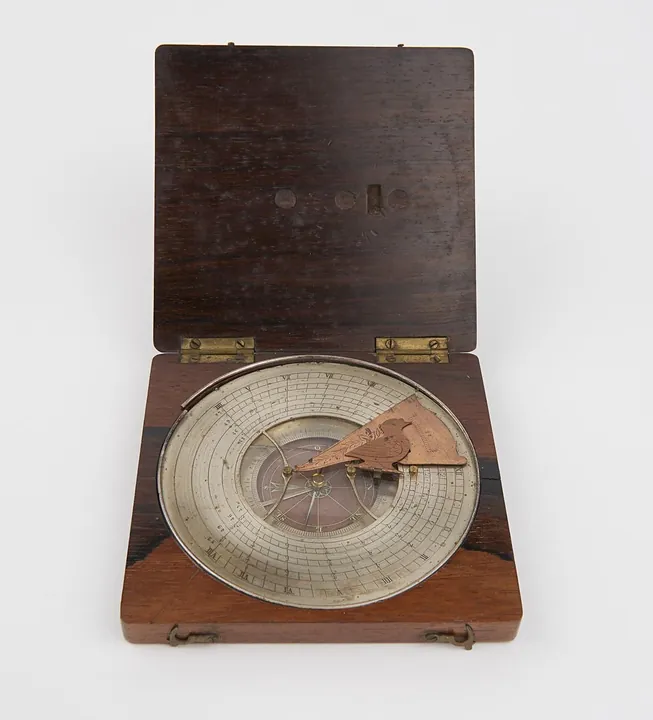
Horizontal compass sundial for latitudes 43 degrees, 46 degrees, 49 degrees, 52 degrees, in rosewood case French, c.1800 Cover glass cracked.
Science Museum Group, London
Instruments · 1751–1850
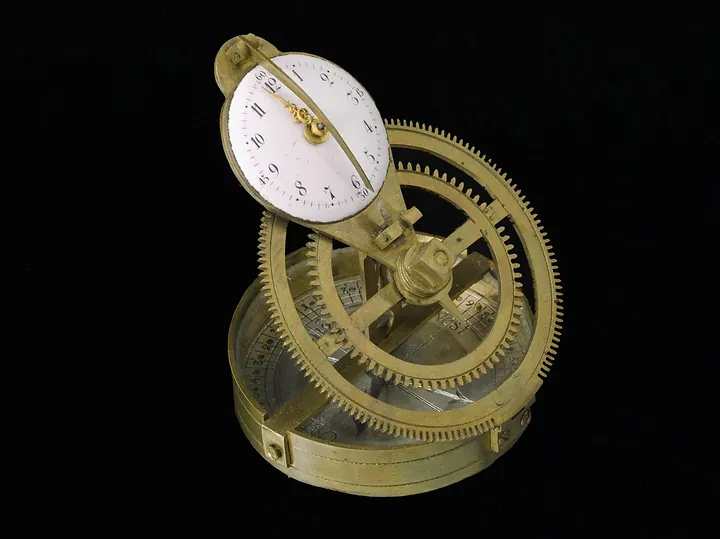
Mechanical equinoctial sundial for latitude 52 degrees, in original card case, one sight missing. French, c.1800
Science Museum Group, London
Instruments · last quarter 18th century
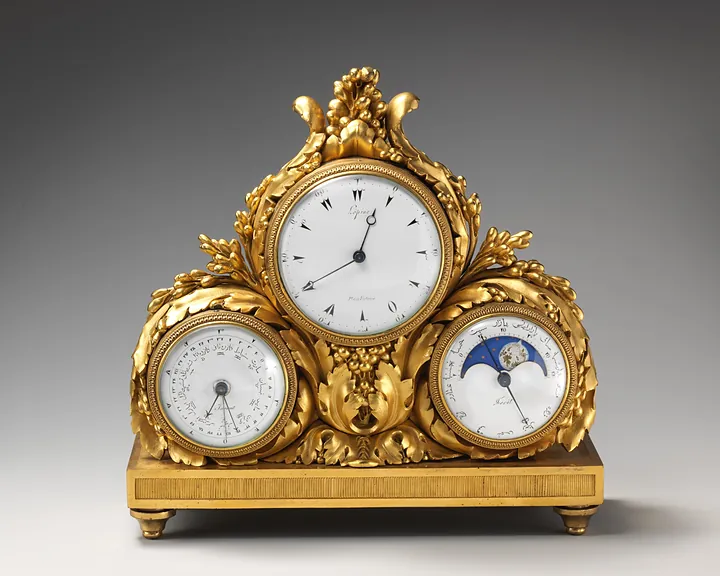
Clock by Jean Antoine Lépine, France, last quarter 18th century
The Metropolitan Museum of Art, New York
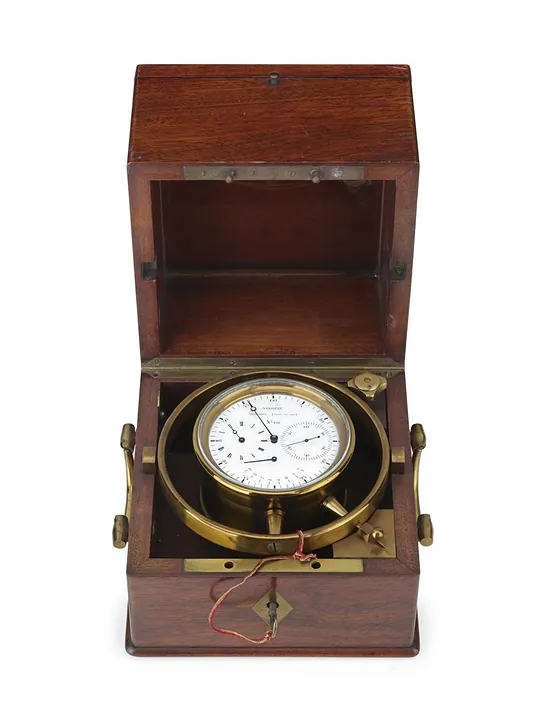
Instruments · 1780–1799
Marine chronometer by Vissière, France, 1780–1799
Science Museum Group, London
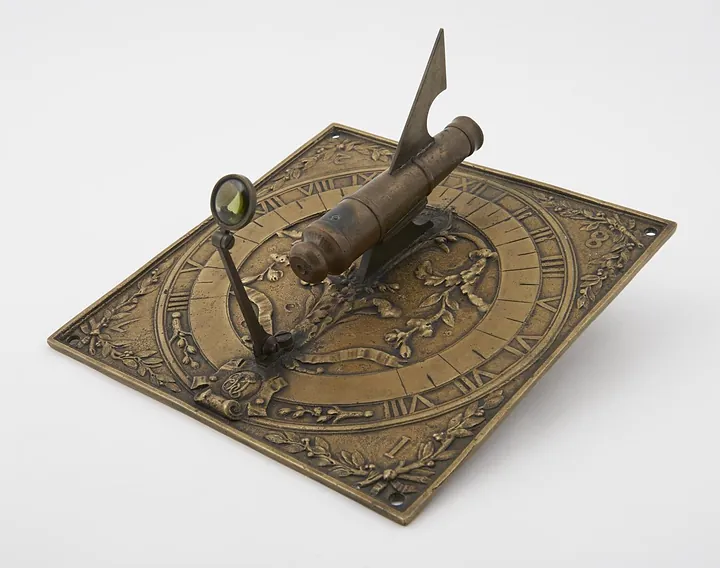
Instruments · 1782
Sundial, gnomon fixed on a cannon over touch hole of which a lens is fixed on a square base, unsigned, French, 1782
Science Museum Group, London
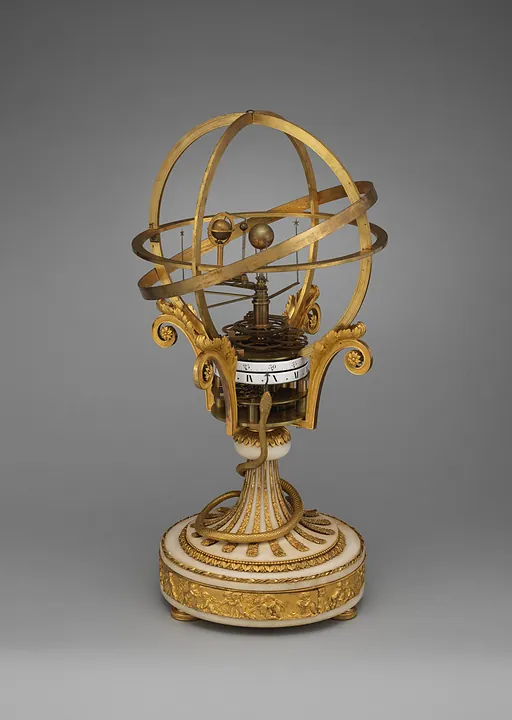
Instruments · 1790
Orrery clock by Louis Thouverez, France, 1790
The Metropolitan Museum of Art, New York
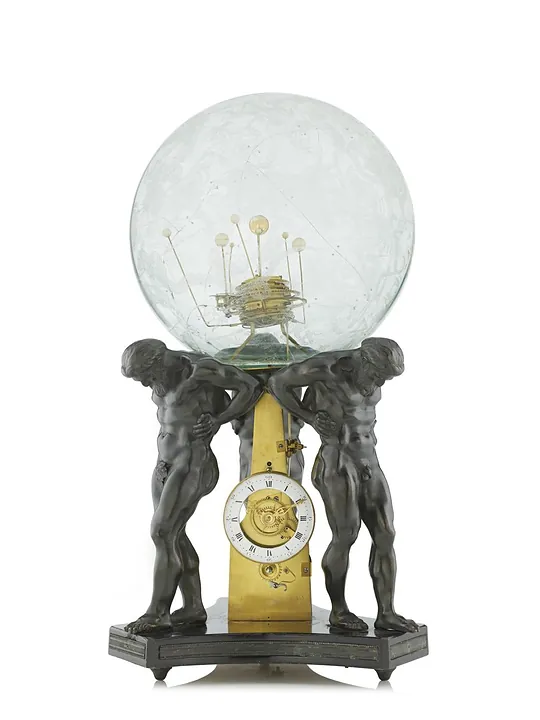
Instruments · 1795–1805
Armillary / astronomical instrument, France, 1795–1805
Science Museum Group, London
Instruments · 1800
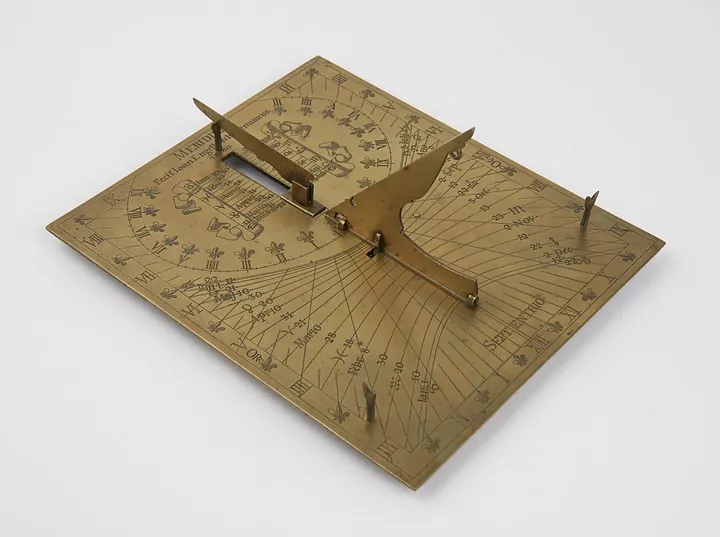
Horizontal and analemmatic sundial, "Engelbrecht, 1800" (plummet missing)
Science Museum Group, London