
Instruments · Marine chronometer
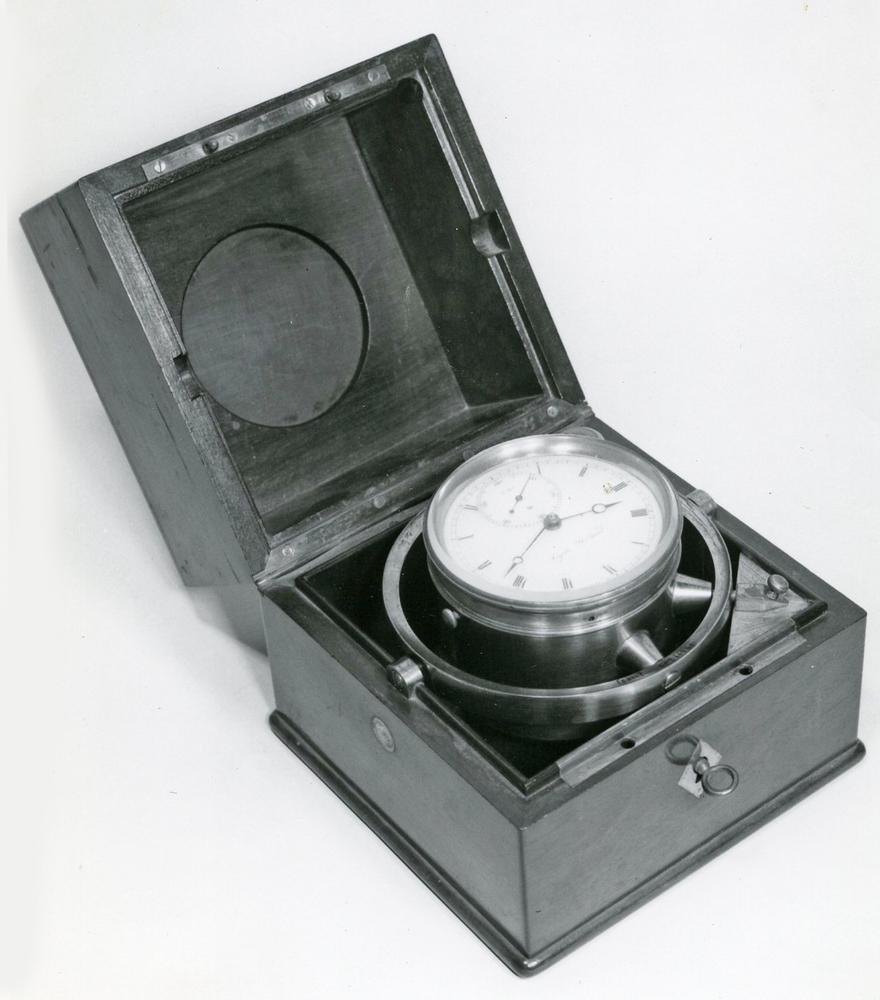
Marine chronometer by Auguste Berthoud
- Maker / attribution
- Auguste Berthoud (possibly) (Made by); Auguste-Louis Berthoud (possibly) (Made by)
- Date
- 1870–1880
- Historical period
- Industrial Revolution (1850 – 1900)
- Country of origin
- Switzerland
- Place
- Switzerland (?)
- Object type
- Marine chronometer
- Materials / technique
- brass, mahogany
- Holding institution
- British Museum
- Accession / object no.
- 1958,1006.1951
- Credit line
- British Museum, London
- Catalogue title (original)
- Marine chronometer; later Earnshaw spring detent escapement; Harrison's maintaining power; movement in brass bowl gimballed in mahogany box; tipsy key; engraved brass dial; blued steel hands (English)
View the source record ↗ (opens another website in a new tab)Suggest a correction
Record summary
Held and catalogued by British Museum (object number 1958,1006.1951), this is a marine chronometer by Auguste Berthoud (possibly), made in Switzerland (?), dated 1870–1880. The Atlas places it in the Industrial Revolution period (1850 – 1900) of its Instruments collection. Materials and techniques recorded by the source: brass, mahogany. The record is illustrated with 6 photographs.
Assembled from the source record's structured fields. Dates and attributions are given as the source states them; where a field is missing the Atlas leaves it blank rather than estimating.
Catalogue description
Description — British Museum
Marine chronometer; later Earnshaw spring detent escapement; Harrison's maintaining power; movement in brass bowl gimballed in mahogany box; tipsy key; engraved brass dial; blued steel hands.
Curator's comments — British Museum
Compare with 1958,1006.1931 Comment from Anthony G. Randall and Richard Good, Catalogue of Watches in the British Museum. Vol. VI (1990) Made by Auguste Berthoud, ?Swiss, c. 1875 Marine Chronometer Signature: On the dial 'Auguste Berthoud. No 293'.(1) Box: The movement contained in a deep brass bowl with a heavy levelling weight screwed to the inside of the bottom, and an eccentric escutcheon disc over the winding hole on the outside. The bezel is held by two screws in the edge diametrically opposite each other, and there is a flat bevel-edged glass with a short blind hole on the outside to clear the cannon pinion. The bowl is suspended in gimbals in a well-made mahogany box. This has a lock at the front, a sliding panel over a circular aperture in the top, a lock for the gimbal ring and a tipsy winding key with reeded edge to the knob. A well-made hinge extends the width of the box. No carrying handles. Brass bowl: diam. 78.9 mm, overall h. 79.4 mm. Mahogany box: base 152 mm square, h. 142 mm. Dial and hands: Engraved brass dial, matt silvered, the engraving filled with black wax, secured in a turned recess in the dial ring by a single screw below the centre of the seconds dial. Blued steel hands. Movement: Dial ring flange diam. 82.9 mm (reduced to 74.4 mm); dial ring thickness 14.4 mm; front plate diam. 63.0 mm; back plate diam. 63.0 mm; frame h. 16.1 mm. Frame: Full plate construction with a detachable barrel bridge, four turned pillars secured to the front plate by brass nuts, the back plate secured by grained steel screws. There is a separate bridge on the front plate for the lower third, fourth and escape pinion arbor bearings. The lower balance staff pivot is carried in a potence screwed to the underside of the back plate. The thick dial ring is attached to the front plate by three shoulder screws under the dial. The brass frame components are finished with a pattern of fine scratches radiating from the centre. Fusee: Reversed fusee with seven-turn Geneva stop-work on the dial side of the front plate. Harrison's maintaining power with a brass ratchet wheel, and integral detent and return spring. The setting-up-work planted on the barrel bridge, the arbor integral and unsnailed, the barrel flanged at both ends. The mainspring is hooked with an eye at both ends and there is a bride between cover and bottom. There is a brass dust cap on the winding square inside a brass tube secured by a foot to the back plate. Going train: Well-made train with polished pinions and arbors, the wheels circular grained. The great wheel assembly held on the fusee by a steel flanged nut with left-hand thread. Jewelling: The pivots of the fourth arbor in the front plate bridge and the escapement are in pierced jewels, the escapement with endstones. A diamond endstone set in a polished steel ring in the balance cock. The pierced jewels each set in a straight-sided brass bush without a flange. Escapement: Spring detent escapement of late Earnshaw pattern, and very well made and finished. The brass escape wheel with the arms only sunk below the level of the rim and teeth. The steel impulse roller grained all over and set with a jewel leaning at about 30° towards a radial to the tip. The discharge roller with two adjusting flats, grained all over, and set with a flat-sided slip of jewel also leaning towards a radial to the tip. The detent very lightly made, with a round locking stone, and a gold passing spring held under a screw head. Banking is provided against a brass screw head set in a brass piece with an overhang over the escape wheel. Where the blade of the detent joins the foot the end of the foot is triangular in shape. Balance: Bimetallic two-armed balance screwed to a steel collet on the balance staff. There are brass timing screws set in the rim near the ends of the arms, and brass segment weights each with a small steel clamping screw set in the edge between two larger steel screws. In the end of each weight is set a small brass screw for making fine adjustments to the compensation. Diam. of rim 26.4 mm, h. 2.1 mm. Balance spring: Blued steel helical spring of 10¾ turns, without terminal curves, clamped concentrically at the full diameter to both the collet and the stud. The stud, with 3 small levelling screws, is held by a single screw on a brass arm secured to the underside of the balance cock. Going-train counts: Great wheel (fusee) 84 teeth, 7 turns of groove Centre pinion 12 leaves, wheel 80 teeth, 5 arms Third pinion 10 leaves, wheel 75 teeth, 5 arms Fourth pinion 10 leaves, wheel 80 teeth, 5 arms Escape pinion 10 leaves, wheel 15 teeth, 3 arms Beats per hour: 14,400 Motion work: Cannon pinion 14 leaves, minute pinion 18 leaves Hour wheel 54 teeth, minute wheel 56 teeth Provenance: Ilbert Collection, purchased by Ilbert from Malcolm Gardner in 1953. Presented by Mr Gilbert Edgar C.B.E. in 1958. Note: (1) Tardy 1971 lists two Auguste Berthouds: Charles-Auguste (1798-1876), son of Louis, was awarded a gold medal in 1849. The other, Auguste-Louis (1828-1910), nephew of Charles-Auguste, published a chronological list of memoirs and notes relating to the measurement of time taken from the proceedings of the Académie of Sciences 1666-1891 in 'Revue Chronometrique', Paris, 1892.
Inscriptions & marks
signature; Auguste Berthoud. No293. [dial]
Provenance
Previous owner/ex-collection:, Courtenay Adrian Ilbert; Donated by:, Gilbert Edgar; Acquired 1958
Historical context
Industrial Revolution (1850 – 1900)
American interchangeable-parts manufacture; railroad time standards; Swiss and German factory systems.
Instruments spread into industry, science and sport: stopwatches, chronoscopes, metronomes, watchmen's clocks and time recorders.
Read the period in the timelineMore instruments from this periodEarlier: Precision & Scientific Horology
Atlas type guide
Marine chronometers
A marine chronometer is a precision timekeeper carried at sea to find longitude: the navigator compares local noon, observed with a sextant, with the time at a reference meridian kept by the chronometer. Each hour of difference corresponds to fifteen degrees of longitude. John Harrison proved the method in the 1760s; Pierre Le Roy, Ferdinand Berthoud, John Arnold and Thomas Earnshaw then developed the detent escapement and the compensation balance that made chronometers practical to manufacture.
By the nineteenth century London, Liverpool, Le Locle and Glashütte supplied navies and merchant fleets. A typical box chronometer has a spring-detent escapement, a fusee to equalise mainspring torque, a bimetallic compensation balance with a helical balance spring, and is mounted in gimbals inside a wooden box so that it stays level.
What to look for
- Gimbals and a three-tier wooden box with a glazed inner lid.
- A power-reserve ('up and down') indicator on the dial, usually showing 56 hours on two-day instruments.
- Spring-detent escapement and a cylindrical (helical) balance spring visible through the movement.
- Admiralty or navy marks (broad arrow), and rating certificates from observatories.
- The maker's number on the dial and movement; many makers' registers survive, allowing dating.
Dating clues
- Earnshaw-type spring-detent chronometers became standard after about 1800.
- Auxiliary compensation devices on the balance appear from the mid-nineteenth century.
- Quartz and radio time signals ended routine use of mechanical chronometers in the 1970s and 1980s.
General guidance written by the Atlas editors about this kind of object. It is not a statement about this particular piece; for that, rely on the source record above and on physical examination.
Read next:Detent escapement
Related records
Instruments · 1848–1874
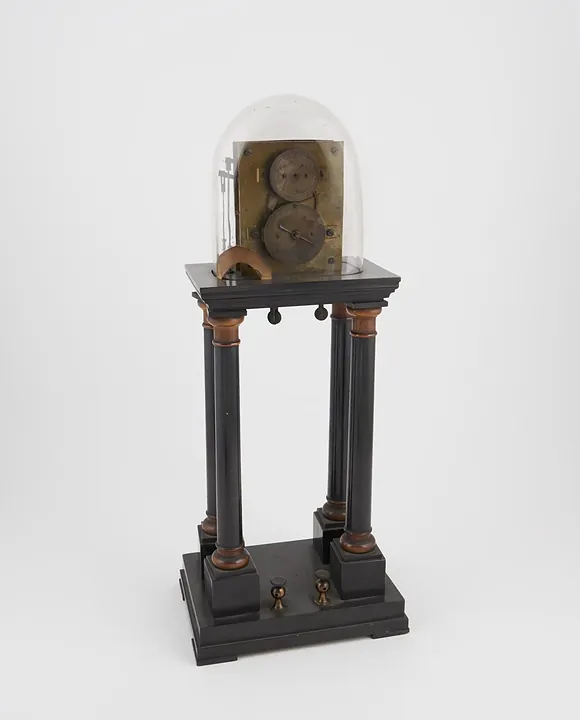
Chronoscope of Hipp type
Science Museum Group, London
Instruments · 1888
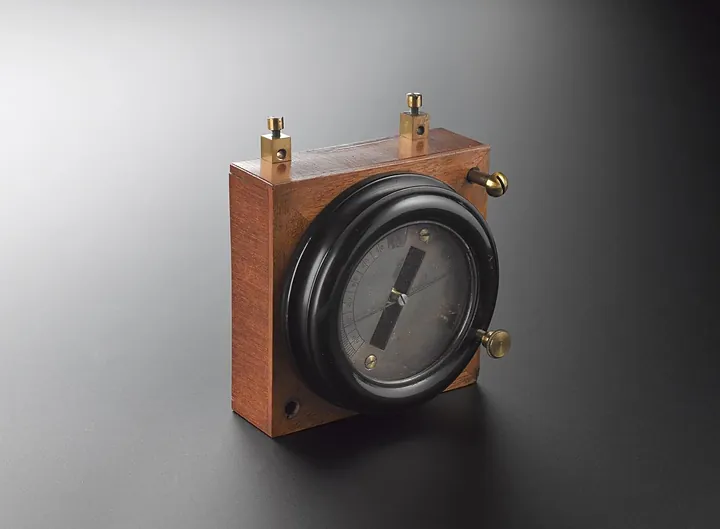
Stopwatch / timer by Matthias Hipp, Switzerland, 1888 (no. 1889-38)
Science Museum Group, London
Instruments · 1888
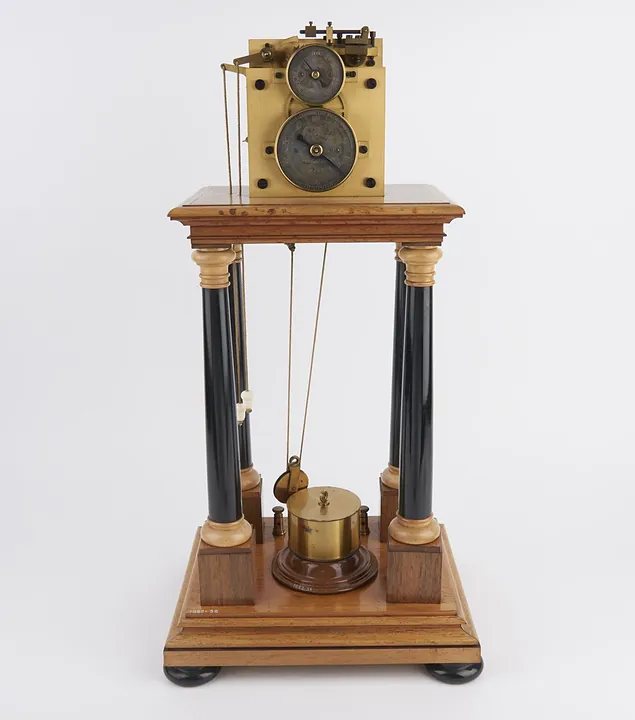
Stopwatch / timer by Matthias Hipp, Switzerland, 1888 (no. 1889-38/1)
Science Museum Group, London
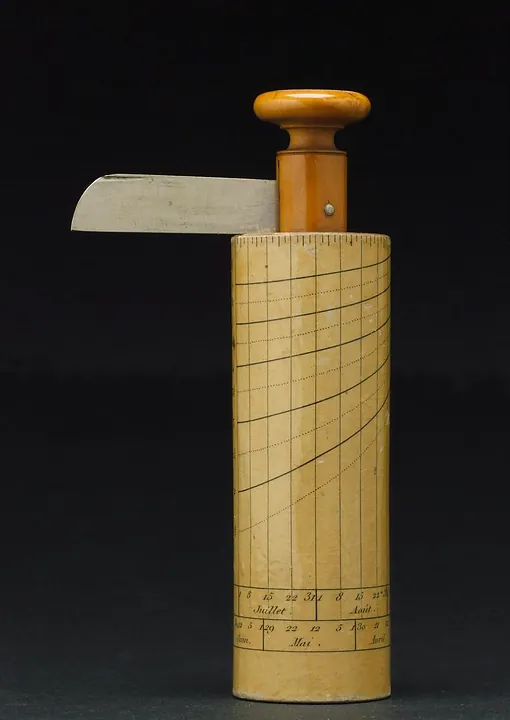
Instruments · 1831–1870
Column dial by Henry Robert, Horloger, au Palais Royal, paper on wood, early 19th century
Science Museum Group, London
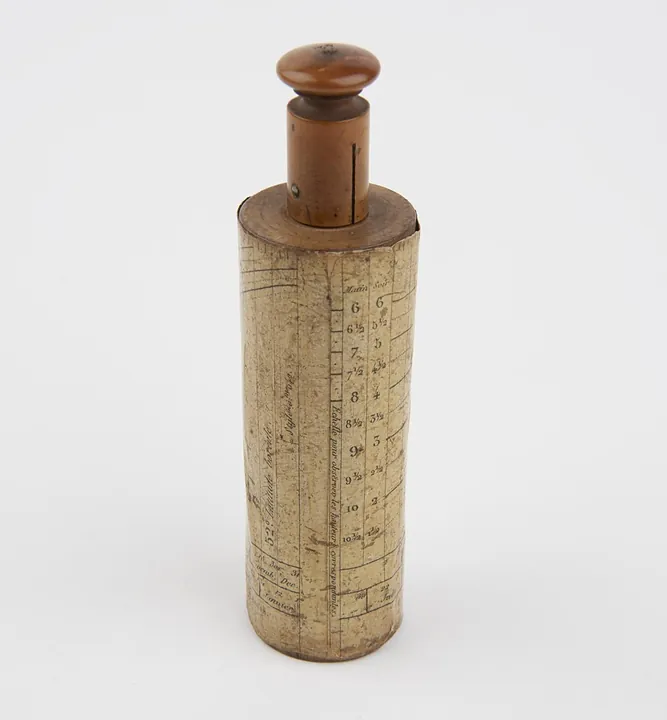
Instruments · 1831–1870
Column sundial for latitude 52 degrees, in boxwood with paper scales by Henry Robert, Horloger, Au Palais Royal, Paris, c.1832
Science Museum Group, London
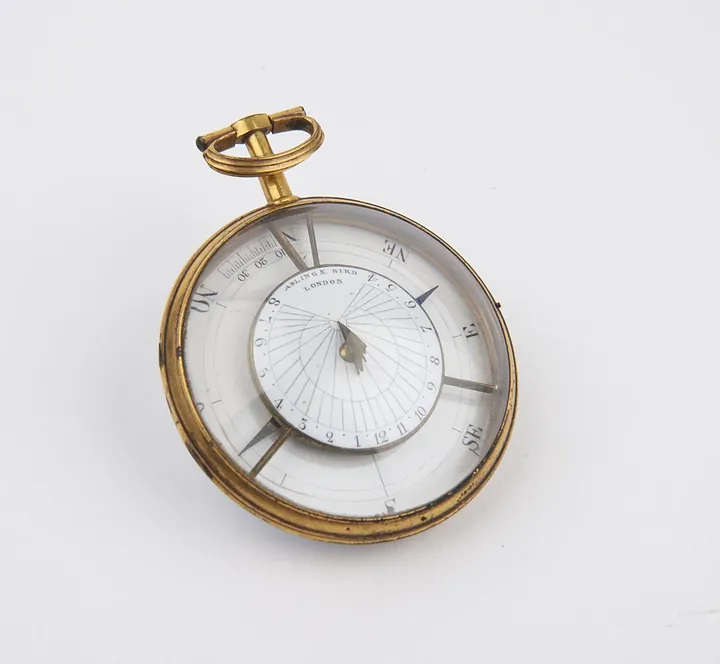
Instruments · 1831–1870
Horizontal compass sundial for latitude for 42 degrees, signed "Asling & Bird, London", in watch type case. English, c.1840.
Science Museum Group, London
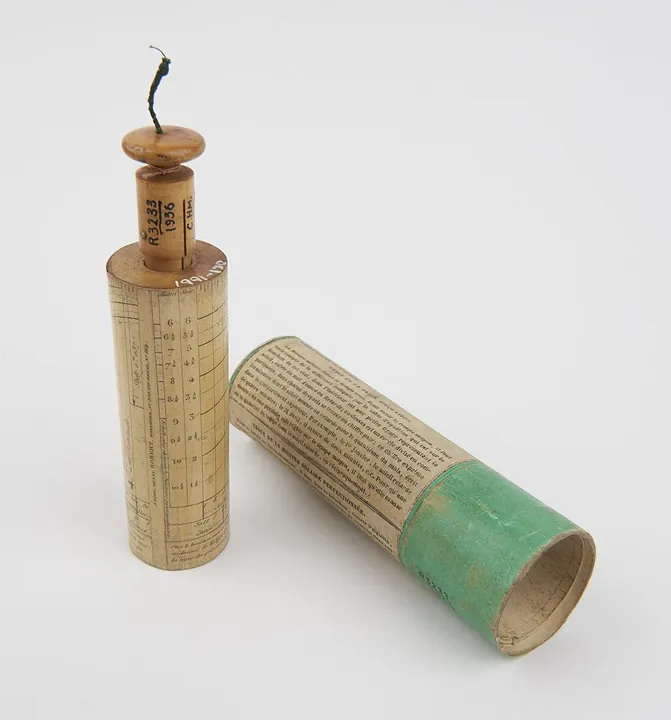
Instruments · 1831–1870
Sundial by Henry Robert, France, 1831–1870
Science Museum Group, London
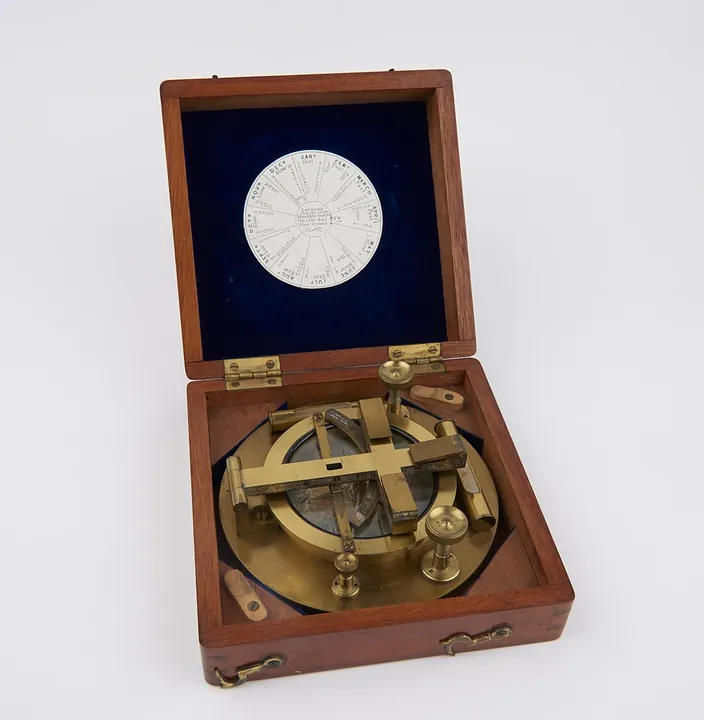
Instruments · 1831–1870
Sundial, in mahogany case
Science Museum Group, London