
Instruments · Marine chronometer
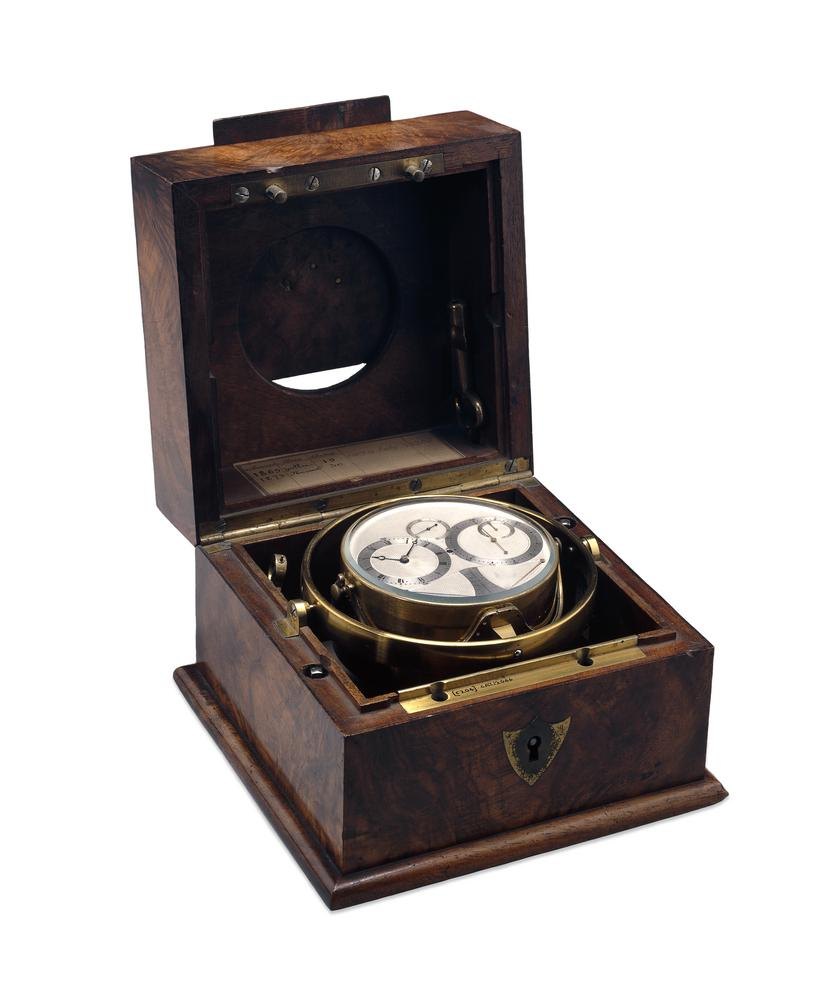
Marine chronometer by Breguet & Fils
- Maker / attribution
- Breguet & Fils (Made by)
- Date
- 1813
- Historical period
- Precision & Scientific Horology (1750 – 1850)
- Country of origin
- France
- Place
- Paris (France)
- Object type
- Marine chronometer
- Materials / technique
- walnut
- Dimensions
- Height: 12.55 centimetres Width: 17.40 centimetres Depth: 17.40 centimetres
- Holding institution
- British Museum
- Accession / object no.
- 1958,1006.2066
- Credit line
- British Museum, London
- Catalogue title (original)
- Marine chronometer by Breguet & Fils (English)
View the source record ↗ (opens another website in a new tab)Suggest a correction
Record summary
Held and catalogued by British Museum (object number 1958,1006.2066), this is a marine chronometer by Breguet & Fils, made in Paris (France), dated 1813. The Atlas places it in the Precision & Scientific Horology period (1750 – 1850) of its Instruments collection. Materials and techniques recorded by the source: walnut. Recorded dimensions: Height: 12.55 centimetres Width: 17.40 centimetres Depth: 17.40 centimetres. The record is illustrated with 6 photographs.
Assembled from the source record's structured fields. Dates and attributions are given as the source states them; where a field is missing the Atlas leaves it blank rather than estimating.
Catalogue description
Description — British Museum
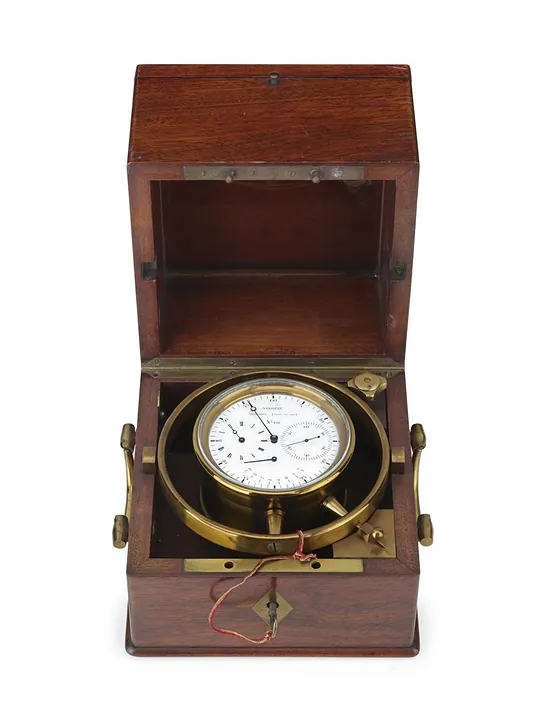
Marine chronometer; spring-driven; thirty-hour movement; fusee with Harrison's maintaining-power; club-tooth lever escapement; balance with bimetallic rim for temperature compensation; independent seconds-train, recording minutes and seconds on right-hand dials; main dial for hours and minutes on left, seconds-dial above; lower 'up-and-down' dials indicate running time available for going-train and independent seconds-train; canister enclosing movement; suspended in gimbals within walnut box; complete with canister-securing key and winding key.
Curator's comments — British Museum
Text from 'Clocks', by David Thompson, London, 2004, p. 134. Breguet et Fils Marine chronometer Paris, 1813 Height 12.55 cm, width 17.4 cm, depth 17.4 cm Towards the end of the eighteenth century, improvements in the timekeepers used for finding longitude at sea were, to a large extent, achieved by English chronometer makers, particularly John Arnold and Thomas Earnshaw. Nevertheless, the great French clockmakers were also striving for the same goal and makers such as Ferdinand Berthoud, Pierre Leroy and Henri Motel all played their part. The most celebrated French watchmaker, Abraham Louis Breguet, was involved in the quest and made a number of marine chronometers. This example was never used at sea. When completed in 1813 Breguet used it himself as an experimental workshop piece until 1822. The chronometer has a lever escapement and also an independent timer for minutes and seconds. The silver dial shows the hours and minutes on the left and has a chapter ring with seconds in the top centre, but there are also dials on the right for independent minute- and seconds-timing and two sectors at the bottom which show the state of wind of the two mainsprings. The box is made from mahogany with gimbal mounts for the drum which holds the chronometer. Unusually, there are two spring-loaded wood screws attached to the box, which are provided to allow the chronometer to be fixed to a flat wooden surface. When not used they are retracted within the perimeter of the box and held there by springs. A key is provided which has two squares for releasing the gimbal lock and also for turning the wood screws. A second ratchet or 'tipsy' key is used to wind the chronometer. It runs for more than thirty-five hours but would have been wound every day. After being used as a test-bed to try the performance of different components it was finally presented to Breguet's friend Monseigneur Louis Belmas (1757-1841), Bishop of Cambrai, to whom it is inscribed, 'Premiere Piece ou la Comunication du Rouage au Régulateur S'Opère Sans Frotement. Exécutée en 1813 par Breguet Pour Mr Belmas ami de l'auteur N02741' ('The first piece in which the transmission from the train to the regulator occurs without friction. Made in 1813 by Breguet for Mr. Belmas friend of the author'). Emmanuel Breguet, in 'Breguet, Watch-makers Since 1775', paints a wonderful picture of Belmas as a collector who spent nearly 20,000 francs on Breguet watches between 1814 and 1822 and who described them in his letters to Breguet in the most affectionate terms. Breguet's aim in this piece was to incorporate an escapement in which there was no sliding friction produced at the point of impulse to the balance. This he achieved with limited success for, while it is true in one respect, he nevertheless introduced other frictions into the impulse geometry, which negated what he had accomplished. Ilbert Collection. View more about curator's comments Comment from Richard Good, Catalogue of Watches in the British Museum. Vol. V (Unpublished manuscript) Made by Breguet et Fils Paris, 1813 One-day marine chronometer with independent seconds indication and with an early lever escapement. Signature: At the bottom of the dial 'Breguet'. On the box cover 'No.2741 Breguet et Fils'. On the back plate 'Breguet et fils No 2741'. On the inner back cover 'Premiere Piece ou la Comunication du Rouage au Regulateur S'opère Sans Frotement Executée en 1813 par Breguet No 2741. Pour Mr Belmas ami de l'auteur'. This can be translated as: 'The first piece where the transmission from the train to the regulator occurs without friction. Made in 1813 by Breguet for his friend, Monseignor Belmas'(1). Box: The movement is contained in an open-ended brass drum with two narrow rings standing proud on the inside. The front plate rests on one and the movement is held by three dogs screws on the other. The dog screws are planted on the edge of the back plate. The inner back cover fits inside the back, it has two holes one for a winder and the other for a key, and two lugs fitting into slots in the drum. The drum is gilded on the outside. There is then a second cover fitting on the outside of the drum, again gilded on the outside. The dial is protected by a glazed cover fitting on the outside of the drum. The glass is flat, with a bevelled edge, and has a short blind hole to clear the cannon pinion. The cover is located by a peg in the drum fitting into a notch in the cover, and fixed by two screws going in from the side. The drum has a gilded band in the middle, on which are fixed a slide to operate the independent seconds train, and a squared arbor with female hole, held under a small plate, for setting the minute hand of the independent seconds train. There are engraved instructions for these. The drum containing the movement fits into a brass cradle heavily counterweighted with a hemispherical piece of brass, and lined with green silk. The cradle is gimballed in a well made and finely figured walnut box of the usual type. The gimbal assembly is locked by a threaded brass plug set in a brass plate in the centre of the bottom of the box. Using a male key this plug can be screwed in and out from underneath, the plug then locks in a hole in the centre of the hemispherical counterweight. The box can be screwed to a wooden surface by two spring loaded wood screws lodged in the side of the box. Each has a square head, and when the key is applied they can be forced down and turned to screw them into the chart room table, or a larger carrying box. They are normally held retracted by flat springs visible when the bottom of the box is removed. The box also has a lock with a shield shaped escutcheon plate, and a sliding cover in the lid over a round aperture, but no carrying handles. The cover is centred with a diamond shaped inset brass plate engraved 'No 2741 Breguet et Fils'. A large brass key is held under a brass clip inside the lid, it has a male square to operate the gimbal ring, and a femal.
Inscriptions & marks
signature; Breguet et Fils No.2741 [movement]; inscription; Premiere Piece ou la Comunication du Rouage au Regulateur S'opere sans frotement. Executee en 1813 par Breguet No 2741 Pour Mr Belmas ami de l'auter. [canister]
Provenance
Previous owner/ex-collection:, Courtenay Adrian Ilbert; Donated by:, Gilbert Edgar; Acquired 1958
Historical context
Precision & Scientific Horology (1750 – 1850)
Harrison solves longitude; Mudge invents the lever; Breguet's Paris workshop defines the modern watch.
The longitude problem was solved by the marine chronometer and lunar distance methods; dividing engines made precision scales possible, and observatories set time by transit instruments.
Read the period in the timelineMore instruments from this periodEarlier: Early Modern Horology
Atlas type guide
Marine chronometers
A marine chronometer is a precision timekeeper carried at sea to find longitude: the navigator compares local noon, observed with a sextant, with the time at a reference meridian kept by the chronometer. Each hour of difference corresponds to fifteen degrees of longitude. John Harrison proved the method in the 1760s; Pierre Le Roy, Ferdinand Berthoud, John Arnold and Thomas Earnshaw then developed the detent escapement and the compensation balance that made chronometers practical to manufacture.
By the nineteenth century London, Liverpool, Le Locle and Glashütte supplied navies and merchant fleets. A typical box chronometer has a spring-detent escapement, a fusee to equalise mainspring torque, a bimetallic compensation balance with a helical balance spring, and is mounted in gimbals inside a wooden box so that it stays level.
What to look for
- Gimbals and a three-tier wooden box with a glazed inner lid.
- A power-reserve ('up and down') indicator on the dial, usually showing 56 hours on two-day instruments.
- Spring-detent escapement and a cylindrical (helical) balance spring visible through the movement.
- Admiralty or navy marks (broad arrow), and rating certificates from observatories.
- The maker's number on the dial and movement; many makers' registers survive, allowing dating.
Dating clues
- Earnshaw-type spring-detent chronometers became standard after about 1800.
- Auxiliary compensation devices on the balance appear from the mid-nineteenth century.
- Quartz and radio time signals ended routine use of mechanical chronometers in the 1970s and 1980s.
General guidance written by the Atlas editors about this kind of object. It is not a statement about this particular piece; for that, rely on the source record above and on physical examination.
Read next:Spring detent (chronometer) escapementBalance spring (hairspring)Detent escapement
Related records
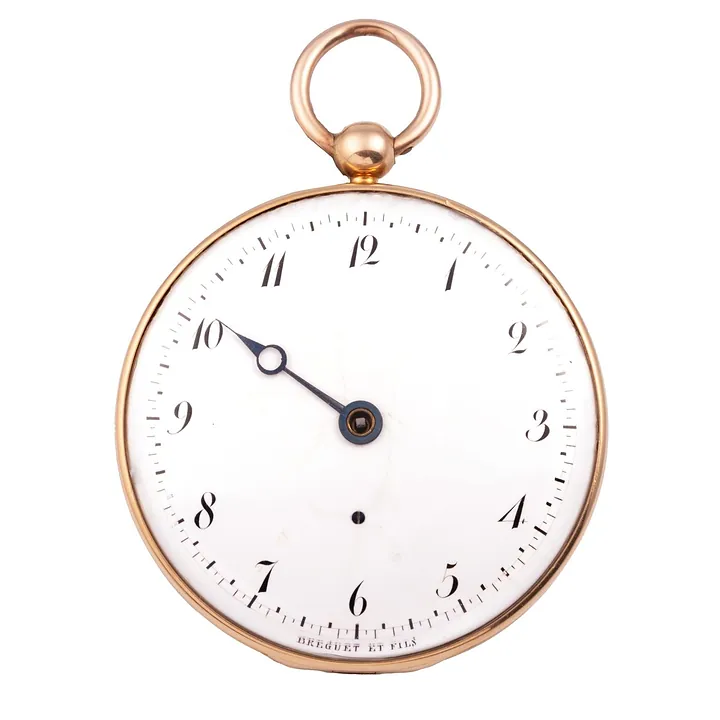
Pocket Watches · Sold to the Russian Consul the 25 August 1817 Mr Hercevanoff
Breguet & Fils pocket watch, Sold to the Russian Consul the 25 August 1817 Mr Hercevanoff
Antiquorum auction archive, Geneva
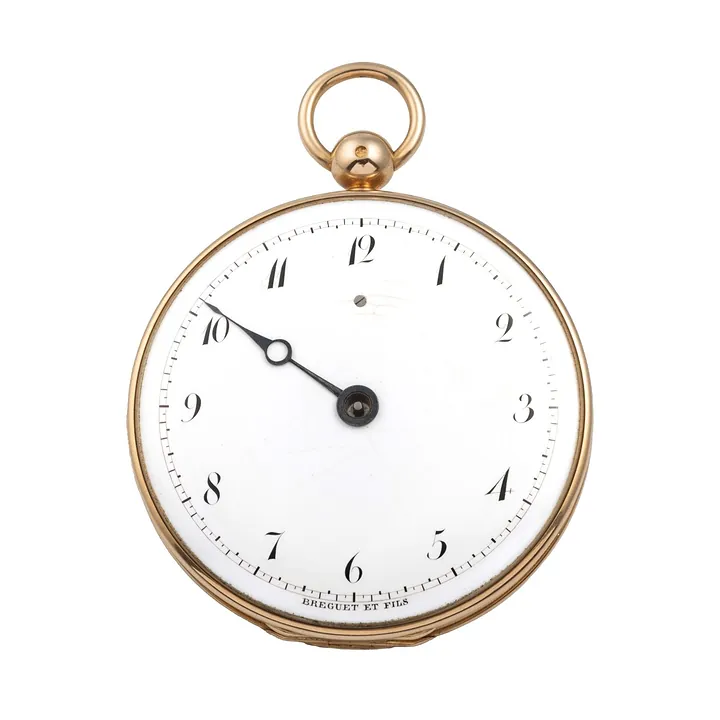
Pocket Watches · Delivered to Jousselin & Brasch the 19 April 1823.
Breguet & Fils pocket watch, Delivered to Jousselin & Brasch the 19 April 1823.
Antiquorum auction archive, Geneva
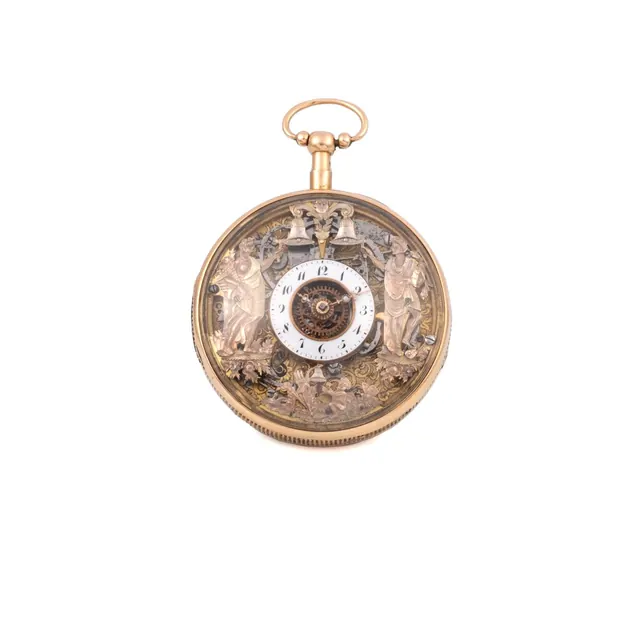
Pocket Watches · c. 1800-1810
Breguet & Fils pocket watch, skeleton quarter-repeater, circa 1800-1810
Antiquorum auction archive, Geneva
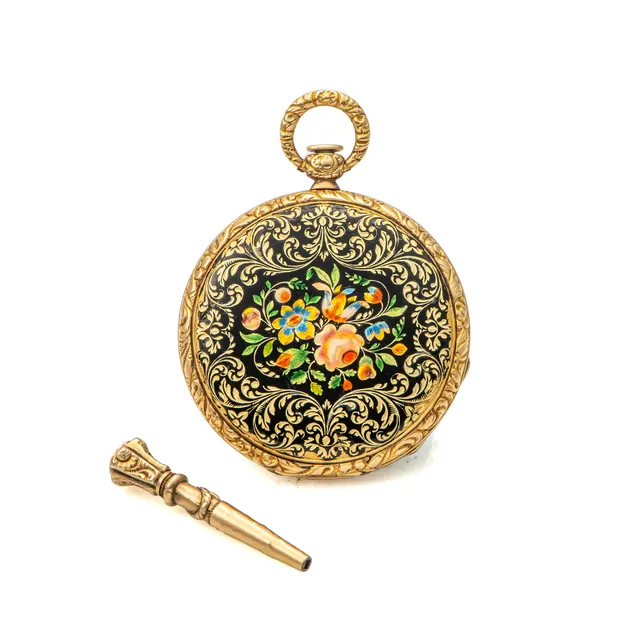
Pocket Watches · c. 1850
Breguet & Fils pocket watch, circa 1850
Antiquorum auction archive, Geneva
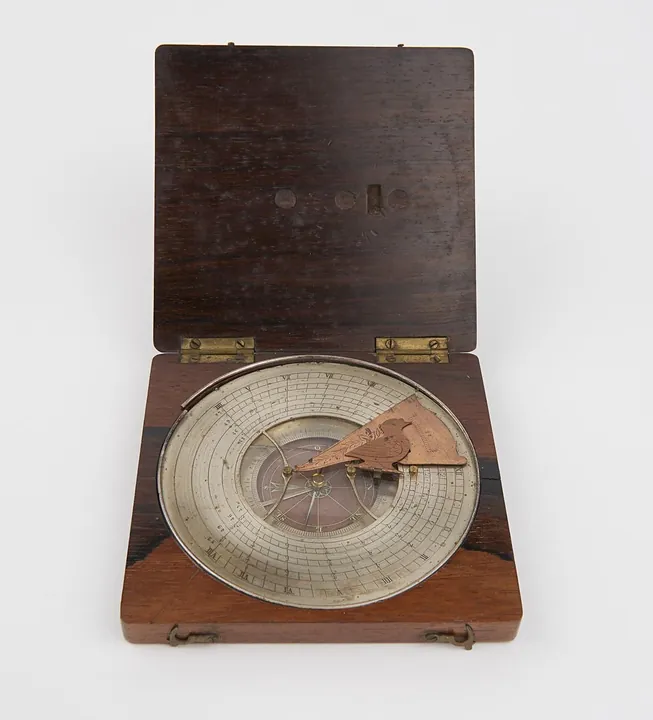
Instruments · 1751–1850
Horizontal compass sundial for latitudes 43 degrees, 46 degrees, 49 degrees, 52 degrees, in rosewood case French, c.1800 Cover glass cracked.
Science Museum Group, London
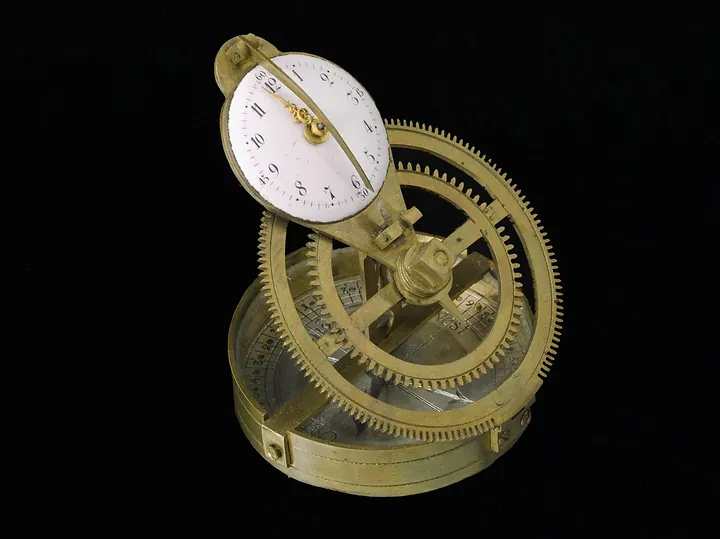
Instruments · 1751–1850
Mechanical equinoctial sundial for latitude 52 degrees, in original card case, one sight missing. French, c.1800
Science Museum Group, London
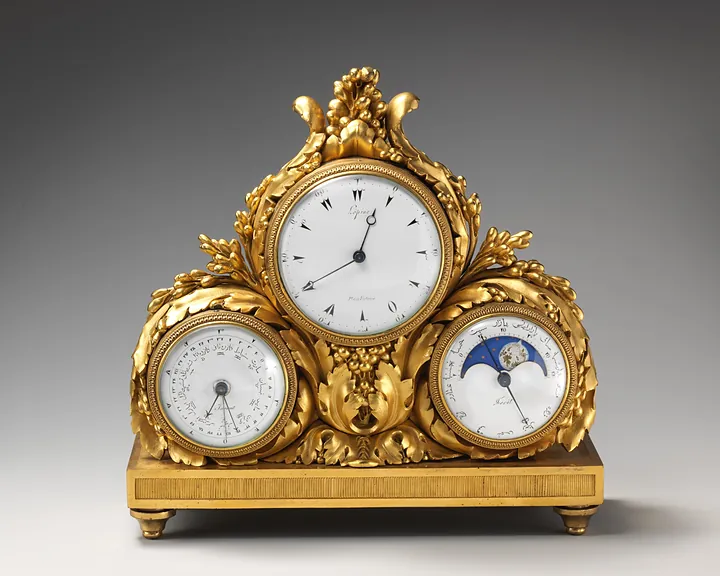
Instruments · last quarter 18th century
Clock by Jean Antoine Lépine, France, last quarter 18th century
The Metropolitan Museum of Art, New York
Instruments · 1780–1799
Marine chronometer by Vissière, France, 1780–1799
Science Museum Group, London