
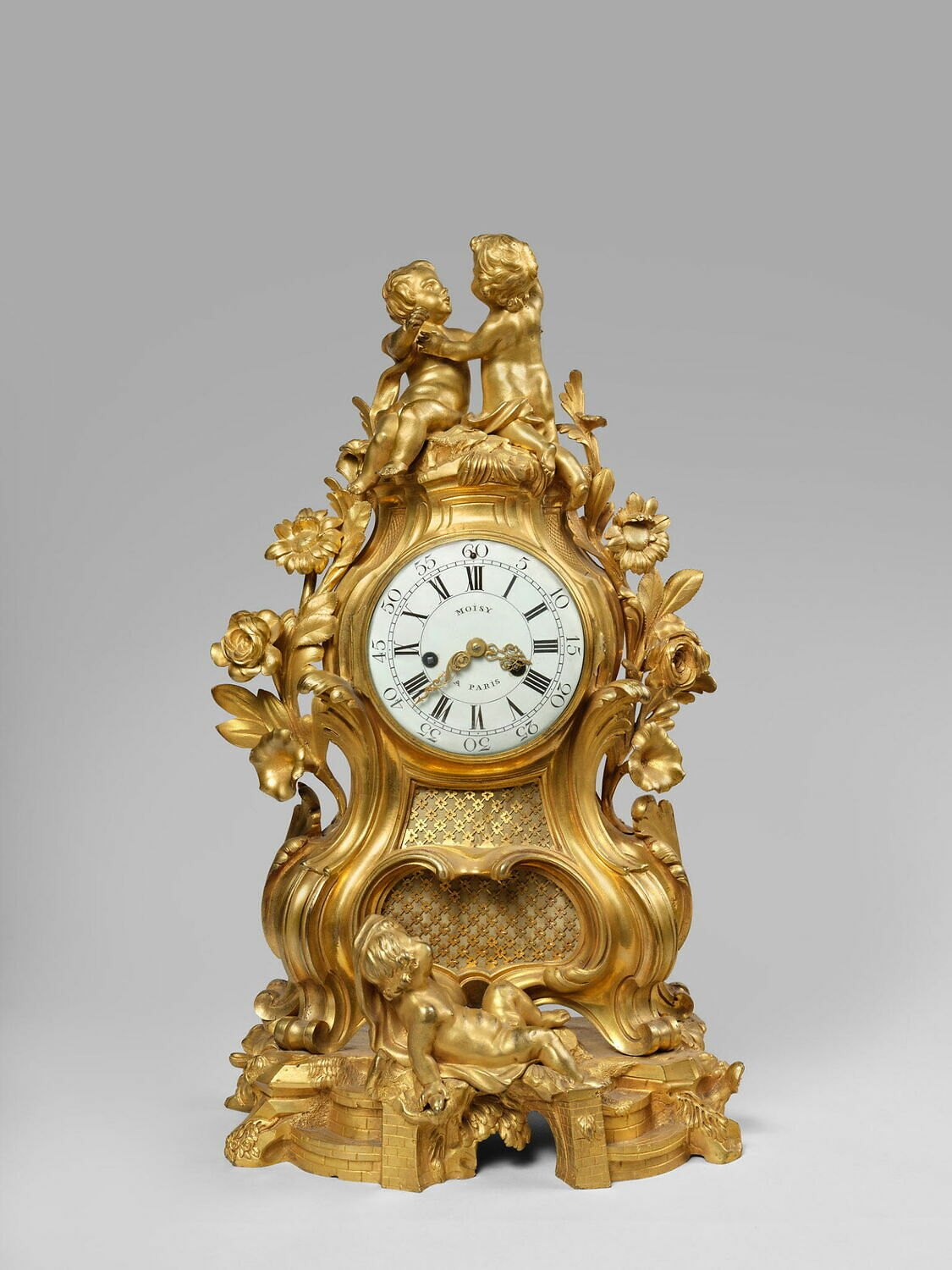
Clocks · Mantel clock
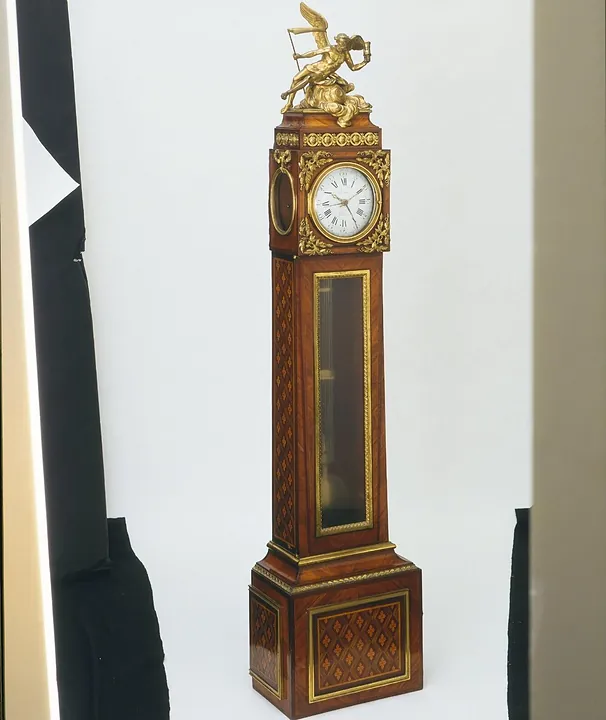
Mantel clock by Jean Moisy, France, 1755–1760
- Maker / attribution
- Jean Moisy (Horloger)
- Date
- 1755–1760
- Historical period
- Precision & Scientific Horology (1750 – 1850)
- Country of origin
- France
- Place
- Paris, France
- Object type
- Mantel clock
- Dimensions
- height 60,5 cm; width 35,5 cm; depth 20 cm; width 35,5 cm
- Holding institution
- Musée du Louvre, Paris
- Accession / object no.
- OAR 374
- Credit line
- Musée du Louvre
- Catalogue title (original)
- Pendule (French)
View the source record ↗ (opens another website in a new tab)Suggest a correction
Record summary
Held and catalogued by Musée du Louvre, Paris (object number OAR 374), this is a mantel clock by Jean Moisy, made in Paris, France, dated 1755–1760. The Atlas places it in the Precision & Scientific Horology period (1750 – 1850) of its Clocks collection. Recorded dimensions: height 60,5 cm; width 35,5 cm; depth 20 cm; width 35,5 cm. The record is illustrated with 6 photographs.
Assembled from the source record's structured fields. Dates and attributions are given as the source states them; where a field is missing the Atlas leaves it blank rather than estimating.
Catalogue description
Catalogue description — Musée du Louvre (French)
Objet composite : la boite est XVIIIe mais avec des ajouts XIXe. Les guirlandes ont des vis modernes. Mouvement ancien
Shown in the original language of the source catalogue. An editor-reviewed English translation has not yet been published; we do not publish machine translations as authoritative text.
Dating and period as catalogued (French)
Epoque / période : Louis XV (1715-1774) (Occident->époque moderne = Ancien Régime->dynastie des Bourbons) · · Date de création/fabrication : vers 1755 - 1760
Shown in the original language of the source catalogue. An editor-reviewed English translation has not yet been published; we do not publish machine translations as authoritative text.
Materials and techniques as catalogued (French)
Matériau : bronze (doré) · Technique : techniques métal (bronze d'ameublement)
Shown in the original language of the source catalogue. An editor-reviewed English translation has not yet been published; we do not publish machine translations as authoritative text.
Inscriptions & marks
Etiquette : ; volante portant les numéros suivants : tampon vert "INV. 1990" ; gommette rouge ; à l'encre noire "GML 8574" ; tampon noir "Récolement général 2001" ; Signature : ; au devant, sur le cadran émaillé de blanc "MOISY/A/PARIS" et gravée sur le revers du mouvement : "MOISY PARIS n° 584"
Provenance
la pendule pourrait être celle présente à la vente Cavendish Bentinck du 8 juillet 1891 à Londres chez Christie, Manson and Woods car sa description ressemble fort à l'OAR 374 : "lot 838 A. A clock by Moisy, of Paris, in Louis XV, of scroll design blodly chased with flowers, foliage and scrolls, and surmounted by a group of two boys, on or-moulu pedestal representing Masonry, with a reclining figure of a boy – on wood plinth, with or-molu feet – 28 in. High. From Sir H. Page Turner’Sale.". Elle provenait de la collection de Sir Henry Page-Turner (1824-1900). Ce lot fut acheté par le marchand d'art londonien [Asher] Wertheimer pour la somme de 84 livres. La pendule est répertoriée dans la liste des pendules récupérées en Allemagne établie par l'OBIP : « [n° d'ordre] 3 ; [n° allemand] 10059 ; [Provenance] Munich (sic) ; [Epoque] Rocaille ; [Sujet] Amours [Matière] Bronze doré ». D'après les documents qui sont en notre possession, elle fut achetée par le Museum für Kunsthandwerk de Francfort avant le 30 octobre 1941 soit auprès de M. Marchand, antiquaire sis boulevard Hausmann à Paris, soit de Théodore William Ward Holzapfel (45 rue des Peupliers, villa Montmorency, Paris 16ème), marchand d'origine franco-américaine ou franco-britannique qui apparaît également dans les sources comme le potentiel vendeur. Ce dernier pourrait également avoir servi d'intermédiaire entre M. Mannowsky, directeur du musée de Francfort et Marchand. La pendule fut donc achetée à Paris pour la somme de 6
Historical context
Precision & Scientific Horology (1750 – 1850)
Harrison solves longitude; Mudge invents the lever; Breguet's Paris workshop defines the modern watch.
The age of the deadbeat escapement, compensated pendulums and observatory regulators. Domestic clocks spread through the middle classes: English longcase and bracket clocks, French gilt-bronze mantel clocks, Viennese Biedermeier wall clocks, Black Forest painted-shield clocks, and the first American shelf clocks.
Read the period in the timelineMore clocks from this periodEarlier: Early Modern Horology
Atlas type guide
Mantel and French pendule clocks
The mantel clock — the French pendule de cheminée — is as much decorative art as timekeeper. From the late seventeenth century Parisian clockmakers worked with cabinet-makers, bronze founders and gilders (ciseleurs-doreurs) to create cases in Boulle marquetry, gilt bronze and marble, while the movements were often supplied by specialist makers. Clocks of the Louis XIV, Louis XV and Louis XVI periods, and Empire clocks with allegorical figures, set fashions copied across Europe.
The nineteenth century industrialised the type. The 'Paris movement', a standardised round movement with silk-thread or Brocot suspension and count-wheel striking, was made in huge numbers by firms such as Japy and Vincenti, and fitted into cases of every style and material.
What to look for
- Round 'Paris' movements with makers' stamps (e.g. Japy Frères, Vincenti, S. Marti) and medal marks from exhibitions.
- Suspension type: silk thread (earlier) or Brocot adjustable suspension (after c. 1840).
- Visible Brocot escapement on the dial in later clocks.
- Fire-gilt (mercury) gilding on bronzes versus later electro-gilding.
- Signed dials naming a retailer rather than the movement maker.
Dating clues
- Silk-suspension Paris movements: c. 1800–1850.
- Brocot suspension and visible escapements: after c. 1840.
- Exhibition medal stamps on movements give dates after the medal year.
General guidance written by the Atlas editors about this kind of object. It is not a statement about this particular piece; for that, rely on the source record above and on physical examination.
Read next:Anchor (recoil) escapement
Related records
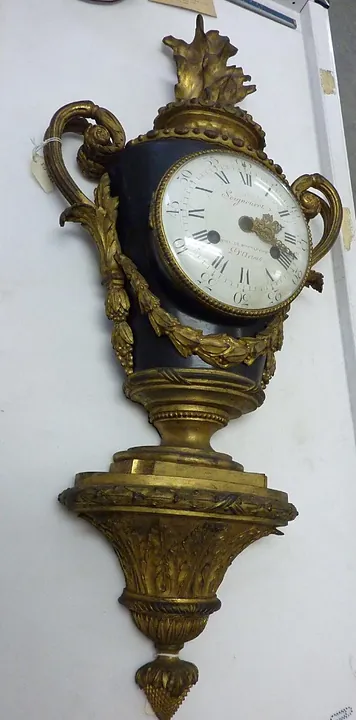
Clocks · 1750–1800
Bracket clock in metal case with scroll handles and flamed-shaped top signed by Pierre Seignoret, Clockmaket to the the Comte d'Artois
Victoria and Albert Museum, London
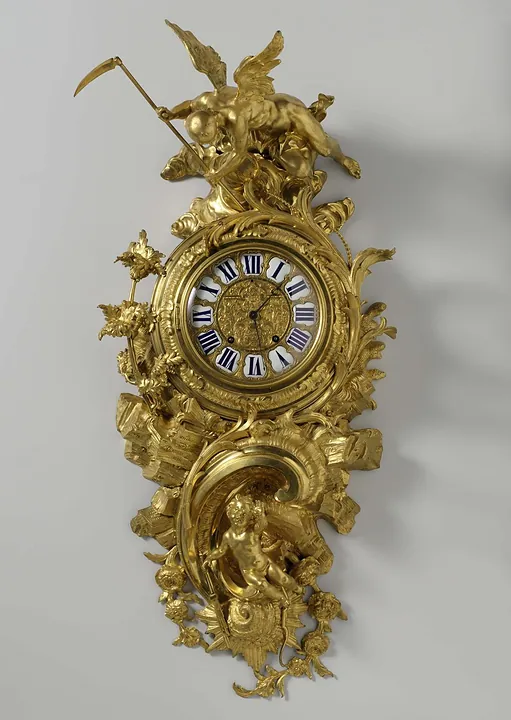
Clocks · 1756
Mantel clock, France, 1756
Rijksmuseum
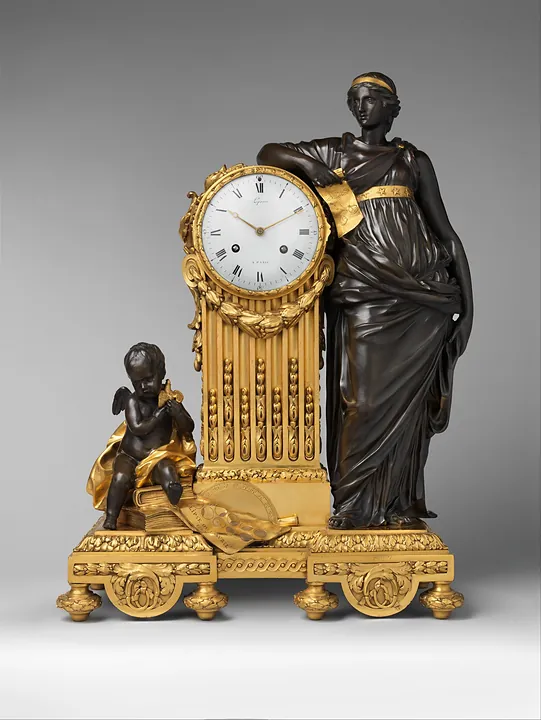
Clocks · c. 1764–70
Mantel clock by Jean-André Lepaute, France, c. 1764–70
The Metropolitan Museum of Art, New York
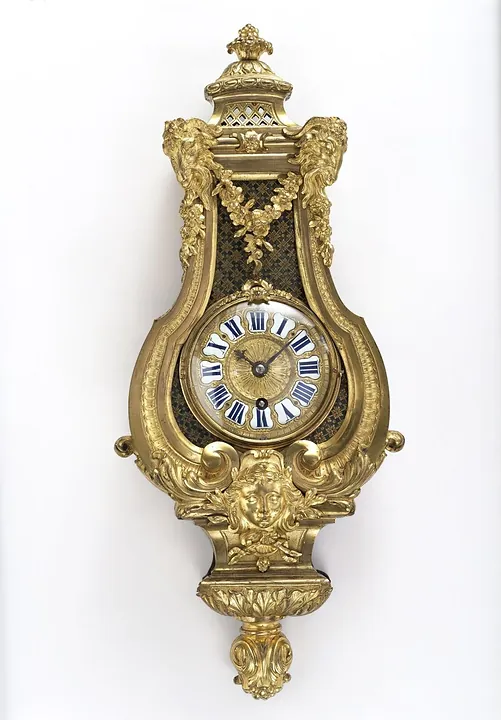
Clocks · 1760–1860
'Pendule d'alcove' wall clock, gilt-bronze and boulle marquetry, Paris, 1760-1860
Victoria and Albert Museum, London
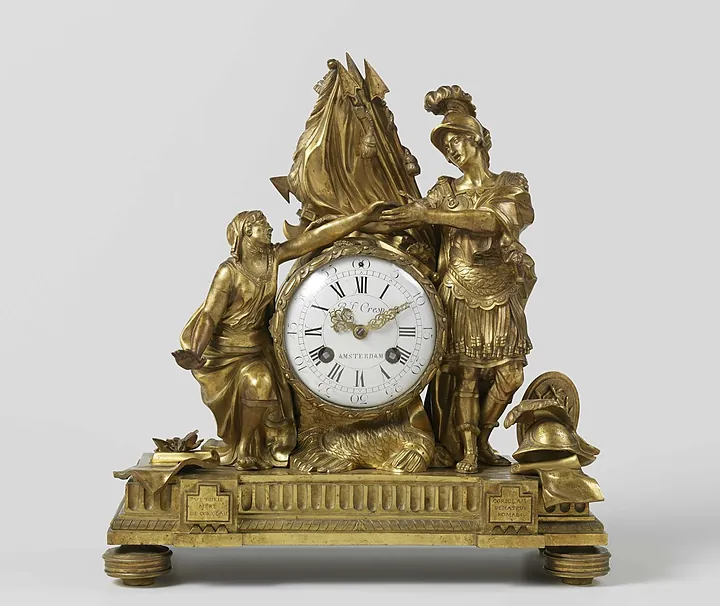
Clocks · 1760
Mantel clock, France, 1760
Rijksmuseum
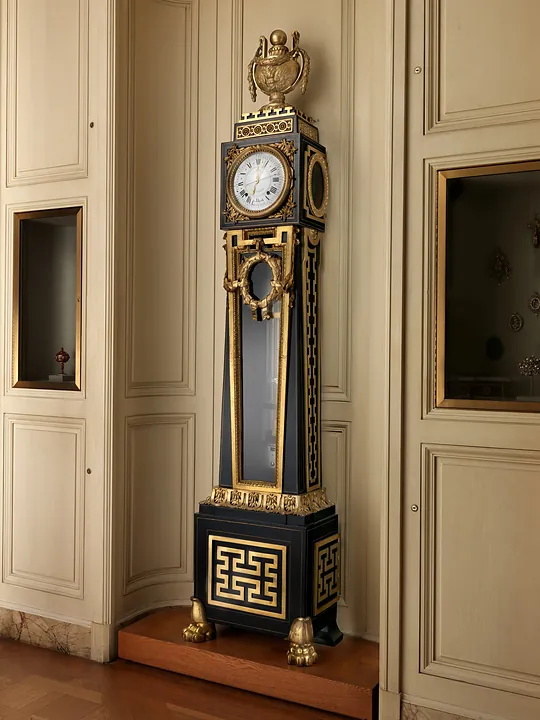
Clocks · c. 1768–70
Longcase astronomical regulator by Ferdinand Berthoud, France, c. 1768–70
The Metropolitan Museum of Art, New York
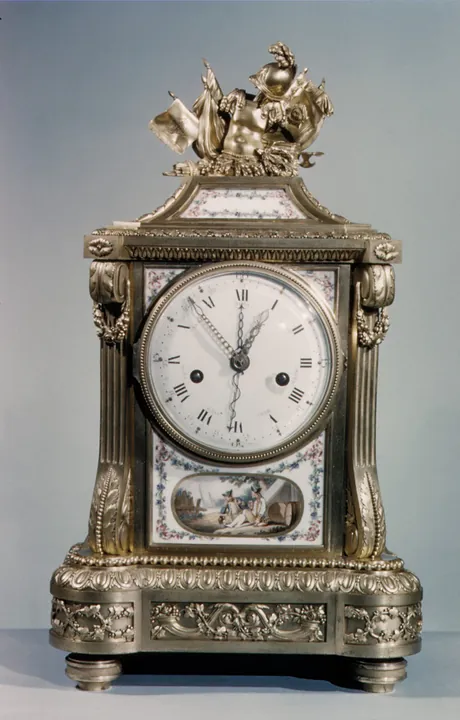
Clocks · c. 1775
Clock by Porcelain plaques by Sèvres Manufactory, France, c. 1775
The Metropolitan Museum of Art, New York
Clocks · 1770–1775
Longcase clock (régulateur) by Robert Robin, France, 1770–1775
Victoria and Albert Museum, London