
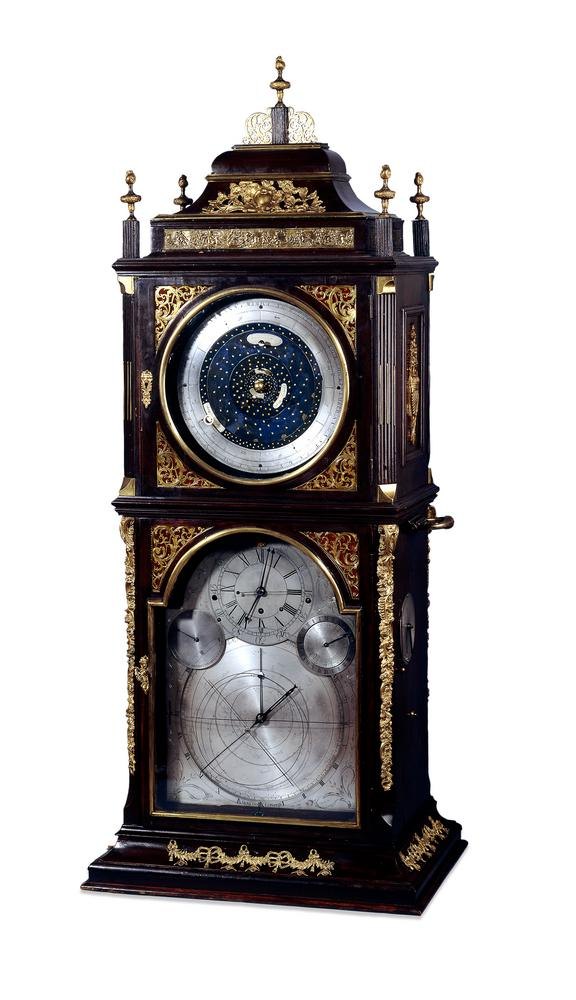
Clocks · Astronomical clock
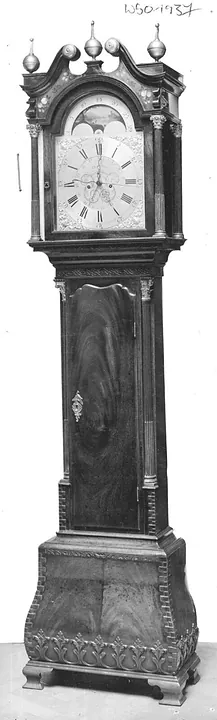
Mahogany cased spring driven astronomical and musical clock [pedestal not original]
- Maker / attribution
- Henry Jenkins (Made by)
- Date
- 1778
- Historical period
- Precision & Scientific Horology (1750 – 1850)
- Country of origin
- England
- Place
- London (England) (68 Aldersgate Street)
- Object type
- Astronomical clock
- Materials / technique
- mahogany, brass, gold
- Dimensions
- Height: 145 centimetres (clock and pedestal) Height: 78 centimetres (pedestal only)
- Holding institution
- British Museum
- Accession / object no.
- 1992,1001.1
- Credit line
- British Museum, London
- Catalogue title (original)
- Mahogany cased spring driven astronomical and musical clock [pedestal not original] (English)
View the source record ↗ (opens another website in a new tab)Suggest a correction
Record summary
Held and catalogued by British Museum (object number 1992,1001.1), this is an astronomical clock by Henry Jenkins, made in London (England) (68 Aldersgate Street), dated 1778. The Atlas places it in the Precision & Scientific Horology period (1750 – 1850) of its Clocks collection. Materials and techniques recorded by the source: mahogany, brass, gold. Recorded dimensions: Height: 145 centimetres (clock and pedestal) Height: 78 centimetres (pedestal only). The record is illustrated with 6 photographs.
Assembled from the source record's structured fields. Dates and attributions are given as the source states them; where a field is missing the Atlas leaves it blank rather than estimating.
Catalogue description
Description — British Museum
Movement: Massive 8-day, spring-driven, three-train movement, the back plate engraved with a foliate design with a basket of fruit, birds, shells and a Chinese pavilion. The time indication, the astronomical dial and the orrery are all driven by the going train. The clock strikes the hours and plays one of a selection of 12 tunes on 13 bells. Dead-beat escapement with later wood-rod pendulum. : DIALS The upper dial, is a heliocentric orrery consisting of six revolving concentric rings painted with gold stars against a dark blue background, each ring with a black and white sphere to represent one of the six planets known at the time [Mercury, Venus, Earth, Mars, Jupiter and Saturn]. Each with an engraved plate inscribed with the duration of its orbit. Around the outside, a fixed silvered-brass ring is engraved with the months, the date and the degrees and signs of the zodiac. The composite lower dial has an upper subsidiary dial with hours, minutes and centre-seconds. To the left a subsidiary dial shows the months and to the right a similar one shows the the time of high tide in a number of named locations. The lower main dial is a mechanical celestial planisphere which shows the relative positions of the earth, sun, moon and principal stars. : CASE Mahogany case with applied gilt-brass foliate mounts to the canted corners of the lower section and fluted canted corners with gilt-brass plinths and capitals on the upper section. The case has an inverted bell top with flaming-urn finials. Around the base of the top are cast gilt-brass panels decorated with putti and chariots in low relief. The upper side apertures [probably with pierced frets originally] are now filled with wood panels with applied, gilt-brass urns. The rear of the case with upper and lower glazed doors. On the right-hand side is a small silvered-brass setting dial engraved with the names of the tunes. The clock now stands on a purpose-built mahogany pedestal which utilizes the original gilt-brass feet and gilt-brass mounts taken from the clock case, the latter replaced with poor-quality copies cast from the originals.
Curator's comments — British Museum
There are three other clocks by Jenkins known to survive. 1. Solar/sidereal clock, National Maritime Museum. 2. Astronomical longcase clock, illustrated in Cescinsky & Webster, English Domestic Clocks, fig.242 3. Astronomical table clock, Cescinsky & Webster, English Domestic Clocks, fig.339. Text from 'Clocks', by David Thompson, London, 2004, p. 112. Henry Jenkins Astronomical clock London, 1778 In the second half of the eighteenth century interest in astronomy was perhaps at its height. The two transits of Venus in 1761 and 1769 had been earnestly followed by such august bodies as the Royal Society, and the work of astronomers such as James Ferguson had done much to popularize the subject among the large fraternity of gentlemen scientists. Astronomical clocks were understandably popular. Henry Jenkins was born and educated in Cornwall. At the age of ten he was apprenticed as a tailor, but he also acquired knowledge of clockmaking and astronomy. He first appears in London in about 1755 and in the following five years made at least four clocks of increasing complexity. In 1778 he published a small treatise entitled 'A Description of Several Astronomical and Geographical Clocks'. In the second edition of the treatise Jenkins described in some detail this particular clock, which he judged his most complicated. The illustration from the treatise (bottom) shows the original design of the case. The clock has astronomical indications on two large dials. The upper dial is in the form of an orrery with the six known planets, Mercury, Venus, Earth, Mars, Jupiter and Saturn, revolving around a fixed sun. It is possible that the Jupiter gearing, which provides an orbit of 4334.3 days, may be Jenkins's more accurate contribution (it is now calculated at 4332.595 days). The lower dial has a series of subsidiaries arranged around it. The large subsidiary dial at the top shows hours, minutes and centre-seconds. The smaller subsidiaries are a calendar to the left and a dial showing the time of high tide at various ports to the right. The main dial consists of a planisphere showing the positions of the sun, moon and the earth relative to the stars. The central, silvered disc is a plane projection of the heavens centred on the celestial north pole and revolving once in a sidereal year. It is engraved with all the major stars known at the time, with concentric circles for the equator and the two tropics, and the eccentric circle of the ecliptic. The movement of the clock is equally impressive, with a back plate engraved with the chinoiserie designs commonly found on clock plates in the third quarter of the eighteenth century. It is designed to go for eight days and is controlled by a pendulum. The clock also plays music: one of the tunes, entitled 'Air by Mudge', written by Richard Mudge (brother of the famous clockmaker), is not known by musicologists to exist in any other form. Purchased in 1992. View more about curator's comments Jenkins, Henry, A DESCRIPTION OF SEVERAL ASTRONOMICAL AND GEOGRAPHICAL CLOCKS, 2nd ed. London 1778. [A copy in the Guildhall Library] Barker & Co. Ltd., Kensington, London W., Sale catalogue [undated] Britten, F.J., OLD CLOCKS AND WATCHES AND THEIR MAKERS, 3rd Ed.London 1911, pp. 363-364. Cescinsky & Webster, ENGLISH DOMESTIC CLOCKS, 2nd Ed? King, H.C., GEARED TO THE STARS, Bristol 1978, pp.147-148. National Heritage Memorial Fund, ANNUAL REPORT, 1992-3, pp.37-38, illus.
Inscriptions & marks
signature; JENKINS LONDON [dial]; inscription; London Rochester Ostend Dover Diep Needles Havre DeGrace Texel Fowey Mounts Bay Amsterdam Gravesend Portsmouth Spithead Shoreham St Helens Portland Plymouth Scilly [tidal dial]; inscription; 1.104 Psalm 2.Lady Coventry's Mint. 3.Gavot by Clark 4.Highland Laddy 5.Mint. by Handle 6.Air by Mudge 7.Air by Handle 8.Lass of Pattys Mill 9.Over the Water 10.Sir Chas. Sidney Mint. 11.Hast to the Wedding 12.Miss Bakers Hornpe. [music-setting dial]
Provenance
Purchased through:, Sotheby's
Historical context
Precision & Scientific Horology (1750 – 1850)
Harrison solves longitude; Mudge invents the lever; Breguet's Paris workshop defines the modern watch.
The age of the deadbeat escapement, compensated pendulums and observatory regulators. Domestic clocks spread through the middle classes: English longcase and bracket clocks, French gilt-bronze mantel clocks, Viennese Biedermeier wall clocks, Black Forest painted-shield clocks, and the first American shelf clocks.
Read the period in the timelineMore clocks from this periodEarlier: Early Modern Horology
Atlas type guide
Astronomical, musical and automaton clocks
Astronomical clocks display more than the hour: the positions of the sun and moon in the zodiac, the phase of the moon, the calendar, sometimes the planets and eclipses. From Richard of Wallingford's and Giovanni de' Dondi's fourteenth-century clocks to the Prague Orloj and the Strasbourg cathedral clocks, they demonstrated the order of the cosmos. Renaissance makers in Augsburg and Nuremberg built celestial globe clocks and monstrance clocks as princely treasures.
Automaton and musical clocks entertained as well as informed: figures move, birds sing, organs and carillons play tunes from pinned cylinders. The eighteenth-century trade with China ('sing-songs') and Ottoman Turkey created a market for elaborate English, Swiss and French automata.
What to look for
- Subsidiary dials for moon phase, calendar, zodiac and planetary positions.
- Celestial globes or armillary spheres turned by the movement.
- Pinned cylinders, bellows and pipes or bells for music.
- Figures on cams and levers; separate trains for automaton work.
Dating clues
- Renaissance astronomical table and globe clocks: c. 1550–1650.
- English and Swiss automaton clocks for the Chinese market: c. 1760–1820.
- Picture clocks (clockwork pictures) are mostly nineteenth century.
General guidance written by the Atlas editors about this kind of object. It is not a statement about this particular piece; for that, rely on the source record above and on physical examination.
Read next:Verge escapementFusee
Related records
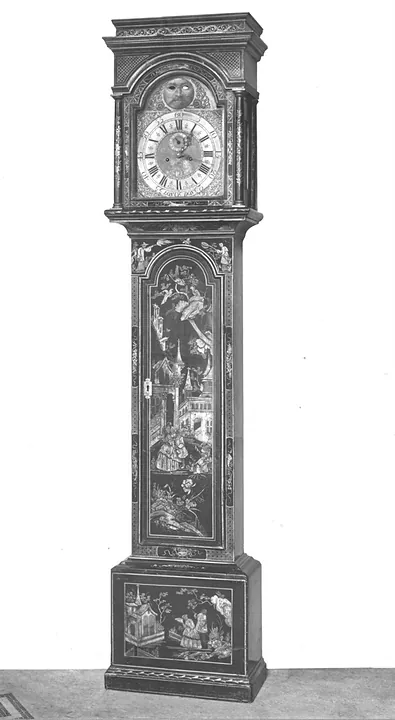
Clocks · 1740–1760
Longcase clock, English, 1740–1760, japanned wood, John Ellicott
Victoria and Albert Museum, London
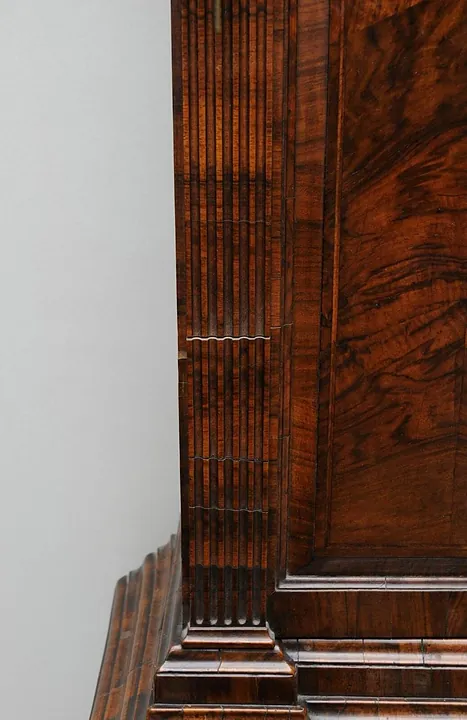
Clocks · c.1750
Long-case clock, English, ca. 1750, by Richard Peyton of Gloucester
Victoria and Albert Museum, London
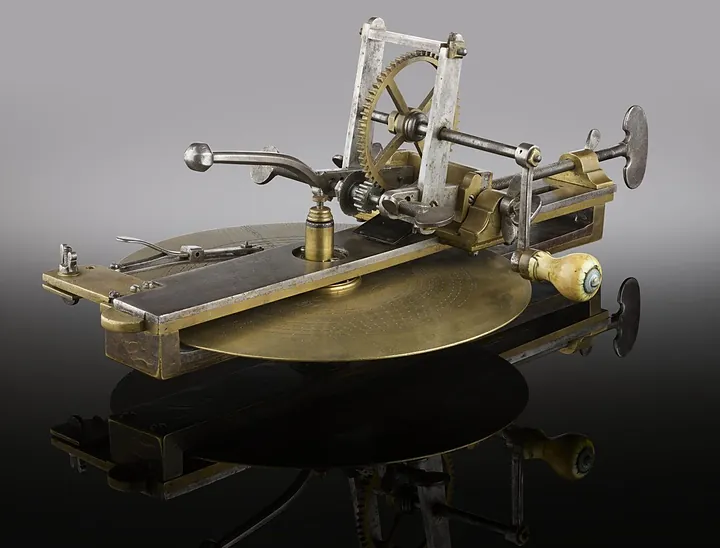
Clocks · 1751
Large wheel engine, signed and dated "John Tipping, Whildon Green, 1751".
Science Museum Group, London
Clocks · 1755
Bracket clock by John Fordham, England, 1755
The Metropolitan Museum of Art, New York
Clocks · c. 1760
Longcase clock by James Cox, England, c. 1760
Victoria and Albert Museum, London
Clocks · 1766
Clock by Alexander Cumming, England, 1766
Science Museum Group, London
Clocks · 1768–1769
Regulator clock by John Shelton, England, 1768–1769
Science Museum Group, London
Clocks · c. 1775
Longcase clock, England, c. 1775
Victoria and Albert Museum, London