
Wristwatches · Wristwatch
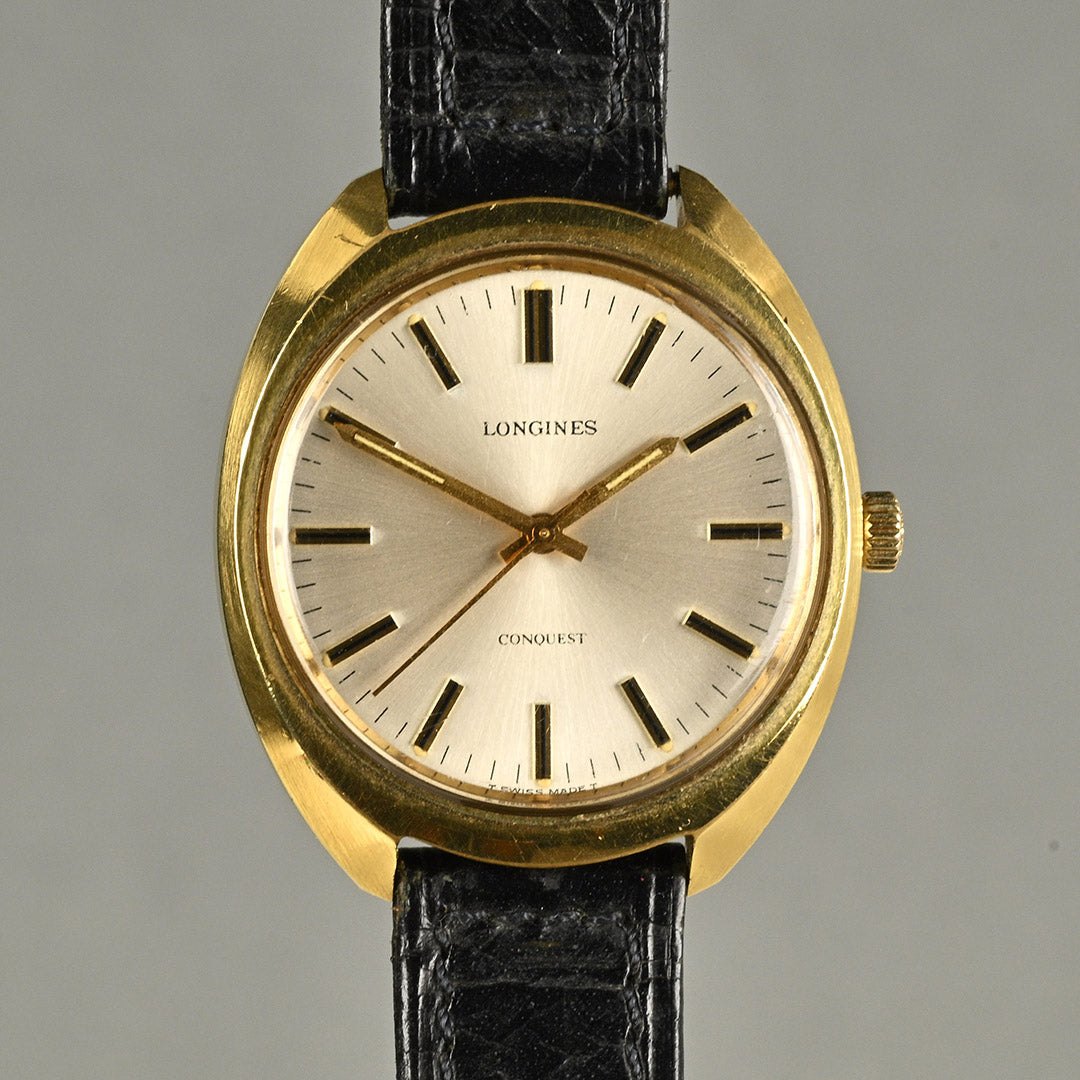
Longines Conquest Gold-Plated Dress Watch ref. 1500-2, circa 1974
- Maker / attribution
- Longines (maker)
- Date
- c. 1974
- Historical period
- Quartz Revolution (1969 – 1990)
- Country of origin
- Switzerland
- Object type
- Wristwatch
- Materials / technique
- gold
- Dimensions
- Case 35 mm
- Stock no.
- vws4528
- Credit line
- Dealer listing, Vintage Watch Specialist (vws4528)
- Catalogue title (original)
- Longines Conquest Gold-Plated Dress Watch Reference 1500-2 c.1974 (English)
View the source record (dealer listing) ↗ (opens another website in a new tab)Suggest a correction
Record summary
Catalogued by Vintage Watch Specialist (dealer), United Kingdom (stock number vws4528), this is a wristwatch by Longines, made in Switzerland, dated c. 1974. The Atlas places it in the Quartz Revolution period (1969 – 1990) of its Wristwatches collection. Materials and techniques recorded by the source: gold. Recorded dimensions: Case 35 mm. The record is illustrated with 6 photographs.
Assembled from the source record's structured fields. Dates and attributions are given as the source states them; where a field is missing the Atlas leaves it blank rather than estimating.
Catalogue description
Dealer description — Vintage Watch Specialist
The Longines Conquest has been part of the Swiss watchmaker's story since 1954, when it became one of the company's first officially registered watch collections. Originally associated with precision, reliability and robust everyday timekeeping, the Conquest gradually evolved into a varied collection encompassing both practical sports watches and more refined designs. By the 1970s, changing tastes had brought a new aesthetic to Swiss watchmaking. Traditional round cases were joined by broader, more sculptural designs, while brushed dials, applied hour markers and gold-tone finishes reflected the period's growing enthusiasm for contemporary styling. Longines embraced these developments while retaining the mechanical craftsmanship on which its reputation had been built. The result was a generation of elegant, understated watches that combined classic Swiss movements with distinctly 1970s design. Today, vintage Conquest models offer collectors an appealing combination of established watchmaking heritage, period character and everyday wearability. What's on Offer Here we have a beautifully presented Longines Conquest Reference 1500-2 , dating to approximately 1974, with a gold-plated case, elegant silver sunburst dial and manually wound mechanical movement. The first thing that catches the eye is the dial. Its finely brushed silver finish catches the light beautifully, creating a subtle sunburst effect that changes with the angle of the watch. Applied gold-tone baton hour markers, each featuring a dark central inlay, provide a lovely contrast against the pale background. There are luminous pips on each index for improved visibility. Matching gold-tone baton hands with luminous inserts complement the hour markers, while a slender central seconds hand completes the uncluttered three-hand display. The Longines name sits neatly beneath 12 o'clock, with the Conquest designation positioned above 6 o'clock. A discreet outer minute track adds definition without disturbing the dial's wonderfully clean appearance. The dial is in excellent condition , and its restrained styling gives the watch a particularly timeless appeal. The gold-plated case measures 35mm across, with a lug-to-lug length of 38mm. Its broad, softly rounded shape and integrated-looking lugs are characteristic of the era, giving the watch a little more presence than its dimensions might initially suggest. The case shows marks of wear consistent with its age, particularly around the edges and lugs, but retains its attractive shape. The bezel is in very good condition, as is the Plexiglass crystal. At 3 o'clock sits the gold-tone winding crown, bearing the Longines winged hourglass emblem, a pleasing detail that reinforces the watch's identity. The stainless steel caseback is engraved with the Longines name and the familiar Waterresistant, Antimagnetic and Shockabsorber wording. Inside the caseback, the model is identified as Reference 1500-2 . Powering the watch is the manually wound Longines Calibre 706 , a 17-jewel mechanical movement with a stated power reserve of approximately 37 hours. The movement has been serviced and is currently recording +12 seconds per day with an amplitude of 270° on the timegrapher. The watch is fitted with a black leather strap featuring a crocodile-style embossed finish, which works particularly well with the warm gold case and silver dial. What makes this Conquest so appealing is its versatility. It has enough 1970s character to interest a vintage watch enthusiast, yet its clean dial and restrained proportions make it equally suitable for everyday wear. An elegant example of vintage Longines watchmaking, combining a well-preserved dial, classic mechanical movement and distinctive period styling. Condition Report: Crystal: Very Good Dial: Excellent Bezel: Very Good Case: Good Movement: Serviced +12s/d 270° Overall: Very Good
Historical context
Quartz Revolution (1969 – 1990)
Seiko's Astron begins mass quartz timekeeping; traditional industries contract sharply.
Quartz and digital watches transformed the market after 1969. Swiss employment collapsed, Japanese and Hong Kong production soared, and the Swatch (1983) helped the Swiss industry recover; mechanical watches survived as luxury goods.
Read the period in the timelineMore wristwatches from this periodEarlier: Modern Mechanical Horology
Atlas type guide
Wristwatches
Bracelet watches were worn by women from the early nineteenth century — Breguet made one for Caroline Murat, Queen of Naples, in 1810–12 — but the wristwatch only became a man's instrument with military use and aviation in the early twentieth century. Between the World Wars it overtook the pocket watch; the 1920s and 1930s brought rectangular Art Deco cases, water-resistant cases and the first automatic winding systems.
After 1945 the wristwatch became a carrier of identity — dress watches, sports and dive watches, chronographs, calendars — produced by Swiss, American, Japanese, German, Soviet and Chinese industries. The quartz revolution after 1969 and the mechanical renaissance since the 1990s, including the rise of independent watchmakers, complete the story.
What to look for
- The reference number (between the lugs or inside the case back) and serial number, the starting point for dating.
- The calibre: its maker and number are often stamped under the dial or on the bridge.
- Originality of dial, hands and crown — refinished ('redial') dials are common.
- Case material marks: 18K/750, 14K/585, stainless steel, gold-filled, plated.
Dating clues
- Wire-lug cases: before c. 1925.
- Water-resistant screw-down cases: from 1926.
- Quartz movements: from 1969; sapphire crystals widespread after c. 1980.
General guidance written by the Atlas editors about this kind of object. It is not a statement about this particular piece; for that, rely on the source record above and on physical examination.
Related records
Instruments · c. 1940
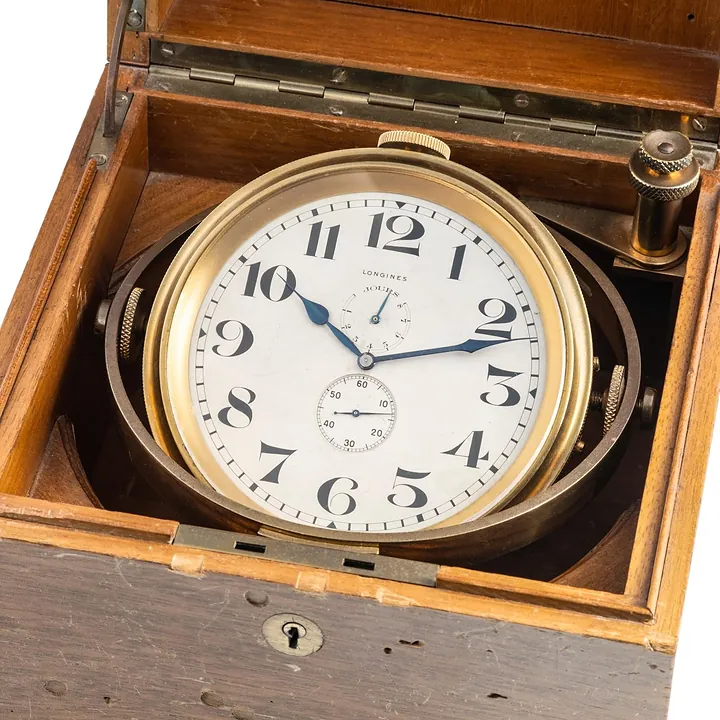
Longines marine chronometer, c. 1940
Antiquorum auction archive, Geneva
Pocket Watches · c. 1910-1920s
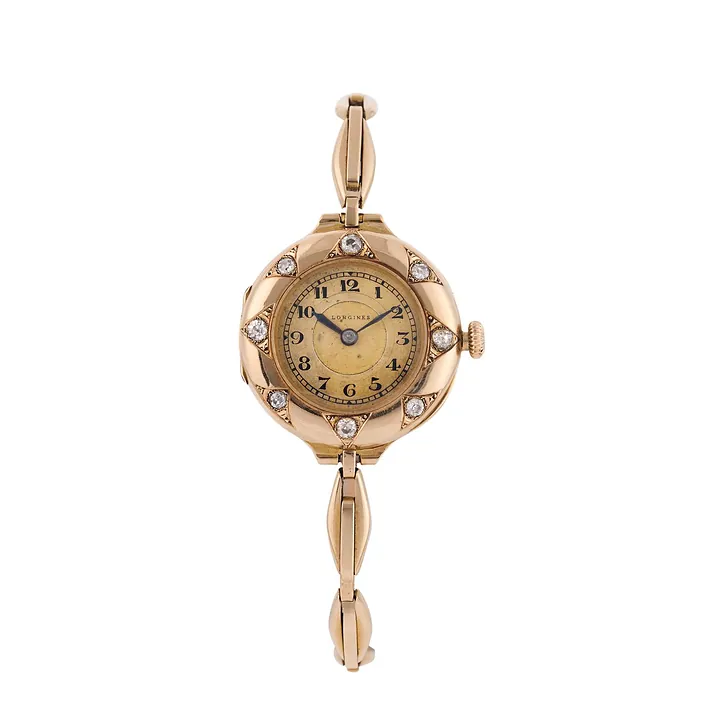
Longines watch, c. 1910-1920s
Antiquorum auction archive, Geneva
Pocket Watches · c. 1915
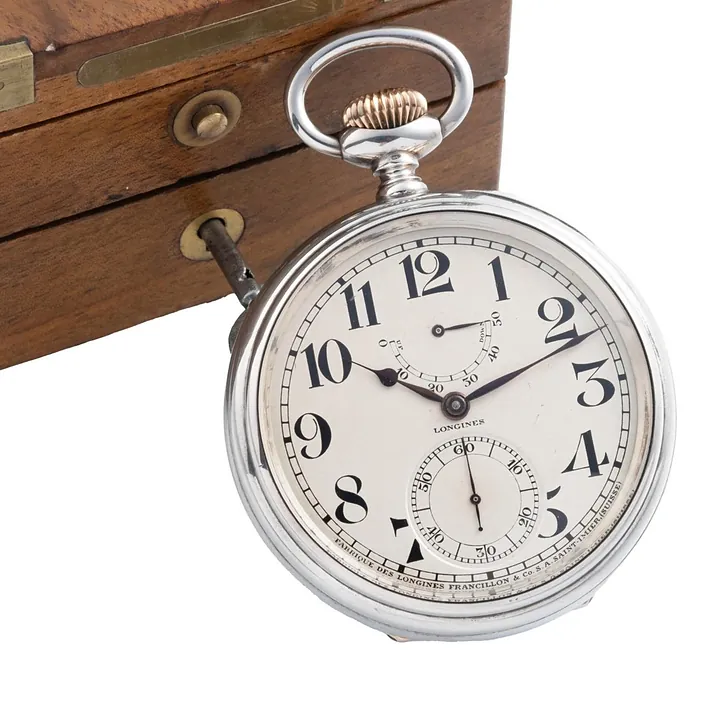
Longines ''torpedo-Boat Watch'', c. 1915
Antiquorum auction archive, Geneva
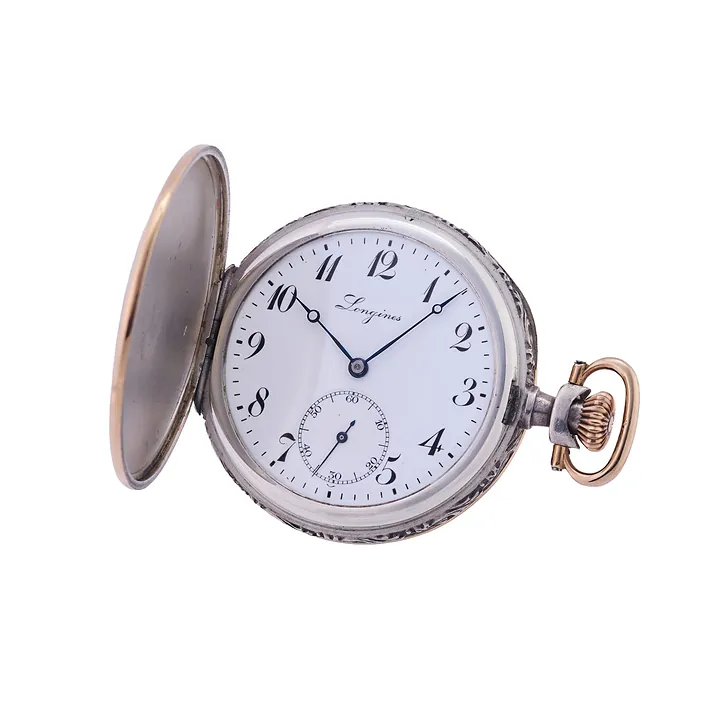
Pocket Watches · c. 1920s
Longines pocket watch, c. 1920s (Antiquorum Lot 389-59)
Antiquorum auction archive, Geneva

Wristwatches · 1970
Wristwatch by Heno, Switzerland, 1970
Museum Rotterdam

Wristwatches · 1960–1986
'Tri-Compax' calendar chronograph wristwatch in gold case, by Universal, Geneva, Switzerland, 1960–1986.
Science Museum Group, London

Wristwatches · 1969–1970
Beta 21 Quartz wristwatch movement, made in Switzerland, 1970.
Science Museum Group, London

Wristwatches · c. 1969
Omega Speedmaster Moonwatch, ref. 145022-69st, c. 1969
Antiquorum auction archive, Geneva