
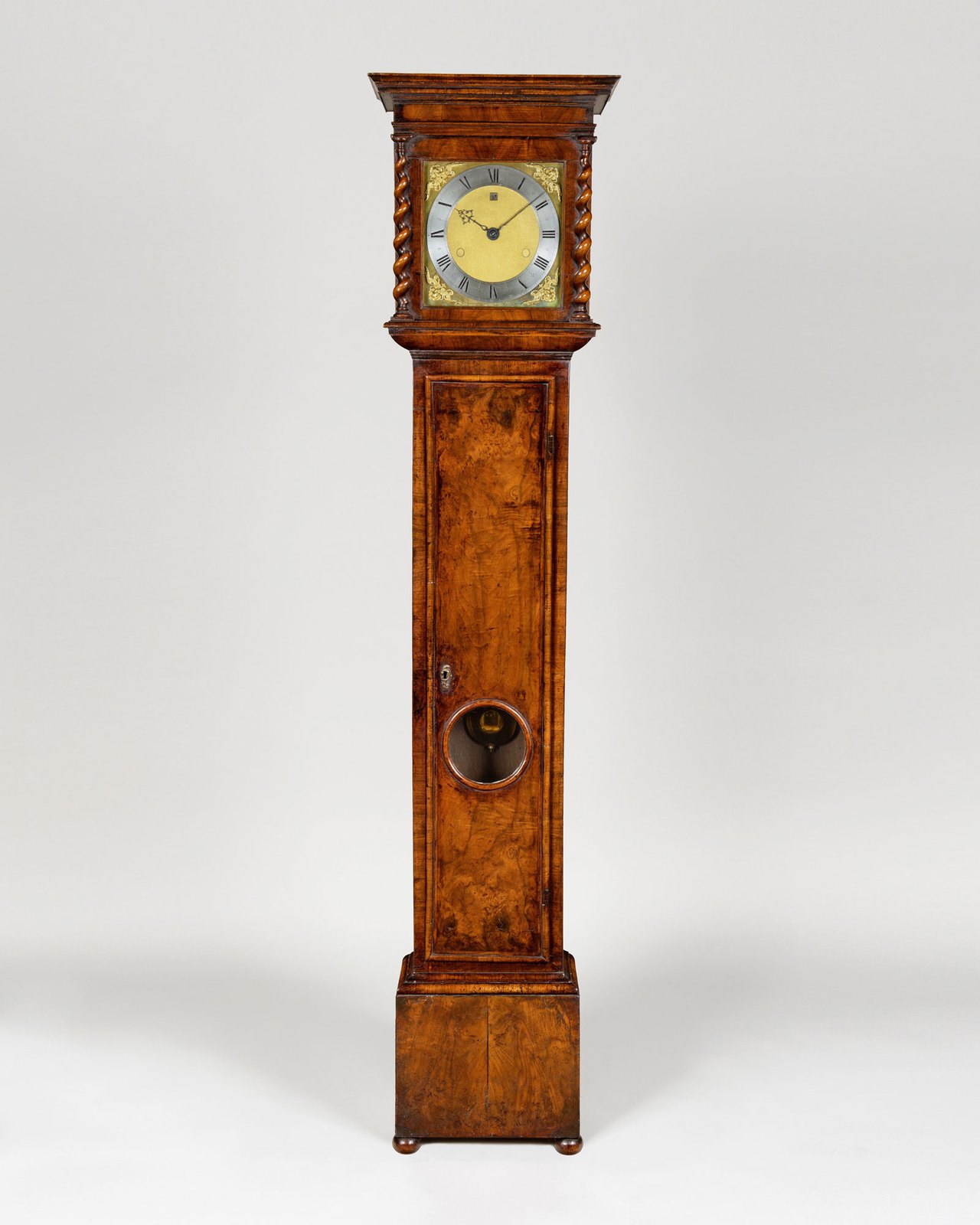
Clocks · Longcase clock
Longcase clock by Thomas Tompion, London, c. 1680
- Maker / attribution
- Thomas Tompion (maker)
- Date
- c. 1680
- Historical period
- Early Modern Horology (1600 – 1750)
- Country of origin
- England
- Place
- London
- Object type
- Longcase clock
- Materials / technique
- walnut
- Dimensions
- Height 195.5 cm
- Stock no.
- SKU 499
- Credit line
- Dealer listing, Howard Walwyn (SKU 499)
- Catalogue title (original)
- THOMAS TOMPION LONDINI FECIT. Charles II period walnut veneered longcase clock (English)
View the source record (dealer listing) ↗ (opens another website in a new tab)Suggest a correction
Record summary
Catalogued by Howard Walwyn Fine Antique Clocks (dealer), London (stock number SKU 499), this is a longcase clock by Thomas Tompion, made in London, England, dated c. 1680. The Atlas places it in the Early Modern Horology period (1600 – 1750) of its Clocks collection. Materials and techniques recorded by the source: walnut. Recorded dimensions: Height 195.5 cm. The record is illustrated with 6 photographs.
Assembled from the source record's structured fields. Dates and attributions are given as the source states them; where a field is missing the Atlas leaves it blank rather than estimating.
Catalogue description
Dealer description — Howard Walwyn
A fine and rare previously unrecorded Charles II period pre-numbered month duration walnut veneered longcase clock by England’s greatest clockmaker. The beautifully proportioned slim case is constructed primarily of oak and veneered with richly patinated walnut of excellent colour. It has a large early lenticle in the trunk door. The hood has barley twist turned walnut columns and a walnut veneered frieze set below the cornice moulding. The substantial early Tompion movement is of month duration with five latched finned pillars and latched dial feet. There is bolt and shutter maintaining power and the hours are sounded on a single bell via a small outside locking plate. There is a brass stabilizing bracket from the movement to the steel bracket on the backboard. The 10 inch square brass dial is of good mellow colour with a matted centre and silvered chapter ring with Roman hour numerals. There is an aperture to view the day of the month below XII. The pierced and facetted steel pointers are of outstanding quality. The four gilt brass corner spandrels are of the winged cherub variety and the maker’s signature Thomas Tompion Londini Fecit is set below VI. Overall the clock is in a fine state of preservation. The wheel work in the movement is in excellent condition. This clock retains its original seatboard and the movement is located with a brass fixing bracket to the steel backboard bracket where it lines up perfectly. The clock is also complete with its brass rod and brass bob pendulum and period brass cased month weights. Date : circa 1680 Height : 77 in (195.5 cm) Width : 17 in (43 cm) Depth : 9 ¼ in (23.5 cm) References : Jeremy Evans, Thomas Tompion and the Three Crowns Evans Carter Wright, Thomas Tompion 300 Years R.W. Symonds, Thomas Tompion His Life and Work THOMAS TOMPION 1639 – 1713 Thomas Tompion is the most highly respected English clockmaker. Born at Ickwell Green, Bedfordshire in 1639 he moved to London in 1671 and became a free brother in the Clockmakers’ Company . In 1674, he established his business at the sign of the Dial and Three Crowns in Water Lane , now called Whitefriars Street. There he met Dr Robert Hooke , an eminent physicist and mathematician, who exchanged ideas with him in the early part of his career when he was gaining commissions for some of his most important clocks and scientific instruments. Through this association Tompion came to the notice of Charles II and from that time he held an unrivalled position in English Horology. In 1695 George Graham joined Tompion and married his niece. In 1701 Tompion took Edward Banger into partnership, another niece’s husband, who had previously been his apprentice. They broke up acrimoniously in 1707 and Graham was then made a full partner. Clocks signed by both Tompion and Graham are very rare. In 1703 Tompion was elected Master of the Clockmakers’ Company . He is known to have made about 650 clocks, approximately 16-20 clocks a year. Sometime between 1680 and 1685 he devised a numbering system for his clocks and watches which go up to 542. This was continued after Tompion’s death by his successor George Graham. Tompion died many years later in 1713 and as a mark of his greatness he is buried in Westminster Abbey.
Historical context
Early Modern Horology (1600 – 1750)
Huygens' pendulum and balance spring transform accuracy; English makers develop the anchor and deadbeat escapements.
Huygens's pendulum (1656–57) improved clock accuracy from about a quarter of an hour to under a minute a day. The anchor escapement (c. 1670) and the long seconds pendulum created the longcase clock; London makers such as Fromanteel, Knibb, Tompion and Quare led European clockmaking, and French makers created the Boulle pendule.
Read the period in the timelineMore clocks from this periodEarlier: Renaissance Horology
Atlas type guide
Longcase (tall-case or grandfather) clocks
The longcase clock was born from two seventeenth-century innovations: Christiaan Huygens's pendulum (1656–57) and the anchor escapement (c. 1670). A long seconds pendulum, nearly a metre long, swings with a small arc, and enclosing it together with the driving weights in a tall wooden case protected the mechanism and created a new piece of furniture. London makers such as Ahasuerus Fromanteel, Thomas Tompion and Joseph Knibb set the pattern.
By the eighteenth century longcase clocks were made throughout Britain, the Netherlands, Scandinavia (the Swedish Mora clock), France (the Comtoise from the Franche-Comté), Germany and colonial America. Eight-day movements with two weights became standard in better clocks; thirty-hour clocks with one weight and a rope or chain were cheaper alternatives.
What to look for
- Winding holes in the dial: two (eight-day, going and striking) or none (thirty-hour, pulled up by a chain).
- Brass dials with applied chapter rings (earlier) versus painted iron 'white' dials (after c. 1770 in Britain).
- Moon-phase arches, date apertures, seconds dials and maker's name on the dial.
- Case woods and style: ebonised, walnut marquetry, lacquer, oak or mahogany; regional styles from London, Lancashire, Scotland or America.
- Whether the movement and dial match the case — 'marriages' are common.
Dating clues
- Square brass dials suggest c. 1670–1720; arched brass dials c. 1715–1790.
- Painted (white) dials were made by Birmingham dial-makers from about 1772.
- Comtoise clocks with repoussé pendulums are mostly nineteenth century.
General guidance written by the Atlas editors about this kind of object. It is not a statement about this particular piece; for that, rely on the source record above and on physical examination.
Read next:Anchor (recoil) escapementDeadbeat escapementAnchor escapement
Related records
Clocks · c. 1690
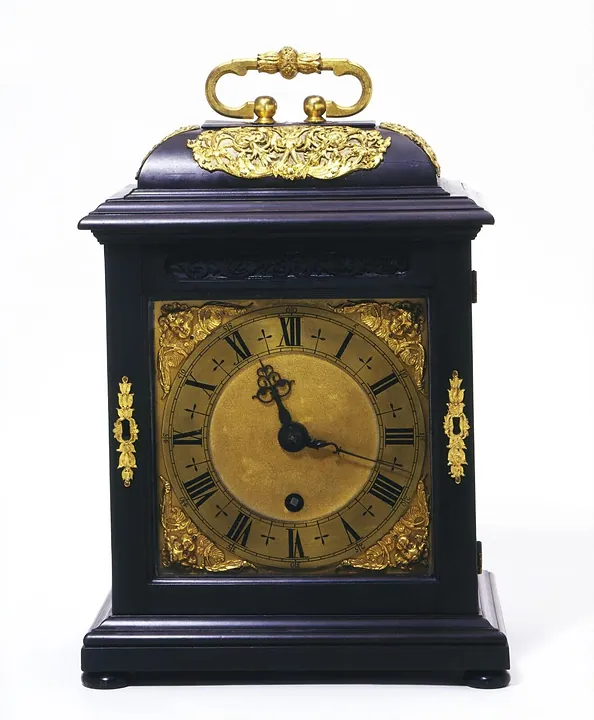
Bracket clock by Thomas Tompion, England, c. 1690
Victoria and Albert Museum, London
Clocks · c. 1696
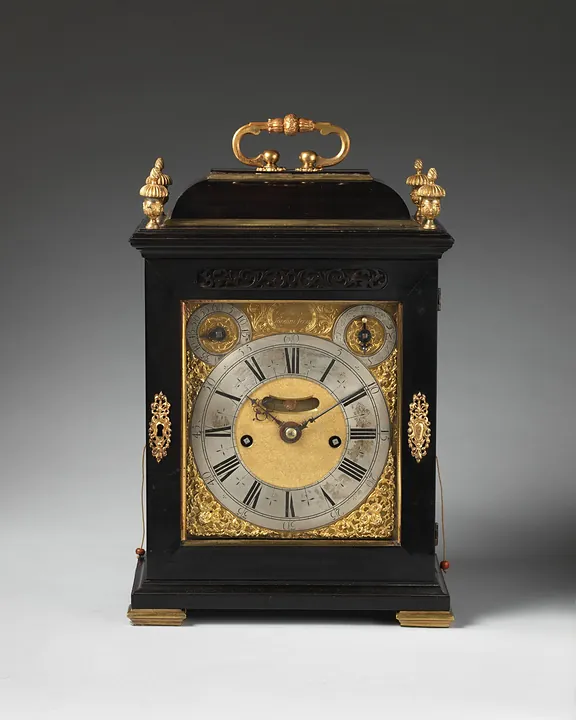
Table or bracket clock by Thomas Tompion, England, c. 1696
The Metropolitan Museum of Art, New York
Clocks · c.1705
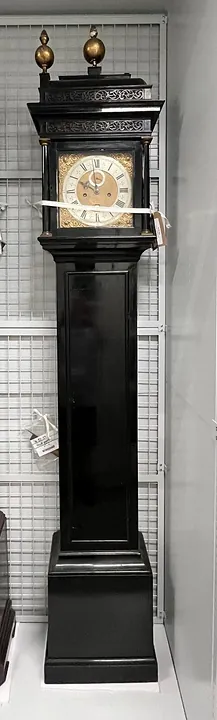
Eight day long case clock, ebonised pearwood veneer on oak carcase, inscribed 'Tho Tompion and Edw Banger London', made in about 1705
Victoria and Albert Museum, London
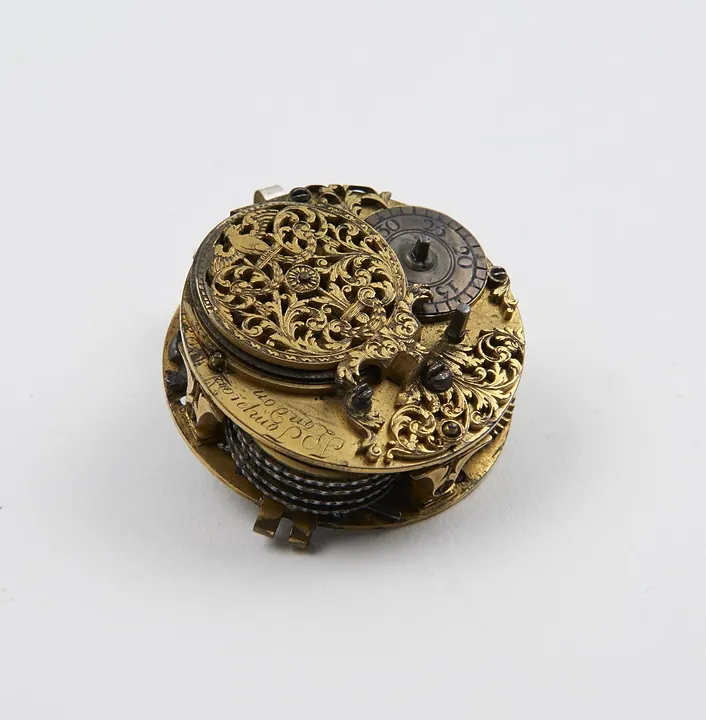
Movements & Components · 1690
Pocket watch verge escapement movement by Thomas. Tompion, London, England,1690
Science Museum Group, London
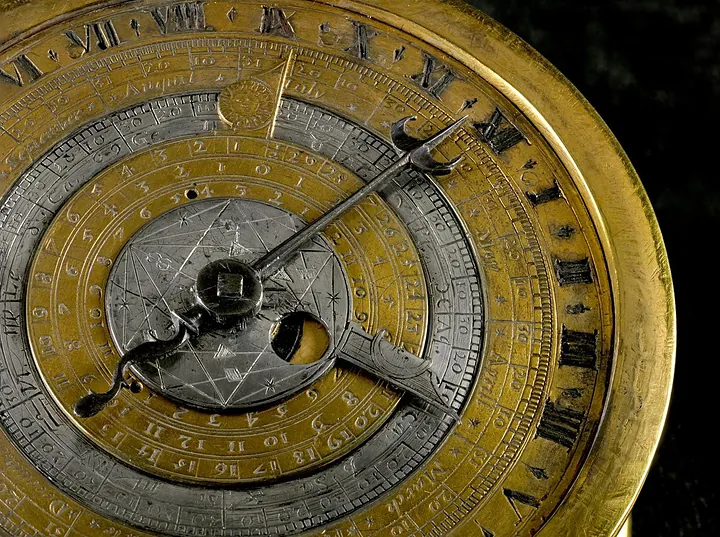
Clocks · 1598–1603
Circular table-clock with calendrical and lunar indications made by Nicholas Vallin in London between 1598 and 1603.
Science Museum Group, London
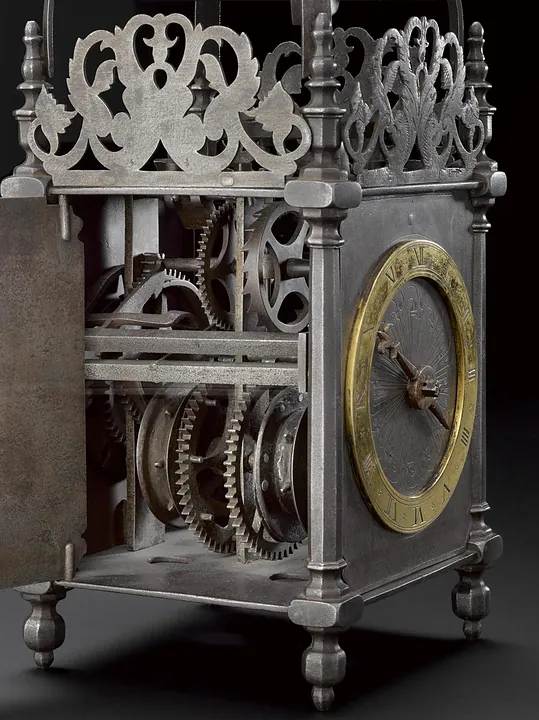
Clocks · 1611
English iron lantern clock, with wheel balance, by John Holloway, Market Lavington, Wiltshire, England, 1611.
Science Museum Group, London
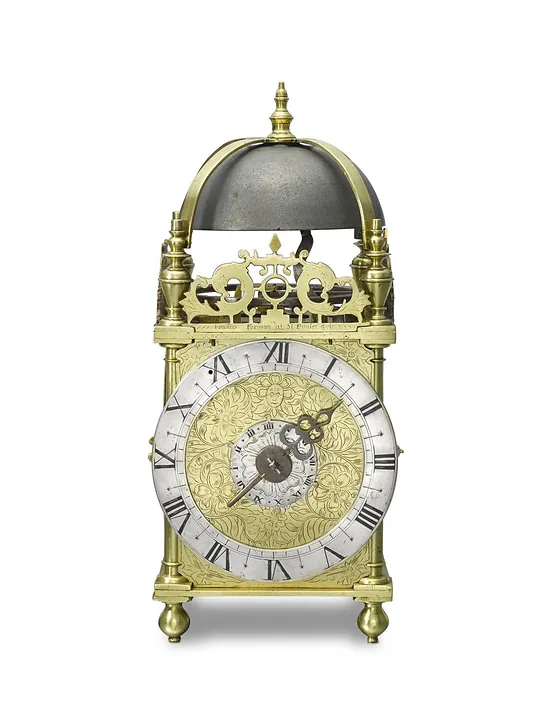
Clocks · 1630
Lantern clock by Francis Forman, England, 1630
Science Museum Group, London
Clocks · 1632–1640
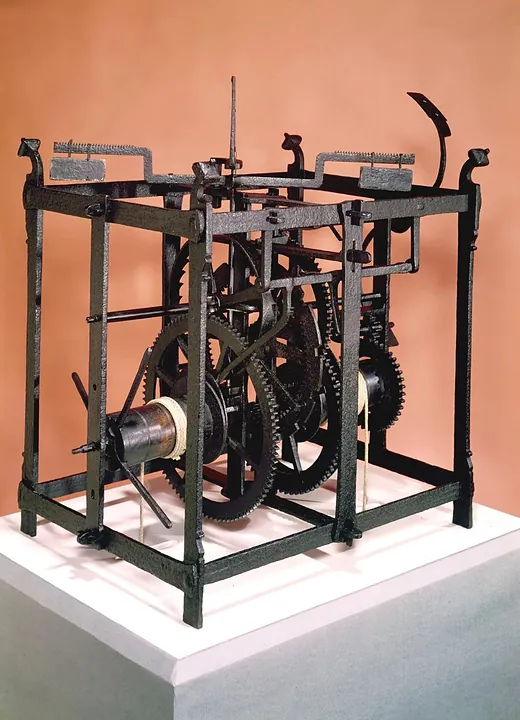
Turret clock, England, 1632–1640
Science Museum Group, London