
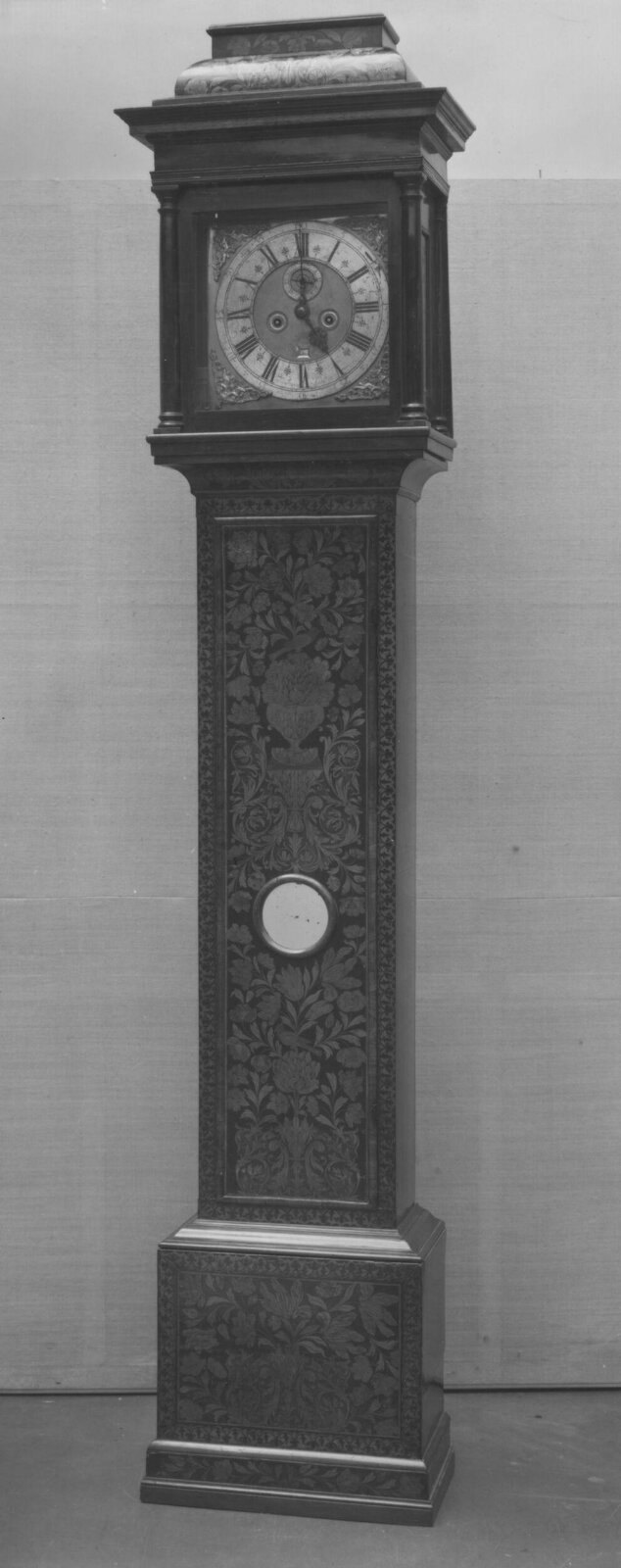
Clocks · Longcase clock
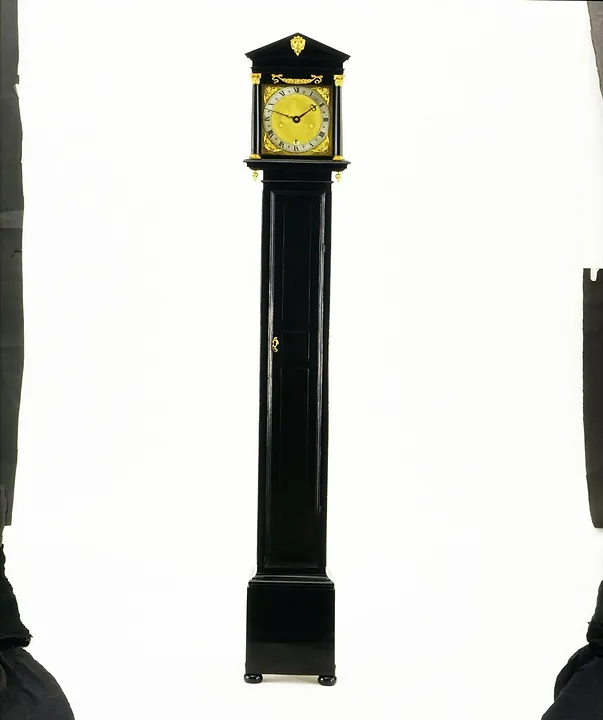
Longcase clock by Thomas Stones, England, c.1700
- Maker / attribution
- Thomas Stones (made)
- Date
- c.1700
- Historical period
- Early Modern Horology (1600 – 1750)
- Country of origin
- England
- Place
- London
- Object type
- Longcase clock
- Materials / technique
- walnut, brass, marquetry
- Dimensions
- Height: 230 cm; Width: 50.5 cm; Depth: 27 cm; Weight: 6.6 kg (circ.383:4 Brass weight 10/10/2025 NH); Weight: 6.5 kg (circ.383:5 Brass weight 10/10/2025 NH)
- Holding institution
- Victoria and Albert Museum, London
- Accession / object no.
- CIRC.383:5-1967
- Credit line
- Given by Mrs ACM Brownjohn
View the source record ↗ (opens another website in a new tab)Suggest a correction
Record summary
Held and catalogued by Victoria and Albert Museum, London (object number CIRC.383:5-1967), this is a longcase clock by Thomas Stones, made in London, England, dated c.1700. The Atlas places it in the Early Modern Horology period (1600 – 1750) of its Clocks collection. Materials and techniques recorded by the source: walnut, brass, marquetry. Recorded dimensions: Height: 230 cm; Width: 50.5 cm; Depth: 27 cm; Weight: 6.6 kg (circ.383:4 Brass weight 10/10/2025 NH); Weight: 6.5 kg (circ.383:5 Brass weight 10/10/2025 NH). The record is illustrated with 1 photograph.
Assembled from the source record's structured fields. Dates and attributions are given as the source states them; where a field is missing the Atlas leaves it blank rather than estimating.
Catalogue description
Summary — Victoria and Albert Museum
Thomas Stones was apprenticed to John Westoby in 1684. He was a member of the Clockmakers’ Company from 1692 to 1735, becoming Master in 1730. He worked in Lothbury. The marquetry on the case combines floral and bird decoration. Interestingly, and somewhat impractically, the lenticle for observing the pendulum is glazed with a mirror. There are also rectangular mirrors decorating the sides of the case. The brass and steel weight driven two train movement has hour striking on a single bell controlled by an inside countwheel
Physical description — Victoria and Albert Museum
Dial: Twelve inch square. Brass dial plate with ringed winding holes and seconds aperture, matted centre with curly engraving around square calendar aperture behind which is a silvered calendar ring. Twin cherubs with crown spandrels are screwed to corners of dial plate, silvered chapter ring and subsidiary seconds ring pinned at back of dial plate. Minute divisions set in from edge of chapter ring by a plain scale having Arabic five minute numbers and half quarter marks similar to Maltese crosses. Roman hour numerals. Arrow heads with semi-circles quarter hour division marks. Signed between VII and V on chapter ring Thõ Stones London. Seconds ring with broad Arabic five seconds numerals occupies a considerable part of the upper dial space between inside of the chapter ring and top of hour hand. Dial attached to front plate by four dial feet pinned to movement. Hands: Steel hands with very little carving to surfaces, the seconds hand with a tail. Movement: 8 day, brass and steel, weight driven, two train movement. Hour striking on bell controlled by inside countwheel. Going train with recoil anchor escapement embracing 6½ teeth. Five pillar movement, each pillar having fins and a semi-circular knop. Pillars riveted to the backplate, four pinned to front plate, bottom central fifth secured by a substantial latch. Lay out scribe lines present on outside of front plate. Proportions of movement plates give a less tall appearance than other studied in this project. Striking pin wheel collet semi-circular in profile. Short pinion head. Remaining wheel collets of two section profile, arbors tending to a parallel profile with longer pinion heads. Where visible without dismantling, scribe lines present on striking gear wheels and Going great wheel. Fly is rectangular. Mounted on pallet arbor with double profiled collet, are broad-armed pallets. Plugs of brass evident around the pallet arbor pivot hole in front plate. Hour wheel bridge of lenticular shape coming to a point at each foot. Dial: The twelve inch dial in combination with the broadening out of the minute scale and the extent to which the seconds ring occupies the dial centre are all pointers to an early 18th century date. The type of spandrel used appears to have come into general use about 1700, whilst the elaborate engraving around the calendar aperture developed a few years earlier. Hands: Less carving and bevelling of the surfaces suggesting an early 18th century date. The seconds hand would seem to be later owing to the presence of a tail. Movement : Having the striking controlled by an inside countwheel was the next stage of development after external countwheel control but was largely superseded by rack striking in London clocks by the first quarter of the 18th century. Other components which show turn of the century (17th to 18th) style include the semi-circular collet mounting the pin wheel, the profile of its arbor, the short pinion head and the scribe lines on wheel faces. Deviations from such styles in the form of, for example double profiled collets, parallel arbors and longer pinion heads are indicative of later, 19th or 20th century alterations. It would appear that most of the Going train wheelwork and striking train arbors higher up in the movement are replacements. Other modifications include the fly, where the original may have had more rounded vanes with an end mounted friction spring, and the pallets which may once have had slender arms with a deep drop to the pads. Alterations in the geometry of the escapement would also account for the work evident by the pallet arbor pivot hole in the front plate. The laying out scribe lines on the front plate are indicative of a handmade movement and may be seen occasionally on quite late clocks, usually provincial one-offs. The pillars are characteristic of the period, but having only one latched at the front when the remaining four are pinned is unusual. Whilst the shape of the latch is typical, its size is somewhat large. Finally the reduction in the proportions of height to width of the movement plates in later work is likely linked to the combination of larger dials and broader chapter rings. Description and notes by Francis Brodie, c. 2008
Brief description — Victoria and Albert Museum
EIGHT DAY LONG CASE CLOCK Marquetry of walnut and other woods Inscribed Thomas Stones, London, around 1700
Provenance
Thomas Stones grandfather clock, bequest of A C M Brownjohn Notes from R.P. 62/3189, 68/630 (Blaise Castle House Folk Museum) 19 October 1955 letter, Mrs A C M Brownjohn to V & A refering to 1939-45 correspondence with Leigh Ashton regarding her intention to bequeath her husband's collection of Chinese porcelain. 24 October 1955 minute paper, E A Lane (V & A) reports that Mrs Brownjohn offers 3 pieces of furniture in addition to the porcelain including an 18th C. grandfather clock. Undated report of inspection "Long case clock. Floral marquetry case. Maker Thomas Stoner, London. Late 17th century. Nice condition". Not considered a primary piece; suitable for lending. 29 October 1964 Follow up inspection by Ayers finds the clock "very presentable" 29 October 1964 Debenham Storr & Johnson Dymond Ltd Appraisal "An antique grandfather clock, marquetry and walnut case by Thomas Stoner, London (small length of beading missing) 7'(?)" high 17" wide Thomas Stones (alias Scones) was apprenticed to John Westoby in 1684, becoming free of the Clockmakers' Company in 1692 (C.E. Atkins, "Register of Apprentices of the Worshipful Company of Clockmakers", 1931; "Freemen of the Worshipful Company of Clockmakers", 1984, Pub. G. Daniels). Westoby himself was apprenticed to Thomas Wheeler in 1669 (C.E. Atkins, "Register of Apprentices of the Worshipful Company of Clockmakers", 1931). Stones became a Junior Warden of the Clockmakers' Company in 1727, Renter Warden in 1728, Upper Warden in 1729 an
Historical context
Early Modern Horology (1600 – 1750)
Huygens' pendulum and balance spring transform accuracy; English makers develop the anchor and deadbeat escapements.
Huygens's pendulum (1656–57) improved clock accuracy from about a quarter of an hour to under a minute a day. The anchor escapement (c. 1670) and the long seconds pendulum created the longcase clock; London makers such as Fromanteel, Knibb, Tompion and Quare led European clockmaking, and French makers created the Boulle pendule.
Read the period in the timelineMore clocks from this periodEarlier: Renaissance Horology
Atlas type guide
Longcase (tall-case or grandfather) clocks
The longcase clock was born from two seventeenth-century innovations: Christiaan Huygens's pendulum (1656–57) and the anchor escapement (c. 1670). A long seconds pendulum, nearly a metre long, swings with a small arc, and enclosing it together with the driving weights in a tall wooden case protected the mechanism and created a new piece of furniture. London makers such as Ahasuerus Fromanteel, Thomas Tompion and Joseph Knibb set the pattern.
By the eighteenth century longcase clocks were made throughout Britain, the Netherlands, Scandinavia (the Swedish Mora clock), France (the Comtoise from the Franche-Comté), Germany and colonial America. Eight-day movements with two weights became standard in better clocks; thirty-hour clocks with one weight and a rope or chain were cheaper alternatives.
What to look for
- Winding holes in the dial: two (eight-day, going and striking) or none (thirty-hour, pulled up by a chain).
- Brass dials with applied chapter rings (earlier) versus painted iron 'white' dials (after c. 1770 in Britain).
- Moon-phase arches, date apertures, seconds dials and maker's name on the dial.
- Case woods and style: ebonised, walnut marquetry, lacquer, oak or mahogany; regional styles from London, Lancashire, Scotland or America.
- Whether the movement and dial match the case — 'marriages' are common.
Dating clues
- Square brass dials suggest c. 1670–1720; arched brass dials c. 1715–1790.
- Painted (white) dials were made by Birmingham dial-makers from about 1772.
- Comtoise clocks with repoussé pendulums are mostly nineteenth century.
General guidance written by the Atlas editors about this kind of object. It is not a statement about this particular piece; for that, rely on the source record above and on physical examination.
Read next:Deadbeat escapementAnchor escapement
Related records
Clocks · 1598–1603
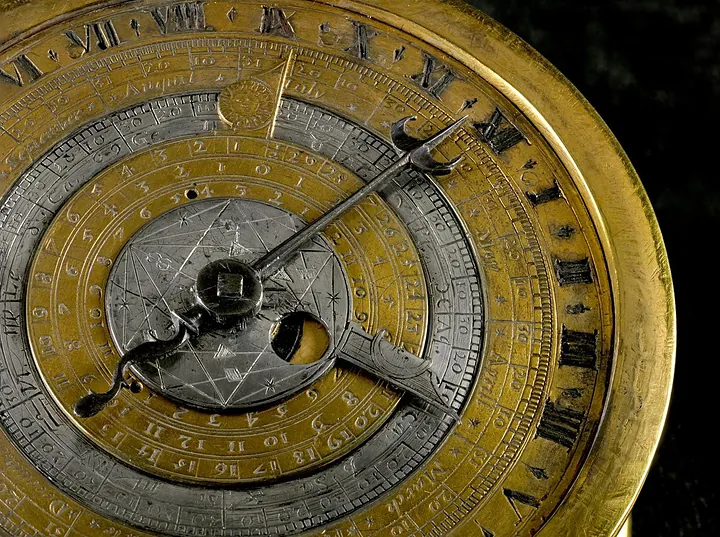
Circular table-clock with calendrical and lunar indications made by Nicholas Vallin in London between 1598 and 1603.
Science Museum Group, London
Clocks · 1611
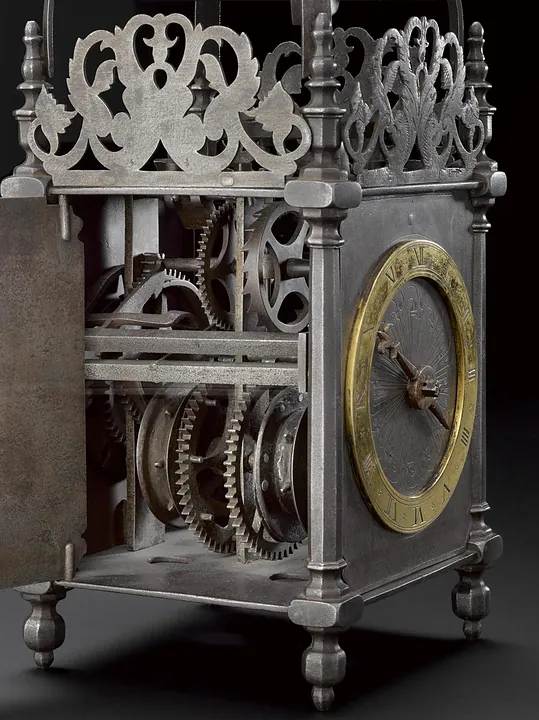
English iron lantern clock, with wheel balance, by John Holloway, Market Lavington, Wiltshire, England, 1611.
Science Museum Group, London
Clocks · 1630
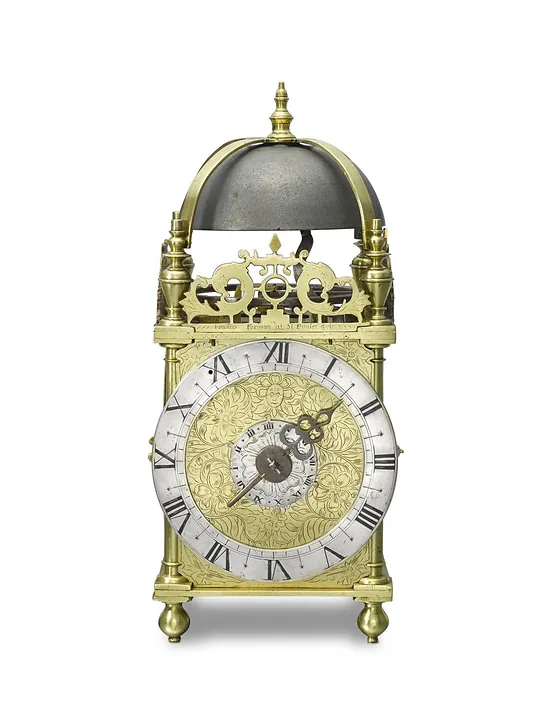
Lantern clock by Francis Forman, England, 1630
Science Museum Group, London
Clocks · 1632–1640
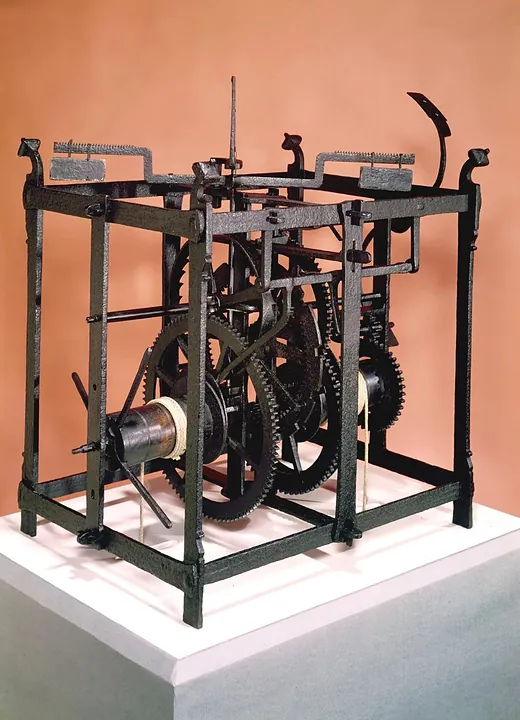
Turret clock, England, 1632–1640
Science Museum Group, London
Clocks · 1645–1655
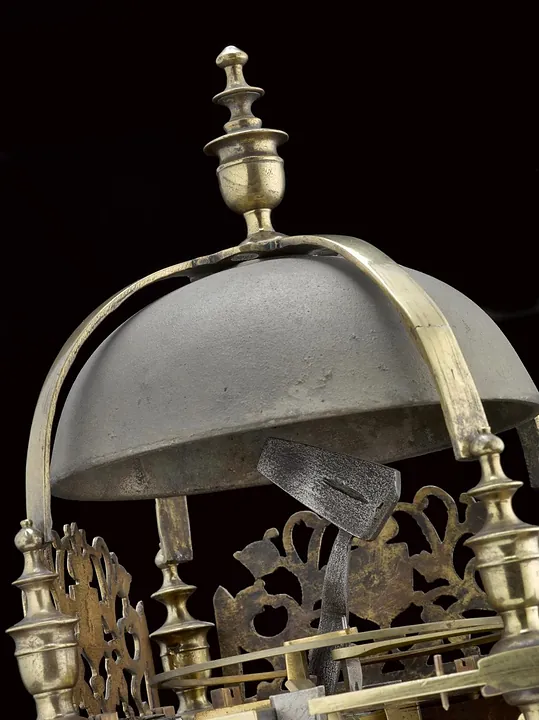
Balance-wheel brass lantern clock, with two driving weights and one counterweight, by Thomas Knifton, Cross Keys, Lothbury, London, England, 1645–1655.
Science Museum Group, London
Clocks · c. 1650
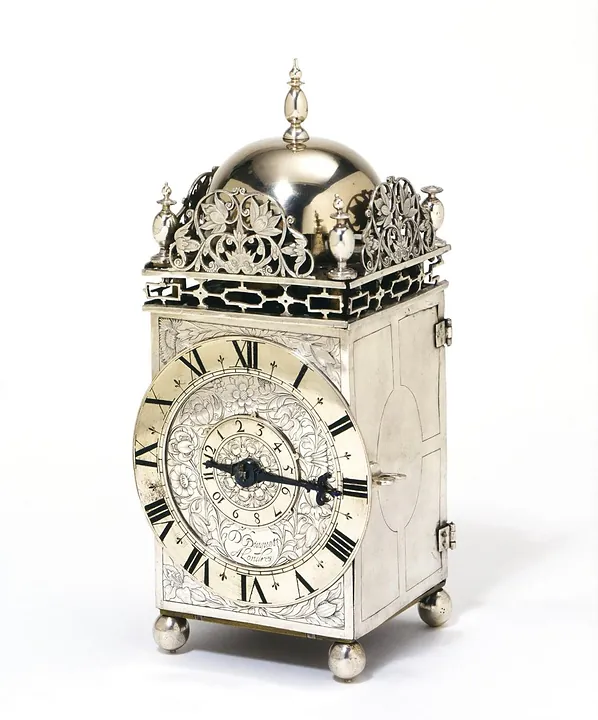
Lantern alarm clock, silver, by David Bouquet, circa 1650
Victoria and Albert Museum, London
Clocks · 1650–1660
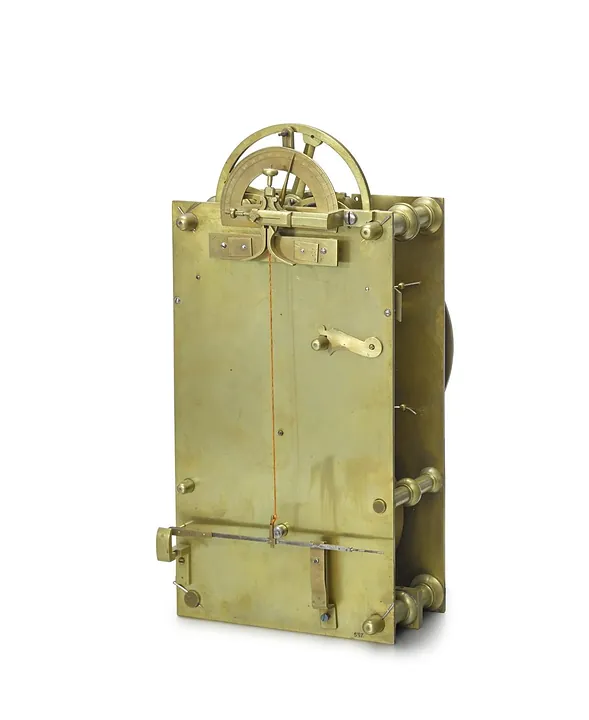
Lantern clock by Peter Closon, England, 1650–1660
Science Museum Group, London
Clocks · c. 1660
Longcase clock, c. 1660, English, made by Ahasuerus Fromanteel
Victoria and Albert Museum, London