
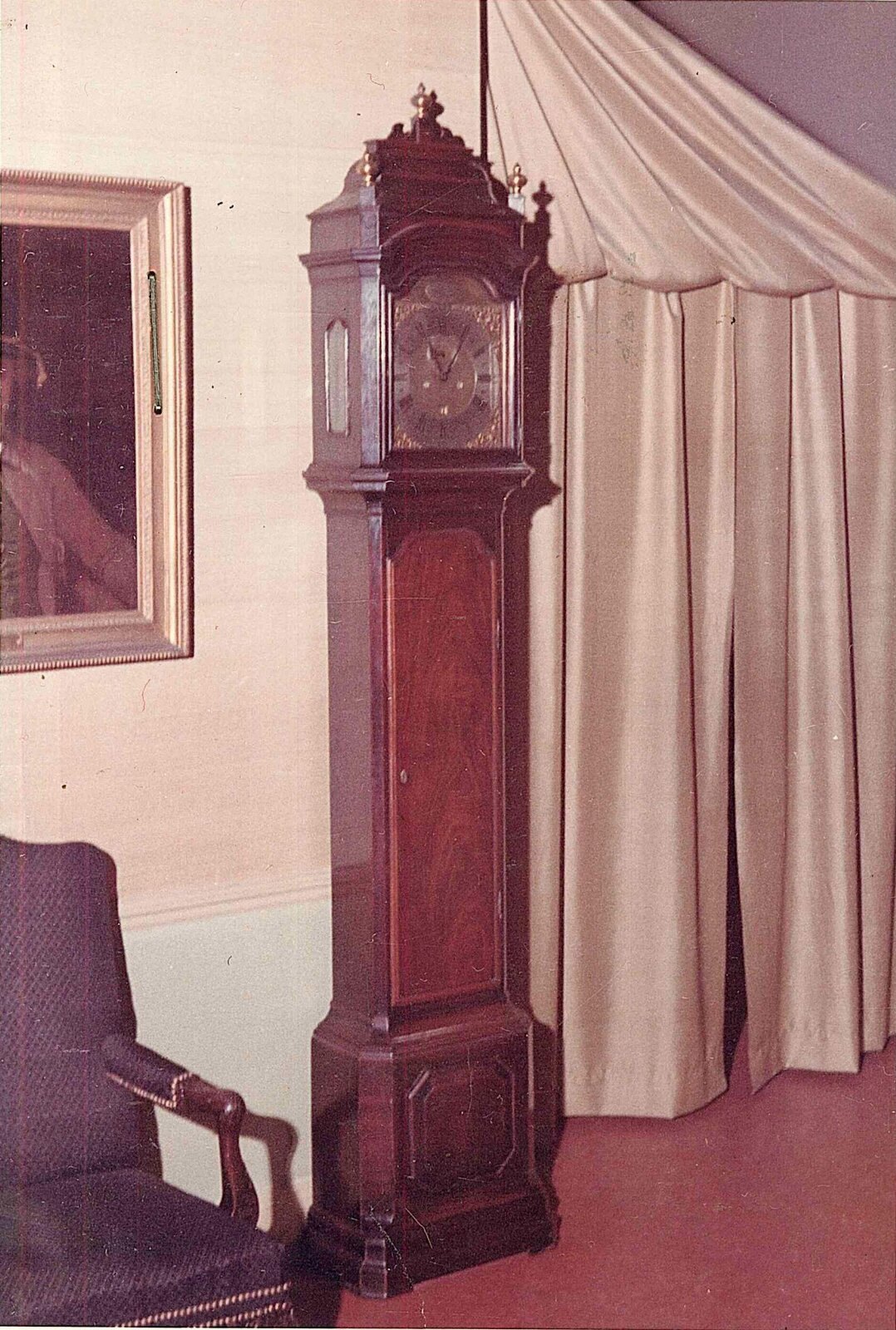
Clocks · Longcase clock
Longcase clock by Daniel Delander, England, c.1740
- Maker / attribution
- Daniel Delander (made)
- Date
- c.1740
- Historical period
- Early Modern Horology (1600 – 1750)
- Country of origin
- England
- Place
- London
- Object type
- Longcase clock
- Materials / technique
- mahogany, clock making
- Dimensions
- Height: 245.5 cm; Width: 46 cm; Depth: 25.5 cm
- Holding institution
- Victoria and Albert Museum, London
- Accession / object no.
- W.40:1to2-1962
- Credit line
- Bequeathed by C. D. Rotch
View the source record ↗ (opens another website in a new tab)Suggest a correction
Record summary
Held and catalogued by Victoria and Albert Museum, London (object number W.40:1to2-1962), this is a longcase clock by Daniel Delander, made in London, England, dated c.1740. The Atlas places it in the Early Modern Horology period (1600 – 1750) of its Clocks collection. Materials and techniques recorded by the source: mahogany, clock making. Recorded dimensions: Height: 245.5 cm; Width: 46 cm; Depth: 25.5 cm. The record is illustrated with 3 photographs.
Assembled from the source record's structured fields. Dates and attributions are given as the source states them; where a field is missing the Atlas leaves it blank rather than estimating.
Catalogue description
Summary — Victoria and Albert Museum
Daniel Delander was apprenticed in1692 to Charles Halstead and became a member of the Clockmakers Company in 1699. He worked with Thomas Tompion, before moving to his own premises in Devereux Court, Temple Bar. There is a long case clock by Delander in Child's Bank in Fleet Street. Examples of his watches are in the Pierpont Morgan collection, New York City. This clock has a duplex escape movement.
Physical description — Victoria and Albert Museum
A longcase clock in a case of mahogany with canted front corners, the base section set on the front with mouldings outlining an octagonal panel, the doors to the trunk with an arched top edge, the hood with a caddy top supporting three brass ball finials. Case: Mahogany. Plinth, base, trunk and hood, including pedestal brackets, with canted corners to front. Low break-arch top to trunk door with moulded border to edges. Concave moulding below hood. Sliding hood with low break-arch to cornice, concave section frieze and glazed front door, itself with moulded border. The whole surmounted by a caddy top flanked by two finials mounted on short pedestals, the top centre with single finial mounted on a bracketed pedestal. Break-arched topped glazed panels to hood sides. Octagonal, moulded-edged panel in centre of base; squat feet to plinth. Trunk door hinges packed up on undersides and vacant holes evident on both door and trunk hinges. Trunk door colour lighter than the rest of case. Inside trunk crudely scalloped out on both sides at same height as pendulum bob. Dial: Brass, low break-arch, total height 14¼ inches, central portion 12 inches square. Centre matted, winding squares concealed by matted shutters; square calendar aperture with bevelled edges located in lower portion of centre. Foliate engravings flank central, oval plaque engraved: Delander / London in break-arch. Female head with headdress spandrels each located by a single screw. Semi-circular slot for the maintaining power lever on the proper left of dial plate. Pinned to the dial plate is the silvered brass chapter ring with engraved minute band having single dots and Arabic minute numerals each at five minute intervals. The quarter hour band with opposed arrows at the hour and small lozenges on the outer line each every half hour. Roman hour numerals. Engraved, lozenge-shaped half-hour markers. Pinned to the dial plate below "XII is the subsidiary seconds ring of silvered brass, with engraved seconds band and Arabic numerals at intervals of five; its diameter is such that a small space exists between bottom of the ring and central hole for the hands. A silvered brass ring with engraved Arabic numerals for the date (1-31) runs behind the dial on brass pulleys. Four dial feet are attached to the movement front plate by pinning. Hands: Steel. Pierced and partially chiselled. Movement: Brass and steel, weight driven hour striking of 8-day duration with so-called duplex escapement, pendulum regulated. Five pillars with turned lines and grooved central knop riveted to the backplate, pinned at the front. Hour striking on bell is controlled by a near vertical outside rack which carrying a pin, operates a locking detent. Brass train wheels with four semicircular crossings. Where visible, scribed lines on faces. Three-spoked crossings on cannon pinion and minute wheel, latter being colleted onto minute pinion arbor, the whole located on front plate by a cock. Skeletonised snail mounted on crossed-out hour wheel (four spokes). Domed wheel collets except escape and warning which are conical. Barrel-shaped steel arbors are with relatively short pinion heads. Bolt and shutter maintaining power acts on centre wheel teeth, its driving spring mounted on inside front plate. Both shutters carried on one lever. Each pallet is separate: impulse pallet (between plates) riveted to pallet arbor; locking pallet (outside backplate) partially located by screwed piece. Crutch attached to pallet arbor by brass collet. Substantial backcock with a semicircular underside occupies full width of backplate. Escapement locking wheel of large diameter is mounted outside backplate on separate cock below backcock; the smaller diameter escape wheel (which provides impulse) is located between plates rather in usual longcase manner. Bevelling to edges of some components. Bell standard is screwed to outside of front plate. Backcock, has plugged hole above the present pallet pivot hole and below, an unused threaded hole. Similar arrangement on front plate except that threaded is hole occupied by a screw with an offset head. Pendulum with broad, double suspension spring, leading into brass rod of upper portion, leading into main rod in form of steel strip. Lead-filled brass bob supported by engraved, graduated rating nut screwed onto coarse-pitched rating thread. Description and notes by Francis Brodie, c. 2008
Provenance
Bequeathed by Claude Rotch, acquired in Taunton in 1934. This clock was exhibited at the Science Museum in 1952 in an exhibition entitled 'British Clockmakers' Heritage', exbn. no. 147. From the 1970s to 1993 this clock was exhibited in Gallery 40. In 1992 it was noted that several small sections of moulding were missing (see diagram in object file). Members of the Antiquarian Horological Society, during a visit in 2000, suggested that the door had undergone restoration and lost mouldings that would have matched those on the front of the base. A number clocks with a similar style of case and movement appear to have been made by Delander. Christies, London 7 February 1979 illustrate Lot 96: Dan. Delander No. 15 in a walnut case. The description notes that this is one of a short series of longcase clocks by Delander, other recorded examples include No. 13, Untermeyer Collection, Metropolitan Museum of Art, New York, No.14, No.15 and, No.17 which was exhibited at Grosvenor House, 1950 and is now in the Museum of Science and Industry, Chicago, Illinois. In the same auction is Lot 173, an Ellicott regulator with a similarly-styled case in mahogany. Christies, London 11 December 2002 sold a Delander, London month Going Equation Calendar longcase clock, also with duplex escapement. This movement does have similarities with W.40-1962 although the case differs; the dial is signed Delander. The movement of No.17 does have many details similar to W.40-1962, although the dial is inscribe
Historical context
Early Modern Horology (1600 – 1750)
Huygens' pendulum and balance spring transform accuracy; English makers develop the anchor and deadbeat escapements.
Huygens's pendulum (1656–57) improved clock accuracy from about a quarter of an hour to under a minute a day. The anchor escapement (c. 1670) and the long seconds pendulum created the longcase clock; London makers such as Fromanteel, Knibb, Tompion and Quare led European clockmaking, and French makers created the Boulle pendule.
Read the period in the timelineMore clocks from this periodEarlier: Renaissance Horology
Atlas type guide
Longcase (tall-case or grandfather) clocks
The longcase clock was born from two seventeenth-century innovations: Christiaan Huygens's pendulum (1656–57) and the anchor escapement (c. 1670). A long seconds pendulum, nearly a metre long, swings with a small arc, and enclosing it together with the driving weights in a tall wooden case protected the mechanism and created a new piece of furniture. London makers such as Ahasuerus Fromanteel, Thomas Tompion and Joseph Knibb set the pattern.
By the eighteenth century longcase clocks were made throughout Britain, the Netherlands, Scandinavia (the Swedish Mora clock), France (the Comtoise from the Franche-Comté), Germany and colonial America. Eight-day movements with two weights became standard in better clocks; thirty-hour clocks with one weight and a rope or chain were cheaper alternatives.
What to look for
- Winding holes in the dial: two (eight-day, going and striking) or none (thirty-hour, pulled up by a chain).
- Brass dials with applied chapter rings (earlier) versus painted iron 'white' dials (after c. 1770 in Britain).
- Moon-phase arches, date apertures, seconds dials and maker's name on the dial.
- Case woods and style: ebonised, walnut marquetry, lacquer, oak or mahogany; regional styles from London, Lancashire, Scotland or America.
- Whether the movement and dial match the case — 'marriages' are common.
Dating clues
- Square brass dials suggest c. 1670–1720; arched brass dials c. 1715–1790.
- Painted (white) dials were made by Birmingham dial-makers from about 1772.
- Comtoise clocks with repoussé pendulums are mostly nineteenth century.
General guidance written by the Atlas editors about this kind of object. It is not a statement about this particular piece; for that, rely on the source record above and on physical examination.
Read next:Anchor (recoil) escapementDeadbeat escapementAnchor escapement
Related records
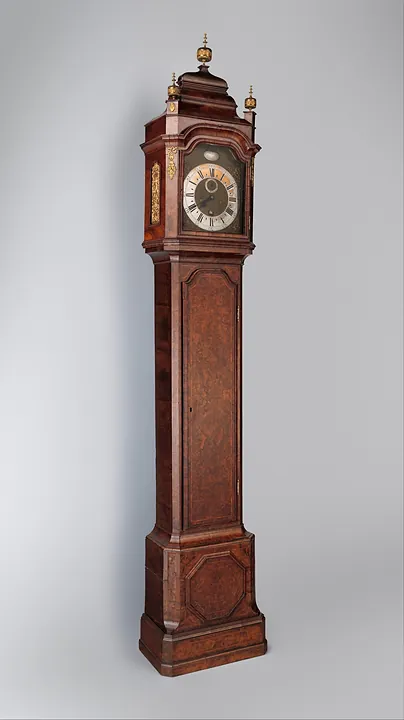
Clocks · probably c. 1720
Longcase clock by Daniel Delander, England, probably c. 1720
The Metropolitan Museum of Art, New York
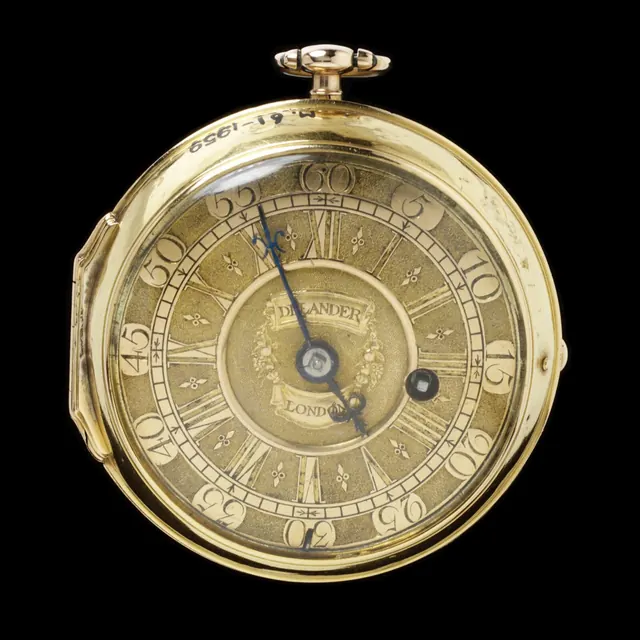
Pocket Watches · 1729–1730
Watch by Daniel Delander, England, 1729–1730
Victoria and Albert Museum, London
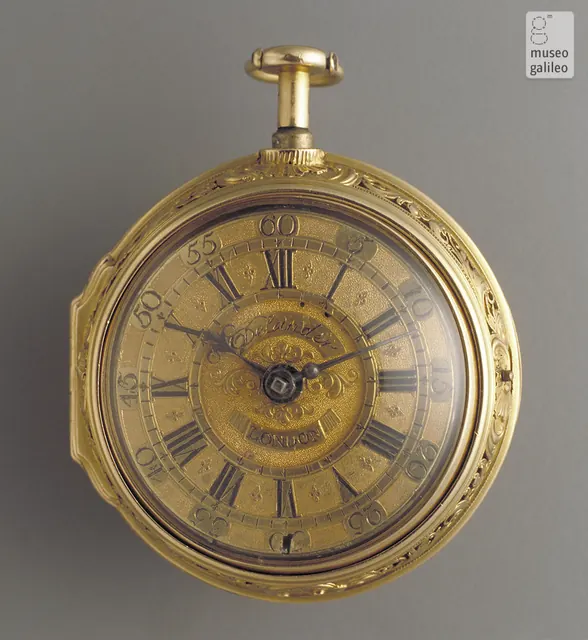
Pocket Watches · 1739
Double-case watch by Daniel Delander, England, 1739
Museo Galileo, Florence
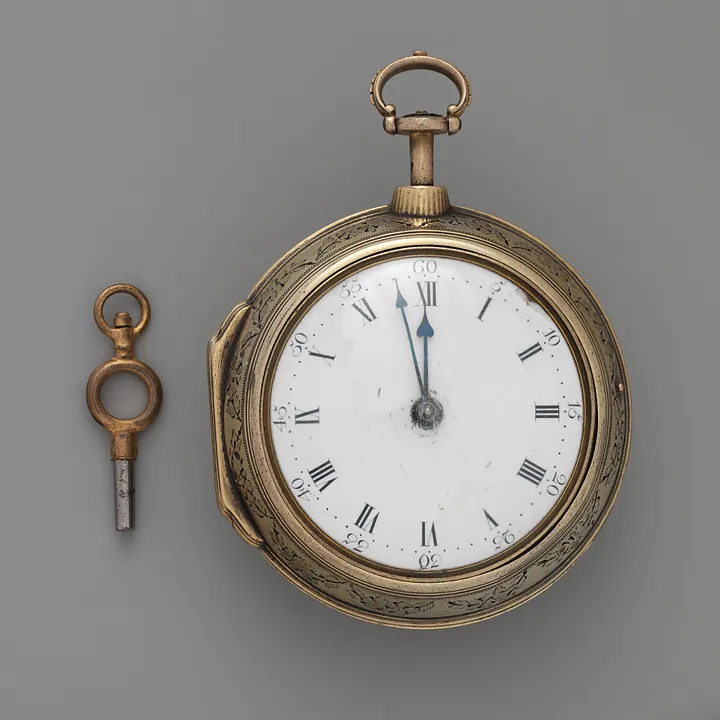
Pocket Watches · c. 1705
Clock-watch by Daniel Delander, England, c. 1705
The Metropolitan Museum of Art, New York
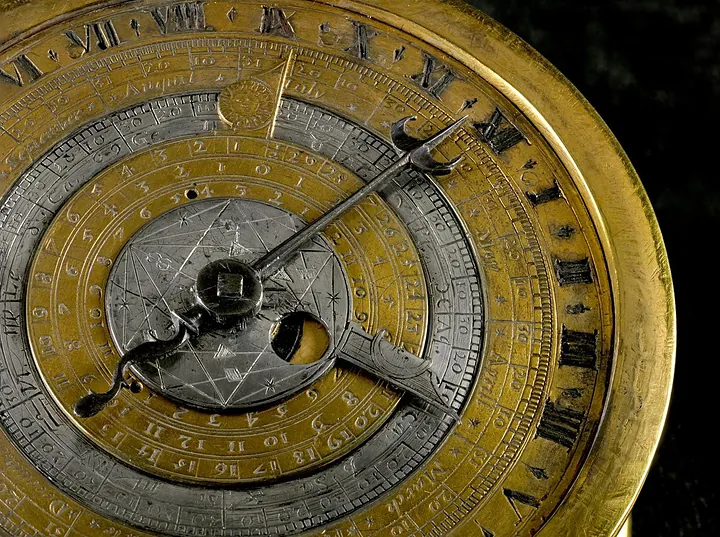
Clocks · 1598–1603
Circular table-clock with calendrical and lunar indications made by Nicholas Vallin in London between 1598 and 1603.
Science Museum Group, London
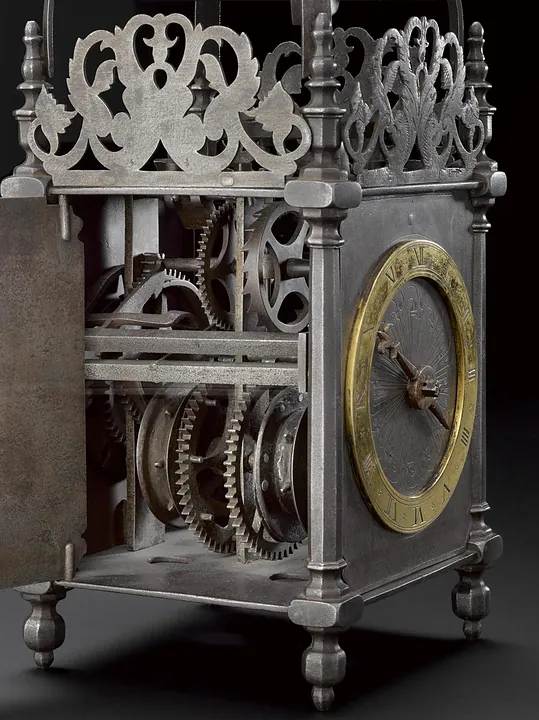
Clocks · 1611
English iron lantern clock, with wheel balance, by John Holloway, Market Lavington, Wiltshire, England, 1611.
Science Museum Group, London
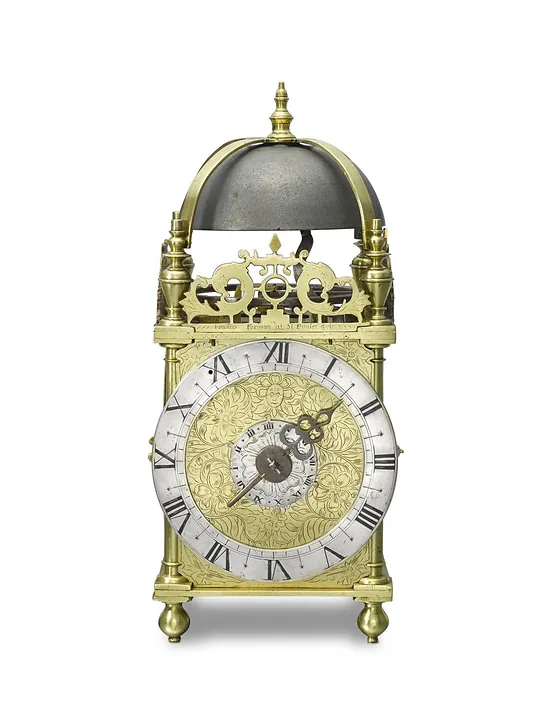
Clocks · 1630
Lantern clock by Francis Forman, England, 1630
Science Museum Group, London
Clocks · 1632–1640
Turret clock, England, 1632–1640
Science Museum Group, London