
Pocket Watches · Quarter repeating verge pocket watch
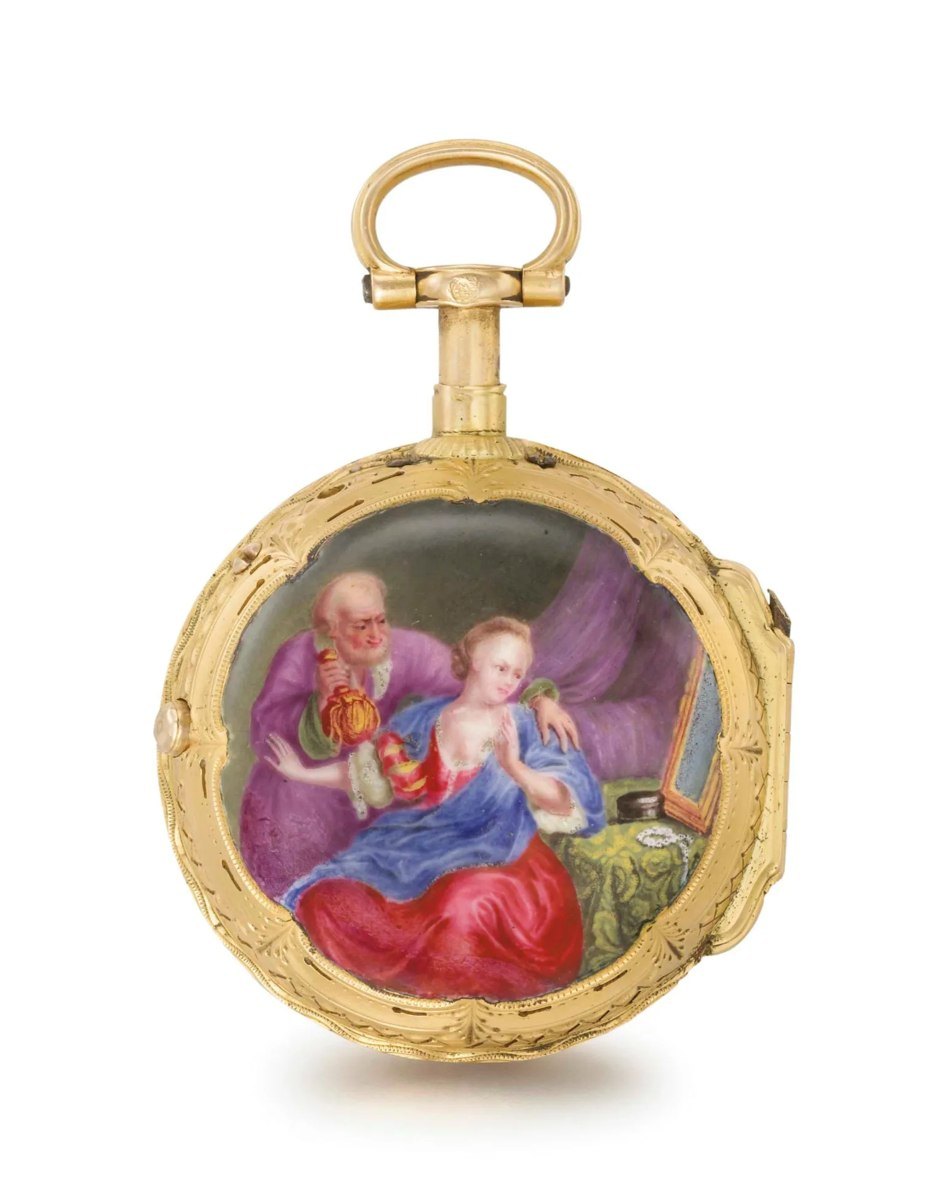
Lepaute 18K Gold and Enamel Openface Quarter Repeating Verge Pocket Watch
- Maker / attribution
- Lepaute (source attribution)
- Date
- c. 1770
- Historical period
- Precision & Scientific Horology (1750 – 1850)
- Country of origin
- France
- Object type
- Quarter repeating verge pocket watch
- Dimensions
- 30 mm
- Holding institution
- Antiquorum / EveryWatch
- Accession / object no.
- 222
- Credit line
- Antiquorum / EveryWatch
- Catalogue title (original)
- Jean-André Lepaute Yellow gold White 1770 | EveryWatch (English)
View the source record ↗ (opens another website in a new tab)Suggest a correction
Record summary
Held and catalogued by Antiquorum / EveryWatch (object number 222), this is a quarter repeating verge pocket watch attributed to Lepaute, made in France, dated c. 1770. The Atlas places it in the Precision & Scientific Horology period (1750 – 1850) of its Pocket Watches collection. Recorded dimensions: 30 mm. The record is illustrated with 1 photograph.
Assembled from the source record's structured fields. Dates and attributions are given as the source states them; where a field is missing the Atlas leaves it blank rather than estimating.
Catalogue description
Original object description
Produced in France around 1770, this 18K yellow gold openface quarter-repeating verge pocket watch spans 30 mm across, representing an unusually petite size for an eighteenth-century repeater. It bears the maker's signature "Lepaute a Paris, No. 191, circa 1770". A polychrome painted enamel scene based on Herman Van der Myn's 'The Temptation' embellishes the case back, illustrating an aged suitor offering a purse of coins to a seated lady positioned by her dressing mirror. Chased geometric bands and pierced borders encircle this narrative tableau. Built with an edge-mounted release button, a lateral hinge, and an oval bow fitted to a straight neck, the watch encloses a white enamel dial marked with Roman numerals. The gilt mechanism features a chain fusée verge escapement alongside a balance cock decorated with piercing and engraving. A push of the pendant actuates two hammers that strike the quarter hours against a bell. The timepiece was formerly part of the Sandberg Collection, appearing as lot 222 in Antiquorum's Geneva auction held on 31 March 2001.
Inscriptions & marks
191
Historical context
Precision & Scientific Horology (1750 – 1850)
Harrison solves longitude; Mudge invents the lever; Breguet's Paris workshop defines the modern watch.
From 1750 to 1850 the watch became a precision instrument. Mudge's lever escapement, the cylinder escapement, Lépine's thin bar calibre, Breguet's innovations (overcoil, tourbillon, perpétuelle) and the pocket chronometer of Arnold and Earnshaw all date from this period, while verge watches remained common in cheaper production.
Read the period in the timelineMore pocket watches from this periodEarlier: Early Modern Horology
Atlas type guide
Verge and pair-cased watches
After Christiaan Huygens and Robert Hooke applied the balance spring around 1675, the verge watch became a reasonably reliable timekeeper and the minute hand became standard. Through the eighteenth century the typical English watch was a pair-cased verge: a fusee movement with a pierced, engraved balance cock, housed in an inner case and a separate protective outer case, often of repoussé gold, shagreen, tortoiseshell or enamel.
French watches of the same period were thicker 'oignons', later replaced by elegant thinner watches following Jean-Antoine Lépine's bar-bridge calibre of c. 1770. Dutch, Swiss and German makers supplied international markets, and verge watches were made until the mid-nineteenth century as cheaper alternatives to the cylinder and lever.
What to look for
- The pierced balance cock on the backplate: winged (continental) or with a foot (English); its style dates the watch.
- Fusee and chain visible through the movement; key winding through the dial (early) or case back.
- Hallmarks inside English silver or gold cases, which give a date letter.
- Maker's name and serial number engraved on the backplate; watch papers inside outer cases.
- Enamel dials (after c. 1720) versus earlier champlevé metal dials.
Dating clues
- Champlevé dials: c. 1680–1730; white enamel dials thereafter.
- English case hallmarks give the year of assay to within a year.
- Verge watches persisted in cheap production until c. 1850.
General guidance written by the Atlas editors about this kind of object. It is not a statement about this particular piece; for that, rely on the source record above and on physical examination.
Related records
Pocket Watches · 18th century
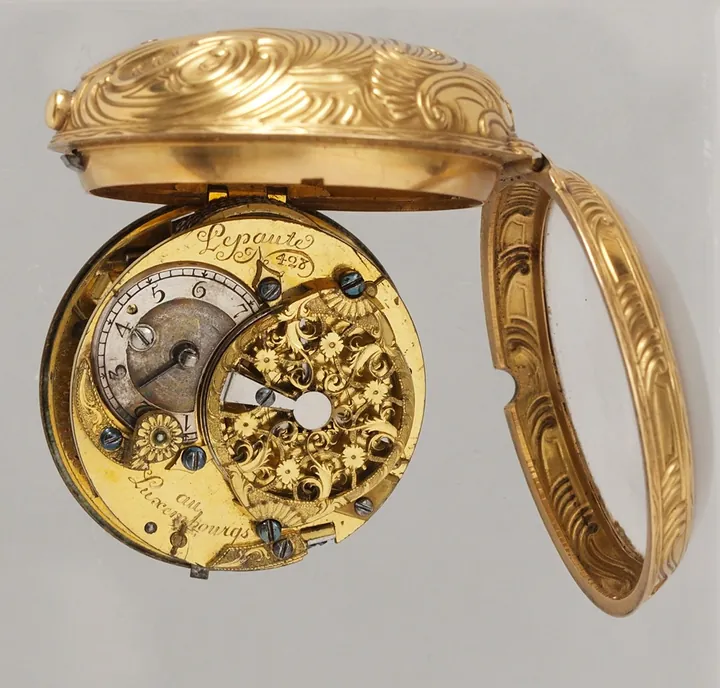
Lepaute 18th-century gold pocket watch
Bukowskis
Pocket Watches · 1745–1755
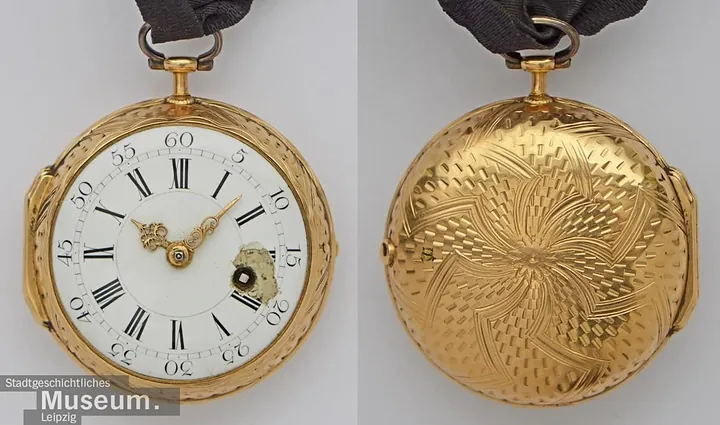
Pocket watch by Jean Baptiste Baillon, France, 1745–1755
Museum of City History Leipzig
Pocket Watches · c. 1750
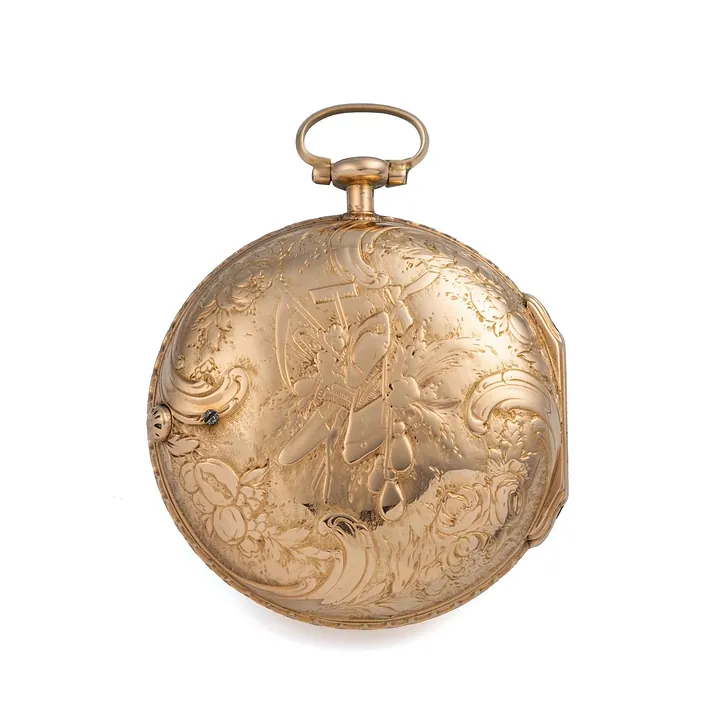
Baillon À Paris pocket watch, c. 1750
Antiquorum auction archive, Geneva
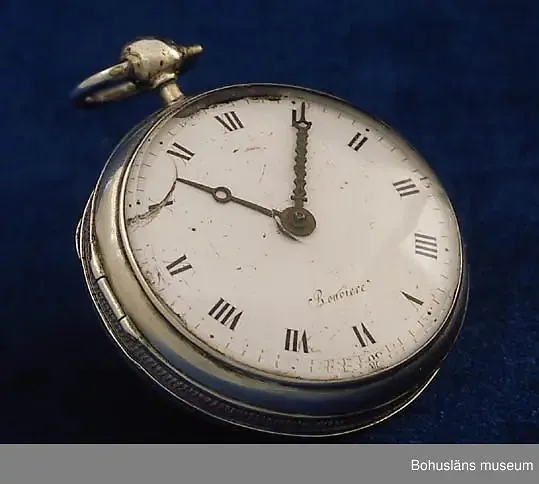
Pocket Watches · 1750–1780
Pocket watch by BONBIERE, France, 1750–1780
Bohuslän Museum
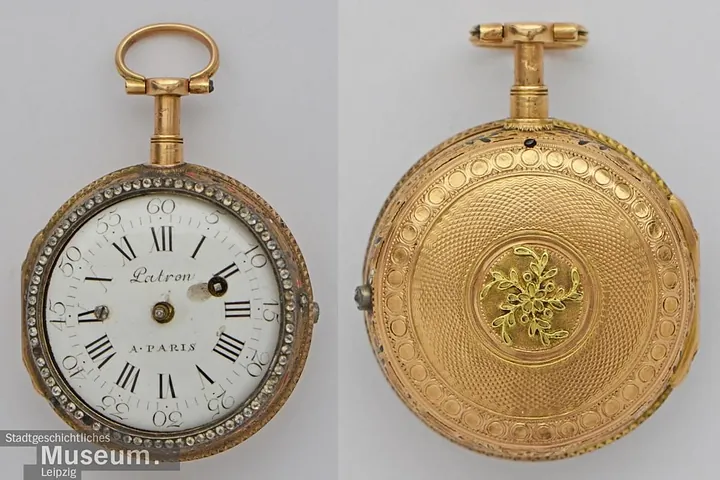
Pocket Watches · 1750
Pocket watch by Patron, France, 1750
Museum of City History Leipzig
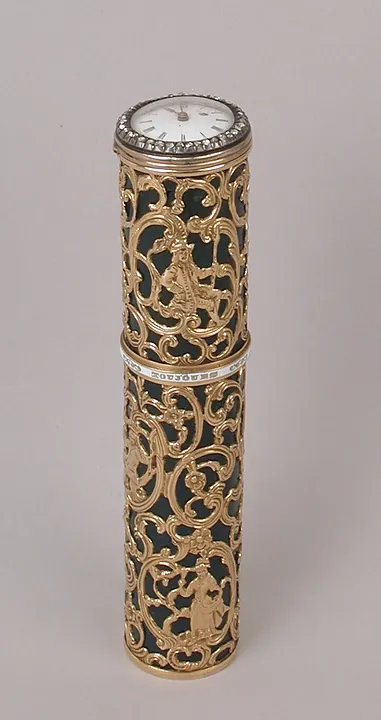
Pocket Watches · second half 18th century
Watch probably by by an imitator of Abraham-Louis Bréguet, France, second half 18th century
The Metropolitan Museum of Art, New York
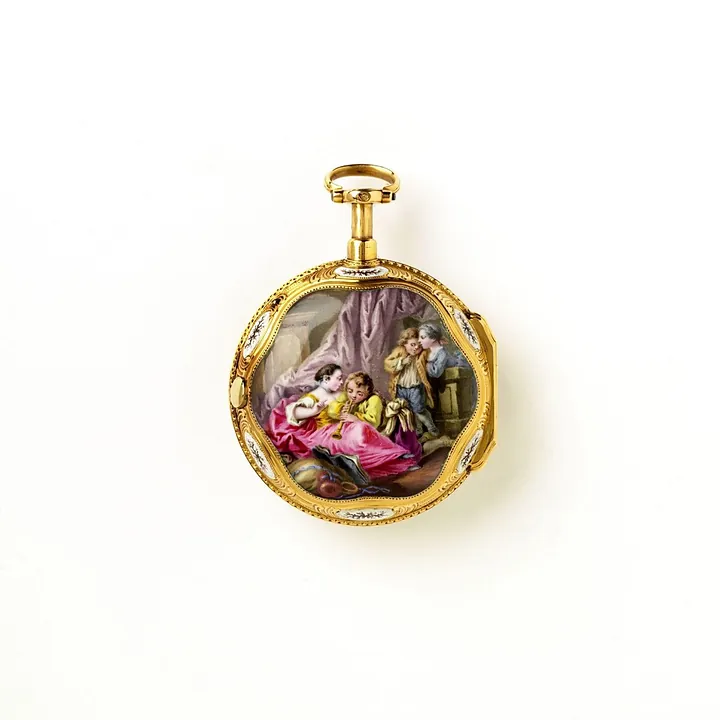
Pocket Watches · 1760–1761
Enamelled gold, quarter repeating watch, Paris, 1760-62, Romilly
Victoria and Albert Museum, London
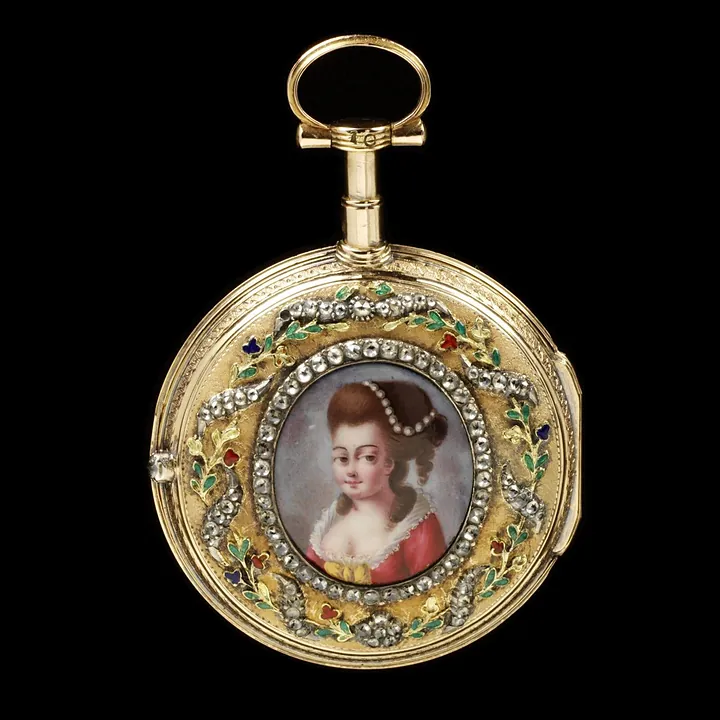
Pocket Watches · 1770-5
Enamelled copper gilt watch set with pastes, signed 'Vauchez A Paris'; made in France or Switzerland, 1770-5
Victoria and Albert Museum, London