Pocket Watches · Watch
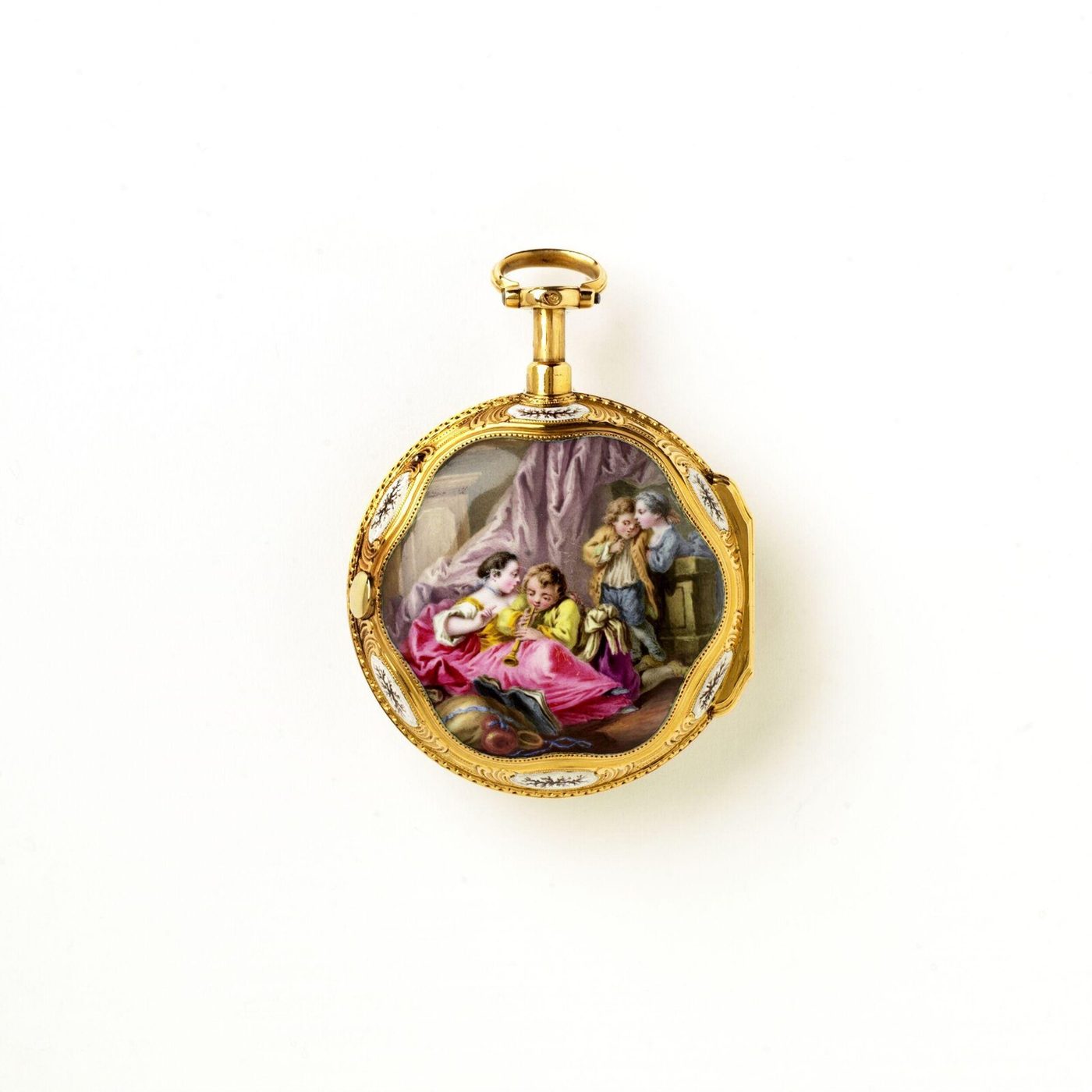
Enamelled gold, quarter repeating watch, Paris, 1760-62, Romilly
- Maker / attribution
- Jean Romilly (maker)
- Date
- 1760-1761
- Historical period
- Precision & Scientific Horology (1750 – 1850)
- Country of origin
- France
- Place
- Paris
- Object type
- Watch
- Materials / technique
- Gold, enamel
- Dimensions
- Height: 6.28 cm; Width: 4.46 cm; Depth: 2.06 cm
- Holding institution
- Victoria and Albert Museum, London
- Accession / object no.
- LOAN:GILBERT.310-2008
- Credit line
- The Rosalinde and Arthur Gilbert Collection on loan to the Victoria and Albert Museum, London
Record summary
Held and catalogued by Victoria and Albert Museum, London (object number LOAN:GILBERT.310-2008), this is a watch by Jean Romilly, made in Paris, France, dated 1760-1761. The Atlas places it in the Precision & Scientific Horology period (1750 – 1850) of its Pocket Watches collection. Materials and techniques recorded by the source: Gold, enamel. Recorded dimensions: Height: 6.28 cm; Width: 4.46 cm; Depth: 2.06 cm. The record is illustrated with 4 photographs.
Assembled from the source record's structured fields. Dates and attributions are given as the source states them; where a field is missing the Atlas leaves it blank rather than estimating.
Catalogue description
V&A — Summary
The playful scene upon this watch depicts a musician leaning over a young woman in order to read his music, while another woman and a boy whisper together in the background. The practice of painting portrait miniatures in enamels developed out of the decorative work of goldsmiths and watchmakers in the French cities of Blois, Châteaudun and Paris. Portrait plaques had been made in the enamelling workshops of Limoges in central France during the 16th century, but in the 1630s, artist Jean Toutin adapted existing techniques to make the subtle colouring and delicate detail of enamel miniatures possible. Small objects like watches or snuffboxes were ideally suited to this technique and many were decorated with portraits and mythological or allegorical scenes. Artists throughout Europe continually refined their approaches to painting enamel portraits. While 17th century enamellers used a very fine stipple to create light and shade in their miniatures, artists in the 18th century began to use larger brushstrokes for a more fluid effect. Sir Arthur Gilbert and his wife Rosalinde formed one of the world's great decorative art collections, including silver, mosaics, enamelled portrait miniatures and gold boxes. Arthur Gilbert donated his extraordinary collection to Britain in 1996.
V&A — Physical description
Enamelled gold, quarter-repeating watch with panels imitating moss agate. The back painted with a scene of a young flute player with three other figures in an interior. A large armoire to the left and a square stone column to the left are counter balanced in their solidarity by a massive waterfall of pale purple silk taffeta flowing into the composition from the upper right.
V&A gallery label
3. Quarter-repeating watch, 1760–61 Museum no. Loan:Gilbert.310-2008
V&A gallery label
Quarter-repeating watch 1760–1 This playful scene depicts a musician leaning over a young woman in order to read his music, while another pair whisper together in the background. Paris, France; Jean Romilly (1714–94) Enamelled gold Museum no. Loan:Gilbert.310-2008
Historical context
Precision & Scientific Horology (1750 – 1850)
Harrison solves longitude; Mudge invents the lever; Breguet's Paris workshop defines the modern watch.
From 1750 to 1850 the watch became a precision instrument. Mudge's lever escapement, the cylinder escapement, Lépine's thin bar calibre, Breguet's innovations (overcoil, tourbillon, perpétuelle) and the pocket chronometer of Arnold and Earnshaw all date from this period, while verge watches remained common in cheaper production.
Read the period in the timelineMore pocket watches from this periodEarlier: Early Modern Horology
Atlas type guide
Repeating watches
Before electric light, telling the time in the dark was a real problem. Repeating watches strike the time on demand when a slide or push-piece is operated: quarter repeaters sound hours and quarters, minute repeaters hours, quarters and minutes. Edward Barlow and Daniel Quare disputed the invention in London in the 1680s. Early repeaters struck on a bell inside the case; Abraham-Louis Breguet introduced the gong (a coiled steel wire) around 1780, allowing thinner watches.
Repeaters require a separate train with racks, snails and a governor to control the striking speed, and are among the most demanding complications to make and adjust. Swiss makers of the Vallée de Joux specialised in repeating ébauches in the nineteenth century.
What to look for
- A slide on the case band or a push-piece through the pendant.
- Gongs encircling the movement (after c. 1780) or a bell in the case (earlier); pierced case for sound.
- The racks, snails and governor visible under the dial or on the movement.
- Terms such as 'Minutes', 'Quarts' or 'Répétition' on the dial or cuvette.
Dating clues
- Bell-striking quarter repeaters: c. 1690–1800.
- Gong repeaters and dumb repeaters (striking on the case): after c. 1780.
- Minute repeaters became more common after c. 1830 with Vallée de Joux ébauches.
General guidance written by the Atlas editors about this kind of object. It is not a statement about this particular piece; for that, rely on the source record above and on physical examination.
Read next:Minute repeaterMinute repeater
Related records
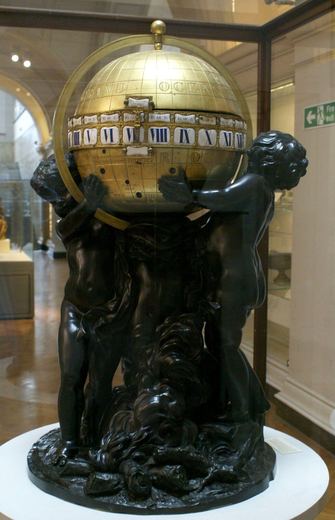
Clocks · 1783-1785
Globe clock by Jean Romilly, France, 1783-1785
Victoria and Albert Museum, London
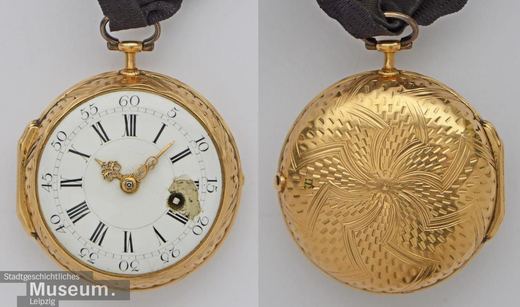
Pocket Watches · 1745–1755
Pocket watch by Jean Baptiste Baillon, France, 1745–1755
Museum of City History Leipzig
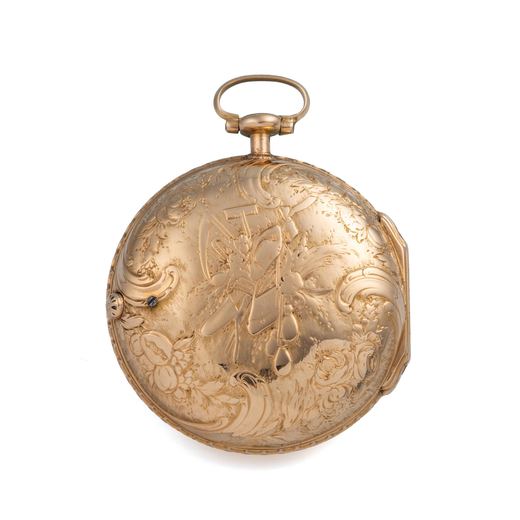
Pocket Watches · circa 1750
Baillon À Paris pocket watch, circa 1750
Antiquorum auction archive, Geneva
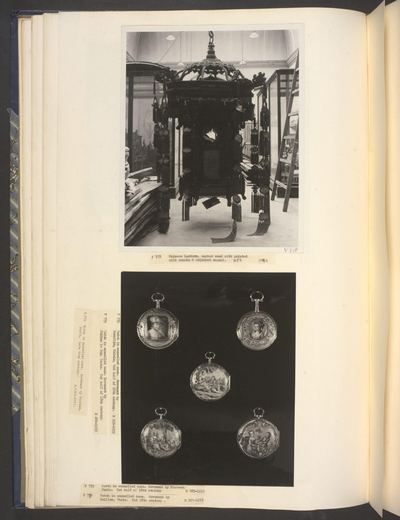
Pocket Watches · 1750-65
Enamelled gold watch, signed 'Baillon A Paris', with a casemaker's mark, 'RC crowned', probably Switzerland, mid 18th century
Victoria and Albert Museum, London
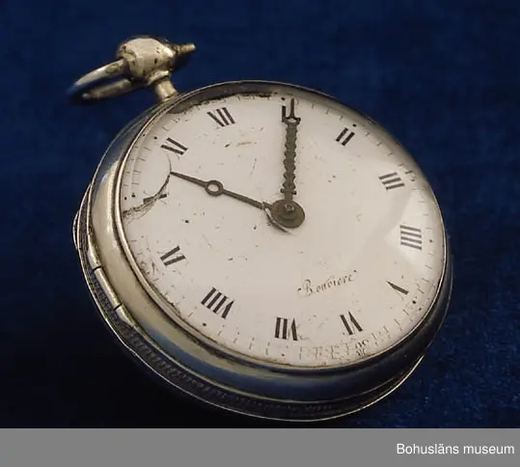
Pocket Watches · 1750–1780
Pocket watch by BONBIERE, France, 1750–1780
Bohuslän Museum
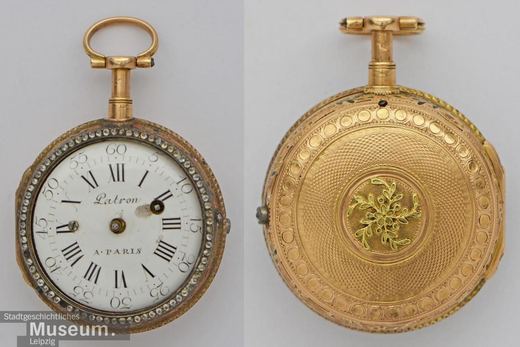
Pocket Watches · 1750
Pocket watch by Patron, France, 1750
Museum of City History Leipzig
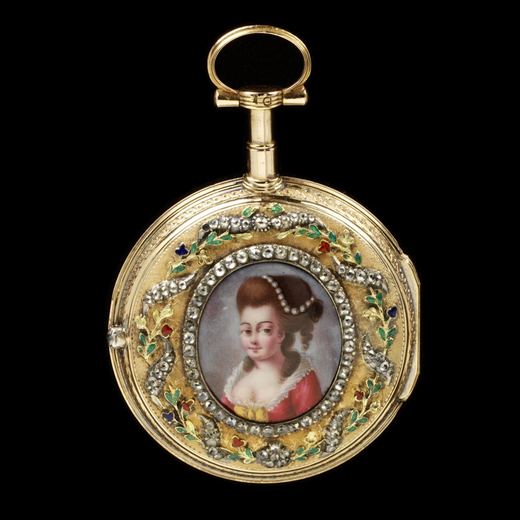
Pocket Watches · 1770-5
Enamelled copper gilt watch set with pastes, signed 'Vauchez A Paris'; made in France or Switzerland, 1770-5
Victoria and Albert Museum, London
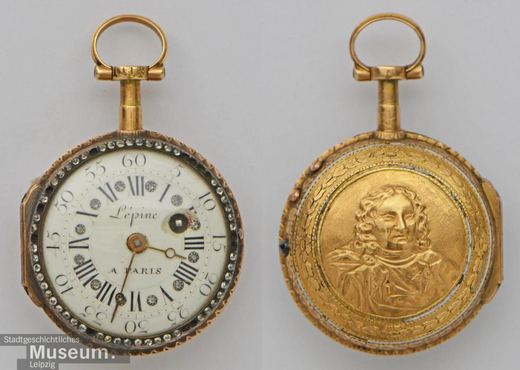
Pocket Watches · 1770–1780
Pocket watch by Lepine, France, 1770–1780
Museum of City History Leipzig