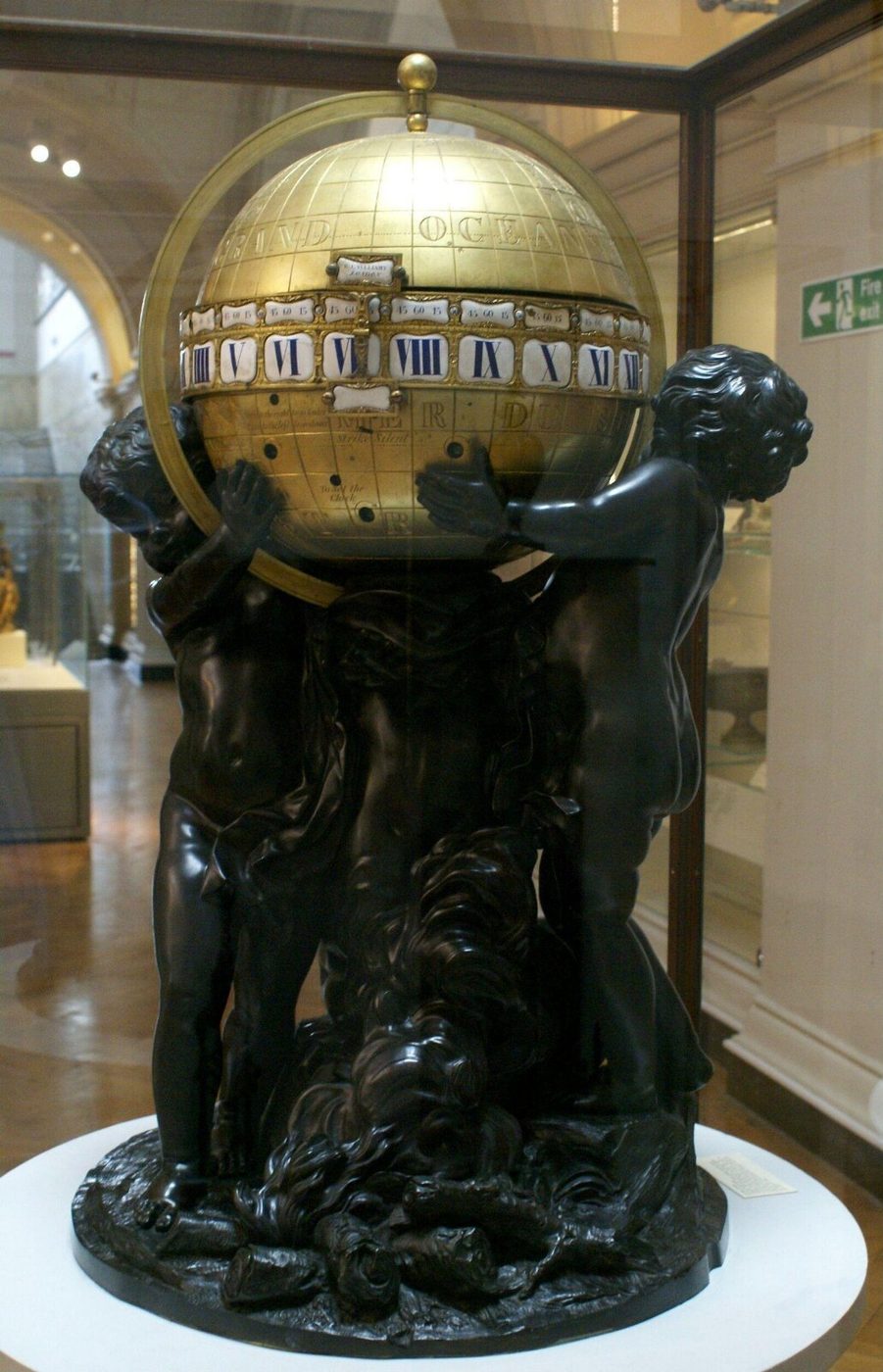
Clocks · Globe clock
Globe clock by Jean Romilly, France, 1783-1785
- Maker / attribution
- Jean Romilly (Clockmaker); Benjamin Lewis Vulliamy (Restorer)
- Date
- 1783-1785
- Historical period
- Precision & Scientific Horology (1750 – 1850)
- Country of origin
- France
- Place
- Paris
- Object type
- Globe clock
- Materials / technique
- The three putti supporting the clock are cast in bronze; the globe is of gilt metal. The Roman numbers for the hours are enamelled.
- Dimensions
- Height: 1175 mm; Diameter: 503 mm
- Holding institution
- Victoria and Albert Museum, London
- Accession / object no.
- 4311-1857
- Credit line
- Purchased by the South Kensington Museum (nee Museum of Ornamental Art) from the Executors of Benjamin Lewis Vulliamy in 1857 after it being lent to the Museum.
Record summary
Held and catalogued by Victoria and Albert Museum, London (object number 4311-1857), this is a globe clock by Jean Romilly, made in Paris, France, dated 1783-1785. The Atlas places it in the Precision & Scientific Horology period (1750 – 1850) of its Clocks collection. Materials and techniques recorded by the source: The three putti supporting the clock are cast in bronze; the globe is of gilt metal. The Roman numbers for the hours are enamelled. Recorded dimensions: Height: 1175 mm; Diameter: 503 mm. The record is illustrated with 3 photographs.
Assembled from the source record's structured fields. Dates and attributions are given as the source states them; where a field is missing the Atlas leaves it blank rather than estimating.
Catalogue description
V&A — Summary
The clock is in the form of a terrestial globe which is supported by three putti, two representing the elements of Earth and Fire. The dial is in the form of a concentric ring situated as an equator with a snake's head pointer to indicate the time. The clock was originally made in France during the 18th century and contained a movement by Jean Romilly which was later removed and replaced by Benjamin Lewis Vulliamy who lent it to the Museum of Ornamental Art at Marlborough House in 1853. This was one of the very earlu incarnations of the museum that later became the V&A. It was purchased from Vulliamy's executors by the Museum in 1854 and features in a watercolour William Linnaeus Casey in 1856 of the diplays at Marlborough House.
V&A — Physical description
The clock is in the form of a terrestial globe which is supported by three putti, two representing the elements of Earth and Fire. The dial is in the form of a concentric ring situated as an equator with a snake's head pointer to indicate the time.
V&A — Object history
From the 'Guide Book of the Museum of Ornamental Art, Marlborough House', 1853, p.10 Quoting Benjamin Vulliamy: 'This bronze group probably represents the four elements, the globe representing the earth. In the absence of any correct knowledge as to its early possessors, it would be difficult to determine the exact time when it was cast but, judging from its excellence and finish, it may, with great certainly, be attributed to the best Florentine period. It is cast particularly thin, so thin that, looked at from within, the daylight is seen in many places. The entire group can, if required, for the convenience of seeing the figures all round, be very easily made to revolve on friction rollers, without fear of stopping the clock. Several modern copies of the figures have been made at Paris, and adapted to carry clocks and a large tazza, but these are very inferior to the original and immediately show their modern origin.' And Gottfried Semper: 'This fine group has the character of a work of the eighteenth century, and probably is of the same date as the clock it originally supported, viz. about 1740. The boys are in the style of the Fiammingos, but certainly not by them, nor of the same period with those distinguished ornamental sculptors.' In the Utensils and Furniture album of drawings in the Library of the Society of Antiquaries is an engraving of the clock with the legend. 'This very beautiful Old French Clock of which there are only two known (the other being in the possession of his Grace the Duke of Sutherland) stands four feet high. The three Figures representing the Elements are in Bronze of the best Florentine period. The Globe is gilt.' The print is lettered 'Drawn by Henry Warren Engraved by Henry Moses'. The Duke of Sutherland's Romilly globe clock was then at Stafford House but is now at the Lady Lever Art Gallery, Port Sunlight. Sir William Lever bought it for 125 guineas at the Christie's Stafford House sale of 11 July 1913. (Information from James Yorke 26 July 2017) There is also a printed memorandum dated 1845 signed by 'B L VULLIAMY Clockmaker to the Queen: the Hon.Board of Ordnance; the Post office; and Her Majesty's Office of Works' with the address 'PALL-MALL' which reads 'THIS Bronze Group is by some persons supposed to represent the Four Elements. In the absence of any correct knowledge as to its early possessors, it would be difficult to determine the exact time when it was cast, but, judging from its excellence and finish, it may with great certainty be attributed to the best Florentine period. The movement originally placed in the Globe was made by ROMILLY, born at Geneva, a Clockmaker of great celebrity, and the author of several very clever papers on Horology, and to disprove the possibility of Perpetual Motion, published in L'Enciclopedie et le Journal de Paris . He died in Paris, A.D. 1796. Sir Samuel Romilly, in his Memoirs written by himself, ( Memoirs of Sir Samuel Romilly . Vol.1, p.64 Murray: London, 1840) relates having made his acquaintance at Paris in 1781, and describes him as a man at the advanced age of seventy, possessing great literary attainments and knowledge of his business. Judging by the style of the work it must have been an early production of the maker, perhaps about the year 1740, but being quite worn out by time, I have replaced it by a Balance Clock which strikes the hours and quarters, the hours upon a bell spring instead of a bell, which has a very good effect. The entire Group can, if required, for the convenience of seeing the figures all round, be very easily made to revolve on friction rollers, without fear of stopping the Clock. Several modern copies of the Figures have been made at Paris, and adapted to carry a large Tazza, but these are very inferior to the original, and immediately show their modern origin. The 4th Marquess of Hertford owned 18th- and 19th-century versions of this clock, the first being kept at Bagatelle. Another 19th century version was sold through Sotheby's London on 11th March 1991, lot 161.
V&A gallery label
GLOBE CLOCK Gilt and patinated bronze French, 18th century with an English movement signed 'Vulliamy London' and numbered 155. It replaced the original movement by Jean Romilly (Maitre 1752, died 1796). The clock was altered by Benjamin Lewis Vulliamy (1780-1854) and lent by him to the Museum of Ornamental Art at Marlborough House in 1853. It was purchased from Vulliamy's executors by this Museum in 1854. 4311-1857
Inscriptions & marks
VULLIAMY LONDON 155
Historical context
Precision & Scientific Horology (1750 – 1850)
Harrison solves longitude; Mudge invents the lever; Breguet's Paris workshop defines the modern watch.
The age of the deadbeat escapement, compensated pendulums and observatory regulators. Domestic clocks spread through the middle classes: English longcase and bracket clocks, French gilt-bronze mantel clocks, Viennese Biedermeier wall clocks, Black Forest painted-shield clocks, and the first American shelf clocks.
Read the period in the timelineMore clocks from this periodEarlier: Early Modern Horology
Atlas type guide
Astronomical, musical and automaton clocks
Astronomical clocks display more than the hour: the positions of the sun and moon in the zodiac, the phase of the moon, the calendar, sometimes the planets and eclipses. From Richard of Wallingford's and Giovanni de' Dondi's fourteenth-century clocks to the Prague Orloj and the Strasbourg cathedral clocks, they demonstrated the order of the cosmos. Renaissance makers in Augsburg and Nuremberg built celestial globe clocks and monstrance clocks as princely treasures.
Automaton and musical clocks entertained as well as informed: figures move, birds sing, organs and carillons play tunes from pinned cylinders. The eighteenth-century trade with China ('sing-songs') and Ottoman Turkey created a market for elaborate English, Swiss and French automata.
What to look for
- Subsidiary dials for moon phase, calendar, zodiac and planetary positions.
- Celestial globes or armillary spheres turned by the movement.
- Pinned cylinders, bellows and pipes or bells for music.
- Figures on cams and levers; separate trains for automaton work.
Dating clues
- Renaissance astronomical table and globe clocks: c. 1550–1650.
- English and Swiss automaton clocks for the Chinese market: c. 1760–1820.
- Picture clocks (clockwork pictures) are mostly nineteenth century.
General guidance written by the Atlas editors about this kind of object. It is not a statement about this particular piece; for that, rely on the source record above and on physical examination.
Read next:Verge escapementFusee
Related records
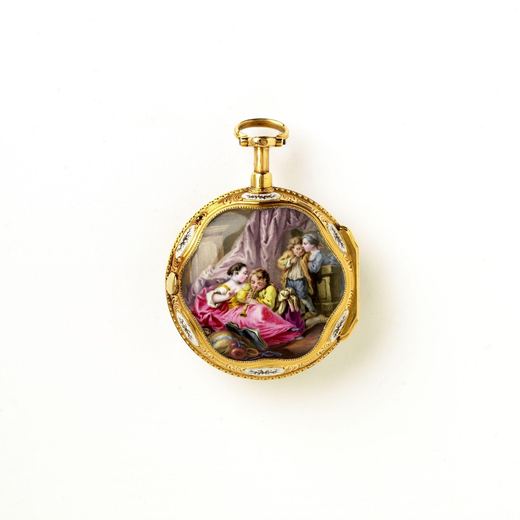
Pocket Watches · 1760-1761
Enamelled gold, quarter repeating watch, Paris, 1760-62, Romilly
Victoria and Albert Museum, London
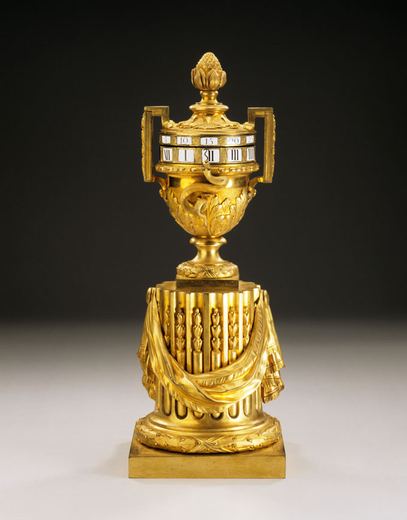
Clocks · 1723–1811
Table clock by Louis Montjoye, France, 1723–1811
Badisches Landesmuseum Karlsruhe
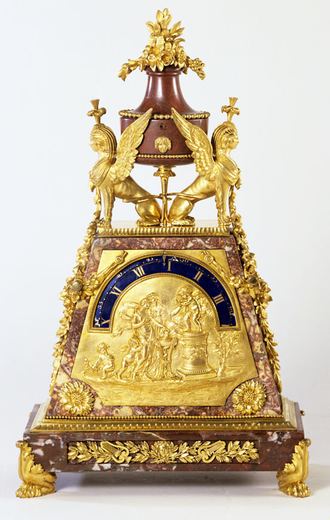
Clocks · 1738–1814
Table clock by Jean Simon Bourdier, France, 1738–1814
Badisches Landesmuseum Karlsruhe
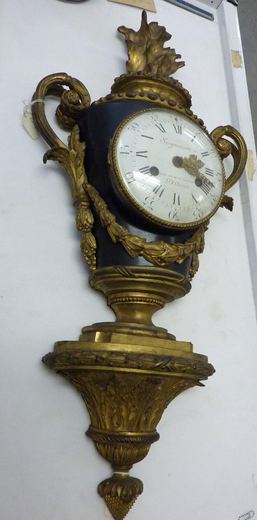
Clocks · 1750-1800
Bracket clock in metal case with scroll handles and flamed-shaped top signed by Pierre Seignoret, Clockmaket to the the Comte d'Artois
Victoria and Albert Museum, London
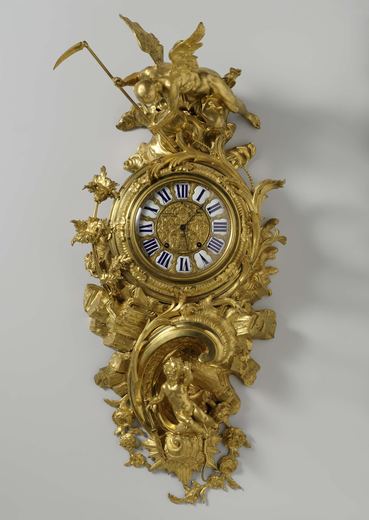
Clocks · 1756
Mantel clock, France, 1756
Rijksmuseum
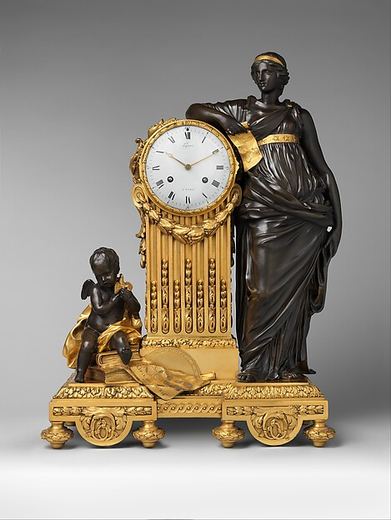
Clocks · ca. 1764–70
Mantel clock by Jean-André Lepaute, France, ca. 1764–70
The Metropolitan Museum of Art, New York
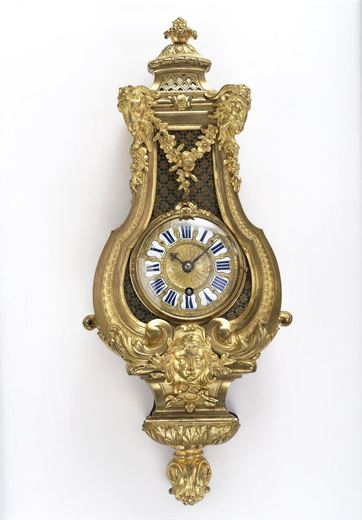
Clocks · 1760–1860
'Pendule d'alcove' wall clock, gilt-bronze and boulle marquetry, Paris, 1760-1860
Victoria and Albert Museum, London
Clocks · 1760
Mantel clock, France, 1760
Rijksmuseum