
Pocket Watches · Open-face pocket watch
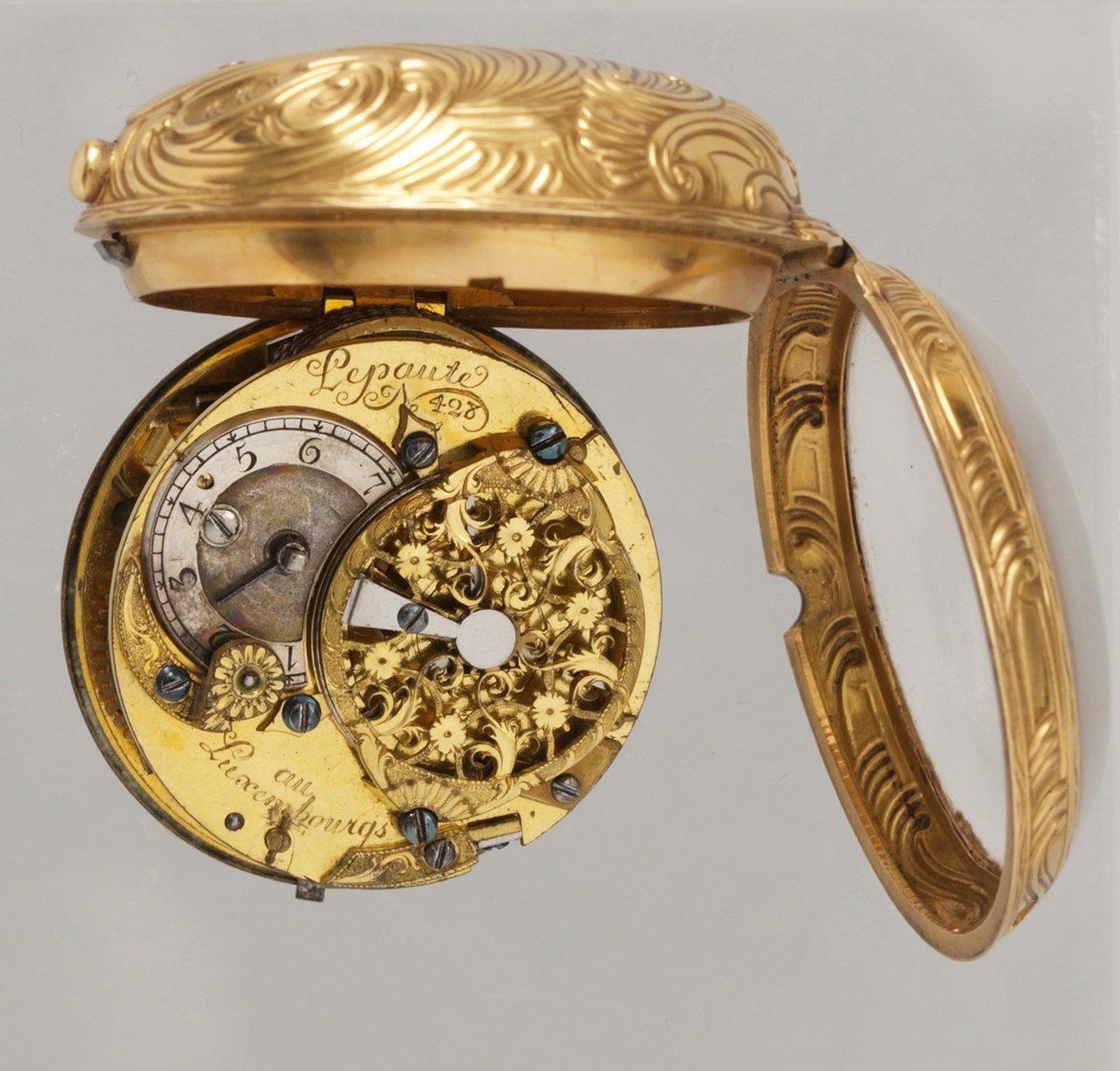
Lepaute 18th-century gold pocket watch
- Maker / attribution
- Lepaute (source attribution)
- Date
- 18th century
- Historical period
- Early Modern Horology (1600 – 1750)
- Country of origin
- France
- Object type
- Open-face pocket watch
- Materials / technique
- 18k gold
- Auction house
- Bukowskis
- Lot
- 1113
- Credit line
- Bukowskis
- Catalogue title (original)
- A French 18th century pocket watch by Lepaute, dial face marked \"Lepaute\" clockwork marked \"Lepaute No 428 au Luxembourgs\". - Bukowskis (English)
View the source record (auction lot) ↗ (opens another website in a new tab)Suggest a correction
Record summary
Catalogued by Bukowskis (lot 1113), this is an open-face pocket watch attributed to Lepaute, made in France, dated 18th century. The Atlas places it in the Early Modern Horology period (1600 – 1750) of its Pocket Watches collection. Materials and techniques recorded by the source: 18k gold. The record is illustrated with 1 photograph.
Assembled from the source record's structured fields. Dates and attributions are given as the source states them; where a field is missing the Atlas leaves it blank rather than estimating.
Catalogue description
Original object description
This eighteenth-century French pocket watch spans 4.5 cm in diameter and is cased in 18-karat gold with illegible assay marks, displaying chased or repoussé wave patterns and fluted scrolls around the bezel and exterior. Although the catalogue notes a white enamel dial inscribed 'Lepaute', catalogue photographs only illustrate the movement and the open case. The outward-hinging gilded movement is signed 'Lepaute No 428 au Luxembourgs', indicating the family's Paris workshop at the Luxembourg Palace. Observable movement features include blued steel screws, a pierced scroll-and-floral balance cock, and a silvered regulating disc marked from 1 to 6; specifications regarding the escapement, geartrain, and running status are not recorded.
Inscriptions & marks
428
Historical context
Early Modern Horology (1600 – 1750)
Huygens' pendulum and balance spring transform accuracy; English makers develop the anchor and deadbeat escapements.
The balance spring (c. 1675) improved watches dramatically and introduced the minute hand. English pair-cased verge watches with pierced balance cocks and French oignons were typical; enamel painting at Blois and Geneva, and the repeating watch (1680s), made watches objects of great refinement.
Read the period in the timelineMore pocket watches from this periodEarlier: Renaissance Horology
Atlas type guide
Hunter, half-hunter and open-face watches
In the nineteenth century the pocket watch case settled into a few standard forms. The hunter (French savonnette) has a hinged front lid protecting the crystal — reputedly for riders who could not risk broken glass — and is opened by pressing the crown or a push-piece. The half-hunter has a small window in the lid so the hands can be read when closed. The open-face (lépine) watch has no front cover, with the crown at 12; hunters normally carry the crown at 3.
Case types also changed with winding: key-wound watches gave way to keyless (stem-wound) mechanisms after Adrien Philippe's and others' designs of the 1840s, with pendant setting or lever setting.
What to look for
- Crown position relative to the seconds dial: at 3 for hunters, at 12 for open-face watches.
- Spring-loaded front cover with a push-piece in the pendant.
- Half-hunter chapter ring enamelled on the lid.
- Key holes in the inner dome (cuvette) versus keyless winding.
Dating clues
- Keyless winding spread after c. 1850 and became standard by c. 1890.
- English hallmarks inside gold and silver cases give the year of assay.
General guidance written by the Atlas editors about this kind of object. It is not a statement about this particular piece; for that, rely on the source record above and on physical examination.
Read next:Detached lever escapement
Related records
Pocket Watches · c. 1770
Lepaute 18K Gold and Enamel Openface Quarter Repeating Verge Pocket Watch
Antiquorum / EveryWatch
Pocket Watches · c. 1600
Pocket watch by Hans Reinboldt, France, c. 1600
German Clock Museum
Pocket Watches · 1600
Pocket watch, France, 1600
Rijksmuseum
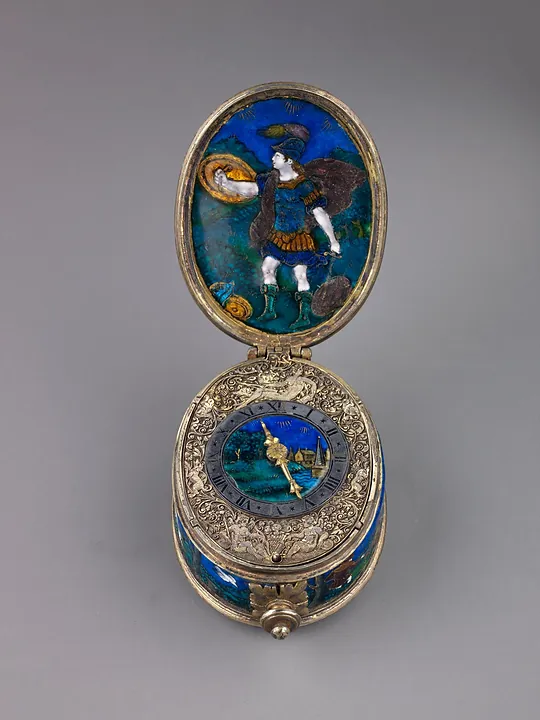
Pocket Watches · first quarter of 17th century
Watch by Suzanne de Court, France, first quarter of 17th century
The Metropolitan Museum of Art, New York
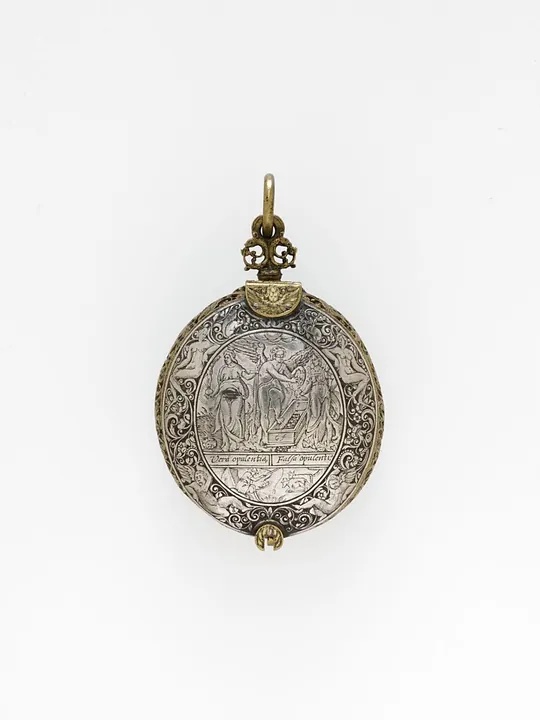
Pocket Watches · early 17th century
Watch of engraved and pierced silver and gilt brass, signed 'Noel Hubert A Rouen', France, early 17th century
Victoria and Albert Museum, London
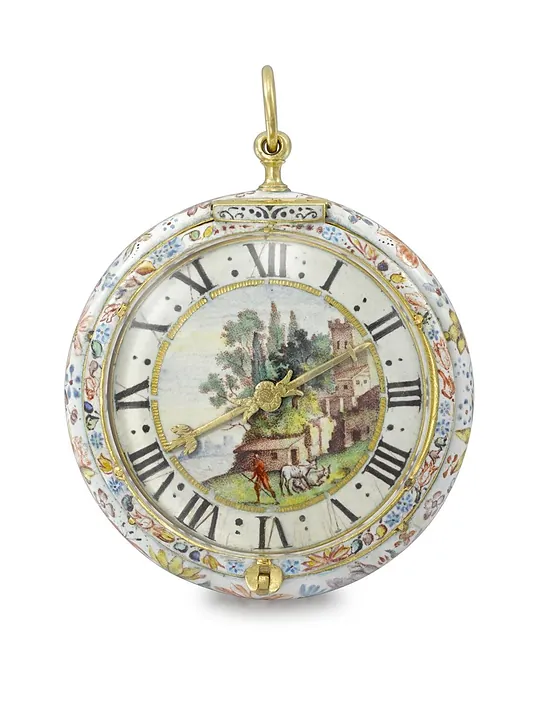
Pocket Watches · 1601–1700
Pocket watch by D Margotin, France, 1601–1700
Science Museum Group, London
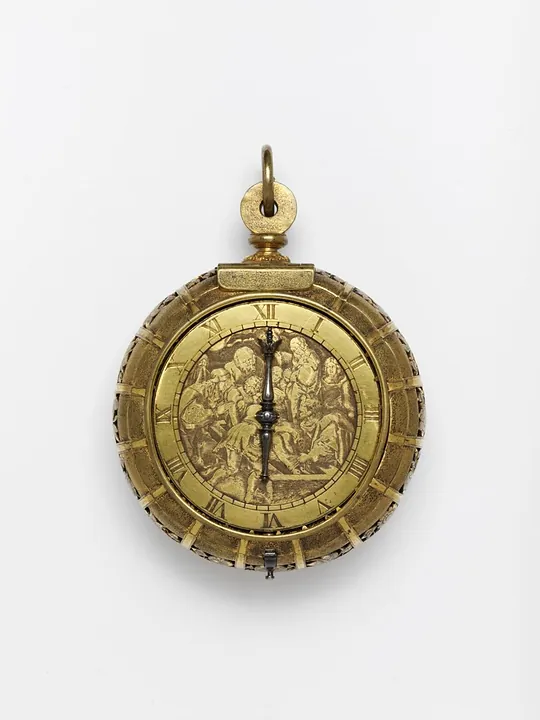
Pocket Watches · 1630
Carriage watch with gilt brass case and engraved dial by Nicolas Lemaindre, Blois, 1630
Victoria and Albert Museum, London
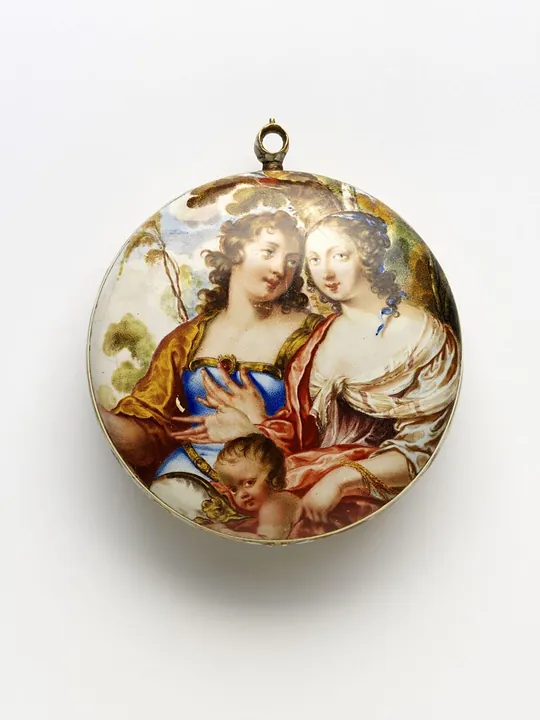
Pocket Watches · 1640–1660
Watch by Jan Bernardus Vrythoff, France, 1640–1660
Victoria and Albert Museum, London