
Clocks · Clock
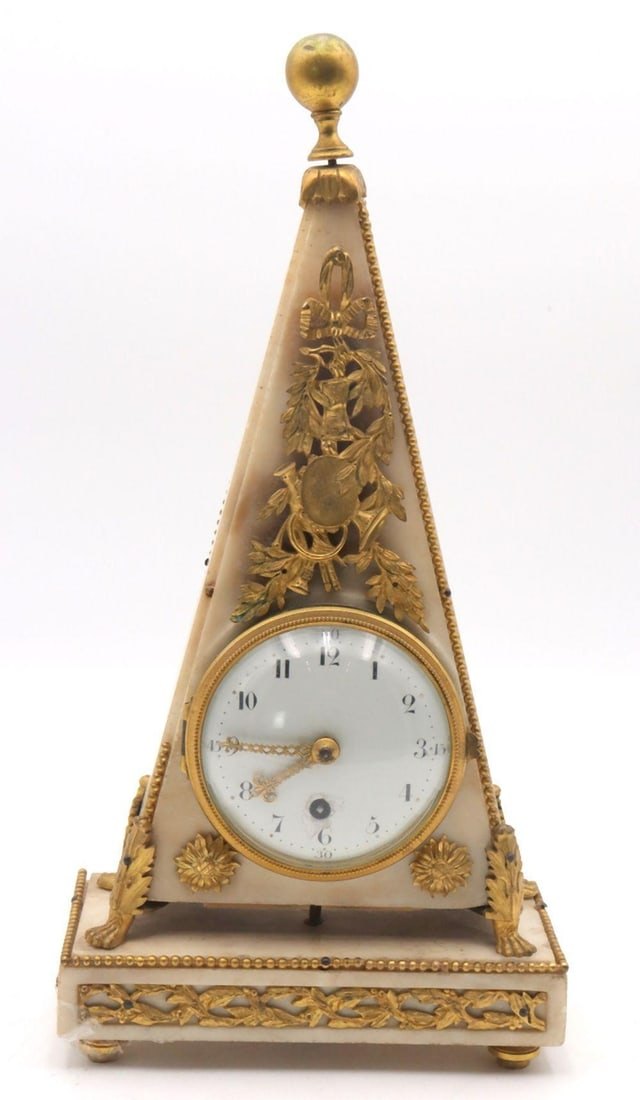
Late 18th C. French Louis XVI Style Obelisk Mantel Clock, c. 1790
- Maker / attribution
- Unrecorded in source
- Date
- c. 1790
- Historical period
- Precision & Scientific Horology (1750 – 1850)
- Country of origin
- France
- Object type
- Clock
- Materials / technique
- bronze
- Auction house
- LiveAuctioneers auction archive
- Lot
- Item 219649335
- Credit line
- Auction lot record: lot 229, Winter Collections of Palm Beach, Market Auctions (2025), via LiveAuctioneers
- Catalogue title (original)
- Late 18th C. French Louis XVI Style Obelisk Mantel Clock (English)
View the source record (auction lot) ↗ (opens another website in a new tab)Suggest a correction
Record summary
Catalogued by LiveAuctioneers auction archive (lot Item 219649335), this is a clock, made in France, dated c. 1790. The Atlas places it in the Precision & Scientific Horology period (1750 – 1850) of its Clocks collection. Materials and techniques recorded by the source: bronze. The record is illustrated with 4 photographs.
Assembled from the source record's structured fields. Dates and attributions are given as the source states them; where a field is missing the Atlas leaves it blank rather than estimating.
Catalogue description
Lot description — Market Auctions
French Louis XVI Style Obelisk Mantel Clock, circa 1790–1800 White marble and gilt bronze (ormolu) Height 14½ in. (36.8 cm); Width 7 in. (17.8 cm) Of neoclassical design, this elegant Louis XVI-style mantel clock takes the rare and distinguished form of an obelisk, a motif inspired by the rediscovery of ancient Egyptian monuments during the late eighteenth century. The white marble case is surmounted by a gilt-bronze finial and bordered by a delicate beaded molding. The circular white enamel dial with Arabic numerals is enclosed within a finely chased gilt-bronze bezel, set against the tapering marble body richly adorned with a finely cast gilt-bronze mount of trophées d’amour—including a bow, quiver, and wreath tied with a ribbon bow—symbolizing love and triumph. The clock rests on a stepped plinth base decorated with a running laurel-leaf frieze and supported on small toupie feet. This piece reflects the late eighteenth-century fascination with antiquity and the geometric purity celebrated by the Louis XVI period’s neoclassical refinement. Comparable examples were produced by renowned Parisian clockmakers and bronziers such as Jean-André Lepaute and Claude Galle, whose works embodied the union of sculptural bronze and pristine marble so favored under the Ancien Régime and early Directoire. Condition : Front bronze mount loose; missing some bronze mounts; cracked glass on back; sold as is. Not guaranteed to be in working condition. Minor wear and age-appropriate patina throughout. Have a similar item to sell? Contact us at info@marketauctionsinc.com Please review all photos closely. The non-appearance of a condition report does not mean that the lot is in perfect condition, does not show wear due to age and use, or is free from damage. Market Auctions Inc. strongly suggests that you request a condition report before placing a bid. You may request one from us via this auction platform. Please note that any condition reports are given as strictly as a courtesy to interested parties and should not be considered a statement of fact. Market Auctions Inc. bears no responsibility for any error or omission. All sales are final and sold as is. Measurements are approximated. Please note shipping is not included. All collectibles, silver, antiques, and paintings please contact our third party shipper listed below: Juniors Auction Services 561-510-0345 / juniorsauctionservices@gmail.com UPS Store 1226 (561) 835-9791 / store1226@theupsstore.com For furniture and very large items, please contact an appropriate freight / transport company for shipment. SALES TAX NOTICE PLEASE TAKE NOTICE that Market Auction, Inc., only collects and remits sales tax on items purchased by Florida residents. ALL OUT OF STATE purchasers are required to pay sales tax to their respective States. Purchasers holding valid resale certificates must provide proof of same prior to purchase. Market Auctions, Inc. takes no responsibility for purchaser failure to remit sales tax to the proper non-Florida taxing authority and for any fines or penalties that may result.
Historical context
Precision & Scientific Horology (1750 – 1850)
Harrison solves longitude; Mudge invents the lever; Breguet's Paris workshop defines the modern watch.
The age of the deadbeat escapement, compensated pendulums and observatory regulators. Domestic clocks spread through the middle classes: English longcase and bracket clocks, French gilt-bronze mantel clocks, Viennese Biedermeier wall clocks, Black Forest painted-shield clocks, and the first American shelf clocks.
Read the period in the timelineMore clocks from this periodEarlier: Early Modern Horology
Atlas type guide
Mantel and French pendule clocks
The mantel clock — the French pendule de cheminée — is as much decorative art as timekeeper. From the late seventeenth century Parisian clockmakers worked with cabinet-makers, bronze founders and gilders (ciseleurs-doreurs) to create cases in Boulle marquetry, gilt bronze and marble, while the movements were often supplied by specialist makers. Clocks of the Louis XIV, Louis XV and Louis XVI periods, and Empire clocks with allegorical figures, set fashions copied across Europe.
The nineteenth century industrialised the type. The 'Paris movement', a standardised round movement with silk-thread or Brocot suspension and count-wheel striking, was made in huge numbers by firms such as Japy and Vincenti, and fitted into cases of every style and material.
What to look for
- Round 'Paris' movements with makers' stamps (e.g. Japy Frères, Vincenti, S. Marti) and medal marks from exhibitions.
- Suspension type: silk thread (earlier) or Brocot adjustable suspension (after c. 1840).
- Visible Brocot escapement on the dial in later clocks.
- Fire-gilt (mercury) gilding on bronzes versus later electro-gilding.
- Signed dials naming a retailer rather than the movement maker.
Dating clues
- Silk-suspension Paris movements: c. 1800–1850.
- Brocot suspension and visible escapements: after c. 1840.
- Exhibition medal stamps on movements give dates after the medal year.
General guidance written by the Atlas editors about this kind of object. It is not a statement about this particular piece; for that, rely on the source record above and on physical examination.
Read next:Anchor (recoil) escapement
Related records
Clocks · 1750–1800
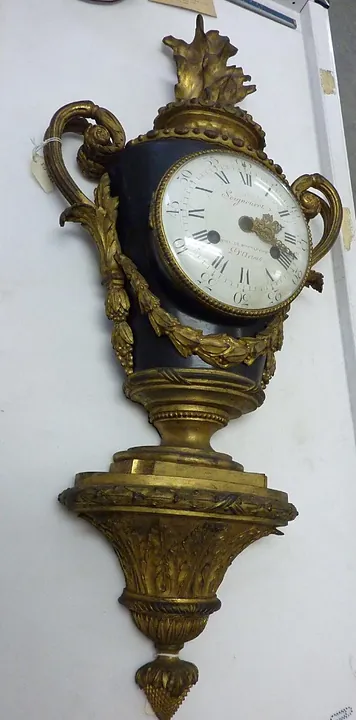
Bracket clock in metal case with scroll handles and flamed-shaped top signed by Pierre Seignoret, Clockmaket to the the Comte d'Artois
Victoria and Albert Museum, London
Clocks · 1756
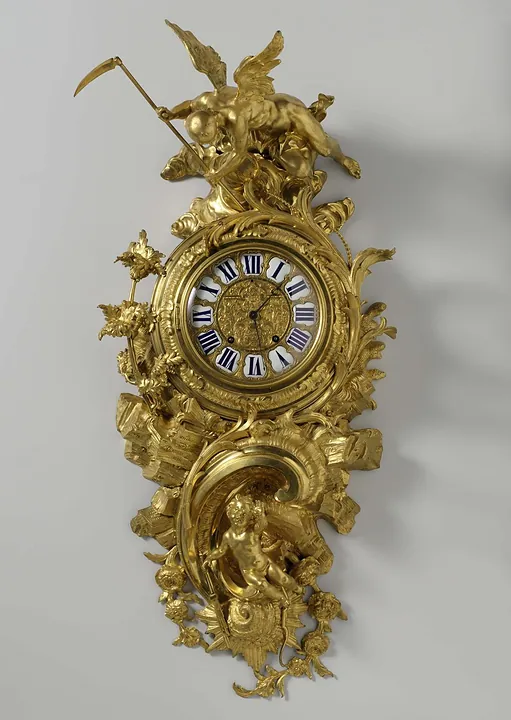
Mantel clock, France, 1756
Rijksmuseum
Clocks · c. 1764–70
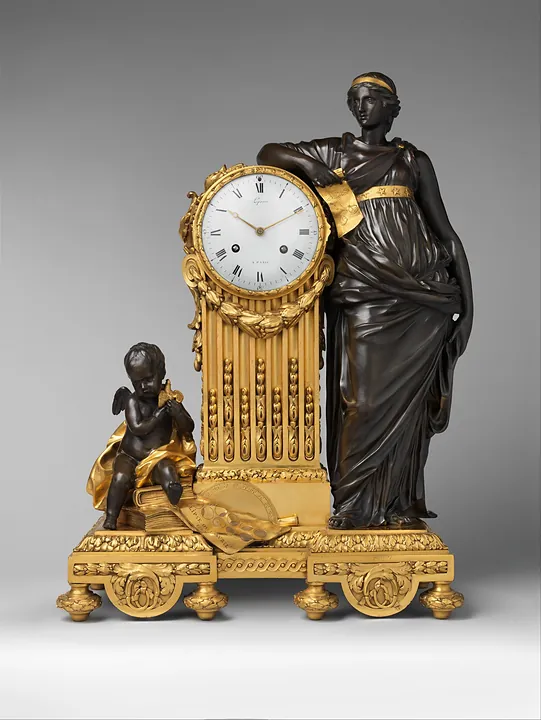
Mantel clock by Jean-André Lepaute, France, c. 1764–70
The Metropolitan Museum of Art, New York
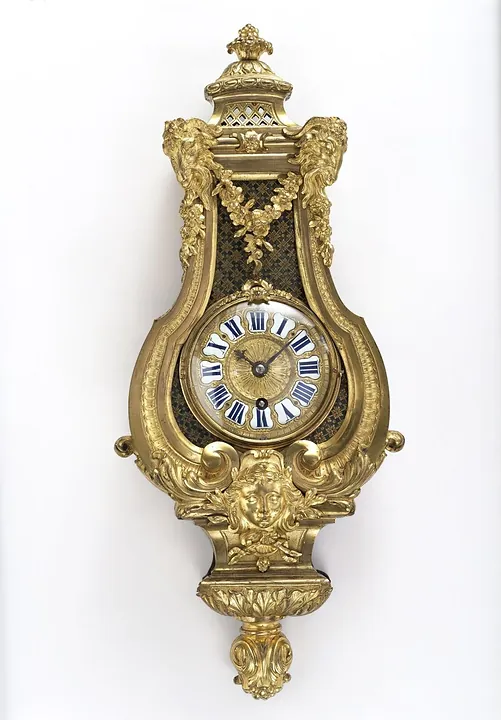
Clocks · 1760–1860
'Pendule d'alcove' wall clock, gilt-bronze and boulle marquetry, Paris, 1760-1860
Victoria and Albert Museum, London
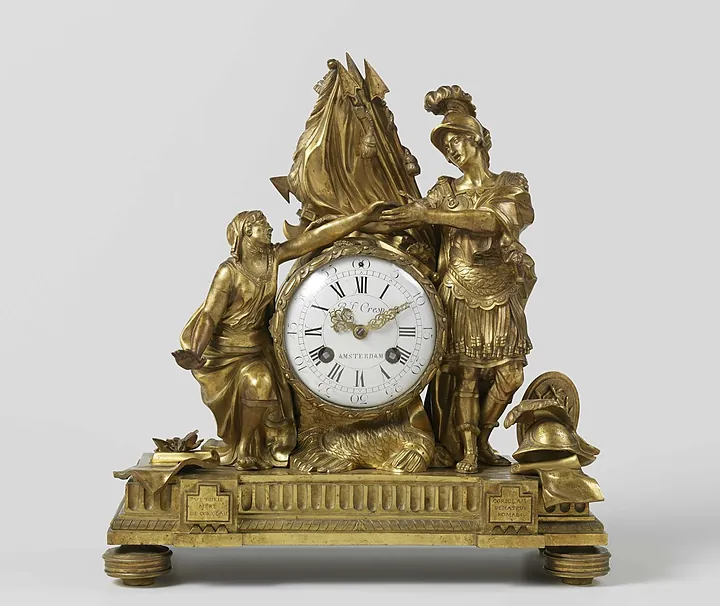
Clocks · 1760
Mantel clock, France, 1760
Rijksmuseum
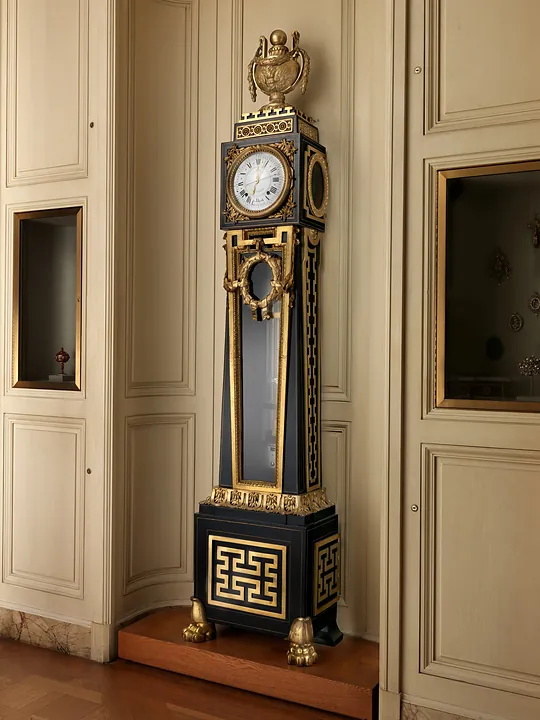
Clocks · c. 1768–70
Longcase astronomical regulator by Ferdinand Berthoud, France, c. 1768–70
The Metropolitan Museum of Art, New York
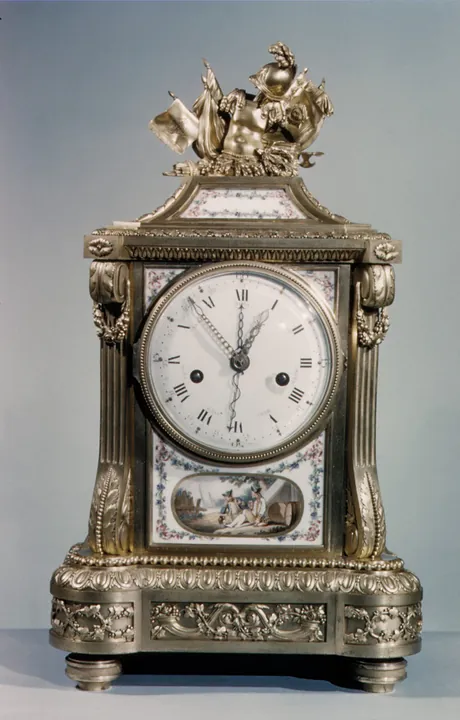
Clocks · c. 1775
Clock by Porcelain plaques by Sèvres Manufactory, France, c. 1775
The Metropolitan Museum of Art, New York
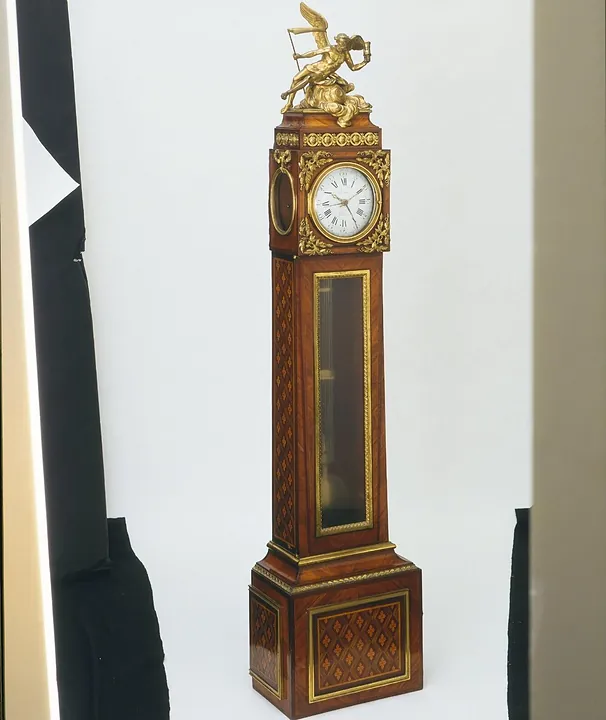
Clocks · 1770–1775
Longcase clock (régulateur) by Robert Robin, France, 1770–1775
Victoria and Albert Museum, London