
Wristwatches · Wristwatch
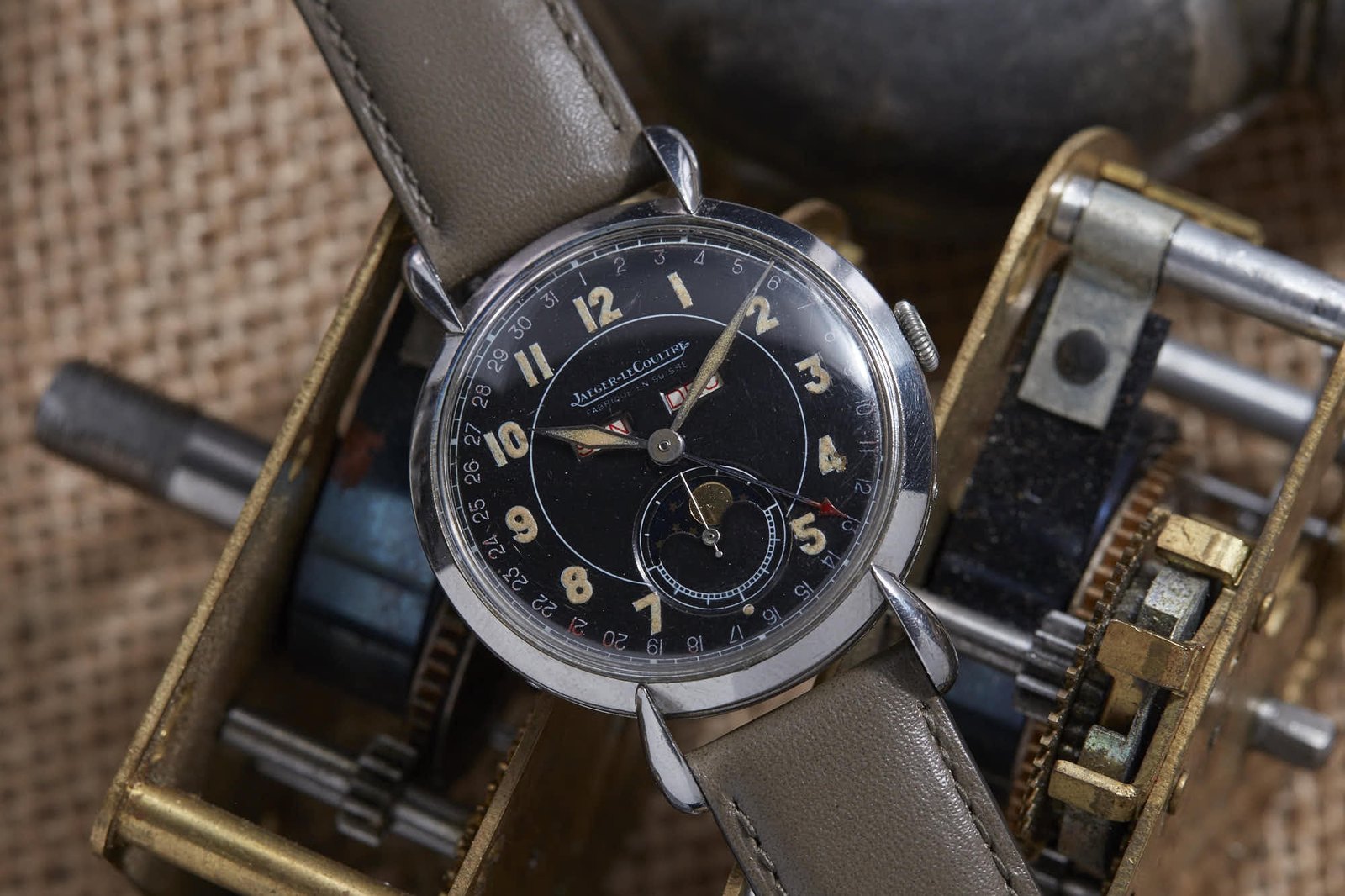
Jaeger-LeCoultre Triple Calendar Moonphase, late 1940s
- Maker / attribution
- Jaeger LeCoultre (maker)
- Date
- late 1940s
- Historical period
- Golden Age of Mechanical Watchmaking (1900 – 1945)
- Country of origin
- Unrecorded in source
- Object type
- Wristwatch
- Dimensions
- Case 36 mm
- Stock no.
- Product 8295139521
- Credit line
- Dealer listing, Analog/Shift (product 8295139521)
- Catalogue title (original)
- Jaeger-LeCoultre Triple Calendar Moonphase (English)
View the source record (dealer listing) ↗ (opens another website in a new tab)Suggest a correction
Record summary
Catalogued by Analog/Shift (dealer), New York (stock number Product 8295139521), this is a wristwatch by Jaeger LeCoultre, dated late 1940s. The Atlas places it in the Golden Age of Mechanical Watchmaking period (1900 – 1945) of its Wristwatches collection. Recorded dimensions: Case 36 mm. The record is illustrated with 6 photographs.
Assembled from the source record's structured fields. Dates and attributions are given as the source states them; where a field is missing the Atlas leaves it blank rather than estimating.
Catalogue description
Dealer description — Analog/Shift
From its inception and on to the present day, Jaeger-LeCoultre has produced timepieces that are both timeless and perpetually-appealing. Though their quality is often under-sung, JLC's offerings sing to us in a soft, alluring timbre. Their pieces--such as the Reverso , Deep Sea Alarm , and the Geophysic --seamlessly bridge the gap between beauty and innovation, exuding an appeal that is hard to resist. While many manufactures devoted their production to military timepieces during World War II, Jaeger-LeCoultre continued to design and produce consumer-grade timepieces alongside aviation wristwatches and a wide array of gauges and cockpit timers and clocks. This particular example dates to the late 1940s and is driven by the Caliber 494. The Caliber 494 is a variant of the same Caliber 478 that powered the brand's military watches and the original Geophysic, but with the addition of a moon-phase and a calendar. Even with their military timepieces, there's a certain visual appeal in the interplay of the Arabic numerals and the stark black dials. It's as though they're beautiful without meaning to be. But, as in the case with this watch, when JLC tries to make something beautiful, the results are nothing short of stunning. The svelte 36mm case with its elegant teardrop lugs cradles a lovely matte black dial with Arabic numerals that have aged to a creamy patina. The outer date track is subtle, but accented with the bright red tip of the date indicator. JLC also offered this watch without the moonphase (Reference 2721), but the addition of the moon-phase and its quirky placement is absolutely mesmerizing. We've seen moon-phases and triple dates from this era in gold and with white or silver dials, but to see one with a black dial and in steel is a rare find. Powerful yet elegant, this gorgeous moon-phase should be high up on your list.
Historical context
Golden Age of Mechanical Watchmaking (1900 – 1945)
The wristwatch displaces the pocket watch; waterproof cases, self-winding and grand complications.
The wristwatch overtook the pocket watch. Military use in the First World War, aviation, water-resistant cases (1926), automatic winding (1923–31), rectangular Art Deco designs and early chronographs and calendars defined the period.
Read the period in the timelineMore wristwatches from this periodEarlier: Industrial Revolution
Atlas type guide
Calendar, moon-phase and perpetual calendar watches
Calendar complications range from a simple date to the perpetual calendar, which automatically allows for months of different lengths and leap years until 2100. Pocket watches with perpetual calendars were made in the eighteenth and nineteenth centuries; Patek Philippe made the first perpetual calendar wristwatch in 1925, and series production followed in 1941. The annual calendar (Patek Philippe, 1996) needs correction only once a year.
Moon-phase displays use a disc with two moons and 59 teeth advanced daily, approximating the 29.5-day lunation; more precise trains reduce the error to one day in over a century.
What to look for
- Apertures or subsidiary dials for day, date, month and leap year.
- Moon disc under a 'bosom' shaped aperture.
- Recessed correctors on the case band for setting the calendar.
Dating clues
- Triple-date wristwatches: popular c. 1940–1955.
- Perpetual calendar wristwatches: from 1925 (unique) and 1941 (series).
General guidance written by the Atlas editors about this kind of object. It is not a statement about this particular piece; for that, rely on the source record above and on physical examination.
Related records
Wristwatches · 1953–1956
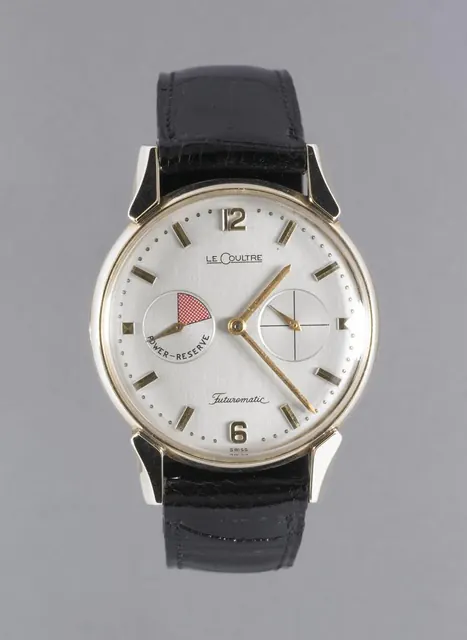
Automatic wristwatch with subsidiary seconds and power-reserve dial
British Museum
Wristwatches · mid 1960s
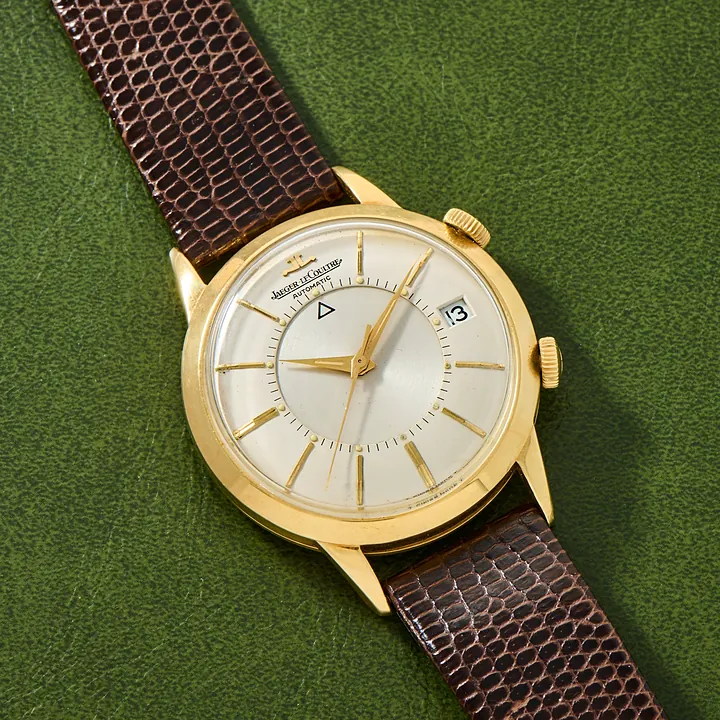
Jaeger-LeCoultre Memovox, mid 1960s
Analog/Shift (dealer), New York
Wristwatches · 1960
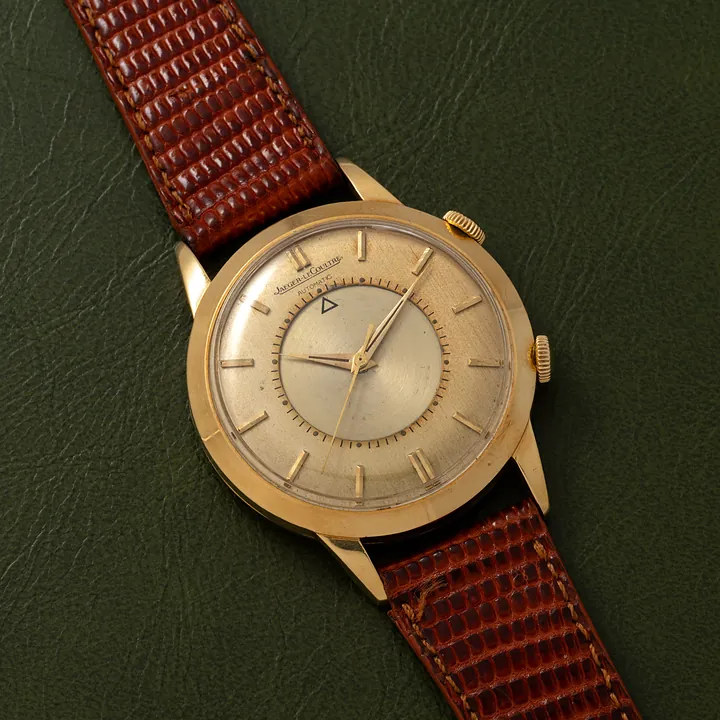
Jaeger-LeCoultre 'European Market' Memovox, 1960
Analog/Shift (dealer), New York
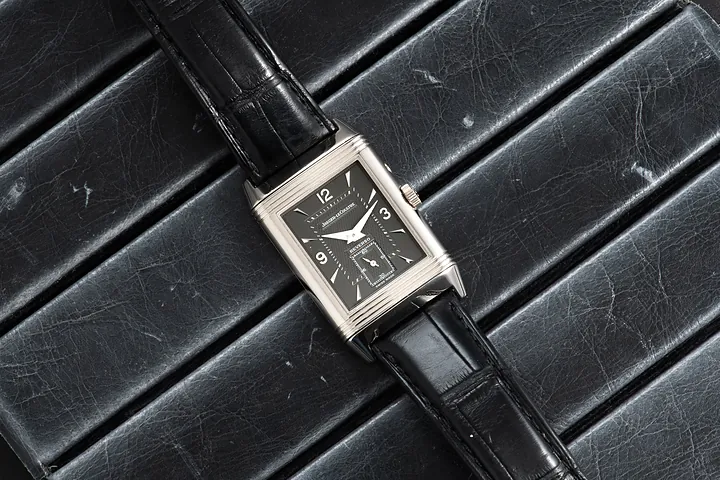
Wristwatches · 2010s
Jaeger-LeCoultre Reverso Duoface Day/Night, 2010s
Analog/Shift (dealer), New York
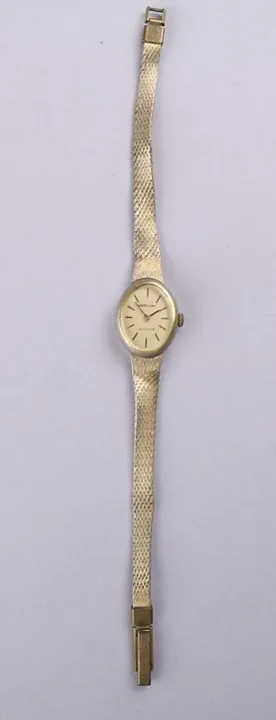
Wristwatches · 1900–1999
Wristwatch by Mercury, 1900–1999
Modemuseum Hasselt
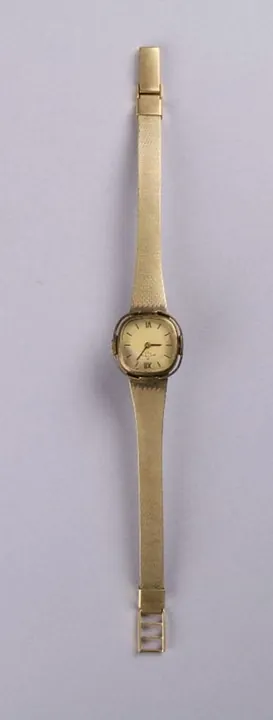
Wristwatches · 1900–1999
Wristwatch by Nutrix, 1900–1999
Modemuseum Hasselt

Wristwatches · 1920
Wristwatch, 1920
Modemuseum Hasselt

Wristwatches · 1931
Rolex 'Oyster Perpetual' rotor self-winding wrist-watch, lever escapement, in steel case with glass in back, Montres Rolex SA, Geneva, Switzerland, 1931
Science Museum Group, London