
Wristwatches · Wristwatch
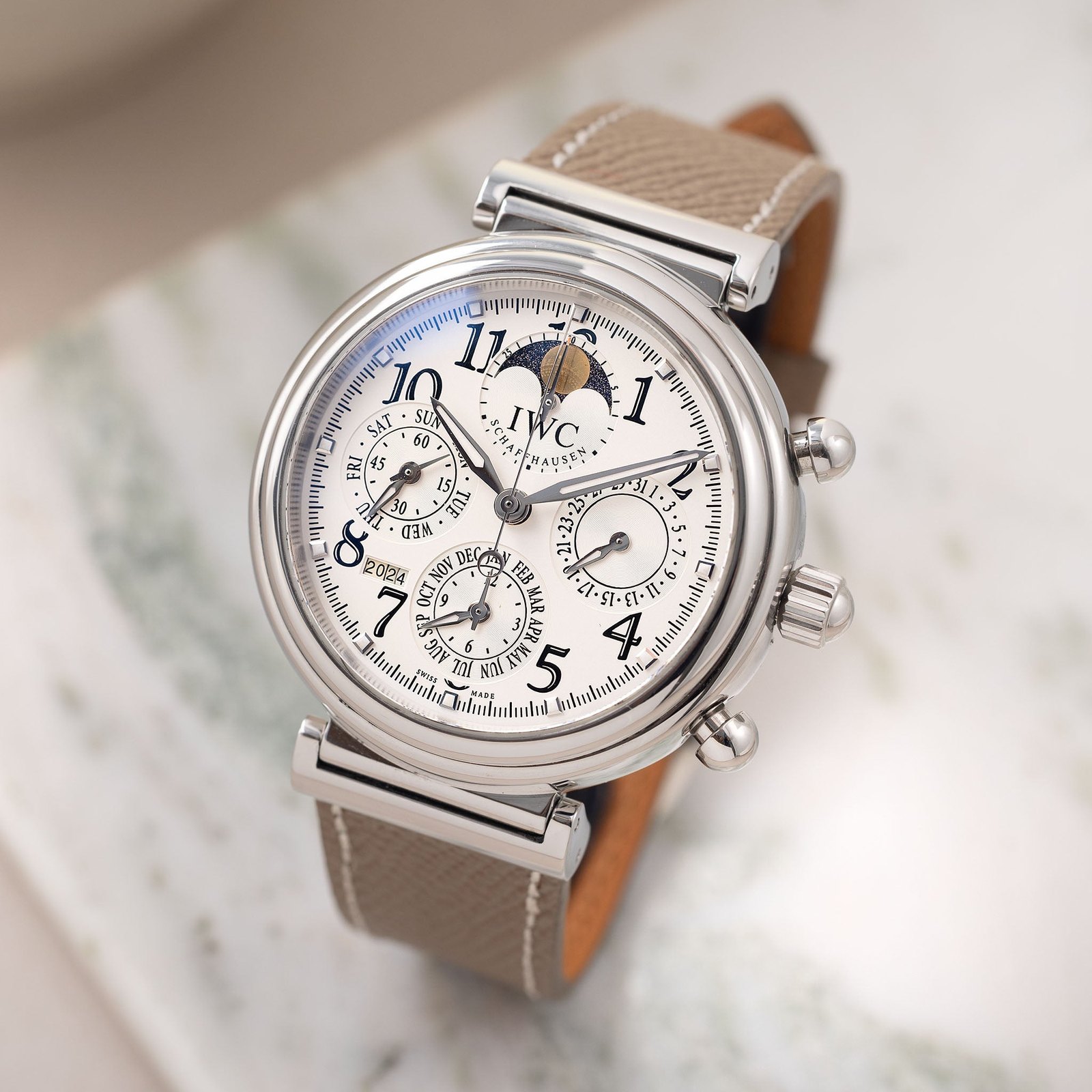
IWC Da Vinci Perpetual Calendar Silver Dial Ref. IW375803, 2004–2006
- Maker / attribution
- IWC (maker)
- Date
- 2004–2006
- Historical period
- Mechanical Renaissance (1990 – 2010)
- Country of origin
- Switzerland
- Object type
- Wristwatch
- Materials / technique
- silver
- Dimensions
- Case 41 mm
- Stock no.
- w-2951
- Credit line
- Dealer listing, Bulang & Sons (w-2951)
- Catalogue title (original)
- IWC Da Vinci Perpetual Calendar Silver Dial Ref. IW375803 (English)
View the source record (dealer listing) ↗ (opens another website in a new tab)Suggest a correction
Record summary
Catalogued by Bulang & Sons (dealer), Copenhagen (stock number w-2951), this is a wristwatch by IWC, made in Switzerland, dated 2004–2006. The Atlas places it in the Mechanical Renaissance period (1990 – 2010) of its Wristwatches collection. Materials and techniques recorded by the source: silver. Recorded dimensions: Case 41 mm. The record is illustrated with 6 photographs.
Assembled from the source record's structured fields. Dates and attributions are given as the source states them; where a field is missing the Atlas leaves it blank rather than estimating.
Catalogue description
Dealer description — Bulang & Sons
The IWC Da Vinci line emerged in 1969 with the introduction of the very first IWC Da Vinci, equipped with the infamous Beta 21 quartz movement. However, the watch we have at hand is a very different kind of timepiece! The first significant evolution of the collection occurred in 1985 with what is undoubtedly the most famous version: the Da Vinci Perpetual Calendar (Ref. 3750). This model was created under the technical guidance of Kurt Klaus, while Günter Blümlein served as CEO of IWC. The launch of this watch is quite significant, and the context warrants explanation. During the early 1980s, the Swiss watch industry faced massive changes. Interest in quality mechanical timepieces—ranging from simple three-hand watches to complex pieces—was limited to a small group of collectors and enthusiasts. Wearers of mechanical watches were rare and often perceived as “old-school” or “outdated.” While sales representatives from historic brands like IWC attempted to convey the beauty of mechanical movements and the dedication of watchmakers in crafting fine timepieces, clients were captivated by the slim and precise electronic quartz watches. At the Basel Watch Fair in 1985, a new watch was introduced that combined striking design with a complex perpetual calendar chronograph movement (the ancestor of the watch we have today): the Da Vinci Perpetual Calendar (Ref. 3750). This watch, the first in the new Da Vinci collection, is the result of designer Hano Burtscher’s vision, featuring a round design with articulated swivel lugs. More importantly, this watch symbolizes the resurgence of complex mechanical movements. At the end of the 1970s, Kurt Klaus developed a perpetual calendar module that allowed all settings to be made via the crown, easily attachable to almost any movement—from a simple three-hander to a chronograph. Our watch is based on this design language and movement, featuring a nicely sized 41mm steel case with “mushroom” pushers. There is a lot to take in when looking at the dial: it features a white background with painted Arabic numeral hour markers, a 12-hour chronograph, a perpetual calendar displaying the day, date, month, and four-digit year, as well as a moonphase! All of this is protected by a sapphire crystal. The moonphase has a lovely sparkle, a little detail we truly appreciate. All settings can be adjusted using the crown at 3 o’clock—a very ingenious design! This lovely IWC comes on a Bulang & Sons strap and has been fully serviced by our watchmaker. Specifications: - IWC Da Vinci Perpetual Calendar - Reference IW375803 - Dates to 2004–2006 - 41mm steel stepped case with swivel lugs and “mushroom” pushers - White/silver dial with day, date, month, and four-digit year display in English, with black Arabic numerals - Chronograph, perpetual calendar, and moonphase - Luminous hands - IWC Calibre C.79261 automatic movement - Bulang & Sons strap - Fully serviced by our watchmaker
Historical context
Mechanical Renaissance (1990 – 2010)
Mechanical watches return as cultural objects; independent watchmaking flourishes.
Mechanical watches returned as cultural and luxury objects. Complications, tourbillons and new materials proliferated; independent watchmakers such as George Daniels, F.P. Journe and Philippe Dufour revived artisanal watchmaking; collecting vintage watches became a major field.
Read the period in the timelineMore wristwatches from this periodEarlier: Quartz Revolution
Atlas type guide
Calendar, moon-phase and perpetual calendar watches
Calendar complications range from a simple date to the perpetual calendar, which automatically allows for months of different lengths and leap years until 2100. Pocket watches with perpetual calendars were made in the eighteenth and nineteenth centuries; Patek Philippe made the first perpetual calendar wristwatch in 1925, and series production followed in 1941. The annual calendar (Patek Philippe, 1996) needs correction only once a year.
Moon-phase displays use a disc with two moons and 59 teeth advanced daily, approximating the 29.5-day lunation; more precise trains reduce the error to one day in over a century.
What to look for
- Apertures or subsidiary dials for day, date, month and leap year.
- Moon disc under a 'bosom' shaped aperture.
- Recessed correctors on the case band for setting the calendar.
Dating clues
- Triple-date wristwatches: popular c. 1940–1955.
- Perpetual calendar wristwatches: from 1925 (unique) and 1941 (series).
General guidance written by the Atlas editors about this kind of object. It is not a statement about this particular piece; for that, rely on the source record above and on physical examination.
Related records
Pocket Watches · c. 1950
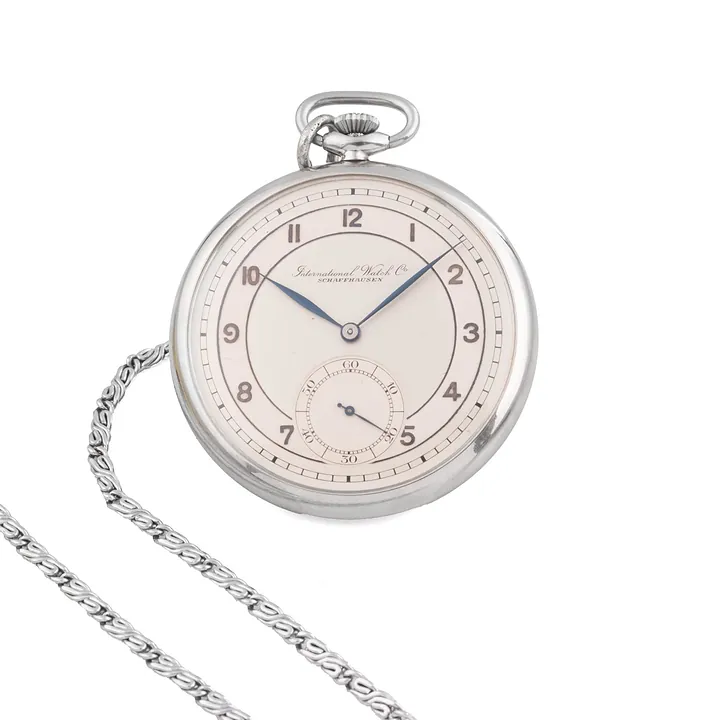
IWC Pocket Watch, c. 1950
Antiquorum auction archive, Geneva
Pocket Watches · c. 1980
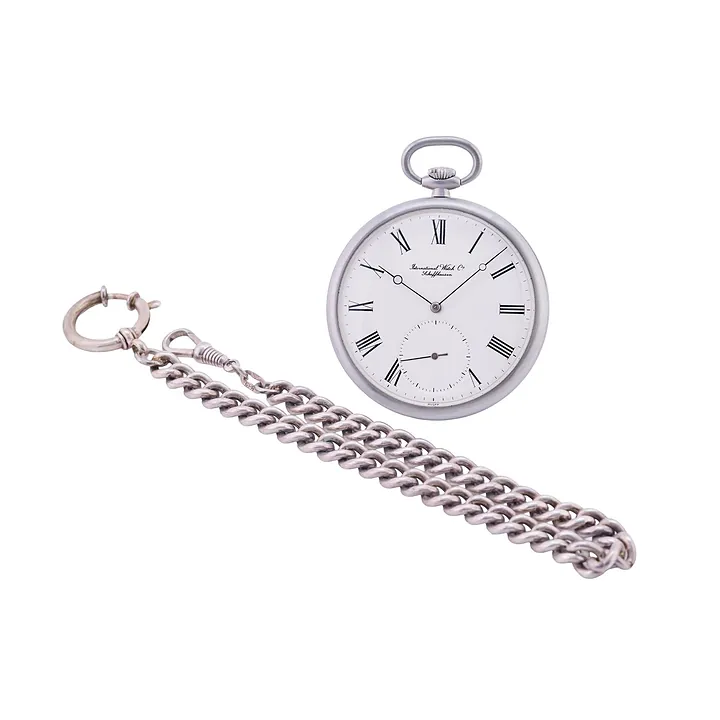
IWC pocket watch, ref. 5301, c. 1980
Antiquorum auction archive, Geneva
Wristwatches · originally sold in April 2016 (per the lot record)
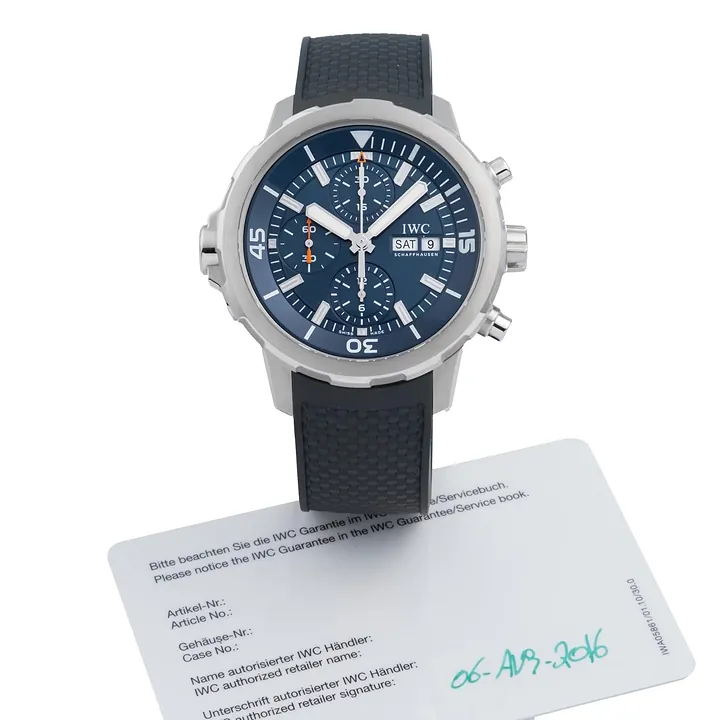
IWC Aquatimer Chronograph Cousteau, ref. IW3768, originally sold in April 2016
Antiquorum auction archive, Geneva
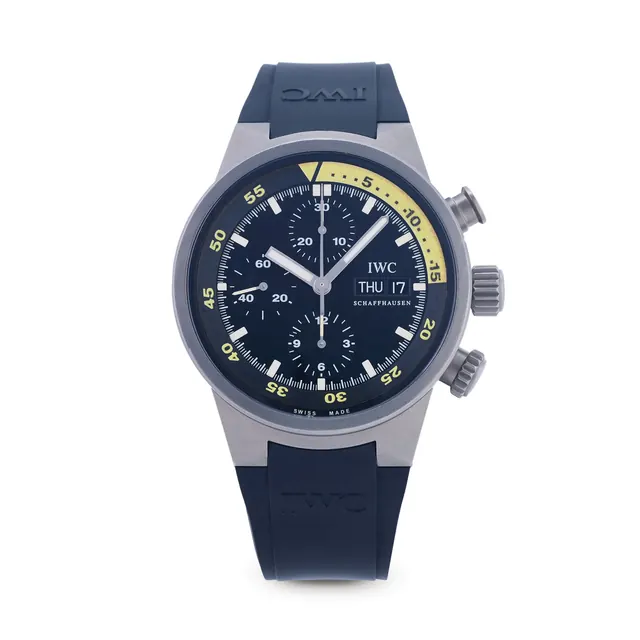
Wristwatches · c. 2010s
IWC wristwatch, ref. IW371918, Aquatimer, circa 2010s
Antiquorum auction archive, Geneva

Wristwatches · 2008
Wristwatch by Breitling?, 2008
Museum Rotterdam

Wristwatches · c. 1990s
Audemars Piguet Bamboo, c. 1990s
Antiquorum auction archive, Geneva

Wristwatches · c. 1990
Audemars Piguet Huitieme Perpetual Calendar, ref. 25696PT, c. 1990
Antiquorum auction archive, Geneva

Wristwatches · c. 1990
Breitling Chronomat, ref. b13050.1, c. 1990
Antiquorum auction archive, Geneva