
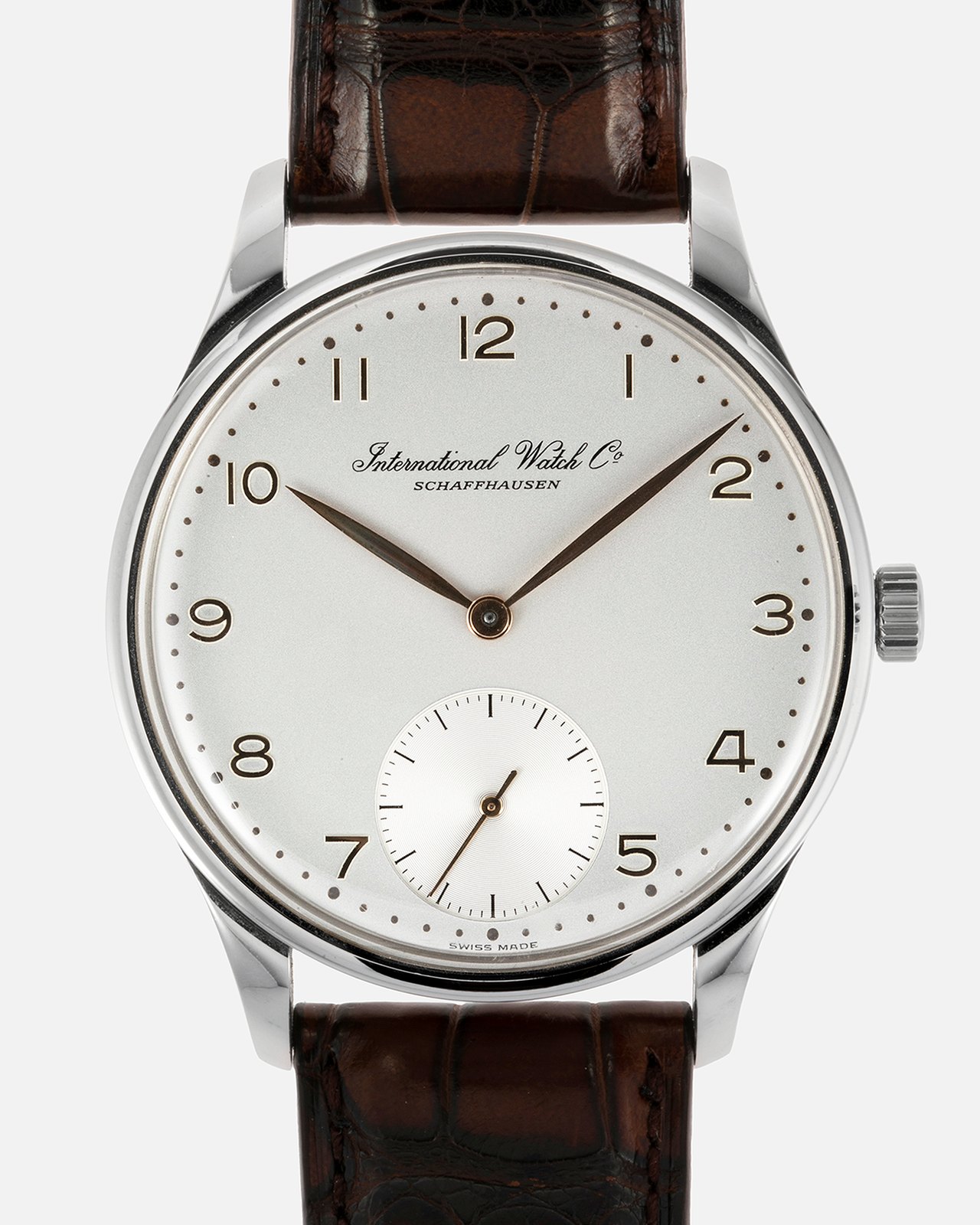
Wristwatches · Wristwatch
IWC 5441 125th Anniversary Jubilee, 1993
- Maker / attribution
- IWC (maker)
- Date
- 1993
- Historical period
- Mechanical Renaissance (1990 – 2010)
- Country of origin
- Switzerland
- Object type
- Wristwatch
- Dimensions
- Case 42 mm
- Stock no.
- Product 6880082133079
- Credit line
- Dealer listing, S.Song Watches (product 6880082133079)
- Catalogue title (original)
- IWC 5441 125th Anniversary Jubilee (English)
View the source record (dealer listing) ↗ (opens another website in a new tab)Suggest a correction
Record summary
Catalogued by S.Song Watches (dealer), Seattle (stock number Product 6880082133079), this is a wristwatch by IWC, made in Switzerland, dated 1993. The Atlas places it in the Mechanical Renaissance period (1990 – 2010) of its Wristwatches collection. Recorded dimensions: Case 42 mm. The record is illustrated with 6 photographs.
Assembled from the source record's structured fields. Dates and attributions are given as the source states them; where a field is missing the Atlas leaves it blank rather than estimating.
Catalogue description
Dealer description — S.Song Watches
It is not very often we get to offer a true historical immortal of the watch industry; with one such example being the IWC Portugieser. Collectors widely regard this as one of the most revered and distinguished wristwatches of the 20 th and 21 st century and it’s hard not to see why. Before we discuss more about the Ref. 5441 that we have on offer here today, I think it is important to provide some context as to why the Portugieser is such an iconic and important model to IWC because the history behind this reference is precisely what makes this model so collectible and sought after by enthusiasts and connoisseurs alike. In 1939, IWC received a request from its Portuguese wholesalers – Messrs. Rodriguez & Antonio Texeira, who asked IWC to make them a wristwatch that was sturdy, accurate, and larger in size (contrary to the smaller wristwatches that were in vogue at the time) and powered by a pocket watch movement. Little did they know, their order would eventually become one of the Maison’s most celebrated models of all time in the many decades that followed. IWC accepted the challenge and built a watch with a larger 42mm steel case, which was also then used to house one of the thinnest and most reliable pocket watch movements in production at that time - the Cal. 74. This led to the creation of the Portugieser, which eventually took on an identity as an icon in the world of watchmaking thanks to its unmistakable and timeless design featuring a large dial, simple and sober Arabic numerals, a small-seconds at 6 o ‘clock, a railway track chapter ring and a perfectly balanced looking dial. Fast forward to 1993, when IWC was preparing for its 125 th Anniversary Jubilee, the Maison decided to bring back one of their most celebrated but most infrequently produced models in their history in the form of the Ref. 5441. The Ref. 5441 was solely created in 1993 for the 125 th Anniversary Jubilee with a breakdown of 1,000 pieces in stainless steel, 500 in pink gold, and 250 in platinum. To IWC collectors, this is as good as it gets. For the decades that followed, the Ref. 5441 became known as one of the most sought-after IWC references not because of the limited production numbers, but because collectors who managed to get their hands on one generally never let them go, and I can definitely see why that is the case here. The Ref. 5441 is a beautiful timepiece. Fundamentally, it is a spitting image of the original and faithful to a fault – 42mm in diameter and 10.4mm in thickness, warm pink gold feuille hands and Arabic numerals, a small-seconds indicator at 6 o ‘clock, and powered by a 19-jeweled, manual-wound pocket watch movement that is now known as the Cal. 9828. It features rhodium plating, with Côtes de Geneve embellishment, a shock absorber device, a monometallic balance with compensation screws on the arms, a swan neck regulator, and a self-compensating Breguet balance spring oscillating away at 18,000 vph within the balance wheel. The Cal. 9828 also features an impressive 54-hour power reserve and is finished excellently. The Ref. 5441 is a watch with a tremendous history behind its existence and we are absolutely delighted to be able to offer an example of this important reference in such great condition. If you are a collector of IWC watches, important historical references, or mid-century classical dress watches, this Ref. 5441 is a watch you simply would not wish to miss out on.
Historical context
Mechanical Renaissance (1990 – 2010)
Mechanical watches return as cultural objects; independent watchmaking flourishes.
Mechanical watches returned as cultural and luxury objects. Complications, tourbillons and new materials proliferated; independent watchmakers such as George Daniels, F.P. Journe and Philippe Dufour revived artisanal watchmaking; collecting vintage watches became a major field.
Read the period in the timelineMore wristwatches from this periodEarlier: Quartz Revolution
Atlas type guide
Wristwatches
Bracelet watches were worn by women from the early nineteenth century — Breguet made one for Caroline Murat, Queen of Naples, in 1810–12 — but the wristwatch only became a man's instrument with military use and aviation in the early twentieth century. Between the World Wars it overtook the pocket watch; the 1920s and 1930s brought rectangular Art Deco cases, water-resistant cases and the first automatic winding systems.
After 1945 the wristwatch became a carrier of identity — dress watches, sports and dive watches, chronographs, calendars — produced by Swiss, American, Japanese, German, Soviet and Chinese industries. The quartz revolution after 1969 and the mechanical renaissance since the 1990s, including the rise of independent watchmakers, complete the story.
What to look for
- The reference number (between the lugs or inside the case back) and serial number, the starting point for dating.
- The calibre: its maker and number are often stamped under the dial or on the bridge.
- Originality of dial, hands and crown — refinished ('redial') dials are common.
- Case material marks: 18K/750, 14K/585, stainless steel, gold-filled, plated.
Dating clues
- Wire-lug cases: before c. 1925.
- Water-resistant screw-down cases: from 1926.
- Quartz movements: from 1969; sapphire crystals widespread after c. 1980.
General guidance written by the Atlas editors about this kind of object. It is not a statement about this particular piece; for that, rely on the source record above and on physical examination.
Related records
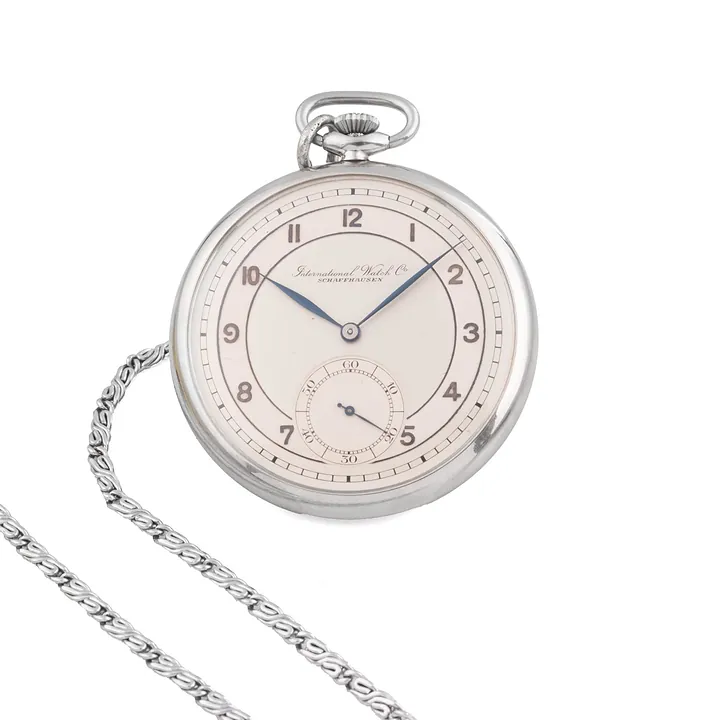
Pocket Watches · c. 1950
IWC Pocket Watch, c. 1950
Antiquorum auction archive, Geneva
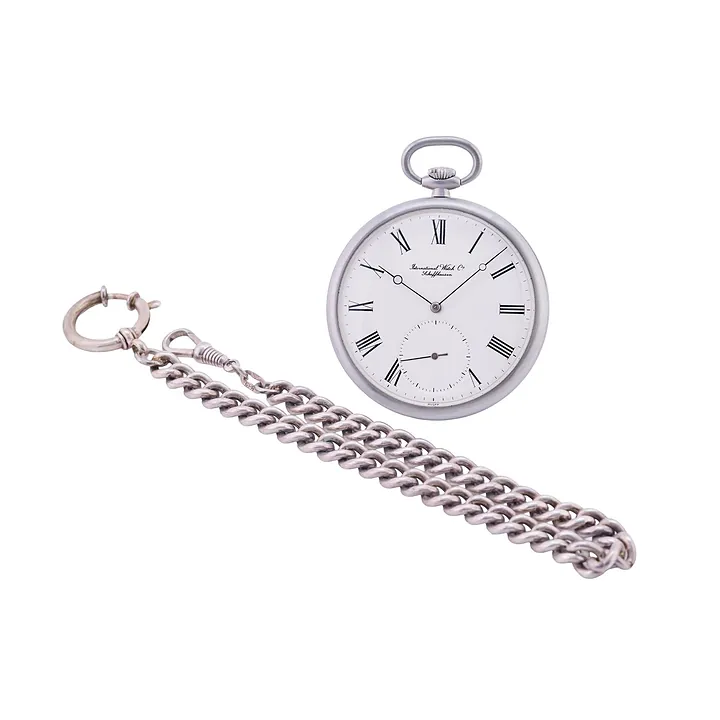
Pocket Watches · c. 1980
IWC pocket watch, ref. 5301, c. 1980
Antiquorum auction archive, Geneva
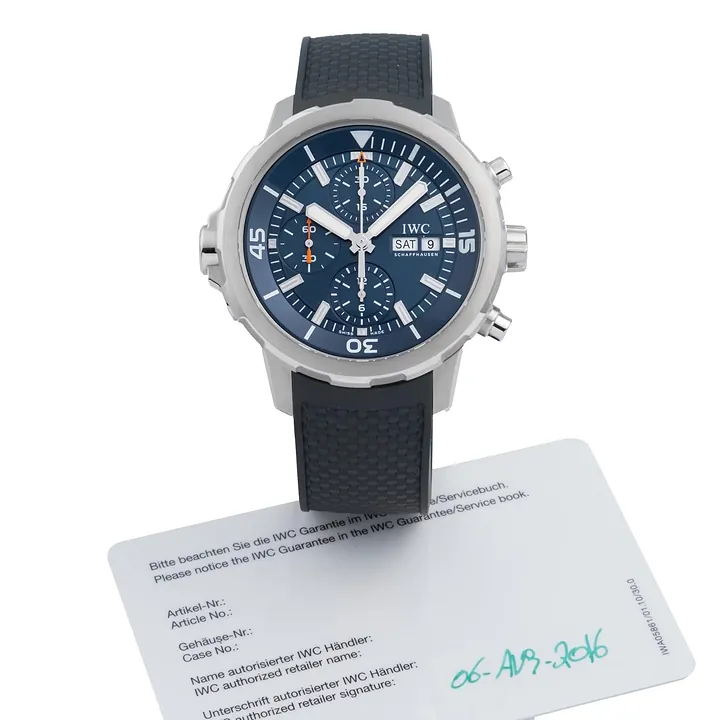
Wristwatches · originally sold in April 2016 (per the lot record)
IWC Aquatimer Chronograph Cousteau, ref. IW3768, originally sold in April 2016
Antiquorum auction archive, Geneva
Wristwatches · c. 2010s
IWC wristwatch, ref. IW371918, Aquatimer, circa 2010s
Antiquorum auction archive, Geneva

Wristwatches · 2008
Wristwatch by Breitling?, 2008
Museum Rotterdam

Wristwatches · c. 1990s
Audemars Piguet Bamboo, c. 1990s
Antiquorum auction archive, Geneva

Wristwatches · c. 1990
Audemars Piguet Huitieme Perpetual Calendar, ref. 25696PT, c. 1990
Antiquorum auction archive, Geneva

Wristwatches · c. 1990
Breitling Chronomat, ref. b13050.1, c. 1990
Antiquorum auction archive, Geneva