
Wristwatches · Wristwatch
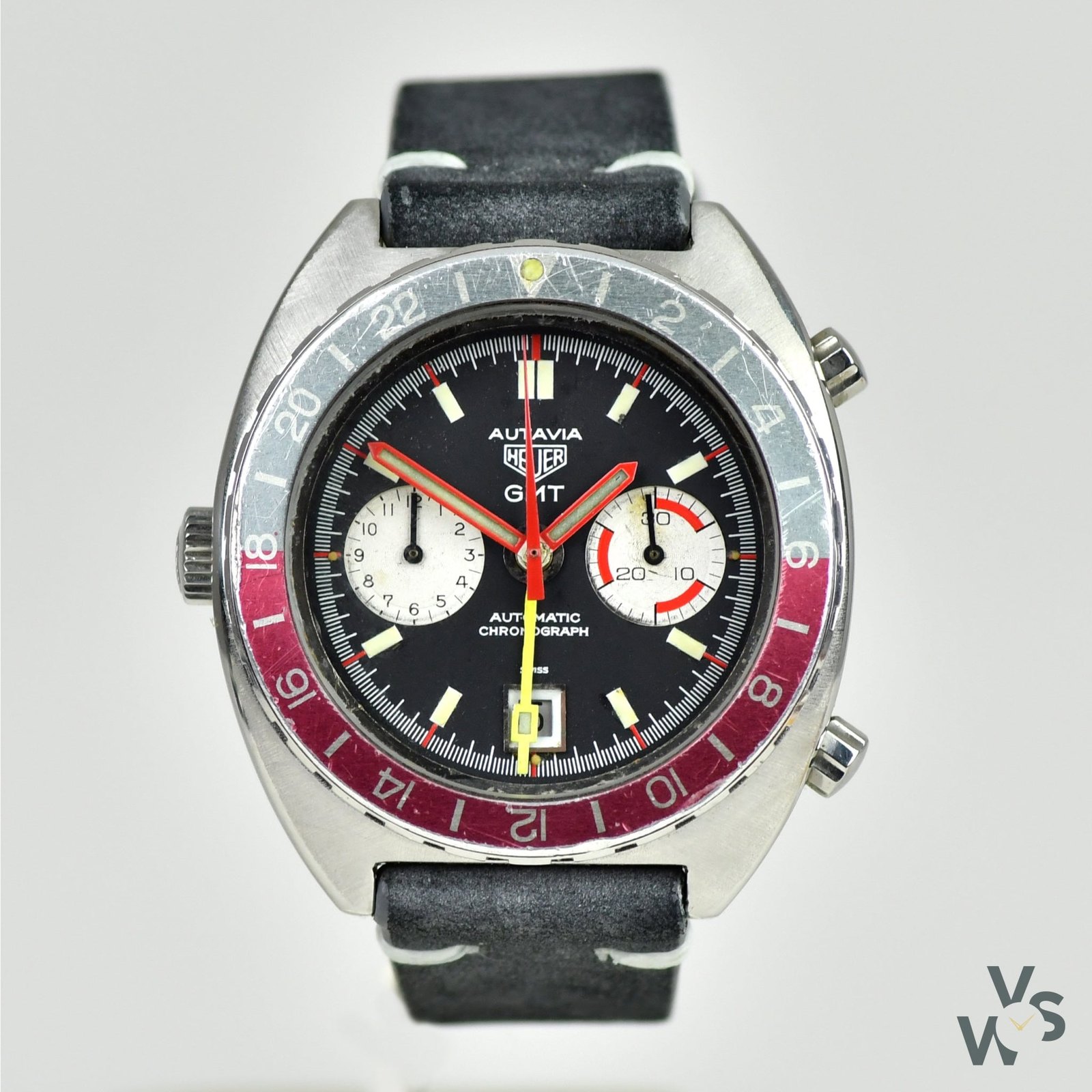
Heuer ‘Autavia’ GMT Automatic, Chronograph Wrist Watch, ref. 11630, circa 1970s
- Maker / attribution
- Heuer (maker)
- Date
- c. 1970s
- Historical period
- Quartz Revolution (1969 – 1990)
- Country of origin
- Switzerland
- Object type
- Wristwatch
- Dimensions
- Case 42 mm
- Stock no.
- vws1185cs
- Credit line
- Dealer listing, Vintage Watch Specialist (vws1185cs)
- Catalogue title (original)
- Heuer - ‘Autavia’ GMT Automatic - Chronograph Wrist Watch - Ref: 11630 - c.1970s ***SOLD*** (English)
View the source record (dealer listing) ↗ (opens another website in a new tab)Suggest a correction
Record summary
Catalogued by Vintage Watch Specialist (dealer), United Kingdom (stock number vws1185cs), this is a wristwatch by Heuer, made in Switzerland, dated c. 1970s. The Atlas places it in the Quartz Revolution period (1969 – 1990) of its Wristwatches collection. Recorded dimensions: Case 42 mm. The record is illustrated with 5 photographs.
Assembled from the source record's structured fields. Dates and attributions are given as the source states them; where a field is missing the Atlas leaves it blank rather than estimating.
Catalogue description
Dealer description — Vintage Watch Specialist
We Are Sorry But This Watch Is Now Sold - If However You Are Looking To Buy Or Sell Something Similar Then Please Email Sales@Vintagewatchspecialist.Com Or Whatsapp/Call +44 7831 454658. Thanks Pre-Owned Vintage Heuer ‘Autavia’ GMT Automatic Chronograph Wrist Watch. 11630. c.1970s. The Heuer ‘Autavia’ is one of the iconic brand’s ‘big three’ watches, alongside the ‘Carrera’ and the ‘Monaco’ (with over 200 variations of these models produced between 1962 and the mid-1980’s.) While the Carrera has the racing name and the Monaco is evocative of both Formula One and the 24 hours of Le Mans, the Autavia was historically the chronograph worn most often by famous motor car racers, with Formula One champions Mario Andretti and Jochen Rindt both wearing mechanical Autavias in the late 1960s. The Heuer Autavia Viceroy was so successful that the brand continued producing the model, with the same features and aesthetics, even after the partnership ended in 1972. The new version had a new reference number - 11630 - and it’s a GMT version of this model that’s on sale here. This large, chunky and unashamedly masculine timepiece has a rotating two-tone 'Pepsi' bezel in blue ( now beautifully faded to grey ) and red and features a fourth hand, added to the centre pinion to provide the GMT function. This fourth GMT hand may not be set or adjusted independently of the main hour hand, but shows the same time, expressed on a 24-hour basis using the bezel. The wearer rotates the two-tone bezel to show the correct time in a second time zone, with the GMT hand pointing to the 24-hour time on the bezel. The watch also features two white chronograph sub-dials on the black dial, two chronograph pushers at the right hand side of the casing and a square date aperture at 6! This piece is sold as it came to us on an unbranded, period steel bracelet ,but Vintage Watch Specialist will also supply this piece with a new leather strap in your colour choice, if preferred at no additional cost. What’s on offer: This watch will be supplied with one of our leather Specialist Watch travel/storage pouches as featured on our site and in our photo's. The overall condition of the piece is very good, the case having being polished over years by the look of it and with a slight patina to the sub dials and a few micro blemishes and some fantastic fading to the bezel which do not harm the overall look and in our opinion only add vintage character to the watch! This piece is supplied on a period stainless steel bracelet and a leather strap in your colour choice, if preferred. Overall the watch is in great condition. Additional information Made from Case: Stainless steel. Dial: Black reverse Panda. Crystal: Sapphire Crystal. Bracelet : Period stainless steel link. Technical specifications Winding: Self-winding. Movement type : Automatic. Calibre : Automatic Buren calibre 14 movement. Jewels: 17. Waterproof : when new. Power reserve: Purchase details Condition: Very good overall, with a slight patina to the sub dials and a few micro blemishes on the case and bracelet - 7/10 Model Reference Number: 11630. Date of issue : 1970s. Guarantee Supplied with a 12-month Vintage Watch Specialist guarantee. Dimensions Width: 42mm. Lug width : 20mm. Lug height (lug to lug) : 47mm Wrist size : Adjustable.
Historical context
Quartz Revolution (1969 – 1990)
Seiko's Astron begins mass quartz timekeeping; traditional industries contract sharply.
Quartz and digital watches transformed the market after 1969. Swiss employment collapsed, Japanese and Hong Kong production soared, and the Swatch (1983) helped the Swiss industry recover; mechanical watches survived as luxury goods.
Read the period in the timelineMore wristwatches from this periodEarlier: Modern Mechanical Horology
Atlas type guide
Chronographs and split-seconds watches
A chronograph is a watch with an additional seconds hand that can be started, stopped and returned to zero independently of the timekeeping. Louis Moinet built an early example in 1816 and Nicolas Rieussec a recording 'chronographe' in 1821; Adolphe Nicole's heart-shaped reset cam (patented 1862) made the modern return-to-zero possible. Split-seconds (rattrapante) chronographs add a second hand that can be stopped for intermediate times; flyback chronographs restart instantly.
Chronographs were essential tools for doctors (pulsometer scales), artillery (telemeter), engineers and sport. In wristwatches, Valjoux, Venus, Lemania and later the automatic chronographs of 1969 (Zenith El Primero, the Chronomatic Calibre 11 group and Seiko 6139) are milestones.
What to look for
- Push-pieces on the case band or a single button in the crown (monopusher).
- Subsidiary registers for minutes and hours; tachymeter, telemeter or pulsometer scales.
- Column wheel versus cam control visible in the movement.
- Calibre markings of specialist makers (Valjoux, Lemania, Venus, Landeron).
Dating clues
- Pocket chronographs with heart cam reset: after 1862.
- Wrist chronographs: from c. 1910; two-button designs from the 1930s.
- Automatic chronographs: from 1969.
General guidance written by the Atlas editors about this kind of object. It is not a statement about this particular piece; for that, rely on the source record above and on physical examination.
Read next:Flyback chronographChronograph
Related records
Pocket Watches · c. 1960
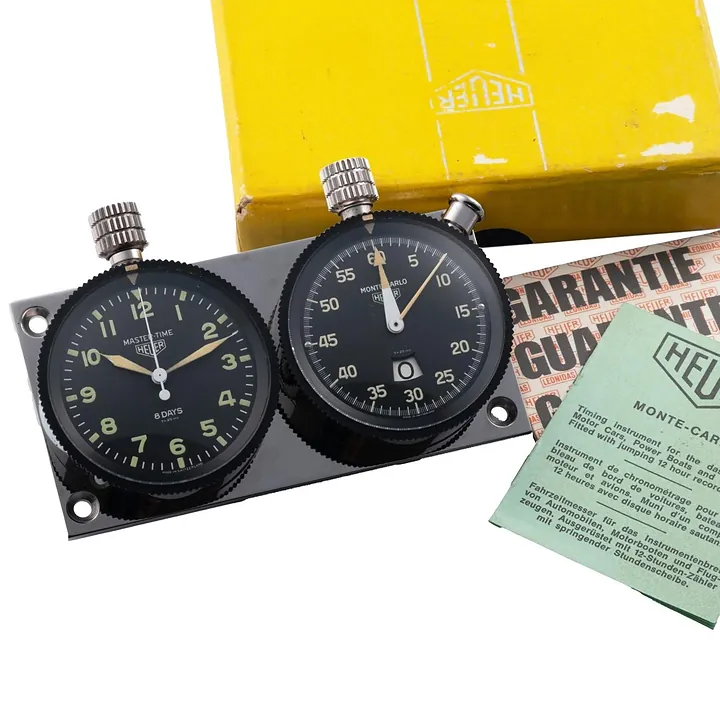
Heuer Racing SET, c. 1960
Antiquorum auction archive, Geneva
Wristwatches · c. 1980
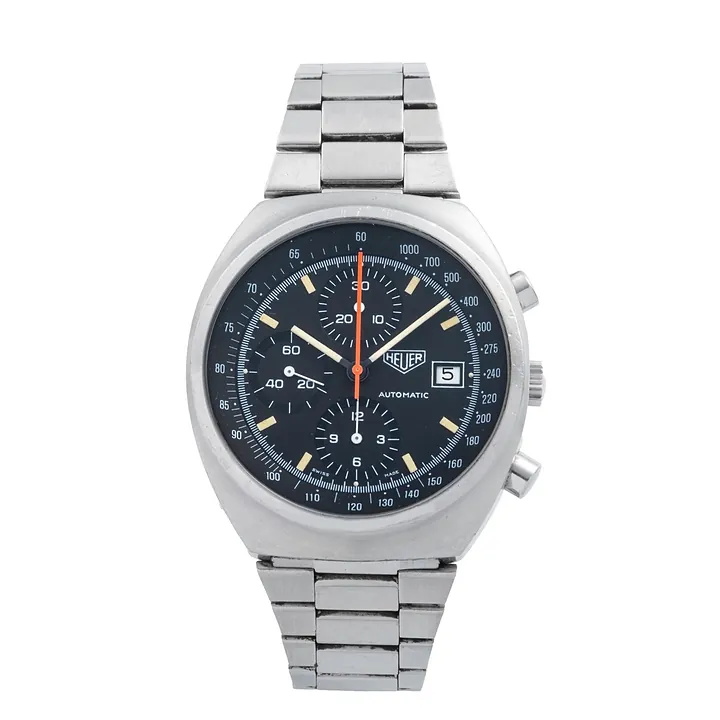
Heuer Pasadena, ref. 750.501-3, c. 1980
Antiquorum auction archive, Geneva
Wristwatches · c. 1970s
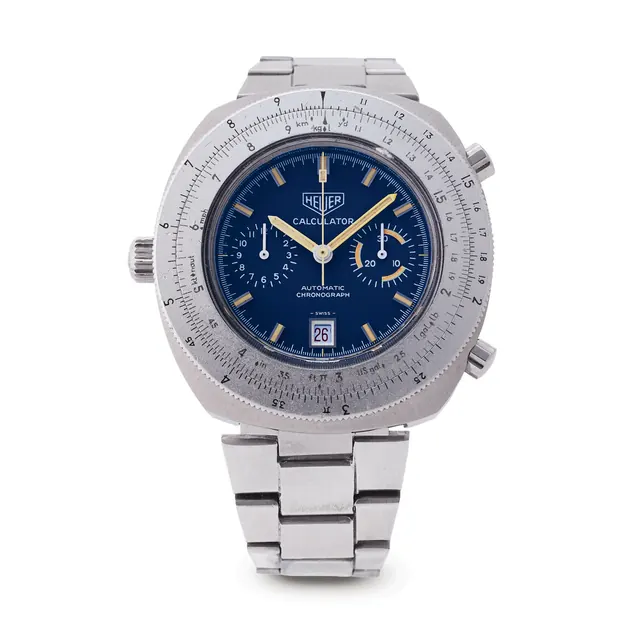
Heuer wristwatch, ref. 110.633, Calculator, circa 1970s
Antiquorum auction archive, Geneva
Wristwatches · c. 1975
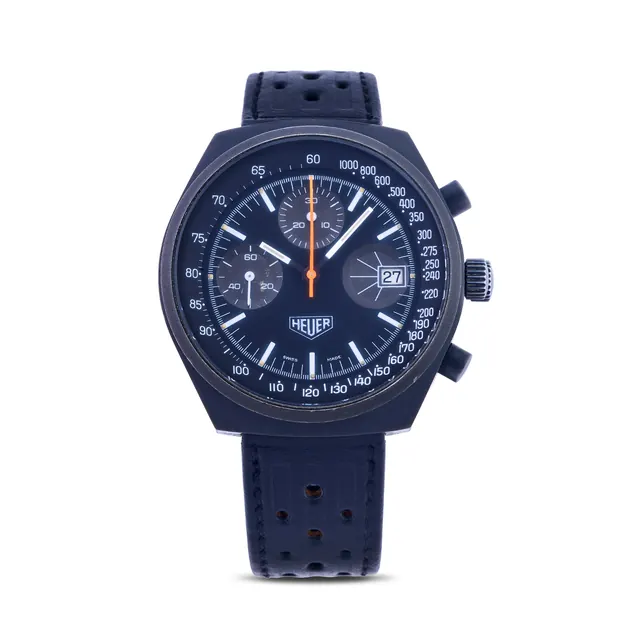
Heuer wristwatch, ref. 13/1, circa 1975
Antiquorum auction archive, Geneva

Wristwatches · 1970
Wristwatch by Heno, Switzerland, 1970
Museum Rotterdam

Wristwatches · 1960–1986
'Tri-Compax' calendar chronograph wristwatch in gold case, by Universal, Geneva, Switzerland, 1960–1986.
Science Museum Group, London

Wristwatches · 1969–1970
Beta 21 Quartz wristwatch movement, made in Switzerland, 1970.
Science Museum Group, London

Wristwatches · c. 1969
Omega Speedmaster Moonwatch, ref. 145022-69st, c. 1969
Antiquorum auction archive, Geneva