
Wristwatches · Wristwatch
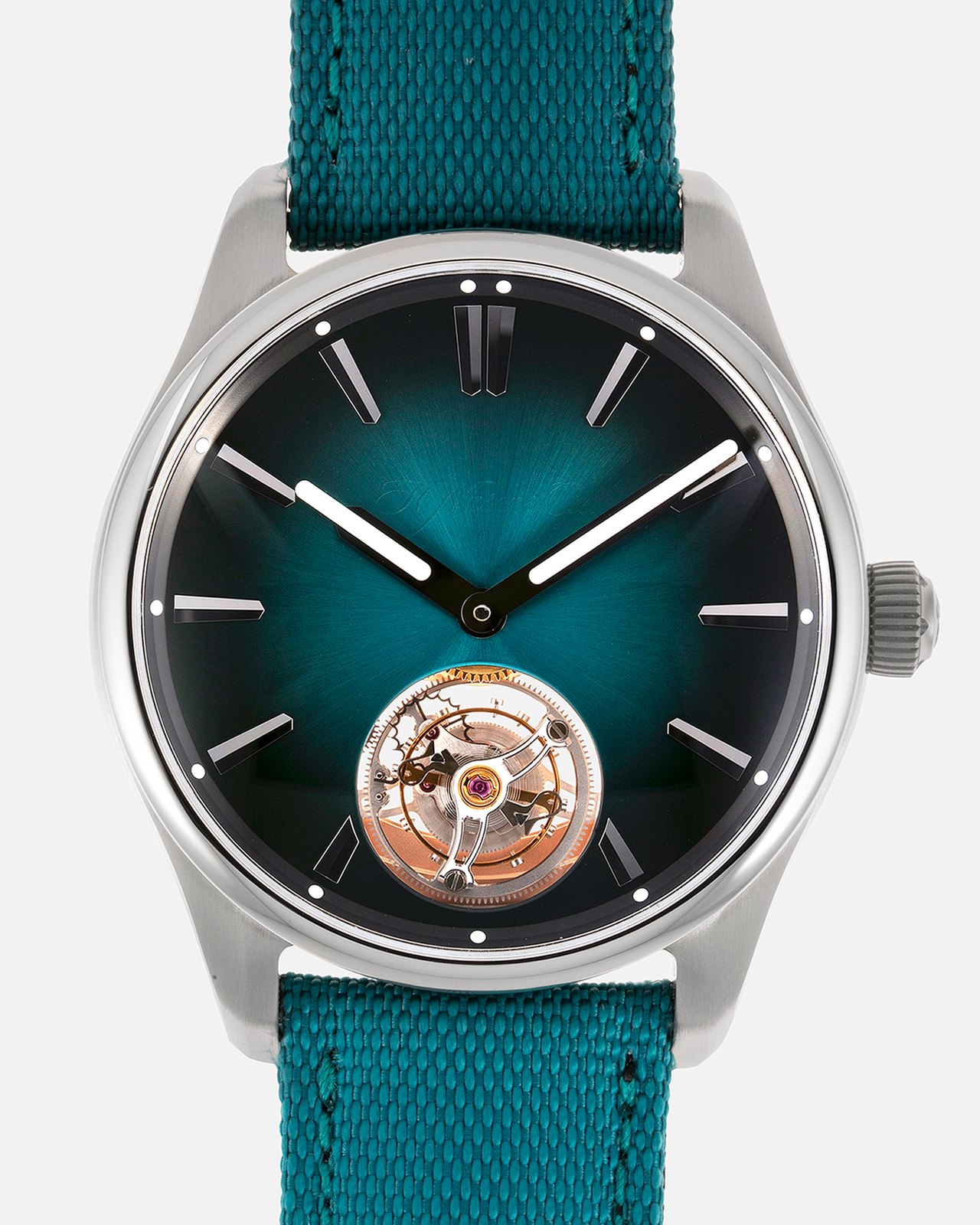
H.Moser & Cie Pioneer Tourbillon Blue Lagoon 'Mega Cool', 2013
- Maker / attribution
- H. Moser & Cie (maker)
- Date
- 2013
- Historical period
- Contemporary Horology (2010 – Present)
- Country of origin
- Switzerland
- Object type
- Wristwatch
- Dimensions
- Case 42.8 mm
- Stock no.
- Product 6811423834199
- Credit line
- Dealer listing, S.Song Watches (product 6811423834199)
- Catalogue title (original)
- H.Moser & Cie Pioneer Tourbillon Blue Lagoon 'Mega Cool' (English)
View the source record (dealer listing) ↗ (opens another website in a new tab)Suggest a correction
Record summary
Catalogued by S.Song Watches (dealer), Seattle (stock number Product 6811423834199), this is a wristwatch by H. Moser & Cie, made in Switzerland, dated 2013. The Atlas places it in the Contemporary Horology period (2010 – Present) of its Wristwatches collection. Recorded dimensions: Case 42.8 mm. The record is illustrated with 6 photographs.
Assembled from the source record's structured fields. Dates and attributions are given as the source states them; where a field is missing the Atlas leaves it blank rather than estimating.
Catalogue description
Dealer description — S.Song Watches
H. Moser & Cie is an independent watch brand that has become known as the enfant terrible of the Swiss watchmaking industry. Quite a polarising brand, they made their name initially creating beautiful elegant timepieces but in the last few years, they have really become a force to reckon with introducing satire into their watchmaking, with pieces such as the one-off ‘Swiss Cheese’ watch and ‘Apple’ watch. I for one think this is refreshing that a brand is taking an active stand to criticize and create a commentary on the Swiss watch industry, especially as it comes from a brand with a very strong pedigree. First of all, let’s talk about the elephant in the room, which is undoubtedly the name of the watch we are offering here today – the Pioneer Tourbillon ‘Mega Cool’, limited to 50 pieces. The CEO of Moser – Eduard Meylan, once said in an interview that the name arose organically when some of the other Moser employees caught a sneak peek of the watch during development, and it literally just got coined as is. I personally thought this was a very fitting move considering the personality of the brand as a whole. The case of the Pioneer Tourbillon is crafted in steel and measures 42.8mm x 10.8mm (excluding the sapphire crystal) in size. It features a screw-down crown, 120m of water resistance, and some very tasteful alternating polished and brushed finishing across all surfaces. In my opinion, this gives the Pioneer Tourbillon a very sporty aesthetic and personality. If you follow the brand close enough, I think it is no surprise that Moser makes one of the best fumé dials in the industry, period. There is a very mesmeric quality about the fumé dials made by Moser and the dial on the Pioneer Tourbillon is no different, because during my time with it, I found myself constantly staring at the fumé dial instead of actually looking at the time. Dubbed the Blue Lagoon, the dial evokes the color of turquoise waters of island lagoons under different shades of lighting. This is mainly attributed to the sunburst gradient which complements the emerald green tone as it radiates from the center of the dial. In other words, this watch screams of summer. The dial also adorns the Moser logo at 12 o ‘clock in transparent lacquer, a very discrete and tasteful touch. At the 6 o ‘clock position, you will find the glorious one-minute flying tourbillon that is traversed by a skeletonized bridge for maximum visual appeal and viewing pleasure. As far as movement is concerned, it houses an in-house automatic HMC 804 with a patented double hairspring, which is also produced in-house. It guarantees timekeeping precision by regulating positional errors and by reducing the effect of friction typically found in single hairspring configurations. The HMC 804 also features a respectable 72-hour power reserve. Another ingenious feature of the Pioneer Tourbillon is the modularity of its tourbillon. Yes, you heard that right. The tourbillon escapement can actually be easily extracted from its cage, which makes servicing and maintenance much easier. I love Moser, for what they stand for in the watchmaking industry as a whole, and for always being unapologetically true to themselves when it comes to modern watch design. Yes, this may not be full avant-garde like many other modern independent watch brands that are available in the market today, but I personally think Moser has found a niche of its own in this highly saturated watch market, and a way to offer a complicated watch that can actually be worn under very typical and normal circumstances- like on a holiday while sipping margaritas at the pool. In a nutshell, this watch is indeed a very cool one. It is, in fact, Mega Cool.
Historical context
Contemporary Horology (2010 – Present)
Silicon components, connected watches, optical-lattice research clocks and a thriving independent scene.
Smartwatches became the world's best-selling watches, while mechanical watchmaking focuses on craft, innovation (silicon components, new escapements) and independent makers.
Read the period in the timelineMore wristwatches from this periodEarlier: Mechanical Renaissance
Atlas type guide
Wristwatches
Bracelet watches were worn by women from the early nineteenth century — Breguet made one for Caroline Murat, Queen of Naples, in 1810–12 — but the wristwatch only became a man's instrument with military use and aviation in the early twentieth century. Between the World Wars it overtook the pocket watch; the 1920s and 1930s brought rectangular Art Deco cases, water-resistant cases and the first automatic winding systems.
After 1945 the wristwatch became a carrier of identity — dress watches, sports and dive watches, chronographs, calendars — produced by Swiss, American, Japanese, German, Soviet and Chinese industries. The quartz revolution after 1969 and the mechanical renaissance since the 1990s, including the rise of independent watchmakers, complete the story.
What to look for
- The reference number (between the lugs or inside the case back) and serial number, the starting point for dating.
- The calibre: its maker and number are often stamped under the dial or on the bridge.
- Originality of dial, hands and crown — refinished ('redial') dials are common.
- Case material marks: 18K/750, 14K/585, stainless steel, gold-filled, plated.
Dating clues
- Wire-lug cases: before c. 1925.
- Water-resistant screw-down cases: from 1926.
- Quartz movements: from 1969; sapphire crystals widespread after c. 1980.
General guidance written by the Atlas editors about this kind of object. It is not a statement about this particular piece; for that, rely on the source record above and on physical examination.
Related records
Wristwatches · originally sold in 2021 (per the lot record)
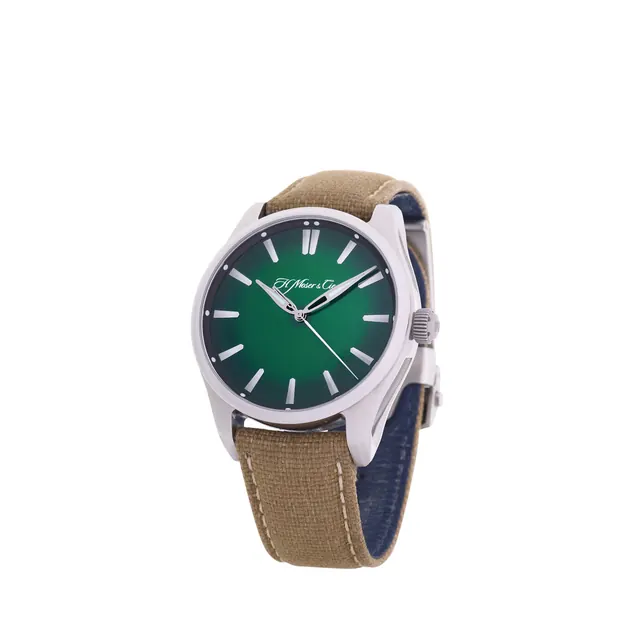
H. Moser & Cie wristwatch, ref. 3200.1202, Pionner, originally sold in 2021
Antiquorum auction archive, Geneva
Wristwatches · c. 2016
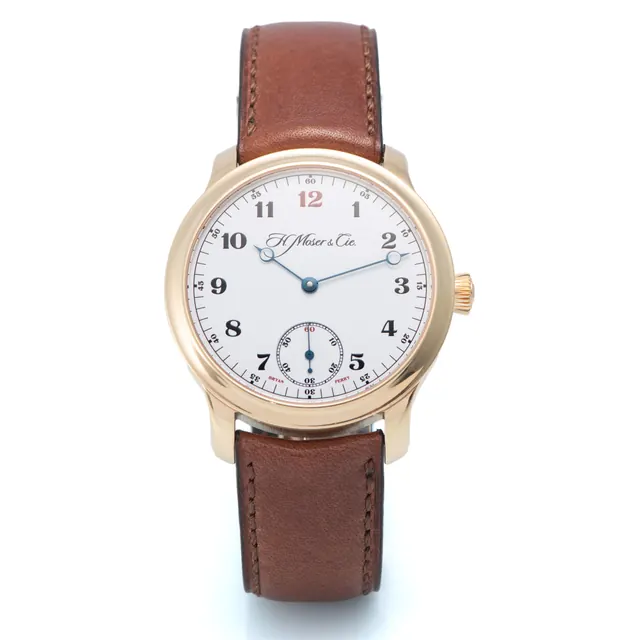
H. Moser & Cie wristwatch, ref. 1321-0116, Endeavour Limited Brian Ferry Edition of 100 Pieces, circa 2016
Antiquorum auction archive, Geneva
Pocket Watches · c. 1910
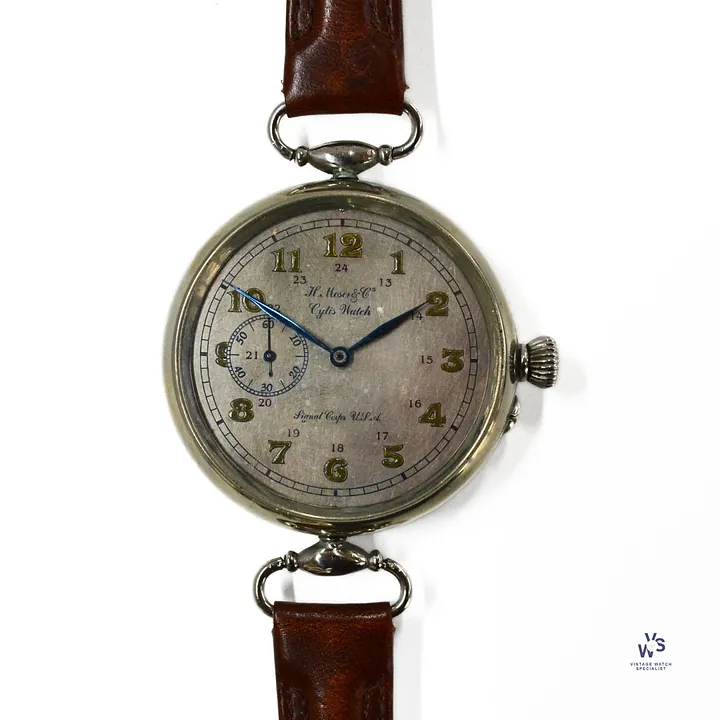
H.Moser & Cie, Cylis Watch, US Signal Corps, Pocket Watch Conversion, circa 1910
Vintage Watch Specialist (dealer), United Kingdom
Wristwatches · 2025
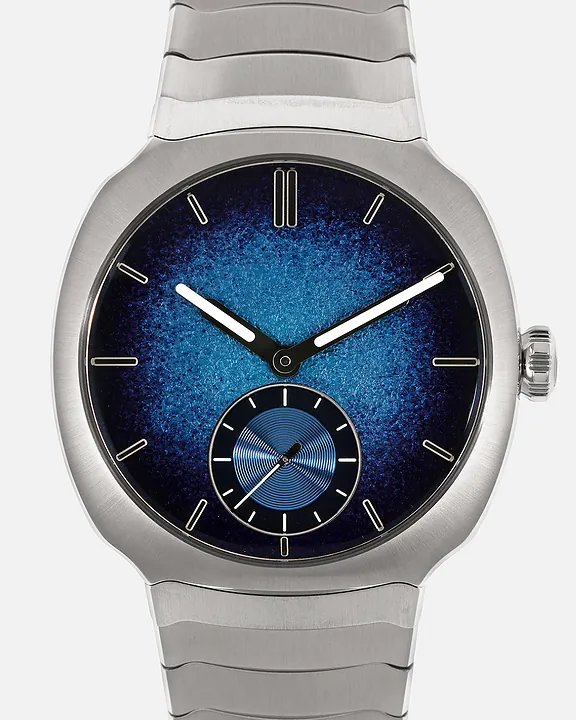
H. Moser & Cie Streamliner Small Seconds Blue Enamel 6500-1200, 2025
S.Song Watches (dealer), Seattle

Wristwatches · c. 2010s
Breguet Type XXI, ref. 3810, c. 2010s (Antiquorum Lot 381-24)
Antiquorum auction archive, Geneva

Wristwatches · c. 2010s
Breguet Type XXI, ref. 3810, c. 2010s (Antiquorum Lot 386-229)
Antiquorum auction archive, Geneva

Wristwatches · Sold in September 2010
Breitling Cosmonaute, ref. A 22322, Sold in September 2010
Antiquorum auction archive, Geneva

Wristwatches · c. 2010
Corum Bubble Chrono, ref. 396.150.20, c. 2010
Antiquorum auction archive, Geneva