
Wristwatches · Wristwatch
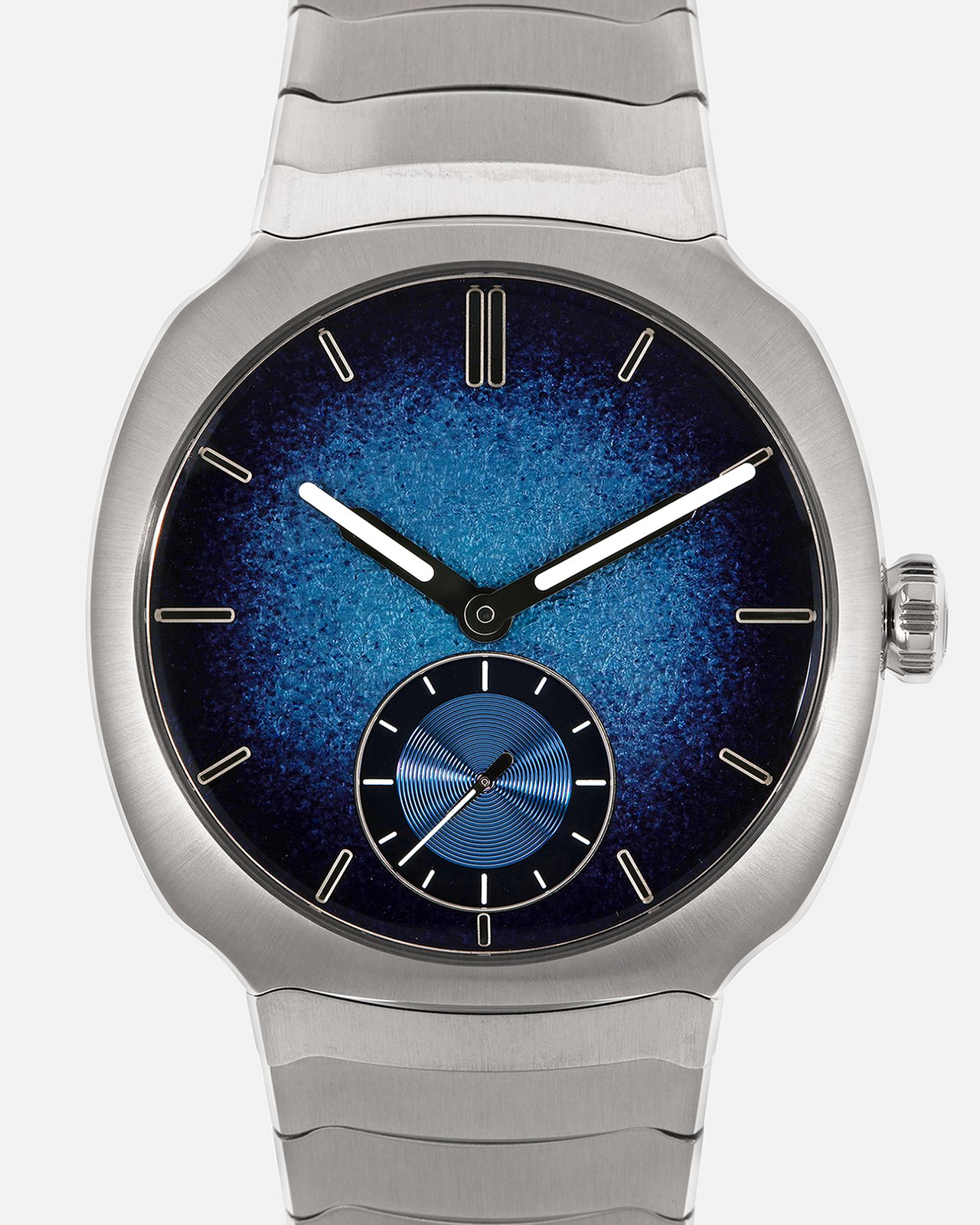
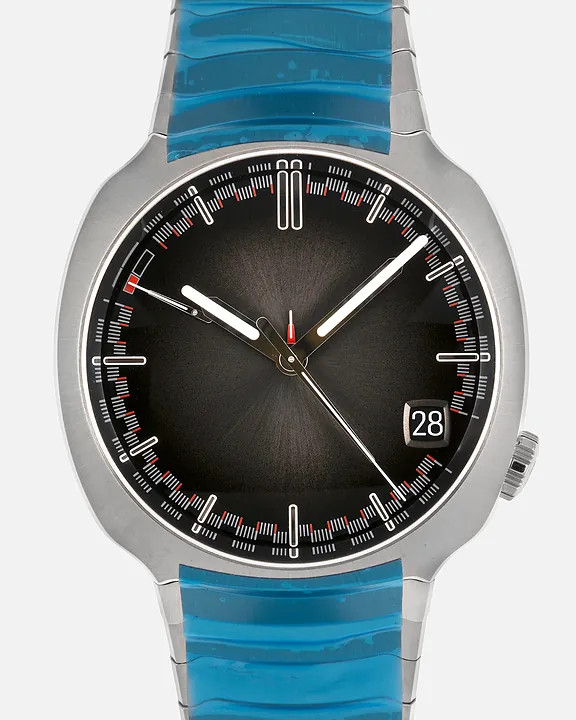
H. Moser & Cie Streamliner Small Seconds Blue Enamel 6500-1200, 2025
- Maker / attribution
- H. Moser & Cie (maker)
- Date
- 2025
- Historical period
- Contemporary Horology (2010 – Present)
- Country of origin
- Switzerland
- Object type
- Wristwatch
- Dimensions
- Case 39 mm
- Stock no.
- Product 7626614440023
- Credit line
- Dealer listing, S.Song Watches (product 7626614440023)
- Catalogue title (original)
- H. Moser & Cie Streamliner Small Seconds Blue Enamel 6500-1200 (English)
View the source record (dealer listing) ↗ (opens another website in a new tab)Suggest a correction
Record summary
Catalogued by S.Song Watches (dealer), Seattle (stock number Product 7626614440023), this is a wristwatch by H. Moser & Cie, made in Switzerland, dated 2025. The Atlas places it in the Contemporary Horology period (2010 – Present) of its Wristwatches collection. Recorded dimensions: Case 39 mm. The record is illustrated with 6 photographs.
Assembled from the source record's structured fields. Dates and attributions are given as the source states them; where a field is missing the Atlas leaves it blank rather than estimating.
Catalogue description
Dealer description — S.Song Watches
In recent years, we’ve witnessed an influx of brands presenting their takes on the ‘70s sports watch with an integrated bracelet, often relying on familiar design cues and predictable variations. It is also one of the most important categories for a modern watch brand to get right, sitting at the intersection of everyday wearability, design identity, and commercial relevance, which explains why competition in this space is so fierce. Yet for all the activity, few recent entries have felt genuinely distinctive. Moser’s Streamliner was a rare exception from the moment it appeared in 2020. Rather than heavily leaning onto nostalgia, it introduced a new silhouette defined by a sculpted cushion case and a fluid integrated bracelet whose rounded links flow almost like a continuous band of steel, an aesthetic that is loosely inspired by the aerodynamic streamliner trains of the early twentieth century. The watch offered here today, the H. Moser Streamliner Small Seconds Blue Enamel 6500-1200, remains one of the most compelling expressions of that idea. Let me start by saying that the Streamliner is perhaps one of the best examples of how thoughtful innovation can breathe life into a category many consider stagnant. Having previously handled and offered a Streamliner Perpetual Calendar, when this watch first arrived at our office, I was immediately struck by how far Moser had refined the blueprint. As expected from a Streamliner, the case design is simply sublime. The softly sculpted cushion profile avoids the sharp angles typically associated with integrated bracelet sports watches, favouring instead smooth, flowing surfaces that transition seamlessly into the bracelet. The result is a silhouette that feels both modern and unmistakably Moser. Measuring at only 39mm x 10.9mm, the Streamliner wears exceptionally well, striking a rare balance between presence and restraint. On the wrist, it feels compact, refined, and extremely comfortable, particularly for smaller wrists, while the bracelet remains one of the most comfortable in the category. All of this leads naturally to what is arguably the watch’s centrepiece, the grand feu enamel dial. Speaking of the dial, the Aqua Blue hammered fumé “Grand Feu” enamel is another highlight of this reference. Grand feu enamel is among the most traditional and demanding dial techniques in watchmaking, where powdered glass pigments are applied and repeatedly fired in a kiln at extremely high temperatures until they fuse into a glossy, permanent surface. Here, the process begins with a gold dial blank that is first stamped with a grain pattern designed to evoke a hand-hammered finish, giving the dial its distinctive underlying texture. From there, three different pigments are meticulously applied, and the dial is fired roughly twelve times to achieve the signature fumé gradient. The resulting colour, named ‘Aqua Blue’, evokes the bubbling depth of a deep body of water, shifting subtly from a rich centre to darker edges depending on the light. As is typical of Moser, the dial layout itself remains remarkably restrained yet highly legible. A small seconds display sits at 6:00 with a subtle radial-circular inner pattern, adding a touch of texture without disrupting the overall balance. That sense of minimalism speaks volumes about Moser’s design philosophy. In fact, they do not even place their logo on the dial, yet even from afar, the watch remains instantly recognizable as a Moser, which says a great deal about how distinctive the Streamliner DNA has become. Powering the watch from within is Moser’s in-house HMC Cal. 500, the brand’s first automatic calibre featuring a platinum micro-rotor. It delivers a 74-hour power reserve and, in this execution, the bridges are partially skeletonised to reveal more of the gear train beneath, giving the movement a sleeker feel than one might expect from a simple time-only movement. The darker anthracite-toned finish complements the Streamliner’s sportier character. Like most Moser calibres, the finishing leans toward clean, industrial precision rather than ornate decoration. The bevels along the bridges are machine-cut, creating crisp edges that may show light machining marks under close inspection, while the platinum micro-rotor itself features slightly softer, more refined beveling. At the end of the day, Moser remains a brand collectors admire for staying unapologetically true to its own design language. In a segment that often leans heavily on familiar ‘70s references, the Streamliner still manages to feel genuinely original while delivering everything you’d want from a modern integrated bracelet sports watch. What makes this reference particularly interesting is the stark contrast in its character, pairing an ornate grand feu enamel dial with the clean, sculpted lines of a sporty case and an integrated bracelet. It’s an unlikely combination on paper, yet Moser has executed it remarkably well. All things considered, this is easily one of their most handsome sports watch offerings to date.
Historical context
Contemporary Horology (2010 – Present)
Silicon components, connected watches, optical-lattice research clocks and a thriving independent scene.
Smartwatches became the world's best-selling watches, while mechanical watchmaking focuses on craft, innovation (silicon components, new escapements) and independent makers.
Read the period in the timelineMore wristwatches from this periodEarlier: Mechanical Renaissance
Atlas type guide
Wristwatches
Bracelet watches were worn by women from the early nineteenth century — Breguet made one for Caroline Murat, Queen of Naples, in 1810–12 — but the wristwatch only became a man's instrument with military use and aviation in the early twentieth century. Between the World Wars it overtook the pocket watch; the 1920s and 1930s brought rectangular Art Deco cases, water-resistant cases and the first automatic winding systems.
After 1945 the wristwatch became a carrier of identity — dress watches, sports and dive watches, chronographs, calendars — produced by Swiss, American, Japanese, German, Soviet and Chinese industries. The quartz revolution after 1969 and the mechanical renaissance since the 1990s, including the rise of independent watchmakers, complete the story.
What to look for
- The reference number (between the lugs or inside the case back) and serial number, the starting point for dating.
- The calibre: its maker and number are often stamped under the dial or on the bridge.
- Originality of dial, hands and crown — refinished ('redial') dials are common.
- Case material marks: 18K/750, 14K/585, stainless steel, gold-filled, plated.
Dating clues
- Wire-lug cases: before c. 1925.
- Water-resistant screw-down cases: from 1926.
- Quartz movements: from 1969; sapphire crystals widespread after c. 1980.
General guidance written by the Atlas editors about this kind of object. It is not a statement about this particular piece; for that, rely on the source record above and on physical examination.
Related records
Wristwatches · originally sold in 2021 (per the lot record)
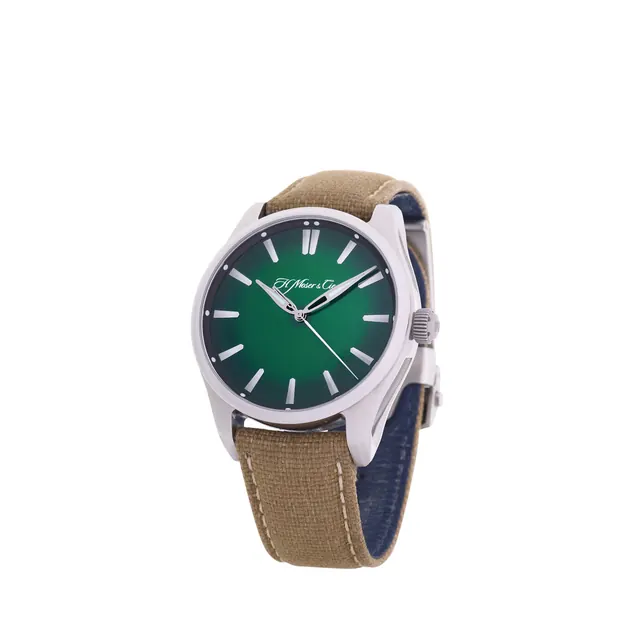
H. Moser & Cie wristwatch, ref. 3200.1202, Pionner, originally sold in 2021
Antiquorum auction archive, Geneva
Wristwatches · c. 2016
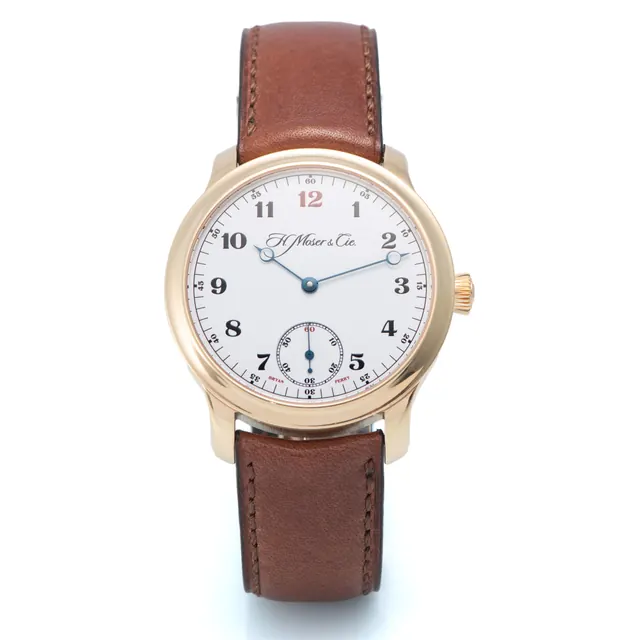
H. Moser & Cie wristwatch, ref. 1321-0116, Endeavour Limited Brian Ferry Edition of 100 Pieces, circa 2016
Antiquorum auction archive, Geneva
Pocket Watches · c. 1910
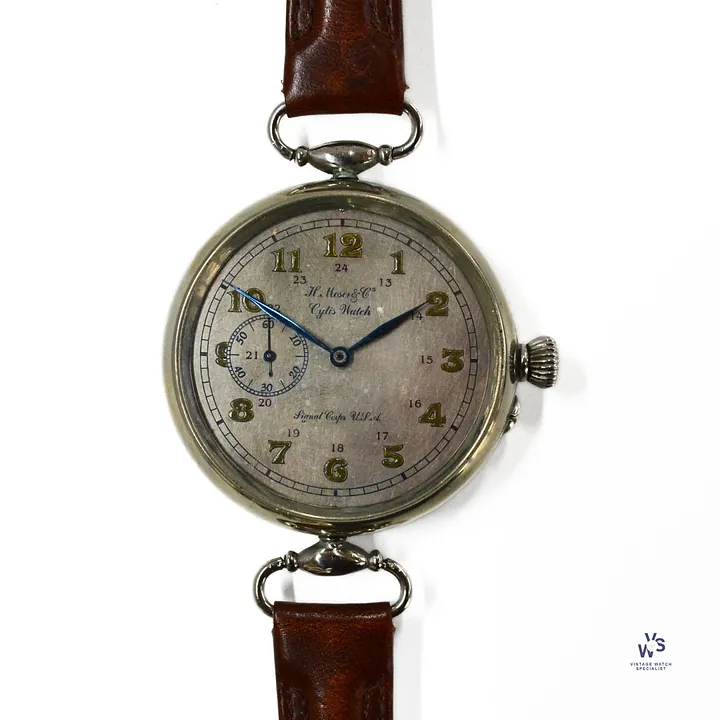
H.Moser & Cie, Cylis Watch, US Signal Corps, Pocket Watch Conversion, circa 1910
Vintage Watch Specialist (dealer), United Kingdom
Wristwatches · 2022
H.Moser & Cie Streamliner Perpetual Calendar, 2022
S.Song Watches (dealer), Seattle

Wristwatches · c. 2010s
Breguet Type XXI, ref. 3810, c. 2010s (Antiquorum Lot 381-24)
Antiquorum auction archive, Geneva

Wristwatches · c. 2010s
Breguet Type XXI, ref. 3810, c. 2010s (Antiquorum Lot 386-229)
Antiquorum auction archive, Geneva

Wristwatches · Sold in September 2010
Breitling Cosmonaute, ref. A 22322, Sold in September 2010
Antiquorum auction archive, Geneva

Wristwatches · c. 2010
Corum Bubble Chrono, ref. 396.150.20, c. 2010
Antiquorum auction archive, Geneva