
Wristwatches · Wristwatch
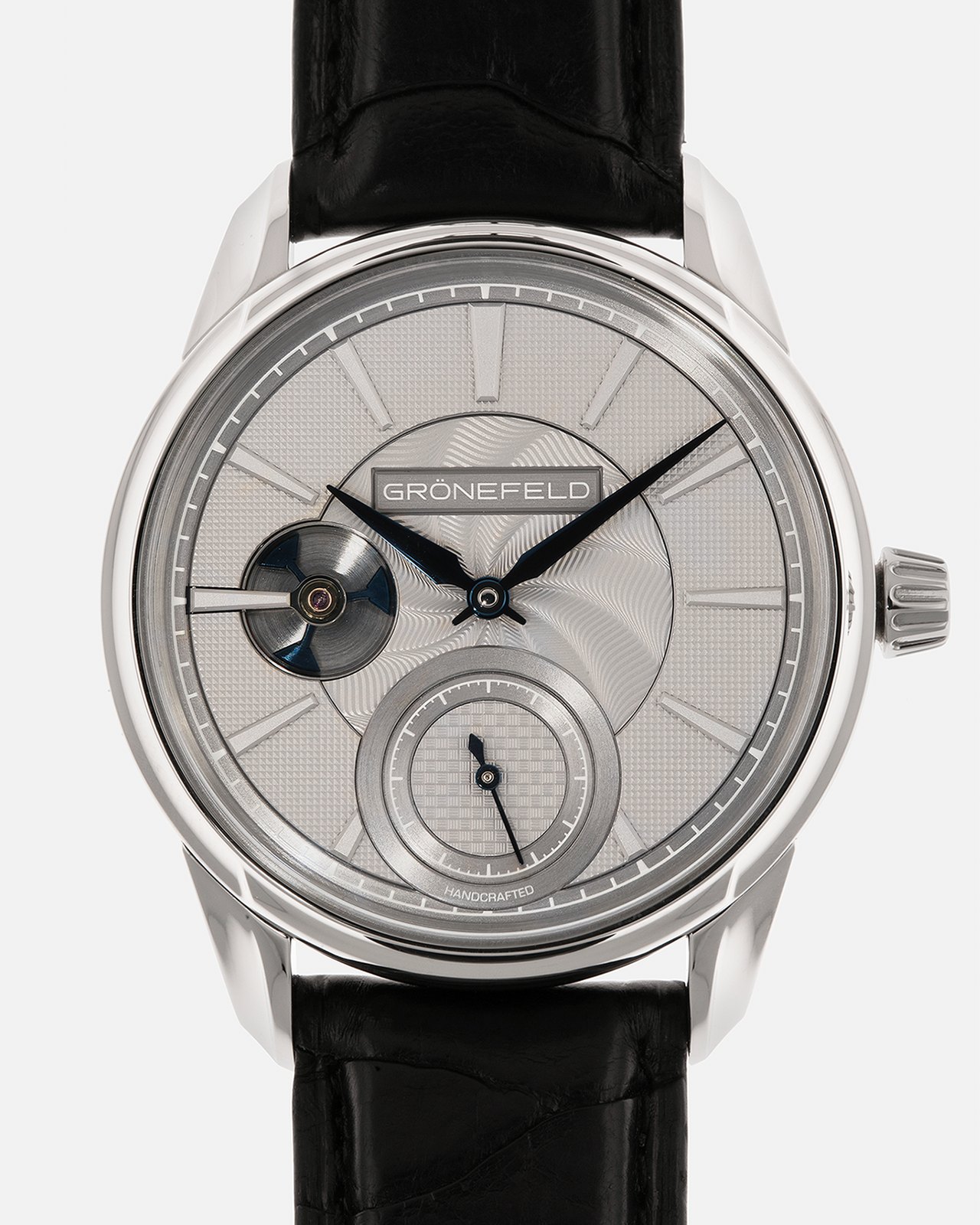
Gronefeld 1941 Remontoire Stainless Steel Piece Unique, 2022
- Maker / attribution
- Grönefeld (maker)
- Date
- 2022
- Historical period
- Contemporary Horology (2010 – Present)
- Country of origin
- Unrecorded in source
- Object type
- Wristwatch
- Materials / technique
- stainless steel
- Dimensions
- Case 39.5 mm
- Stock no.
- Product 7568829644887
- Credit line
- Dealer listing, S.Song Watches (product 7568829644887)
- Catalogue title (original)
- Gronefeld 1941 Remontoire Stainless Steel Piece Unique (English)
View the source record (dealer listing) ↗ (opens another website in a new tab)Suggest a correction
Record summary
Catalogued by S.Song Watches (dealer), Seattle (stock number Product 7568829644887), this is a wristwatch by Grönefeld, dated 2022. The Atlas places it in the Contemporary Horology period (2010 – Present) of its Wristwatches collection. Materials and techniques recorded by the source: stainless steel. Recorded dimensions: Case 39.5 mm. The record is illustrated with 6 photographs.
Assembled from the source record's structured fields. Dates and attributions are given as the source states them; where a field is missing the Atlas leaves it blank rather than estimating.
Catalogue description
Dealer description — S.Song Watches
For those who are unfamiliar, Grönefeld is an independent watch brand that epitomises the essence of a true watch connoisseur's brand, helmed by two horological brothers , Tim and Bart, who hail from a lineage of watchmakers spanning three generations. Raised in the Dutch town of Oldenzaal, their upbringing was deeply steeped in the craft of watchmaking, with their father and grandfather, Sjef and Johan Grönefeld, both seasoned watchmakers operating a workshop in St. Plechelmus. It was there that they maintained the town’s church clock, which notably featured a remontoire mechanism. This very mechanism serves as the foundational inspiration for the watch we are excited to be able to offer today—the 1941 Remontoire. As for its name, '1941 Remontoire' pays homage to their father, Sjef, born in 1941. Before we delve further, for those unfamiliar with the remontoire mechanism (or remontoir d'egalité) , it is perhaps one of the most elegant techniques in watchmaking, guaranteeing a consistent and ample supply of force to the escapement in a watch or clock movement. Originating from the French word ' remonter ', meaning 'to wind', a remontoire typically presents itself in the form of a secondary wheel that intermittently re-winds itself using energy derived from the mainspring nestled within the movement. Starting with the 1941 Remontoire’s beautifully sculpted 39.5mm stainless steel case, it is alone an exceptional work of art. While it may appear like any other conventional watch case from a distance, upon closer inspection, its exceptional craftsmanship is revealed. There is a subtle concave recess on the bezel between 1:30 and 4:30, as well as between 7:30 and 10:30. This design feature allows the case profile to seamlessly harmonize with the convex surfaces of the lugs, which lends the case a strong and futurist appearance. What makes this example particularly intriguing is that it was commissioned as a pièce unique , with a beautiful dial produced by Kari Voutilainen’s dial maker, Coblémine. It features a radiant triple-sector silver dial decorated with a tasteful combination of three distinct guilloché styles: clous de Paris (hobnail) on the main outer sector, a soleil (sunburst) motif in the middle, and a panier croisé (basketweave) on the sub-dial. The interplay of these patterns reflects light beautifully, creating a stunning visual effect when viewed under direct lighting. The hours and minutes are elegantly indicated at the centre by a pair of extended Lancette hands, accompanied by a small seconds sub-dial with a thermally-blued hand at 6:00. Positioned at 9:00 is the 'speed governor’, serving to regulate the pace at which the gears rotate when the remontoire hairspring is rewound, precisely every eight seconds. As a bespoke execution, this example has its governor heat blued, and it also omits the “Eight Seconds Remontoire” text typically found above the small seconds sub-dial. When you flip over the 1941 Remontoire, you'll quickly notice that Grönefeld didn't solely concentrate on the front. Nestled within its stainless steel case is the in-house, manual-winding Grönefeld Cal. G-05, powering this mechanical masterpiece. What struck me most about the movement is its immersive visual presentation beneath the sapphire caseback—it is both visually stunning and technically impressive. The Cal. G-05 carries a 35-hour power reserve when fully wound and consists of 258 individual components meticulously working together whilst showcasing an array of top-notch finishing techniques. The stainless steel bridges, reminiscent of the facades of Dutch houses (also called ‘bell gables’), offer a clever and subtle nod to the brothers' Dutch roots. Limited to just 188 pieces across all metal variations, the Grönefeld 1941 Remontoire is an extraordinary timepiece, defined by a movement crafted for purists and the most discerning collectors. This particular example, however, is made even more compelling by its status as a pièce unique within that run, setting it apart from an already scarce production.
Historical context
Contemporary Horology (2010 – Present)
Silicon components, connected watches, optical-lattice research clocks and a thriving independent scene.
Smartwatches became the world's best-selling watches, while mechanical watchmaking focuses on craft, innovation (silicon components, new escapements) and independent makers.
Read the period in the timelineMore wristwatches from this periodEarlier: Mechanical Renaissance
Atlas type guide
Wristwatches
Bracelet watches were worn by women from the early nineteenth century — Breguet made one for Caroline Murat, Queen of Naples, in 1810–12 — but the wristwatch only became a man's instrument with military use and aviation in the early twentieth century. Between the World Wars it overtook the pocket watch; the 1920s and 1930s brought rectangular Art Deco cases, water-resistant cases and the first automatic winding systems.
After 1945 the wristwatch became a carrier of identity — dress watches, sports and dive watches, chronographs, calendars — produced by Swiss, American, Japanese, German, Soviet and Chinese industries. The quartz revolution after 1969 and the mechanical renaissance since the 1990s, including the rise of independent watchmakers, complete the story.
What to look for
- The reference number (between the lugs or inside the case back) and serial number, the starting point for dating.
- The calibre: its maker and number are often stamped under the dial or on the bridge.
- Originality of dial, hands and crown — refinished ('redial') dials are common.
- Case material marks: 18K/750, 14K/585, stainless steel, gold-filled, plated.
Dating clues
- Wire-lug cases: before c. 1925.
- Water-resistant screw-down cases: from 1926.
- Quartz movements: from 1969; sapphire crystals widespread after c. 1980.
General guidance written by the Atlas editors about this kind of object. It is not a statement about this particular piece; for that, rely on the source record above and on physical examination.
Related records
Wristwatches · 2010
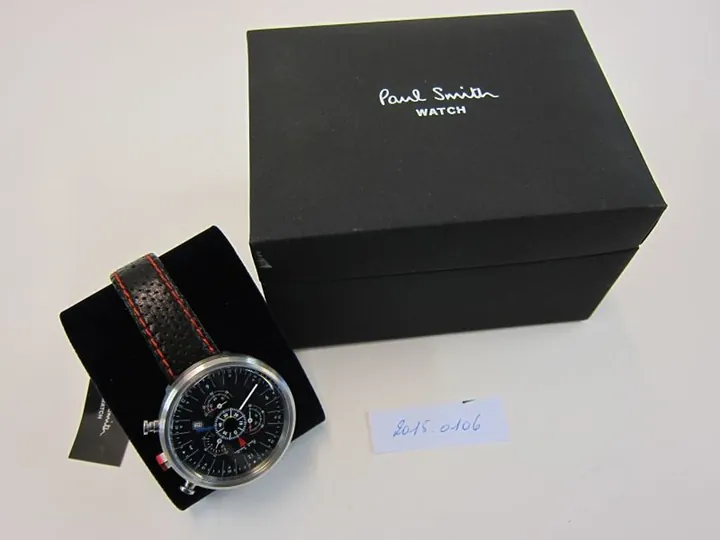
Wristwatch, 2010
Modemuseum Hasselt
Wristwatches · 2018 (Series 4 released in September 2018; '1977' in the source is the model number A1977)
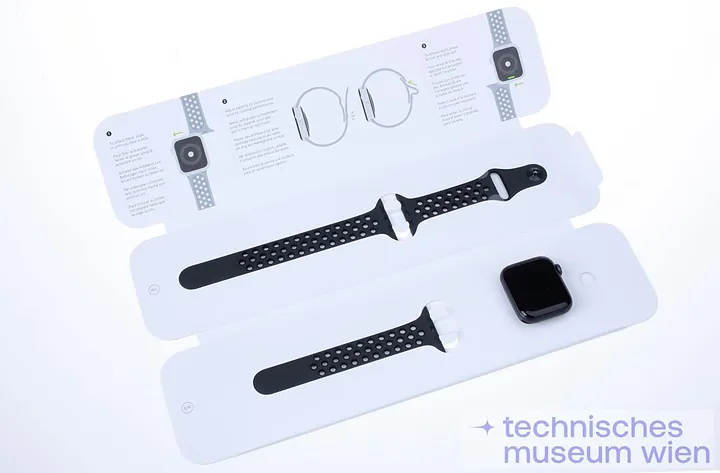
Apple Watch Series 4 (GPS, 40 mm, model A1977), 2018
Vienna Museum of Science and Technology
Wristwatches · c. 2010s
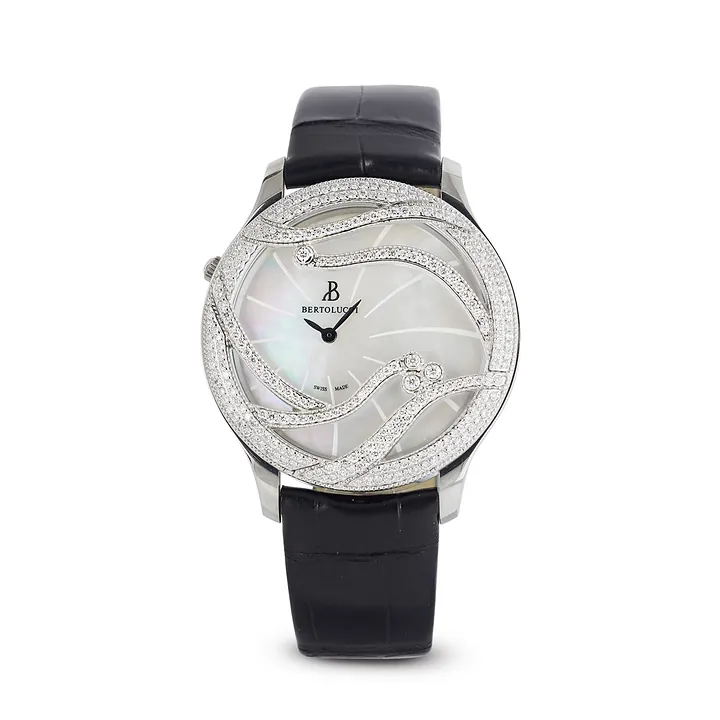
Bertolucci Stria III, ref. 11513.50.45.B88.6C1.501, c. 2010s
Antiquorum auction archive, Geneva
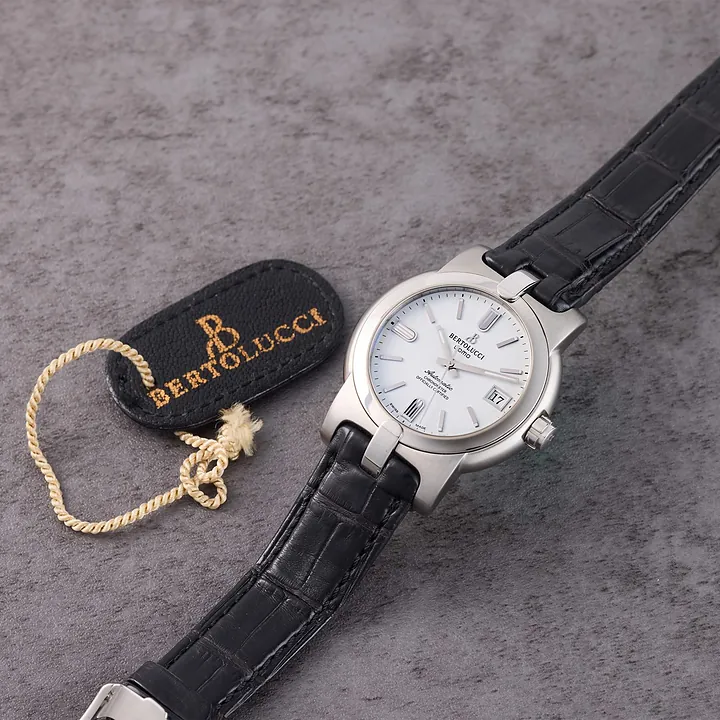
Wristwatches · c. 2010s
Bertolucci Uoma, ref. 824.51.41.10B, c. 2010s
Antiquorum auction archive, Geneva

Wristwatches · c. 2010s
Breguet Type XXI, ref. 3810, c. 2010s (Antiquorum Lot 381-24)
Antiquorum auction archive, Geneva

Wristwatches · c. 2010s
Breguet Type XXI, ref. 3810, c. 2010s (Antiquorum Lot 386-229)
Antiquorum auction archive, Geneva

Wristwatches · Sold in September 2010
Breitling Cosmonaute, ref. A 22322, Sold in September 2010
Antiquorum auction archive, Geneva
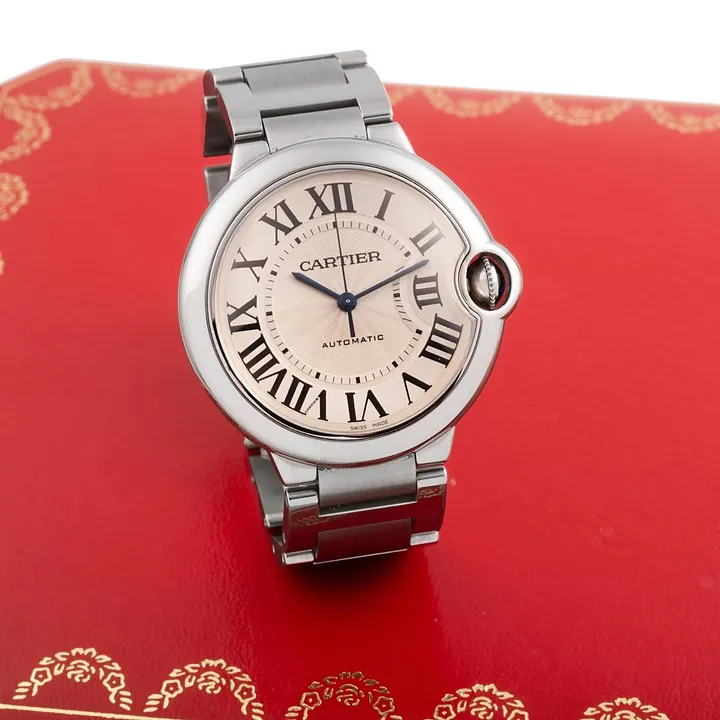
Wristwatches · c. 2010s
Cartier Ballon Bleu, ref. 3284, c. 2010s
Antiquorum auction archive, Geneva