
Wristwatches · Wristwatch
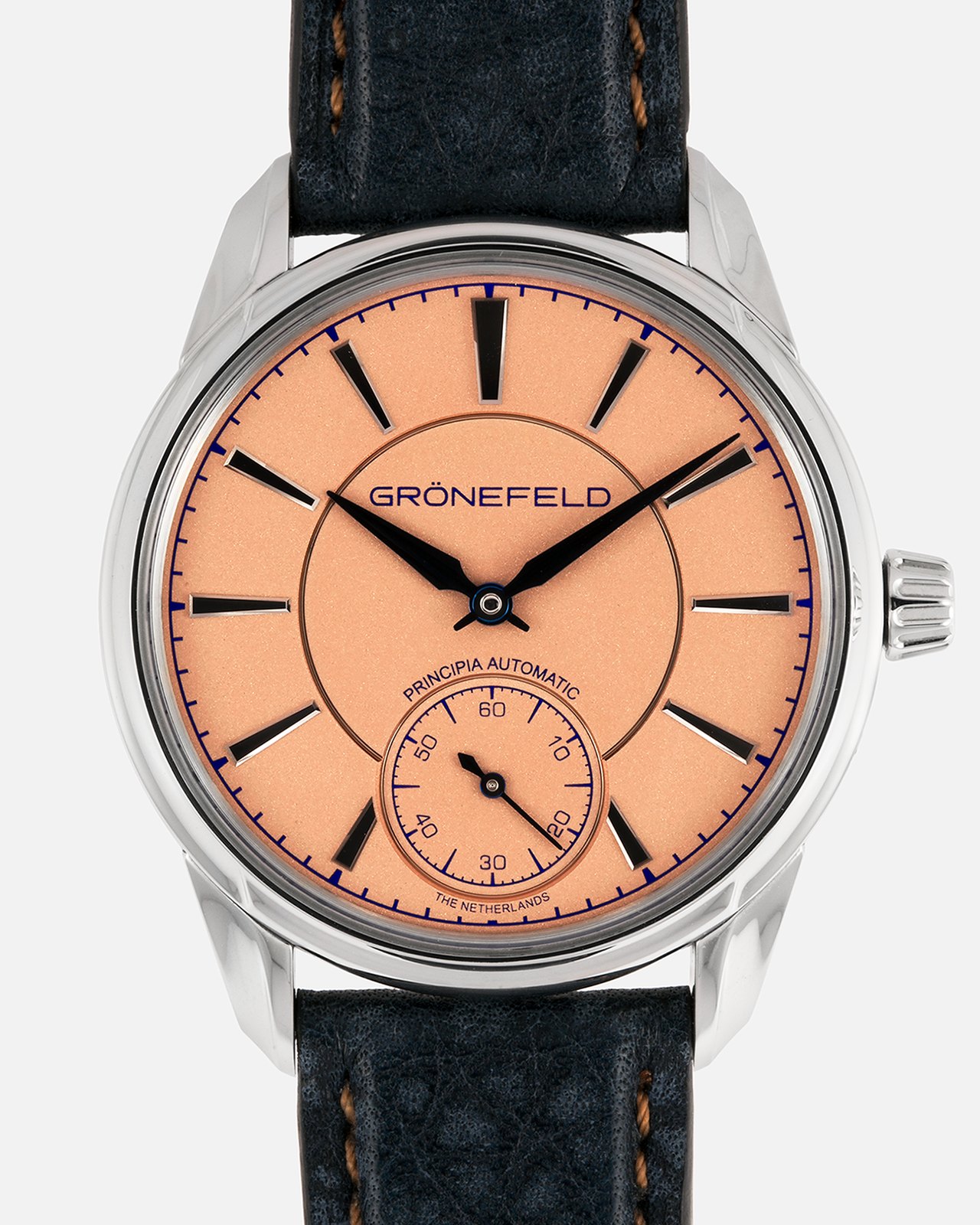
Grönefeld 1941 Principia Salmon, 2022
- Maker / attribution
- Unrecorded in source
- Date
- 2022
- Historical period
- Contemporary Horology (2010 – Present)
- Country of origin
- Unrecorded in source
- Object type
- Wristwatch
- Dimensions
- Case 39.5 mm
- Stock no.
- Product 7773272703063
- Credit line
- Dealer listing, S.Song Watches (product 7773272703063)
- Catalogue title (original)
- Grönefeld 1941 Principia Salmon (English)
View the source record (dealer listing) ↗ (opens another website in a new tab)Suggest a correction
Record summary
Catalogued by S.Song Watches (dealer), Seattle (stock number Product 7773272703063), this is a wristwatch, dated 2022. The Atlas places it in the Contemporary Horology period (2010 – Present) of its Wristwatches collection. Recorded dimensions: Case 39.5 mm. The record is illustrated with 6 photographs.
Assembled from the source record's structured fields. Dates and attributions are given as the source states them; where a field is missing the Atlas leaves it blank rather than estimating.
Catalogue description
Dealer description — S.Song Watches
Founded by Dutch brothers Bart and Tim Grönefeld, Grönefeld has established itself as one of the most respected names in contemporary independent watchmaking. Coming from three generations of watchmakers, the brothers combine traditional hand-finishing with a distinctive approach to movement and case construction that has made their watches immediately recognisable. Introduced in 2018, the 1941 Principia marked an important moment for Grönefeld as the brothers’ first self-winding watch. While the brand is perhaps better known for technically ambitious pieces such as the 1941 Remontoire and Parallax Tourbillon, the Principia strips things back to the essentials of hours, minutes and small seconds, placing the emphasis firmly on proportion, finishing and everyday wearability. The watch takes its name from Sir Isaac Newton’s Philosophiæ Naturalis Principia Mathematica , while the "1941" designation refers to the birth year of Bart and Tim’s father, Sjef Grönefeld. The Principia is housed within Grönefeld’s beautifully sculpted 1941 case, measuring 39.5mm in diameter and just 10.5mm thick. Executed here in stainless steel, the case is considerably more complex than it first appears, with a recessed bezel profile and deeply scalloped lugs flowing into the mid-case. The lugs themselves are individually attached using hidden titanium screws, allowing them to be removed for refinishing or replacement. This example is paired with arguably one of the most attractive configurations offered for the Principia, the salmon dial. Produced from a solid sterling silver base, the warm salmon tone is contrasted by faceted, mirror-polished applied indices and Grönefeld’s signature extended Lancette hands. The hands are flame-blued with mirror-polished centres, giving them an almost two-tone appearance as they catch the light. A recessed small seconds display at 6 o’clock completes what is otherwise an exceptionally clean and restrained dial. Turning the watch over reveals the in-house Calibre G-06, Grönefeld’s first automatic movement. Comprising 226 components and offering a 56-hour power reserve, the movement is dominated by its hand-finished 22-carat solid gold rotor. The movement architecture is unmistakably Grönefeld. Its stainless steel bridges take inspiration from the bell-gabled facades of traditional Dutch houses and are particularly challenging to finish due to the hardness of the material. Each bridge is hand-bevelled and polished, with micro-blasted centres and circular-grained upper surfaces, while several of the 31 jewels are set within solid gold chatons. The contrast between the steel bridges, gold chatons and ruthenium-plated mainplate makes the G-06 every bit as impressive visually as the more complicated movements produced by the brothers. The 1941 Principia is ultimately Grönefeld at its most straightforward. It is a simple automatic three-hander, but one executed with the same level of casework, movement architecture and hand-finishing found throughout the brothers’ far more complicated watches. In its stainless steel and salmon dial configuration, it is also one of the most attractive and versatile executions of the Principia.
Historical context
Contemporary Horology (2010 – Present)
Silicon components, connected watches, optical-lattice research clocks and a thriving independent scene.
Smartwatches became the world's best-selling watches, while mechanical watchmaking focuses on craft, innovation (silicon components, new escapements) and independent makers.
Read the period in the timelineMore wristwatches from this periodEarlier: Mechanical Renaissance
Atlas type guide
Wristwatches
Bracelet watches were worn by women from the early nineteenth century — Breguet made one for Caroline Murat, Queen of Naples, in 1810–12 — but the wristwatch only became a man's instrument with military use and aviation in the early twentieth century. Between the World Wars it overtook the pocket watch; the 1920s and 1930s brought rectangular Art Deco cases, water-resistant cases and the first automatic winding systems.
After 1945 the wristwatch became a carrier of identity — dress watches, sports and dive watches, chronographs, calendars — produced by Swiss, American, Japanese, German, Soviet and Chinese industries. The quartz revolution after 1969 and the mechanical renaissance since the 1990s, including the rise of independent watchmakers, complete the story.
What to look for
- The reference number (between the lugs or inside the case back) and serial number, the starting point for dating.
- The calibre: its maker and number are often stamped under the dial or on the bridge.
- Originality of dial, hands and crown — refinished ('redial') dials are common.
- Case material marks: 18K/750, 14K/585, stainless steel, gold-filled, plated.
Dating clues
- Wire-lug cases: before c. 1925.
- Water-resistant screw-down cases: from 1926.
- Quartz movements: from 1969; sapphire crystals widespread after c. 1980.
General guidance written by the Atlas editors about this kind of object. It is not a statement about this particular piece; for that, rely on the source record above and on physical examination.
Related records
Wristwatches · 2010
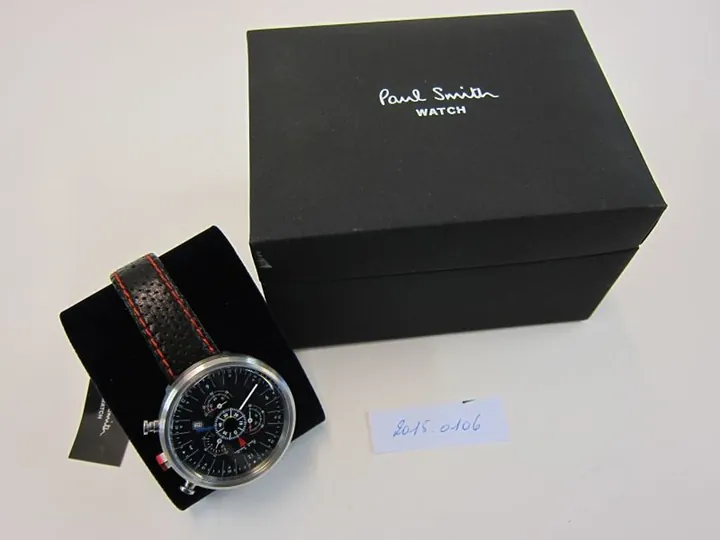
Wristwatch, 2010
Modemuseum Hasselt
Wristwatches · 2018 (Series 4 released in September 2018; '1977' in the source is the model number A1977)
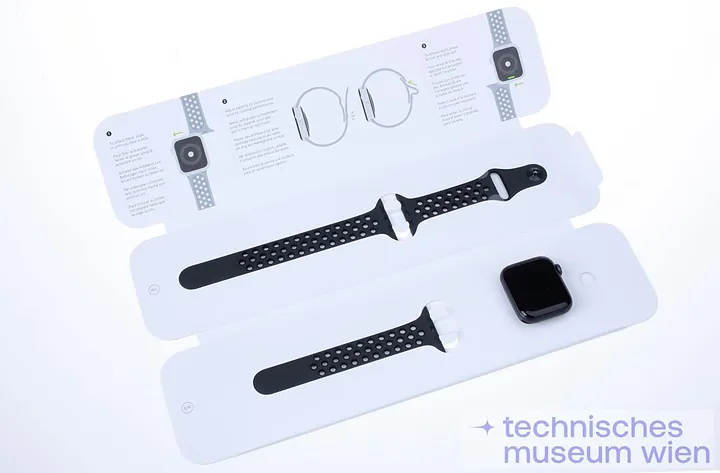
Apple Watch Series 4 (GPS, 40 mm, model A1977), 2018
Vienna Museum of Science and Technology
Wristwatches · c. 2010s
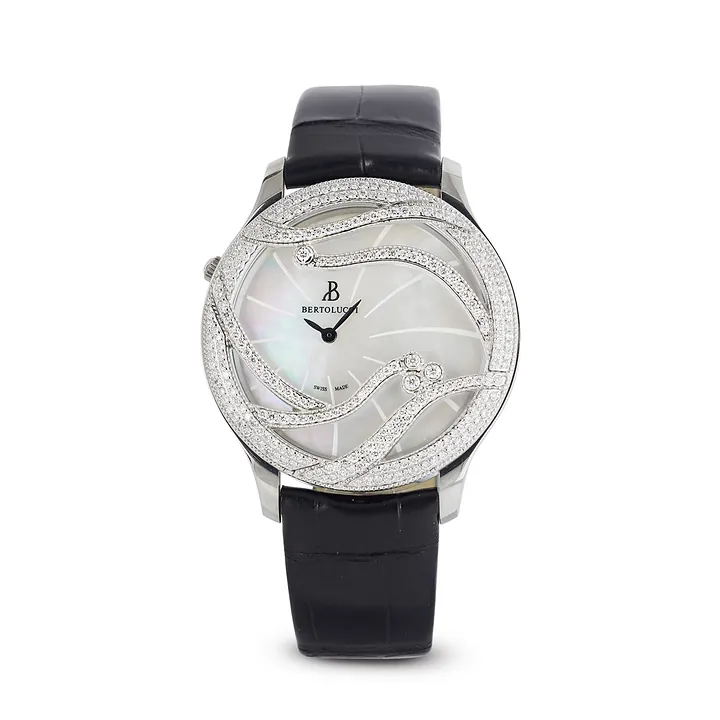
Bertolucci Stria III, ref. 11513.50.45.B88.6C1.501, c. 2010s
Antiquorum auction archive, Geneva
Wristwatches · c. 2010s
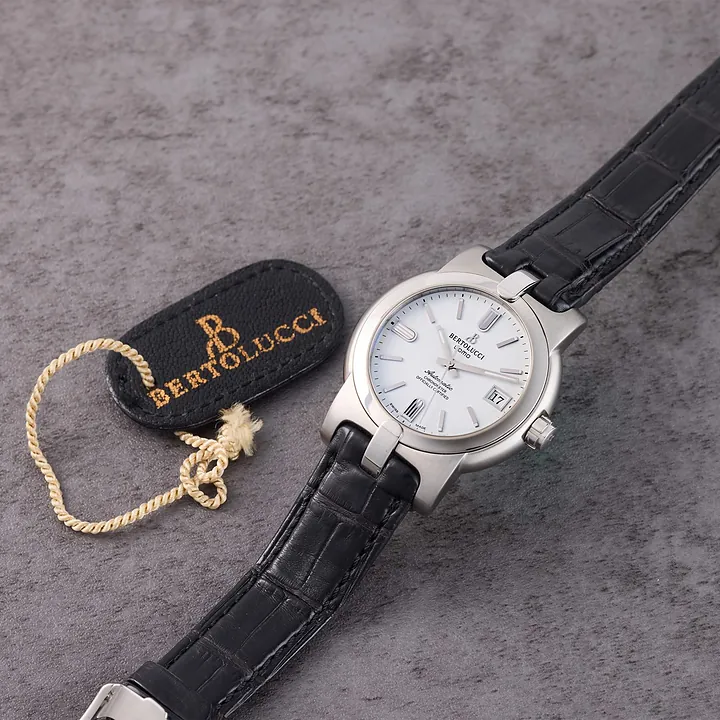
Bertolucci Uoma, ref. 824.51.41.10B, c. 2010s
Antiquorum auction archive, Geneva

Wristwatches · c. 2010s
Breguet Type XXI, ref. 3810, c. 2010s (Antiquorum Lot 381-24)
Antiquorum auction archive, Geneva

Wristwatches · c. 2010s
Breguet Type XXI, ref. 3810, c. 2010s (Antiquorum Lot 386-229)
Antiquorum auction archive, Geneva

Wristwatches · Sold in September 2010
Breitling Cosmonaute, ref. A 22322, Sold in September 2010
Antiquorum auction archive, Geneva
Wristwatches · c. 2010s
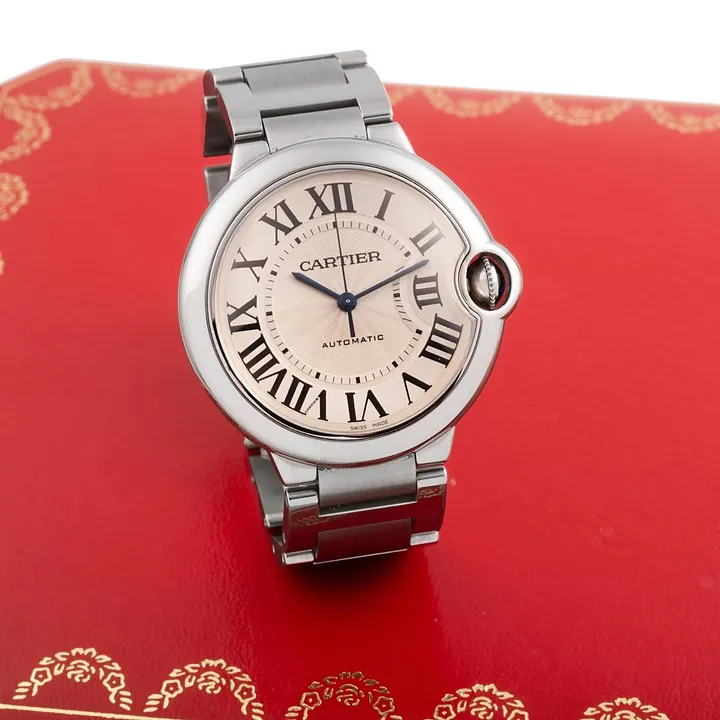
Cartier Ballon Bleu, ref. 3284, c. 2010s
Antiquorum auction archive, Geneva